

When a sudden loss occurs because of another person's negligence, the immediate grief is often compounded by a frantic search for answers and financial stability. You likely feel that no amount of money can replace your loved one, yet you know your family's future depends on securing the resources they need to move forward. This guide explains how a seasoned Texas wrongful death lawyer can help you hold the responsible parties accountable and secure the financial recovery necessary to stabilize your household. At The Todd Law Group, PLLC, we believe legal representation is a vital part of your road to recovery, providing a sense of order during a chaotic time.
Understanding the legal framework is your first step toward justice. In this comprehensive guide, we will break down the two year filing deadline established under Texas Civil Practice and Remedies Code §16.003(b), identify which family members are eligible to file a claim, and distinguish between wrongful death and survival actions. Whether you're facing funeral costs or the loss of a lifetime of income, you'll gain the clarity needed to navigate the complex Texas statutes and protect your family's long term security.
Key Takeaways
- Learn how Texas Civil Practice and Remedies Code Chapter 71 establishes your legal right to seek justice when negligence leads to a fatal accident.
- Identify which specific beneficiaries are eligible to file a claim and why Texas law excludes siblings or grandparents from these legal actions.
- Understand the vital distinction between wrongful death and survival actions to ensure your family pursues every available avenue for financial recovery.
- Discover how to calculate economic losses and non-economic damages like emotional distress to protect your family's future stability.
- See how partnering with a dedicated texas wrongful death lawyer provides the professional authority needed to hold negligent parties accountable while you focus on your road to recovery.
Understanding the Texas Wrongful Death Act: A Legal Foundation for Families
The Texas Wrongful Death Act, codified in Chapter 71 of the Texas Civil Practice and Remedies Code, serves as the primary legal framework for families seeking justice after a fatal incident. This statute allows surviving family members to pursue a civil action if a person's death resulted from the "wrongful act, neglect, carelessness, unskillfulness, or default" of another party. Unlike criminal proceedings that focus on punishment or state-led prosecution, a wrongful death lawsuit is a private legal action designed to provide financial stability and a sense of accountability. It addresses the void left in a family's life, specifically focusing on the loss of companionship, emotional support, and financial contributions. Partnering with an experienced texas wrongful death lawyer ensures that your family's rights are protected while you focus on the emotional aspects of your road to recovery.
Negligence remains the heart of these claims. To succeed, you must prove that the defendant owed the deceased a duty of care, breached that duty, and directly caused the fatal injury. This civil remedy is entirely independent of any criminal charges. Even if a defendant is acquitted in a criminal court, they can still be held liable for damages in a civil suit, as the burden of proof is lower in civil litigation. The law provides this pathway to ensure that the negligent party, rather than the grieving family, bears the financial burden of the tragedy.
What Qualifies as Wrongful Death in Texas?
A claim arises when a fatality occurs due to avoidable errors or intentional harm. In Texas, this encompasses a wide range of incidents including high-speed car accidents, surgical errors in medical malpractice cases, or unsafe conditions leading to workplace injuries. Establishing liability requires a detailed look at the "default" or breach of duty. For example, if a trucking company ignores federal rest requirements and a fatal collision occurs, that breach of safety standards forms the basis of the legal action. These cases don't just seek a check; they seek to highlight the negligence that caused the loss.
The Legal Timeline: Texas Statute of Limitations
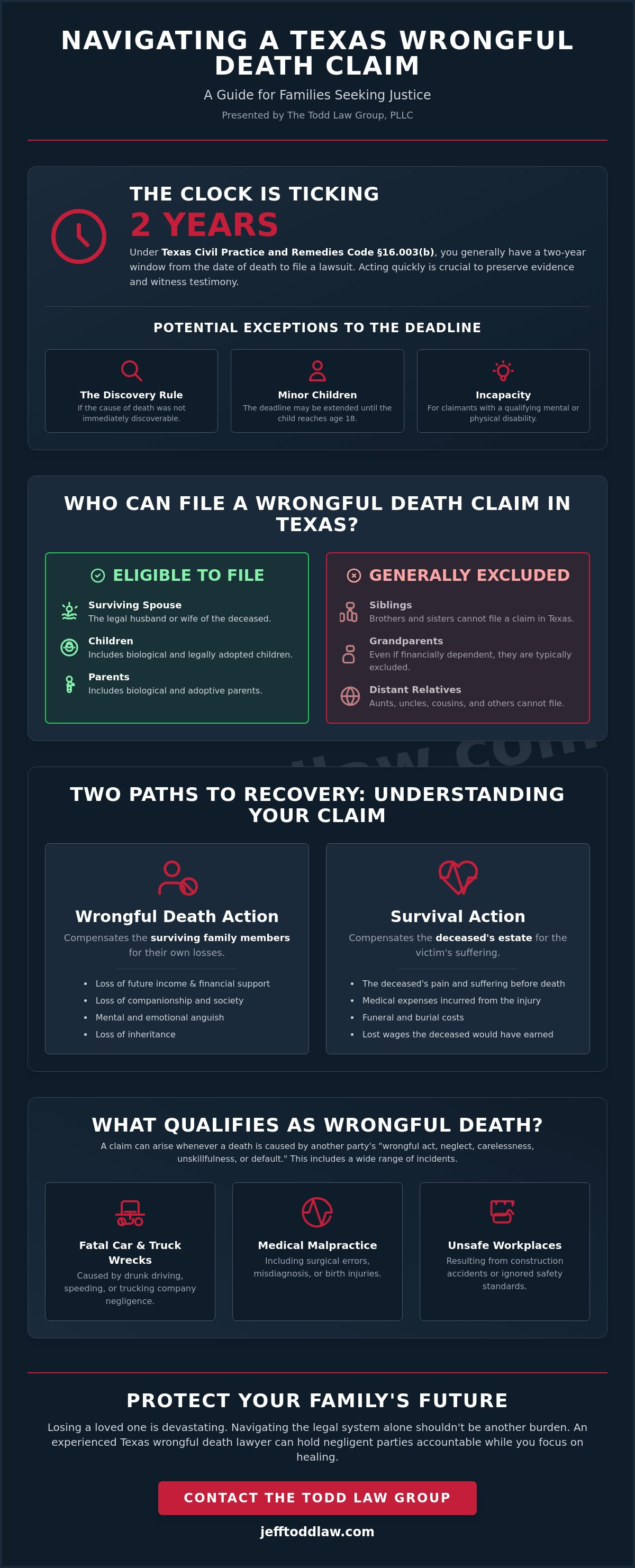
Time is a critical factor in any legal recovery. Under Texas Civil Practice and Remedies Code §16.003(b), families generally have a two year window from the date of death to file their lawsuit. Missing this deadline usually results in the permanent loss of your right to seek compensation. A texas wrongful death lawyer can identify if specific exceptions apply to your situation, such as:
- The Discovery Rule: Applicable when the cause of death was not immediately apparent or discoverable.
- Minor Children: The statutory clock might not start until a child reaches the age of 18.
- Mental or Physical Incapacity: Specific conditions that prevented the timely filing of a claim.
Waiting too long often leads to faded witness memories or the loss of physical evidence, such as vehicle data or surveillance footage. Starting the process early helps preserve the integrity of your case and ensures the negligent party is held responsible before evidence disappears.
Who Can File a Wrongful Death Claim in Texas?
While the loss of a loved one ripples through an entire community, the legal right to seek damages is strictly limited under the Texas Wrongful Death Act. Only a specific group of individuals has the legal standing to bring a lawsuit. This group includes the surviving spouse, the children, and the parents of the deceased. These eligible parties can file a claim individually or join together in a single action. If you fall into one of these categories, consulting with a texas wrongful death lawyer can help you understand how to protect your family's interests during this difficult transition.
It is vital to recognize who is excluded from this process. Texas law generally does not allow siblings, grandparents, or more distant relatives like cousins or aunts to file a wrongful death claim. This remains true even if the sibling was the primary caregiver or was financially dependent on the deceased. The law prioritizes the immediate nuclear family to prevent a multiplicity of suits and to focus recovery on those most directly impacted by the loss of support and companionship.
Surviving Spouses and Common Law Marriage
Texas is one of the few states that recognizes common-law marriage, which provides the same legal standing in a wrongful death case as a formal ceremony. If you can prove you agreed to be married, lived together in Texas as spouses, and represented yourselves to others as married, you have the right to file. Legal separation doesn't end this right; until a judge signs a final divorce decree, the surviving spouse remains an eligible claimant. Even if the marriage was very recent, such as a few days before the accident, the law protects the spouse's right to seek a road to recovery.
The Role of the Executor or Administrator
If the surviving spouse, children, or parents don't file a claim within three calendar months (90 days) of the death, the responsibility may shift. At this point, the executor or personal representative of the deceased’s estate is permitted to file the claim. This ensures that the negligent party doesn't escape accountability simply because the family was too overwhelmed by grief to act immediately. However, if all eligible family members specifically request that the lawsuit not be filed, the executor cannot proceed. A dedicated legal advocate can help determine the best timing for filing to ensure all beneficiaries are fairly represented and that the estate's interests are protected throughout the litigation process.
Adult children also maintain the same legal rights as minor children. While a minor child’s claim often focuses on the loss of parental guidance and financial support, an adult child can still seek damages for the loss of companionship and inheritance. The law recognizes that the parent-child bond remains a significant source of emotional and financial stability throughout life, regardless of the child's age at the time of the tragedy.
Wrongful Death vs. Survival Actions: Why the Distinction Matters
Many families are surprised to learn that a single fatal accident often results in two separate legal claims. While they are related, they target different types of losses and serve distinct purposes. A survival action is the deceased's personal injury claim that "survives" their passing. This means the legal right to sue for injuries doesn't vanish when the victim dies. Instead, the estate takes over the claim. An experienced texas wrongful death lawyer understands that filing both a survival action and a wrongful death claim concurrently is often the most effective way to secure a full road to recovery for the family.
The primary difference lies in whose loss is being compensated. A wrongful death claim focuses on the survivors' suffering, while a survival action focuses on the victim's experience before their death. Because these claims are distinct, the damages are distributed differently. Awards from a survival action flow into the deceased's estate, whereas wrongful death awards go directly to the beneficiaries. Understanding these Wrongful Death Laws in Texas is essential to ensure your family doesn't leave any available compensation on the table.
The Survival Action: Seeking Justice for the Deceased
This claim focuses entirely on what your loved one went through before they passed away. If the victim survived for even a few minutes after the incident, the estate can recover damages for the physical pain and mental anguish they suffered. It also covers medical expenses accumulated between the injury and the time of death. Because these damages belong to the deceased, they are paid into the estate and distributed through the probate process. This means the funds follow the deceased's will or Texas inheritance laws and may be subject to the estate's existing debts.
Wrongful Death: Focusing on the Survivors
In contrast, a wrongful death claim is designed to compensate the living family members for their own unique losses. It doesn't look at the victim's pain, but rather at the hole left in the family's life. This action allows you to seek direct compensation for mental anguish and "loss of consortium," which refers to the loss of love, companionship, and emotional support. It also addresses the loss of financial support and the loss of inheritance the deceased would have likely provided. By following the Texas Wrongful Death Statutes, beneficiaries receive these funds directly. Unlike survival damages, these awards are generally protected from the estate's creditors. A texas wrongful death lawyer ensures that these two legal paths are navigated correctly so that every aspect of your family's loss is addressed.
The Financial and Emotional Road to Recovery: Calculating Damages
Quantifying the value of a human life is perhaps the most difficult task in the legal system. It requires a meticulous examination of both the tangible financial contributions the deceased made and the intangible emotional void left behind. A texas wrongful death lawyer approaches this process by building a comprehensive profile of your family's loss. We don't just look at the present; we project the entire future that was taken away. This calculation is a vital part of your road to recovery, ensuring that your family remains financially stable while you navigate the grieving process.
Damages in these cases are generally divided into economic and non-economic categories. Economic damages cover concrete costs like funeral and burial expenses, as well as the medical bills that accrued before your loved one's passing. In contrast, non-economic damages address the psychological toll. If the death resulted from gross negligence or a willful act, Texas law may also allow for exemplary damages. These are punitive awards meant to punish the defendant and prevent similar tragedies in the future. To ensure accuracy, we often engage forensic economists who use actuarial data to calculate the exact impact of the loss on your household's future.
Pecuniary Loss and Financial Stability
Pecuniary loss refers to the loss of the deceased’s earning capacity, advice, and counsel. It isn't limited to a simple paycheck. It includes the value of household services, such as childcare or home maintenance, that the surviving family must now replace. We focus on maintaining your family's standard of living for years to come. This is why many wrongful death settlements are structured to provide long term support rather than a single, immediate payment. Our goal is to replace the financial security that was lost, providing a stable foundation for your children and spouse.
Mental Anguish and Intangible Losses
Texas courts recognize that the emotional bond between family members has significant legal value. This is often termed "loss of consortium," which compensates a spouse or parent for the loss of love, companionship, and comfort. Proving mental anguish requires more than just stating you are sad. It involves documenting the deep psychological impact of the tragedy. We often rely on testimony from close friends, neighbors, and coworkers to illustrate the quality of the relationship that was severed. This personal evidence helps a jury or insurance company understand the true depth of the suffering that cannot be found in a medical report.
If you are struggling to understand how to value your family's future, you can contact us for a professional assessment to begin your journey toward accountability.
How The Todd Law Group, PLLC Navigates Texas Wrongful Death Litigation
Legal representation should be a source of stability, not another source of stress. Jeff Todd’s "Road to Recovery" philosophy recognizes that families in grief need more than just a legal technician; they need a partner who handles the logistical burdens. From the moment you engage a texas wrongful death lawyer at our firm, we take over the heavy lifting. This includes managing communications with insurance adjusters, subpoenaing records, and securing vital evidence before it disappears. We believe your primary focus should be on healing and honoring your loved one’s memory while we build a case for accountability.
Financial barriers shouldn't prevent you from seeking justice. Our firm operates on a contingency fee model, meaning there are no upfront costs or hourly fees for our services. We only receive a fee if we successfully secure a recovery for your family. This approach aligns our interests with yours and ensures that high-caliber legal advocacy is accessible to everyone, regardless of their current financial situation. We also provide immediate practical tools, such as our "Crash Report" utility, to help you gather essential documentation quickly and efficiently. This proactive approach ensures that we preserve the facts while they're still fresh.
A Dedicated Advocate for Houston and Austin Families
With physical offices in Houston, Austin, and Galveston, we're deeply rooted in the local communities we serve. Jeff Todd brings a unique perspective to personal advocacy, having transitioned from a prestigious career in elite corporate law in Washington, D.C. This background provides him with the intellectual rigor and "heavy hitter" experience needed to take on negligent corporations and insurance giants. He applies the same sophisticated strategies used in high-stakes mergers and reinsurance disputes to protect the rights of Texas families. Our firm is dedicated to ensuring that even the most powerful negligent parties are held responsible for the harm they cause.
Your First Steps on the Road to Recovery
The path forward begins with a free, compassionate case evaluation where we listen to your story and explain your legal options. During this initial phase, we help you identify the necessary documentation to strengthen your claim. This usually includes death certificates, law enforcement accident reports, and medical records from the time of the injury. Having these documents ready allows a texas wrongful death lawyer to move quickly and decisively on your behalf. If you're ready to take the next step toward financial security and accountability, contact The Todd Law Group, PLLC today for a private consultation.
Secure Your Family's Future and Stability
Navigating the aftermath of a fatal accident requires a balance of legal precision and personal resilience. By understanding the Texas Wrongful Death Act and the critical differences between wrongful death and survival actions, you've already taken the first step toward justice. These statutes exist to ensure that negligent parties are held accountable for the emotional and financial void they create. A dedicated texas wrongful death lawyer provides the professional authority needed to manage complex litigation while you focus on the personal aspects of your road to recovery.
Jeff Todd has been licensed in Texas since 1994 and brings a seasoned, battle-tested perspective to every case. With physical offices in Houston, Austin, and Galveston, our firm is ready to provide the local support your family deserves. We operate on a contingency-based model, which means there's no fee unless we win your case. This commitment ensures that elite legal representation remains accessible during your most difficult moments. Start your road to recovery with a free case evaluation from Jeff Todd today. You don't have to face this journey alone; we're here to help you rebuild with confidence and peace of mind.
Frequently Asked Questions
Can I file a wrongful death claim in Texas if there are no criminal charges?
Yes, you can file a civil claim regardless of whether criminal charges were filed or if the defendant was acquitted. Civil lawsuits operate on a lower burden of proof than criminal cases; you only need to prove it's more likely than not that the defendant’s negligence caused the death. This allows families to seek accountability and financial recovery even when the state chooses not to prosecute.
What is the average settlement for a wrongful death lawsuit in Texas?
There is no universal average settlement because every case depends on unique factors like the deceased's age, earning capacity, and the level of negligence involved. While some cases result in six-figure recoveries for medical bills and funeral costs, others involving gross negligence or high-income earners reach much higher amounts. A texas wrongful death lawyer evaluates specific financial data and loss of inheritance to determine the appropriate value for your family's recovery.
How long do I have to file a wrongful death claim in Texas?
You generally have two years from the date of the individual’s death to file a claim under Texas Civil Practice and Remedies Code §16.003(b). Failing to meet this strict deadline usually results in the court dismissing your case permanently. There are limited exceptions for minor children or cases involving fraudulent concealment, but you should act quickly to ensure evidence is preserved and witnesses are interviewed while memories remain fresh.
Can siblings file a wrongful death lawsuit in Texas?
No, siblings don't have the legal standing to file a wrongful death lawsuit in Texas. The state legislature specifically limits these claims to the surviving spouse, children, and parents of the deceased. While the loss of a brother or sister is devastating, the law doesn't provide a pathway for siblings or grandparents to seek damages for their own emotional or financial suffering.
What happens if the negligent party does not have insurance?
If the negligent party lacks insurance, you can still pursue a judgment against their personal assets, though collecting these funds is often difficult if they don't have significant property or savings. In many cases, we investigate secondary parties, such as an employer or a vehicle manufacturer, who may share liability. You might also be able to file a claim through your own uninsured motorist coverage if the incident involved a motor vehicle.
How are wrongful death proceeds divided among family members in Texas?
Wrongful death proceeds are divided based on the specific losses suffered by each individual beneficiary rather than a flat, equal split. A jury or a settlement agreement determines the proportion each person receives based on their relationship with the deceased and their financial dependence. For example, a surviving spouse who lost a lifetime of household support may receive a larger portion than an adult child with independent income.
What is the difference between a wrongful death claim and a survival action?
A wrongful death claim compensates the family for their own losses, such as emotional distress and lost financial support. A survival action is essentially the personal injury claim the deceased could've filed if they had lived, covering their pain and suffering before death. While the wrongful death award goes directly to family members, survival damages flow into the estate and are distributed according to a will or inheritance laws.
Do I need a lawyer to file a wrongful death claim in Texas?
While you aren't legally required to hire an attorney, partnering with a texas wrongful death lawyer is vital for navigating complex statutes and aggressive insurance company tactics. These cases involve intricate calculations of future earnings and expert testimony that are difficult to manage alone. An experienced firm handles the technical litigation and heavy lifting, allowing your family to focus on the emotional road to recovery without the burden of legal deadlines.


