
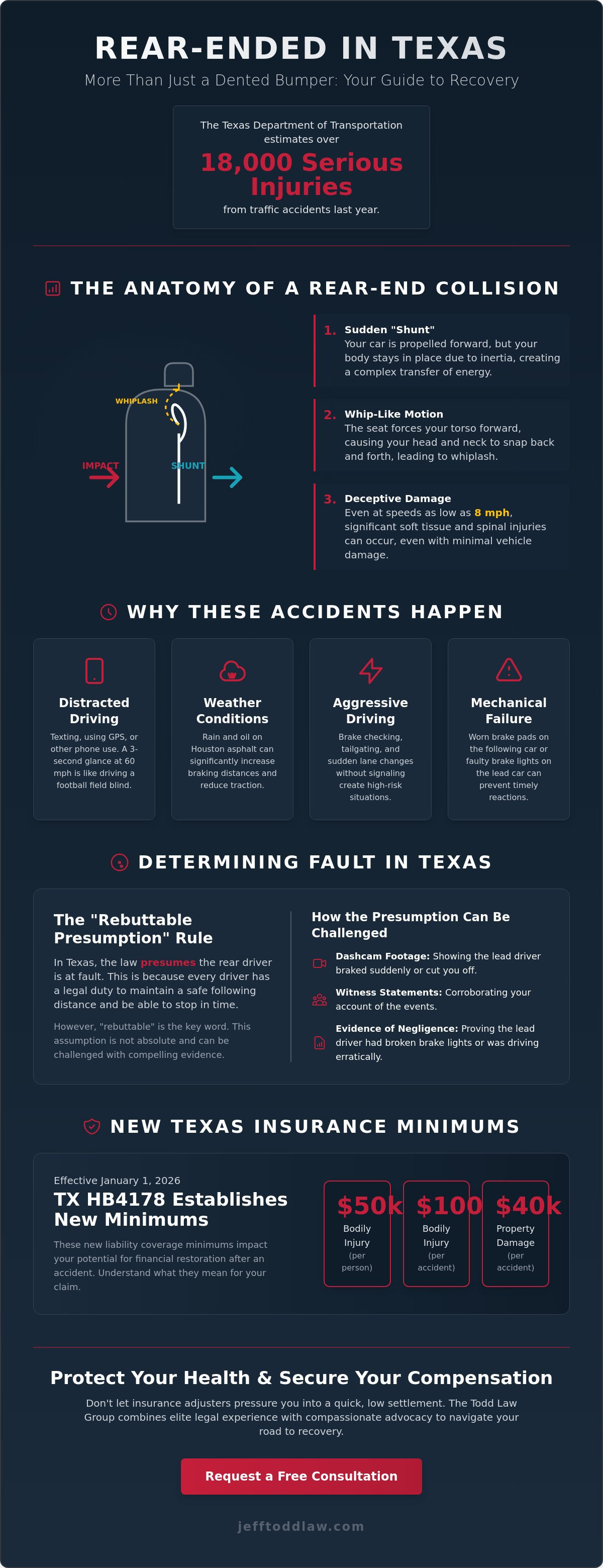
What if the "minor" tap you felt at a red light is actually a ticking clock for your physical health and your legal rights? Many drivers assume that if they were rear ended at a low speed, the impact isn't serious enough to warrant a medical evaluation or legal counsel. However, with the Texas Department of Transportation estimating that over 18,000 people suffered serious injuries in accidents last year, the reality is often much more complex than a dented bumper.
You likely feel frustrated by the sudden disruption to your life and perhaps pressured by aggressive insurance adjusters to accept a quick settlement. We understand this stress and are dedicated to helping you find your way back to the road to recovery. This guide will provide the legal clarity you need regarding fault and explain the medical symptoms you should never ignore. You'll learn how the 51% bar rule impacts your claim and why the new 50/100/40 insurance minimums established by TX HB4178 on January 1, 2026, matter for your financial restoration. We will walk through the essential steps to protect your health and secure the compensation you deserve.
Key Takeaways
- Learn why being rear ended is a significant medical event that often results in deceptive soft tissue injuries even during low-impact collisions.
- Understand the "rebuttable presumption" of fault in Texas and the specific legal duties drivers have regarding following distances.
- Identify the critical biological mechanisms of whiplash to ensure you don't overlook symptoms that could lead to long-term chronic pain.
- Gain a clear, step-by-step plan for the scene of the accident to preserve evidence and secure your right to financial restoration.
- Discover how a "road to recovery" philosophy combines elite legal experience with compassionate advocacy to handle aggressive insurance tactics.
What Does It Mean to Be Rear-Ended? Definitions and Dynamics
In the eyes of the law and insurance carriers, a driver is considered to have been involved in a rear-end collision when the front bumper of one vehicle strikes the rear of the vehicle ahead. While simple in definition, the physical reality is a complex transfer of energy often called a "shunt." When you are rear ended, your car is suddenly propelled forward while your body, governed by inertia, stays in place until the seat frame pushes you forward. This creates a whip-like motion that can cause internal damage even when the car's exterior looks fine. In Houston, these incidents are the most frequent accident type due to our high traffic density and constant stop-and-go congestion. A fender bender at a stoplight might only cost a few hundred dollars in paint repair, but a high-velocity impact on the Beltway can result in totaled vehicles and life-altering spinal trauma.
The Anatomy of a Rear-End Collision
The sudden acceleration-deceleration force of a collision primarily targets the cervical spine and the lower back. Even at speeds as low as 8 miles per hour, the energy transferred into the cabin is enough to cause significant soft tissue damage. Your seatbelt and headrest are critical safety tools designed to mitigate these forces, yet if they aren't positioned correctly, they can contribute to the injury by creating a pivot point for the neck to snap over. These injuries are incredibly common for those who have been rear ended on Houston highways like I-10 or the 610 Loop. On these routes, sudden traffic stalls turn high-speed cruising into immediate danger zones. The shunt doesn't just damage metal; it disrupts the delicate alignment of your vertebrae and can lead to long-term neurological symptoms.
Why These Accidents Happen: More Than Just Tailgating
While following too closely is a primary cause, modern distractions have changed the landscape of road safety. Smartphone use accounts for a massive portion of wrecks in Texas, as a three-second glance at a notification at 60 mph means traveling the length of a football field without looking at the road. Common causes include:
- Distracted Driving: Texting, using GPS, or adjusting the radio while in motion.
- Weather Conditions: Rain and oil on Houston asphalt that increase braking distances significantly.
- Aggressive Driving: Brake checking and sudden lane changes without signaling in heavy traffic.
- Mechanical Failure: Worn brake pads or faulty tail lights on the lead vehicle that prevent timely reactions.
In these high-stress moments, the rear driver is often blamed by default, but the specific circumstances of the crash require a sophisticated legal analysis to protect your road to recovery. Whether the cause was a slick road or a distracted teenager, the impact on your life remains the same.
Determining Fault: Is the Rear Driver Always Liable in Texas?
Many people believe that if they are hit from behind, the other driver is automatically 100% responsible. In Texas, there is a legal concept known as a "rebuttable presumption." This means the court generally assumes the following driver is at fault because they have a legal duty of care to maintain a safe distance. If you were rear ended, it's likely the other driver failed to account for traffic speed or road conditions. While the physical impact often leads to whiplash and neck strain, the legal impact depends on proving the other driver's negligence. However, "rebuttable" is the key word; this assumption can be challenged with the right evidence.
To secure your recovery in a Houston courtroom, you'll need concrete proof. This includes dashcam footage, electronic logging device (ELD) data from commercial trucks, or credible witness statements that reconstruct the moments before impact. In high-traffic areas like the Westpark Tollway or the Katy Freeway, the speed of traffic changes in seconds. A driver's failure to adjust to these changes is a breach of their duty of care. When you're injured, the burden of proof rests on your ability to show that the other driver's negligence was the direct cause of your suffering. If you're unsure how these rules apply to your crash, you can request a consultation to review the specifics of your case.
When the Lead Driver May Be at Fault
Liability isn't always a straight line. If the lead vehicle has broken brake lights, the following driver lacks adequate warning to stop. Similarly, if a driver shifts into reverse in a travel lane or engages in "brake checking" to harass others, they bear significant responsibility. In chain reaction pileups, the person who initiated the first impact is usually the one held liable for all subsequent collisions. Proving these nuances requires a meticulous investigation of the crash site and vehicle data.
Texas Comparative Negligence Explained
Texas follows a modified comparative negligence rule, also known as the 51% bar. Under Texas law, if you're found to be 10% at fault for the collision, you can still recover 90% of your total damages. Insurance adjusters use this to lower settlements by claiming you stopped too abruptly or were distracted. If they can push your fault to 51%, you recover nothing. Securing a Houston car accident lawyer ensures your percentage of recovery remains protected and your road to recovery is prioritized.
The Medical Reality: Why 'Minor' Collisions Are Deceptive
Your body is a marvel of biological survival, but that same survival instinct can hide serious injuries after you've been rear ended. In the moments following a crash, your brain releases a massive surge of adrenaline and endorphins. This natural "fight or flight" response is designed to mask pain so you can move to safety. Consequently, many drivers tell police officers or insurance adjusters they feel fine, only to wake up 48 hours later unable to turn their heads. This delay isn't a sign that you're faking; it's a documented physiological response to trauma. If you ignore these early signs, you risk turning a treatable injury into a lifelong struggle with chronic pain.
The idea that low-speed collisions don't cause harm is a dangerous myth. Research shows that even a 5 mph impact can exert enough force to cause significant spinal misalignment. When a vehicle stops or starts abruptly, the human frame absorbs the energy that the car's heavy steel body was designed to withstand. This energy doesn't just disappear; it travels through the seat and into your musculoskeletal system. Without a professional medical evaluation, you might leave a "minor" accident with underlying damage that won't fully manifest until your road to recovery becomes much steeper and more expensive.
Navigating the financial burden of these injuries requires a proactive legal strategy. Specialized firms like Charles Injury Law emphasize the importance of early intervention to protect the rights of accident victims and ensure they receive the maximum results possible for their recovery.
Whiplash and Latent Injuries
Whiplash is the most common injury in these scenarios, occurring when the neck is whipped back and forth with extreme speed. Symptoms like neck stiffness, persistent headaches, and radiating shoulder pain often don't peak until several days after the incident. This is frequently called the "48-hour rule" by medical professionals. Beyond soft tissue damage, the "coup-contrecoup" movement of the brain inside the skull can cause concussions or traumatic brain injuries (TBIs) without the head ever hitting the dashboard. If you're experiencing blurred vision, irritability, or sleep disturbances, these are red flags that your injury is neurological, not just muscular.
Property Damage vs. Bodily Injury
Insurance adjusters often point to a "clean" bumper as proof that you couldn't have been hurt. This is a deceptive tactic. Modern cars are engineered with "crumple zones" and reinforced bumpers designed to protect the vehicle's structural integrity. However, when a bumper doesn't crumple, it doesn't absorb the kinetic energy of the crash. Instead, that energy is transferred directly to the occupants. The Texas Driver Handbook outlines safety standards for vehicles, but it cannot account for the vulnerability of the human spine. You should always seek a medical evaluation regardless of how your car looks. A vehicle can be repaired with new parts; your body requires immediate and specialized care to ensure a full restoration of health.
Immediate Steps to Take After Being Rear-Ended
If you have been rear ended, the first sixty seconds are critical for your safety and your future legal claim. Your priority must be to move your vehicle to a safe location, such as a shoulder or a nearby parking lot, to avoid a secondary collision. Once you are out of the flow of traffic, check yourself and your passengers for injuries. Even if you feel only a slight jolt, call 911 immediately. Under the Texas Transportation Code, you are legally required to report any accident that results in injury or property damage of $1,000 or more. A formal police report serves as the unbiased foundation for your insurance claim and provides a documented timeline that adjusters cannot easily dispute.
While waiting for law enforcement, interact with the other driver only to exchange insurance and contact information. Resist the natural urge to apologize or make definitive statements about your physical condition. Phrases like "I'm okay" or "I didn't even see you" can be used against you later to minimize your suffering. Remember that adrenaline is currently masking your pain, and what feels like a minor ache today could become a debilitating injury by tomorrow morning. Your statements at the scene are often recorded in the officer’s notes and can impact your road to recovery before it even begins.
On-the-Scene Documentation
Visual evidence is difficult to contradict in a courtroom. Use your smartphone to capture high-resolution photos of the damage to both vehicles, the position of the cars relative to lane markers, and any visible skid marks on the asphalt. If there are witnesses nearby, ask for their names and phone numbers before they leave the area. Our firm provides a specialized Crash Report utility to help you organize this data efficiently. This tool ensures you don't miss vital details like the other driver’s license plate number or the specific weather conditions at the time of the impact.
Navigating Insurance Communications
Expect a phone call from an insurance adjuster within 24 to 48 hours. They may seem helpful, but their primary goal is to protect their company's bottom line. Be especially cautious when handling Progressive claims or dealing with other major Texas carriers. They often push for a "quick settlement" offer, which is a tactic designed to close your file before the full extent of your medical needs is known. Never provide a recorded statement without consulting a professional, as adjusters are trained to lead you into admissions of partial fault. If you are feeling overwhelmed by these calls, you can contact our team today to handle the insurance companies on your behalf.
Navigating Your Road to Recovery with The Todd Law Group, PLLC
At The Todd Law Group, PLLC, we believe that being rear ended is more than just a legal dispute; it's a pivotal event that requires a holistic approach to healing. Jeff Todd’s "road to recovery" philosophy is built on the understanding that your physical restoration and financial recovery are deeply interconnected. We don't just see a case number; we see a neighbor whose life has been disrupted by someone else's negligence. Our firm positions itself as a stable partner for those facing the daunting task of rebuilding their lives after a collision. We provide the steady reassurance you need while applying the intellectual rigor required to win complex personal injury claims.
Choosing the right representation means finding an attorney who understands the tactics used by large insurance corporations. Jeff Todd’s sophisticated background in corporate law, which spans from Washington, D.C. to the heart of Texas, gives our clients a unique advantage. He possesses the battle-tested experience of a "heavy hitter" who has navigated high-volume, high-stakes legal environments involving reinsurance and complex mergers. This corporate-level precision is now dedicated to helping individuals stand up against aggressive adjusters. We operate on a contingency fee basis, meaning there is no fee unless we win your case. This model ensures that high-caliber legal advocacy is accessible to everyone, regardless of their current financial situation.
How a Houston Personal Injury Lawyer Builds Your Case
Success in the courtroom or at the negotiating table starts with a meticulous investigation. We coordinate with expert witnesses and accident reconstruction specialists to prove exactly how the crash occurred. This is vital in Texas, where the 51% bar rule can be used by the defense to shift blame onto the victim. We calculate the full scope of your damages, looking far beyond immediate medical bills to include lost wages, diminished earning capacity, and future rehabilitative needs. Our team negotiates from a position of authority, ensuring that insurance companies recognize the full weight of your suffering and the legal strength of your claim.
Your Next Steps Toward Justice
The transition from the shock of an accident to a successful recovery requires immediate action for anyone who has been rear ended. Under Texas Civil Practice & Remedies Code § 16.003, you generally have two years to file a lawsuit, but the work of preserving evidence must begin today. We encourage you to schedule a free consultation to evaluate the specific merits of your case and discuss how we can hold the negligent party accountable. Legal advocacy is the most effective way to secure the resources you need for a full restoration of your health and peace of mind. Contact The Todd Law Group, PLLC today to start your road to recovery.
Secure Your Physical and Financial Future
The path forward after being rear ended requires more than just medical care; it demands a strategic legal plan to protect your interests. We've discussed the deceptive nature of latent injuries and the importance of documenting every detail on Houston's busy corridors. By understanding your rights under Texas liability laws, you've already taken the first step in reclaiming control over your physical and financial well-being. Now is the time to transition from managing the immediate crisis to securing a long-term resolution.
The Todd Law Group, PLLC has been a dedicated partner for accident victims across the state since 1994. With our main offices in Houston and additional locations in Austin and Galveston, we are personally invested in the communities we serve. We operate under a strict contingency-based model, which means there's no fee unless we win your case. This commitment allows you to focus entirely on your physical restoration while we handle the complex negotiations required for your financial recovery.
Start Your Road to Recovery with a Free Case Evaluation. Our team is ready to provide the steady reassurance and battle-tested advocacy you deserve to move past this accident and back to your normal life.
Frequently Asked Questions
Is it always the back driver's fault if you get rear-ended in Texas?
While the rear driver is usually presumed at fault, this isn't an absolute rule in Texas. You can rebut this presumption if the lead driver engaged in dangerous behaviors like "brake checking," reversing illegally, or driving with non-functional brake lights. Proving these factors requires specific evidence like dashcam footage or witness statements to show the lead driver breached their duty of care.
What should I do if the person who rear-ended me has no insurance?
You should look to your own insurance policy for Uninsured Motorist (UM) coverage if the person who hit you lacks insurance. This coverage is designed to pay for your medical bills and property damage when the at-fault party cannot. If you don't have UM coverage, you may need to file a personal injury lawsuit directly against the driver, though recovering assets from uninsured individuals is often difficult.
Can I still sue for a rear-end accident if I don't feel hurt right away?
Yes, you can still pursue a claim because medical symptoms often take 48 hours or longer to manifest. Adrenaline frequently masks internal trauma like whiplash or concussions immediately after you've been rear ended. Seeking a medical evaluation within the first few days is critical to documenting the injury and establishing a direct link between the crash and your physical condition.
How much is a typical settlement for a rear-end collision in Houston?
There is no "typical" settlement amount because every case depends on specific factors like medical expenses, lost wages, and available insurance policy limits. A minor soft tissue injury will result in a different recovery than a spinal fracture requiring surgery. The total value is calculated based on your actual economic losses and the impact the injury has on your daily quality of life.
What happens if I was partially to blame for getting rear-ended?
Texas uses a modified comparative fault rule, meaning you can still recover damages as long as you are 50% or less at fault. If a jury finds you 20% responsible for the accident, your total compensation will be reduced by that same 20%. However, if your fault is determined to be 51% or more, Texas law prevents you from recovering any compensation from the other driver.
How long do I have to file a lawsuit after a rear-end accident in Texas?
You generally have two years from the date of the accident to file a personal injury lawsuit in Texas. This deadline is strictly mandated by the Texas Civil Practice & Remedies Code § 16.003. Missing this window usually results in the permanent loss of your right to seek compensation, so it's vital to begin the legal process well before the two-year mark expires for anyone who has been rear ended.
Should I see a doctor even if my car only has a scratch?
You should absolutely see a doctor because vehicle damage does not always correlate with bodily injury. Modern cars are built to maintain structural integrity, which means the energy of the impact is often transferred directly to your spine instead of the bumper. A medical professional can identify latent issues like disc herniations that may not be visible on the surface of your vehicle or your skin.


