
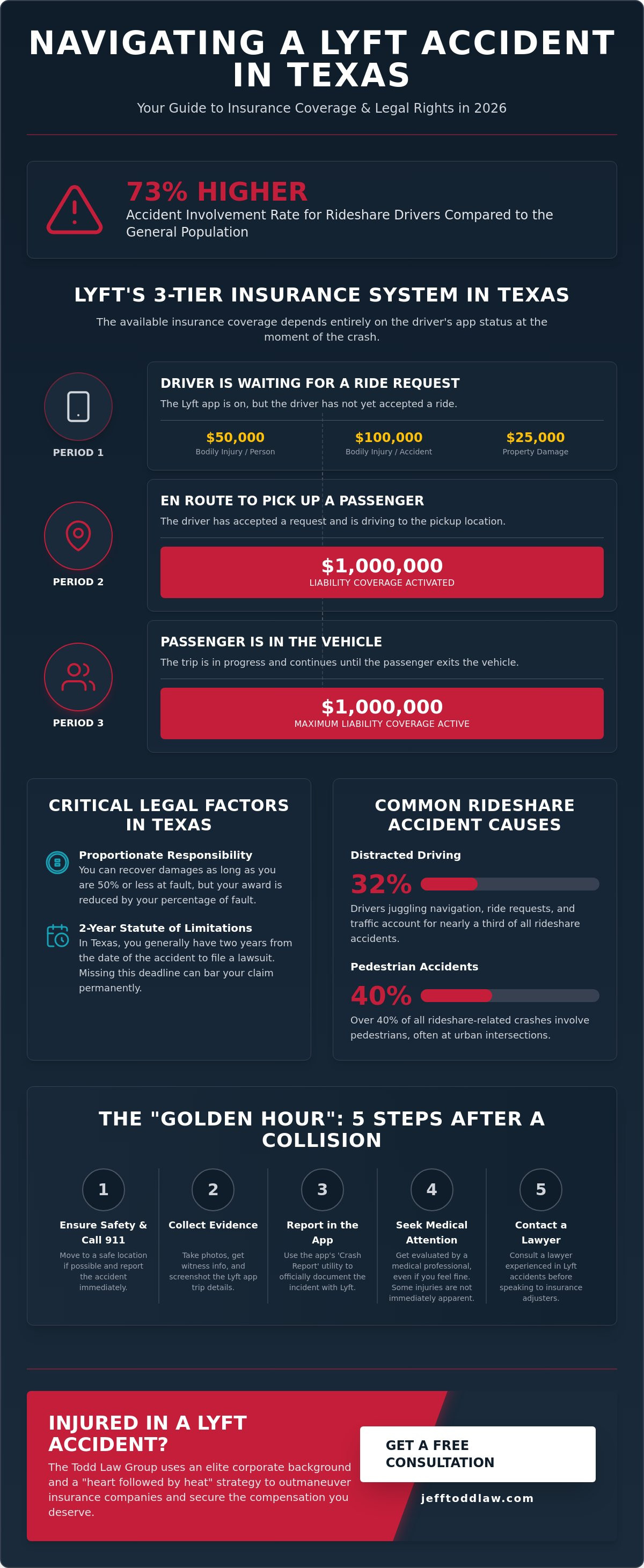
Did you know that rideshare drivers have a 73% higher accident involvement rate than the general population? While Lyft reports a fatality rate of 0.94 deaths per 100 million miles as of early 2026, the sheer volume of time these drivers spend on Texas roads creates a constant risk for passengers and other motorists. If you've been injured in a collision, partnering with a dedicated lyft accident lawyer is the first step toward securing your future. You're likely feeling the weight of mounting medical bills and the confusion of determining whether Lyft's $1,000,000 liability policy or a driver's personal insurance applies to your specific situation.
We understand that you're looking for more than just a settlement; you're looking for stability. This guide provides the clarity you need to manage the complexities of Texas Insurance Code Chapter 1954 and the state's two-year statute of limitations. You'll learn how to hold negligent parties accountable and secure the maximum financial recovery necessary for your road to recovery. We'll examine the three-tier insurance system, the impact of driver fatigue, and the exact steps required to protect your family's financial health in 2026.
Key Takeaways
- Learn how the tiered insurance system under Texas law dictates whether Lyft’s $1,000,000 corporate policy or a driver’s personal coverage applies to your specific claim.
- Understand how Texas "Proportionate Responsibility" rules can affect your final settlement when accidents occur on high-traffic Houston routes like I-10 or the 610 Loop.
- Discover why hiring an experienced lyft accident lawyer is essential for managing complex subrogation issues and securing compensation for both physical and emotional damages.
- Master the "Golden Hour" of evidence collection and use our "Crash Report" utility to preserve critical data before it disappears from the rideshare app.
- See how a legal team with an elite corporate background uses "heart followed by heat" to outmaneuver aggressive insurance adjusters on your road to recovery.
Understanding Lyft Accident Liability: Why Rideshare Claims Are Different
Texas law defines Lyft as a Transportation Network Company (TNC) under Chapter 1954 of the Insurance Code. This distinction is critical because it separates rideshare services from traditional taxi fleets and private vehicles. When you're injured, your "Road to Recovery" starts with identifying which insurance policy is active at the moment of impact. Standard car accident rules often fail to address the digital complexities of these cases. A qualified lyft accident lawyer must understand how the driver's app status dictates the available compensation and which corporate entities are ultimately responsible.
Confusion often arises when a driver's personal insurance carrier denies a claim due to a "commercial use" exclusion. This leaves victims caught between a driver who lacks coverage and a corporation that denies responsibility. We provide the steady reassurance you need during this stressful time. Our team applies the same intellectual rigor used in high-level corporate litigation to dismantle the defense strategies used by TNCs. We are dedicated to ensuring that the technicalities of the app don't stand in the way of your physical and financial restoration.
The Three Critical Periods of Rideshare Coverage
The level of protection available to you depends entirely on the driver's activity within the app when the crash occurs. Texas law mandates a tiered system to ensure victims aren't left without recourse.
- Period 1: The app is on, but the driver is waiting for a request. Texas law requires coverage of at least $50,000 for bodily injury per person, $100,000 per accident, and $25,000 for property damage.
- Period 2: The driver has accepted a ride and is traveling to the pickup location. At this stage, the $1,000,000 third-party auto liability coverage is triggered.
- Period 3: A passenger is physically in the car. The maximum $1,000,000 coverage remains active until the trip is completed in the app.
Independent Contractor Status vs. Corporate Responsibility
Lyft frequently relies on the Ridesharing company business model to claim that its drivers are independent contractors. This strategy is a primary tool used to deflect vicarious liability and protect corporate assets. Overcoming this defense requires an attorney who is battle-tested in complex jurisdictions and understands the nuances of reinsurance and corporate structures. In 2026, Texas legal precedents continue to evolve, making it possible to hold TNCs accountable for issues like inadequate driver screening or app-based distractions that lead to collisions.
We take a proactive approach to these cases, proving that the corporation's influence over the driver creates a direct link to your injuries. Your lyft accident lawyer should possess the intellectual weight to challenge these corporate giants while remaining personally invested in your local community's safety. By applying a "heart followed by heat" strategy, we ensure that your case is handled with both speed and meticulous attention to detail.
Determining Fault in a Houston Lyft Accident: Driver vs. Company
Houston’s sprawling highway system, particularly the congested stretches of I-10 and the 610 Loop, serves as a backdrop for thousands of collisions every year. In 2024, failure to control speed contributed to approximately 135,000 accidents across Texas, many of which involved rideshare vehicles. Determining fault in these scenarios is rarely straightforward. If you've been injured, a lyft accident lawyer can help you navigate Texas' "Proportionate Responsibility" statute. This law allows you to recover damages as long as you're not more than 50% at fault for the incident. However, your recovery is reduced by your percentage of responsibility.
Distracted driving remains a critical factor, accounting for 32% of rideshare accidents as of early 2026. Drivers often juggle navigation apps and incoming ride requests while maneuvering through heavy Houston traffic. This distraction frequently leads to devastating pedestrian accidents in urban intersections, which account for over 40% of all rideshare-related crashes. While the legal framework often mirrors California's insurance rules for rideshare companies, Texas has its own unique statutes that require a sophisticated legal approach to prove negligence.
When the Lyft Driver is at Fault
If the Lyft driver caused the crash through speeding or an illegal turn, we look first to their personal insurance. Most personal policies in Texas exclude commercial activity, which is where Lyft’s excess liability coverage becomes vital. Proving negligence in these cases often involves more than just a police report. We secure "black box" digital records directly from Lyft to analyze the driver’s speed and app activity at the precise moment of impact. This level of detail is essential to ensure your road to recovery isn't blocked by corporate denials. If you need immediate assistance, you can consult with our team to review your options.
Third-Party Liability and Uninsured Motorists
Sometimes, the Lyft driver isn't the one who caused the harm. If another motorist strikes your rideshare vehicle, we pursue a claim against that third party’s insurance. If that driver is uninsured or underinsured, we leverage Lyft’s mandated Uninsured/Underinsured Motorist (UM/UIM) coverage. Holding multiple parties accountable requires a "heavy hitter" who understands how to coordinate between various insurance jurisdictions. We fight to ensure every available dollar is put toward your physical and financial restoration. Our dedicated approach ensures that no stone is left unturned when identifying every potential source of compensation.
Calculating Damages and the Real Value of Your Claim
Determining the financial weight of a rideshare collision requires a sophisticated understanding of both immediate losses and long-term consequences. We take a holistic view of your recovery, categorizing damages into economic and non-economic buckets to ensure no detail is overlooked. Economic damages cover tangible costs like hospital invoices and repair bills, while non-economic damages address the human cost, including pain, suffering, and emotional distress. Maximum Compensation is the total sum of past, present, and future losses. In May 2026, we must also account for the reality that healthcare costs in Texas have outpaced general inflation, making accurate future-care projections more critical than ever.
Even in accidents that seem minor at first, victims often face complex subrogation meaning issues. This occurs when your health insurance provider seeks reimbursement from your settlement for the medical bills they covered. Without an experienced lyft accident lawyer to manage these negotiations, a significant portion of your recovery could be diverted back to an insurance corporation. We apply the same intellectual rigor used in high-stakes mergers to protect your settlement from these aggressive claims. It's also vital to recognize that insurance coverage gaps can still exist despite modern regulations, potentially leaving you vulnerable if your legal team isn't prepared to dig into the details of the driver's policy.
Medical Expenses and the Road to Physical Recovery
Your physical restoration is our primary concern. We look beyond the initial emergency room visit to identify latent injuries, such as Traumatic Brain Injuries (TBI), which may not show symptoms for days or weeks after the crash. A comprehensive claim must include costs for rehabilitative care, physical therapy, and any necessary medical equipment. We are dedicated to ensuring that your settlement reflects the true cost of a full recovery, not just a quick fix for today's symptoms.
Lost Wages and Diminished Earning Capacity
Valuing lost income is straightforward for some, but it becomes complex for salaried professionals or those with performance-based bonuses. We analyze your career trajectory to calculate not just the hours you missed, but the diminished earning capacity you may suffer if your injuries prevent you from returning to your previous role. Our firm's corporate legal background provides a unique advantage in these calculations. We understand how to value complex financial losses and bring the "heat" of litigation to the negotiating table, demanding that Lyft's insurers pay what you are truly owed.
Steps to Take After a Rideshare Collision: Your Immediate Road to Recovery
The first sixty minutes following a collision represent the "Golden Hour" for evidence collection. This window is your best opportunity to secure the facts before the scene is cleared and memories fade. We provide a specialized "Crash Report" utility to help victims document these critical details in real-time. Using this tool ensures you capture the specific data points a lyft accident lawyer needs to challenge corporate insurance teams later. While the immediate aftermath is a time for physical care and emotional support, the "heart" of our process, it quickly transitions into the "heat" of the legal battle.
Speaking to Lyft's insurance adjusters without a representative is a significant risk to your recovery. These professionals are trained to minimize corporate payouts by eliciting statements that can be used against you. They often reach out within 24 to 48 hours of an incident, hoping to catch you while you're still disoriented. You aren't obligated to provide a recorded statement or accept an early settlement offer that likely undervalues your long-term needs. Our firm acts as a shield, managing all communications so you can focus on healing.
Documenting the Scene and the App Status
Digital evidence is remarkably fragile in rideshare cases. You should screenshot your ride details, driver information, and the "trip in progress" screen immediately. Once a trip ends or is cancelled, that data can become difficult to retrieve from the app interface. Identifying witnesses is also vital, though it's harder in urban Houston areas where people move quickly. Don't rely solely on the app; obtain the official police report from the responding Texas officer. This document serves as the foundation for your claim and provides an unbiased account of the scene.
Seeking Medical Attention and Legal Consultation
A gap in medical treatment is an insurance company's most effective weapon. If you wait more than 72 hours to see a doctor, adjusters will argue your injuries weren't caused by the accident or aren't serious. Even if you feel fine, latent symptoms from a collision can take days to manifest. Once your health is stabilized, consult with a houston car accident lawyer to protect your rights. We offer a no-fee-unless-we-win guarantee, ensuring that financial stress doesn't prevent you from seeking justice. If you're ready to start your journey, schedule your free consultation today to secure the dedicated advocacy you deserve.
How The Todd Law Group Navigates Complex Lyft Litigation
Lyft is a multi-billion dollar entity protected by sophisticated legal defenses and deep pockets. To secure a fair settlement, you need a lyft accident lawyer who has operated within those same elite corporate circles. Jeff Todd transitioned from a prestigious professional history in Washington, D.C., to personal advocacy in Texas, bringing the intellectual rigor of a corporate attorney to individuals in distress. This background allows us to anticipate the tactics used by TNC legal teams, from complex reinsurance arguments to jurisdictional maneuvers. Choosing the right lyft accident lawyer means finding an advocate who understands both the law and the human impact of your injuries. We don't view you as a file in a stack; we see a neighbor who deserves a dedicated partner on their road to recovery.
Our approach is built on a calculated blend of professional authority and compassionate advocacy. We understand that a collision isn't just a financial transaction; it's a life-altering event that requires a holistic healing process. By applying the "heart followed by heat" strategy, we establish trust through steady reassurance before proving our capability in the courtroom. This combination of heart and heat ensures that your case is handled with both the empathy you need and the aggressive litigation the insurance company fears. We move quickly from identifying the problem to offering a solution, maintaining a goal-oriented rhythm that keeps your case moving forward.
Our High-Volume Experience and Courtroom Rigor
Insurance giants often settle for higher amounts when they know a trial lawyer isn't afraid of the courtroom. Our high-volume experience means we've seen every defense tactic used by Transportation Network Companies. We apply meticulous attention to detail to every case, ensuring that every digital log and insurance layer is analyzed for your benefit. This courtroom rigor is essential for TNC litigation, where billions of dollars are at stake. We provide the same intellectual weight to your injury case that is typically reserved for high-level mergers and corporate disputes. Our firm is comfortable in the courtroom and efficient in our processes, ensuring no detail is overlooked.
Personalized Support for Houston and Austin Families
We ground our identity in the Texas communities we serve. Whether you're in Houston or Austin, you'll receive direct communication and steady reassurance as we hold global corporations accountable for local negligence. We understand the logistical maze that follows a crash. Our firm acts as your partner, guiding you through the financial and physical restoration process. We are personally invested in seeing you reach the end of your road to recovery with the maximum compensation you deserve. You'll never be just a case number; you're a person we are dedicated to helping through a difficult transition.
Secure Your Financial Future and Physical Restoration
Navigating the aftermath of a rideshare crash requires more than just filing a claim. It demands a deep understanding of the tiered insurance systems mandated by Texas law and the foresight to preserve digital evidence before it disappears. We have examined how app status dictates liability and why corporate insurance adjusters often push for undervalued settlements that ignore long-term medical needs. Partnering with a seasoned lyft accident lawyer ensures that you have the intellectual weight and courtroom experience necessary to challenge billion-dollar corporations.
Jeff Todd has been licensed in Texas since 1994, bringing elite corporate-level legal rigor to every personal injury case. We operate on a contingency basis, so there is no fee unless we win your case. You deserve a dedicated partner who prioritizes your physical restoration and financial stability above all else. Start your Road to Recovery with a free consultation today. We are ready to guide you through the legal maze with steady reassurance and unwavering commitment. Your path to healing and justice begins here.
Frequently Asked Questions
Can I sue Lyft if my driver was at fault for the accident?
You can hold Lyft accountable through their corporate insurance policy if the driver was logged into the app. Under Texas Insurance Code Chapter 1954, Lyft provides up to $1,000,000 in coverage when a driver is en route or on a trip. If you've been injured, a lyft accident lawyer can help you navigate the complexities of corporate liability to ensure you aren't ignored by their legal teams.
What happens if I was a passenger in a Lyft during a crash?
Passengers are generally protected by Lyft’s $1,000,000 third-party auto liability policy during an active trip. This coverage applies regardless of whether the Lyft driver or another motorist caused the collision. You are entitled to seek compensation for medical bills, lost wages, and physical pain. We ensure your road to recovery is supported by the full weight of this corporate policy.
How much does a Lyft accident lawyer cost in Texas?
Most personal injury firms in Texas operate on a contingency fee basis. This means you don't pay any upfront costs or hourly rates for your legal representation. We only receive a percentage of the final settlement or verdict we secure for you. If we don't win your case, you owe us nothing for our services.
What should I do if Lyft's insurance company calls me after an accident?
You should politely decline to give a recorded statement and refer the adjuster to your legal counsel. Insurance adjusters often call within 48 hours to secure admissions that might reduce your claim's value. Providing the "heat" of professional representation prevents these companies from taking advantage of your situation while you're focused on healing.
Can a pedestrian hit by a Lyft driver recover compensation?
Pedestrians hit by a rideshare driver can recover compensation from Lyft’s insurance if the driver was active on the app. Urban intersections account for over 40% of rideshare accidents, often involving distracted drivers. Depending on the driver's app status, coverage ranges from $50,000 per person to the full $1,000,000 liability limit.
How long do I have to file a Lyft accident claim in Texas?
You have exactly two years from the date of the accident to file a lawsuit in Texas. This deadline is strictly enforced under Texas Civil Practice and Remedies Code § 16.003. Waiting too long can result in the permanent loss of your right to seek damages. A lyft accident lawyer will ensure all filings are completed within these statutory limits.
What if the Lyft driver's personal insurance denies my claim?
Personal insurance carriers almost always deny claims for accidents occurring during commercial activity. If this happens, we look to Lyft’s tiered coverage to fill the gap. As long as the driver was logged into the app, Texas law requires the Transportation Network Company to provide some level of liability protection for victims.
Is Lyft responsible for an accident if the app was off?
Lyft is not responsible for damages if the driver’s app was completely turned off. In this scenario, the driver is considered a private motorist, and their personal auto insurance is the sole source of recovery. The $1,000,000 corporate policy only triggers once the driver accepts a ride request or is transporting a passenger.


