Did you know that Harris County saw over 6,300 commercial vehicle crashes in 2025? That is an average of more than 17 accidents every single day right here in Houston. It's natural to feel a surge of anxiety when you're merging onto I-10 or the 610 Loop and find yourself boxed in by a massive 18-wheeler. You've likely heard that modern safety sensors make you visible, but the reality is that many drivers remain dangerously hidden in a truck's blind spots. At The Todd Law Group, we understand the stress of navigating these busy corridors and the physical toll an accident takes on your road to recovery.
We want to empower you with the life-saving truth about how to navigate Houston’s busiest highways safely. By dismantling five dangerous myths, you'll learn exactly where the "No-Zone" begins and ends to avoid becoming another statistic. Knowledge is your best defense. This guide provides a clear overview of the physical boundaries of a semi-truck's reach, incorporates the latest 2026 FMCSA safety standards, and explains your legal rights if a blind-spot accident occurs.
Key Takeaways
- Visualize the four specific "No-Zone" areas surrounding commercial vehicles where truck drivers completely lose sight of your car.
- Understand why relying solely on modern monitoring technology or vehicle height can create a false sense of security on the highway.
- Identify high-risk Houston corridors, such as the I-10 East Freeway, where Port of Houston traffic increases the likelihood of side-swipe collisions.
- Master practical defensive driving techniques like "Pass with Purpose" to minimize the time you spend traveling in a truck's blind spots.
- Learn how Texas comparative negligence laws affect your legal rights and why a detailed crash report is essential for your road to recovery.
Understanding the Vehicle Blind Spot: The "No-Zone" Explained
Every vehicle on a Texas highway has areas where the driver cannot see other motorists through the windows or mirrors. In the trucking industry, safety experts refer to these hazardous areas as "No-Zones." While a standard passenger car has blind spots primarily caused by the structural A, B, and C pillars that support the roof, the No-Zones of a commercial semi-truck are exponentially larger and more dangerous. If you've ever felt like a truck driver didn't know you were there, you were likely right. They literally couldn't see you.
Structural obstructions are a reality for every driver. The A-pillars flanking your windshield can hide a pedestrian, while the C-pillars at the rear of your car can swallow a motorcycle during a lane change. However, a commercial vehicle's obstructions are not just limited to thin metal pillars. The sheer size of the trailer and the height of the cab create massive pockets of invisibility. Understanding these zones is the first step on your road to recovery from driving anxiety and the best way to prevent a devastating collision.
The Anatomy of a Semi-Truck Blind Spot
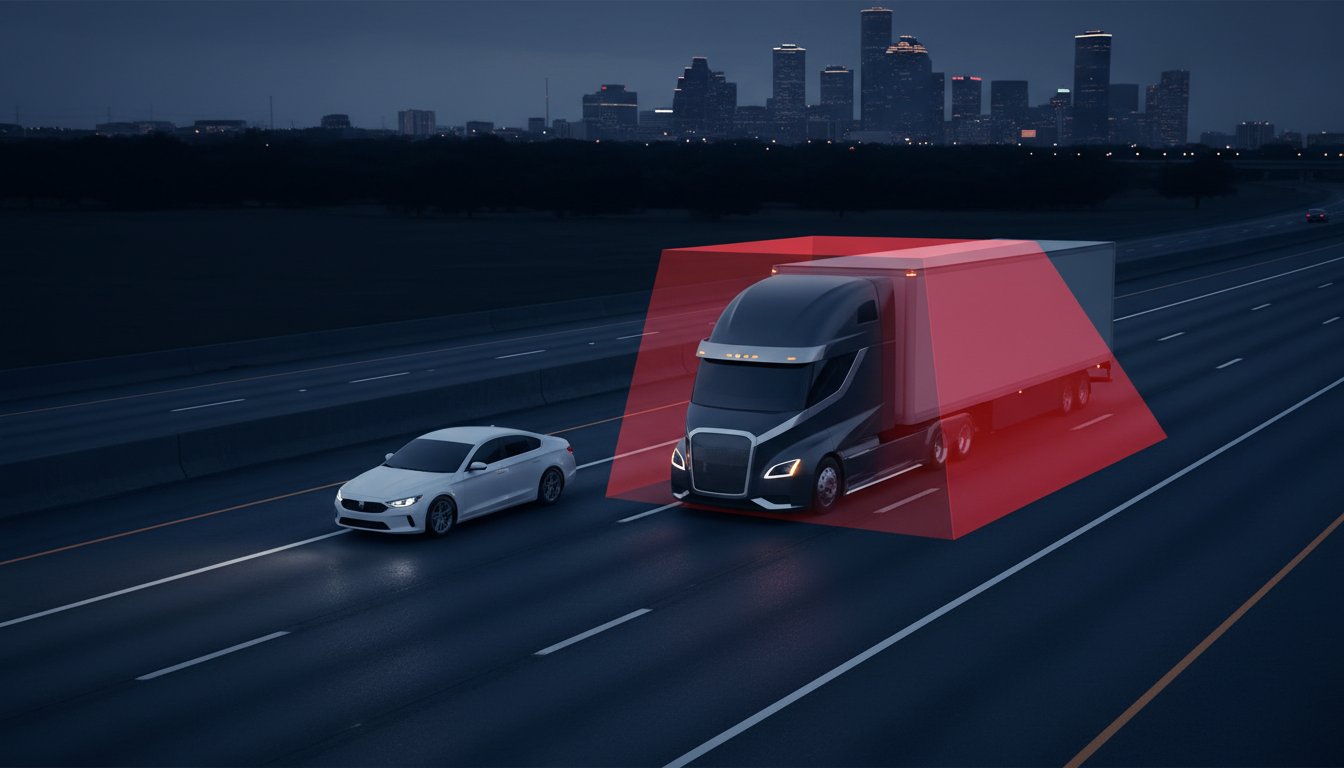
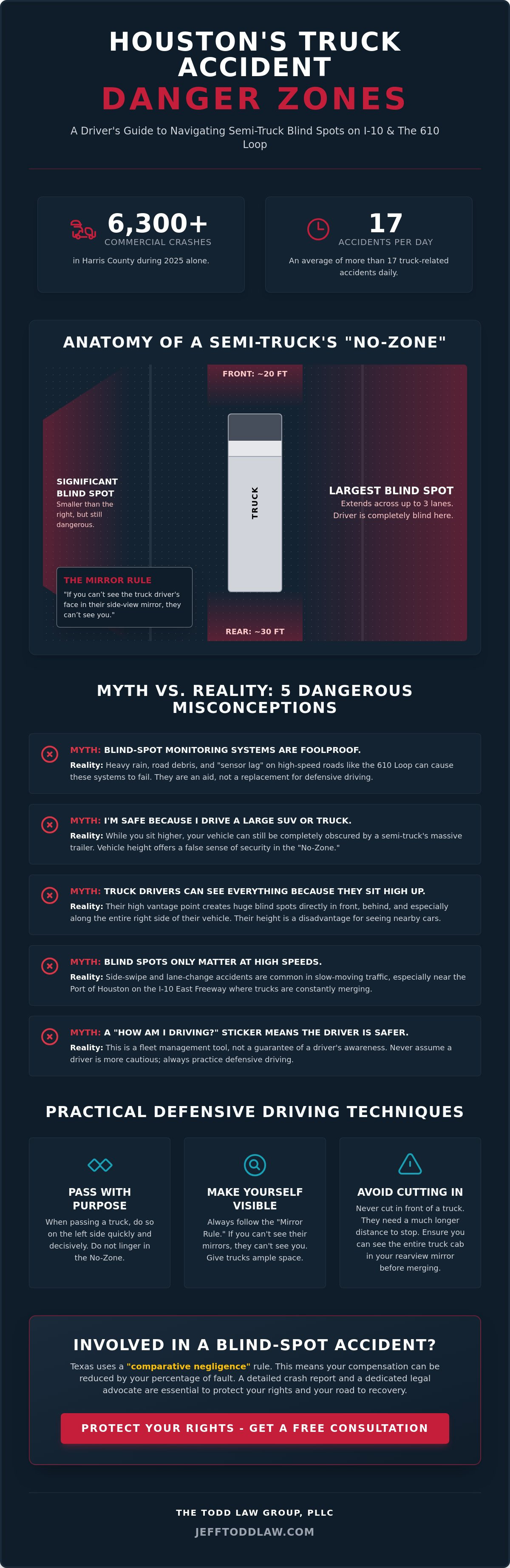
A typical 18-wheeler has four primary No-Zones that every Houston driver must memorize. The right side is the most dangerous area. Because the driver sits on the left, the right-side blind spot extends across three lanes of traffic and runs the entire length of the trailer. If you are cruising next to a truck's right door, you are invisible. The front No-Zone extends approximately 20 feet ahead of the cab. If you cut off a truck too closely, the driver cannot see your bumper. The rear blind spot extends about 30 feet behind the trailer, meaning the driver has no way of knowing you are tailgating. Finally, the left side has a significant blind spot that begins at the cab and angles outward, though it is smaller than the right side.
Why "If You Can’t See Their Mirrors, They Can’t See You" Still Matters
The "Mirror Rule" remains the gold standard for road safety in Texas. If you cannot see the truck driver's face in their side-view mirror, they cannot see your vehicle. While modern trucks use convex mirrors to provide a wider field of view, these mirrors distort reality. They make objects appear smaller and further away than they actually are, which can lead to misjudgments during lane changes. Even with these specialized mirrors, physical gaps remain. Vibrations from high speeds on I-10 and road debris can further reduce a driver's visibility. You should never assume a commercial driver is aware of your presence, even if you can see the side of their truck clearly.
Myth vs. Reality: 5 Dangerous Blind Spot Misconceptions
Believing you are safe just because your car has a blinking light on the side mirror is a dangerous gamble. In the 6,300 commercial vehicle crashes recorded in Harris County during 2025, many drivers likely assumed their technology or vehicle size would protect them. These misconceptions often lead to catastrophic collisions on our crowded interchanges. To stay safe, you must separate marketing promises from the physical reality of the road. If you have suffered an injury due to a driver’s failure to check their surroundings, securing a dedicated legal advocate is a vital step on your road to recovery.
There are five primary myths that frequently lead to accidents in Houston:
- Myth 1: Blind-spot monitoring systems are foolproof.
- Myth 2: Driving an SUV or truck gives you a better view of other vehicles.
- Myth 3: Truck drivers can see everything because they sit so high up.
- Myth 4: Blind spots only matter when you are moving at high speeds.
- Myth 5: If a truck has a "How am I driving?" sticker, the driver is extra cautious about their No-Zones.
The Technology Trap: Sensors vs. Human Sight
Modern safety tech is a helpful tool, but it's not a replacement for a physical shoulder check. Radar and ultrasonic sensors often struggle in heavy Houston rain, which can scatter the signals and lead to false negatives. Furthermore, "sensor lag" is a documented issue during high-speed merges on the 610 Loop. A car moving at 70 mph can enter your danger zone faster than some older software can trigger a warning light. Relying on a sensor alone means you're trusting a computer that might be blinded by a sudden Gulf Coast downpour.
The "Professional Driver" Fallacy
It is a common mistake to assume that Commercial Driver’s License (CDL) holders possess "super-human" visibility. While these drivers are highly trained, they are still limited by the physical structure of their equipment. Even the most experienced Houston truckers cannot overcome the laws of physics that create the No-Zone. Additionally, driver fatigue remains a significant factor in 2025 accident data. A tired driver has reduced spatial awareness, making it even harder for them to track smaller vehicles hovering in their blind spots. High-volume experience doesn't grant X-ray vision; if you are in their No-Zone, you don't exist to them.
Finally, many drivers believe blind spots are only a concern during lane changes. In reality, these zones are just as dangerous at red lights or in stop-and-go traffic. A truck driver might not see a motorcycle or a small car that stopped directly in front of their bumper or along their right side. When the light turns green, the truck may accelerate right into the vehicle it can't see, leading to a devastating "squeeze" accident.
Houston’s High-Risk Zones: Where Blind Spots Cause the Most Wrecks
Houston’s identity as a global trade hub creates a unique set of challenges for local motorists. The Port of Houston remains one of the busiest ports in the United States, generating a relentless stream of heavy truck traffic that flows directly onto the I-10 East Freeway. This corridor is a primary site for blind spots collisions because of the high density of 18-wheelers moving freight toward the interior of the country. When you are driving alongside these industrial giants, the margin for error is non-existent. A single moment in a No-Zone can lead to a side-swipe accident that forever changes your road to recovery.
Beyond the port-side freeways, the "Spaghetti Bowl" interchanges in downtown Houston present a different kind of danger. These complex junctions require rapid lane changes and constant merging, which are the exact conditions where visibility gaps become most lethal. Additionally, Houston’s perpetual infrastructure projects create temporary construction zones. These areas often feature narrowed lanes and concrete barriers that limit a driver’s escape routes and create unexpected, structural blind spots. In 2025, Harris County’s 17 daily commercial vehicle crashes often occurred in these high-pressure environments where space is at a premium.
Navigating the I-10 and I-45 Interchanges
Merging onto I-10 or I-45 requires more than just a turn signal; it requires a strategic understanding of truck volume. Many Harris County on-ramps feature "blind merge" points where the angle of the ramp makes it impossible for a truck driver to see a merging passenger car through their side mirrors. You should avoid the "blind spot squeeze" by staying well behind or ahead of a truck’s cab during tight turns in the downtown area. Truckers often need to swing wide to navigate these interchanges, and if you are tucked into their right-side No-Zone, you risk being crushed against the guardrail.
The Role of Houston’s Weather in Visibility
Gulf Coast weather adds a layer of unpredictability to Houston’s highways. High humidity and sudden afternoon downpours can instantly coat mirrors in moisture, rendering even the best safety sensors unreliable. The "glare factor" is another serious concern on concrete-heavy routes like the Westpark Tollway or the 610 Loop during sunrise and sunset. Intense light reflecting off the road surface can mask the presence of a vehicle in a truck’s peripheral vision. You should increase your following distance to at least four seconds during Houston "gray-outs" to ensure you have time to react if a truck begins to drift into your lane.
Staying Safe: Practical Strategies for Houston Drivers
Navigating the complex multi-lane feeder roads and sprawling interchanges of Harris County requires a proactive defensive strategy. While you cannot control the actions of a commercial driver, you can control your vehicle's position relative to their blind spots. High-volume traffic on the 610 Loop or the Sam Houston Tollway often forces drivers into dangerous proximity with 18-wheelers. By implementing specific tactical adjustments, you significantly reduce the risk of a side-swipe or squeeze accident.
One of the most effective methods for passenger vehicle drivers is the "Pass with Purpose" technique. This involves maintaining a consistent speed that allows you to move through a truck's No-Zone in a matter of seconds. Never linger alongside a trailer. If traffic is too heavy to complete a pass, drop back until you have the space to move through the entire danger zone at once. Additionally, you should adjust your side mirrors using the SAE (Society of Automotive Engineers) method. By angling your mirrors outward so you can no longer see the side of your own car, you minimize the overlap between your mirrors and your peripheral vision.
The 10-Second Pass Rule
When you prepare to pass a semi-truck on the Katy Freeway, aim to complete the maneuver within approximately 10 seconds. Always pass on the left. Passing on the right is significantly more dangerous because the right-side No-Zone is the largest and most difficult for a trucker to monitor. Signal your intent at least three seconds before moving. This gives the truck driver time to notice your blinker in their convex mirrors, even if they cannot see your car directly. Once you have passed, don't merge back into the truck's lane until you can see both of their headlights in your rearview mirror.
Defensive Driving in Harris County
In the stop-and-go congestion of US-59, maintaining a "space cushion" is your best defense. If you are stuck in traffic, avoid stopping directly in front of or behind a commercial vehicle. Trucks require much longer braking distances; their front blind spots can make a small car invisible in a low-speed crawl. Look for visual cues that a driver is preparing to change lanes, such as the truck hugging the lane line or a slight change in speed. If you realize you've been coasting in a No-Zone, immediately accelerate or decelerate to clear the area. If you've already suffered an injury due to a visibility-related wreck, you should consult with a truck accident attorney to protect your rights on the road to recovery.
Legal Rights After a Blind Spot Accident: Your Road to Recovery
Texas law operates under a modified comparative negligence system. This means that in the aftermath of a collision, the court assigns a percentage of fault to each party involved. If you were traveling in one of a truck's blind spots, the insurance company might attempt to shift the blame onto you to reduce their payout. However, as long as you are 50% or less responsible for the accident, you maintain the right to recover compensation for your medical bills, lost wages, and pain. Securing a comprehensive Crash Report is the first step in protecting these rights. This document provides the objective data points needed to prove you were operating your vehicle safely before the trucker's negligence caused the wreck.
Many commercial drivers attempt to use the "I didn't see them" defense as a way to avoid liability. In a court of law, this excuse carries little weight. Professional CDL holders have a heightened duty of care to monitor their No-Zones constantly. Failing to check a mirror or ignoring a blind-spot sensor is a breach of that duty. If a driver’s lack of spatial awareness leads to a crash, they and their employer are legally responsible for the resulting damages. We focus on the facts of the incident to ensure no negligent party escapes accountability.
Proving Liability in a Houston Truck Wreck
Proving what happened in a No-Zone requires sophisticated evidence. We frequently utilize "black box" data from the truck’s Event Data Recorder (EDR). This technology tracks the vehicle's speed, braking patterns, and steering angles in the moments before impact. When combined with expert witness testimony from accident reconstructionists, this data paints a clear picture of how the truck moved into your lane. Dashcam footage has also become an invaluable tool in Harris County personal injury litigation. It provides an undeniable visual record that can override a truck driver’s faulty memory of the event.
The Todd Law Group: Your Partners in Recovery
Jeff Todd brings more than 30 years of experience in Texas law to your case. His background includes high-level corporate legal work, giving him the intellectual rigor needed to take on major insurance carriers. At The Todd Law Group, we believe legal representation should be a holistic process. Our "Road to Recovery" philosophy ensures that we support your physical and financial healing every step of the way. As a Houston Car Accident Lawyer, Jeff Todd is dedicated to helping individuals restore their lives after a serious wreck. We handle the logistical and legal burdens so you can focus on getting better. Contact The Todd Law Group today for a free case evaluation.
Secure Your Safety on Houston's Highways
Protecting yourself on the 610 Loop or I-10 requires more than just luck. It demands a clear understanding of where blind spots exist and the discipline to "Pass with Purpose." By debunking common myths about sensor reliability and vehicle height, you've taken a vital step toward safer driving. Remember that even the most seasoned CDL holders are limited by the physical design of their equipment; this makes your defensive positioning the most effective tool in your arsenal.
If you've already suffered an injury in a commercial vehicle wreck, professional legal guidance is essential for your financial restoration. Attorney Jeff Todd has been licensed to practice in Texas since 1994 and provides the intellectual rigor necessary to challenge aggressive insurance companies. Our dedicated Houston office offers personalized litigation tailored to your specific needs. We operate on a contingency fee basis, so you pay no fee unless we win your personal injury case. Start your road to recovery with a free consultation today. We are committed to helping you navigate this difficult time with steady reassurance and expert advocacy.
Frequently Asked Questions
Is the driver who hits someone in their blind spot always at fault in Texas?
No, fault is not automatic in these cases, although truck drivers have a significant legal duty to clear their surroundings. Texas follows a modified comparative negligence rule. If the other driver was speeding or made an illegal maneuver, a jury might assign them a portion of the blame. However, a professional driver’s failure to check their No-Zone is a primary cause of liability in most Houston collisions.
How can I tell if I am currently in a truck’s blind spot?
The most reliable method is the "Mirror Rule." If you cannot see the truck driver’s face in their side-view mirror, they cannot see your vehicle. You should assume you are invisible if you are traveling directly behind the trailer, within 20 feet of the front bumper, or along either side of the truck where mirrors don't reach.
Does Texas law require special mirrors to eliminate blind spots?
Texas law and federal FMCSA regulations require commercial vehicles to have mirrors that provide a clear view of the road to the rear and sides. While most modern trucks use convex mirrors to widen the field of vision, these tools do not completely eliminate blind spots. Physical obstructions and trailer length still create zones where smaller cars remain hidden from the driver's sight.
What should I do immediately after a blind-spot accident on a Houston highway?
You should first move to a safe location and call 911 to ensure a police officer creates a formal Crash Report. This document is essential for your road to recovery as it records the position of the vehicles. Take photos of the truck’s mirrors and any visible sensors, then seek medical evaluation immediately to document your physical condition after the impact.
Can I still recover compensation if I was partially in a truck’s No-Zone?
Yes, you can still recover damages as long as you are 50% or less at fault for the accident. Your total compensation will be reduced by your percentage of responsibility. For example, if a court finds you 20% negligent for lingering in a No-Zone, you can still collect 80% of your total damages from the trucking company.
How do blind-spot sensors affect insurance liability in a Houston crash?
Sensors are classified as driver assistance tools and don't replace the driver’s duty to manually verify that a lane is clear. If a trucker ignores a warning or if the technology fails in heavy rain, the driver and the carrier are still held liable. Insurance companies cannot use a sensor's presence to shift blame away from a driver who failed to clear their blind spots.
What are the most dangerous highways in Houston for blind-spot accidents?
The I-10 East Freeway and the 610 Loop are the highest-risk corridors due to the heavy volume of freight moving from the Port of Houston. In 2025, Harris County saw an average of 17 commercial vehicle crashes every day. These accidents frequently occur at major interchanges where rapid lane changes and merging are required in tight traffic.
How long do I have to file a claim after a truck accident in Harris County?
The statute of limitations for personal injury claims in Texas is generally two years from the date of the accident. It's important to act much faster because critical evidence like "black box" data can be overwritten in as little as 30 days. Contacting a legal partner early ensures that all digital and physical evidence from the No-Zone collision is preserved for your case.


