
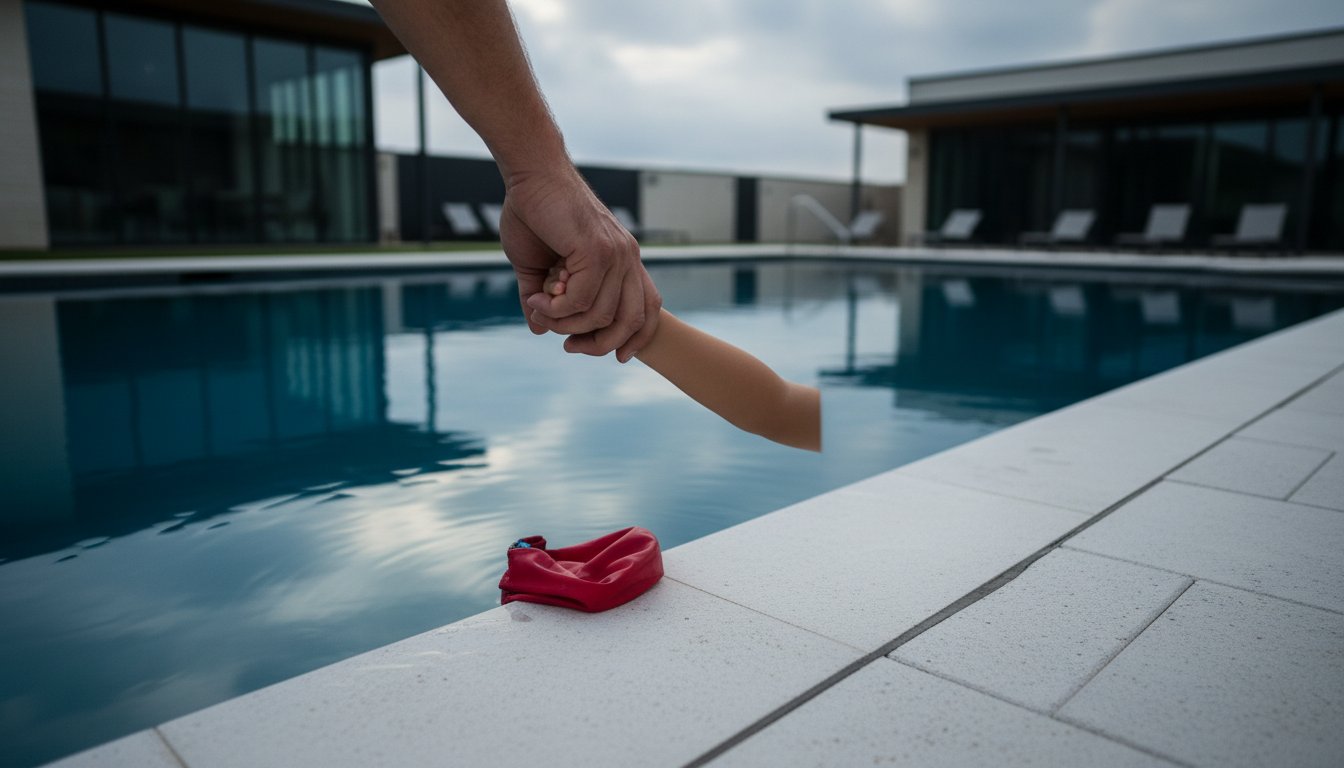
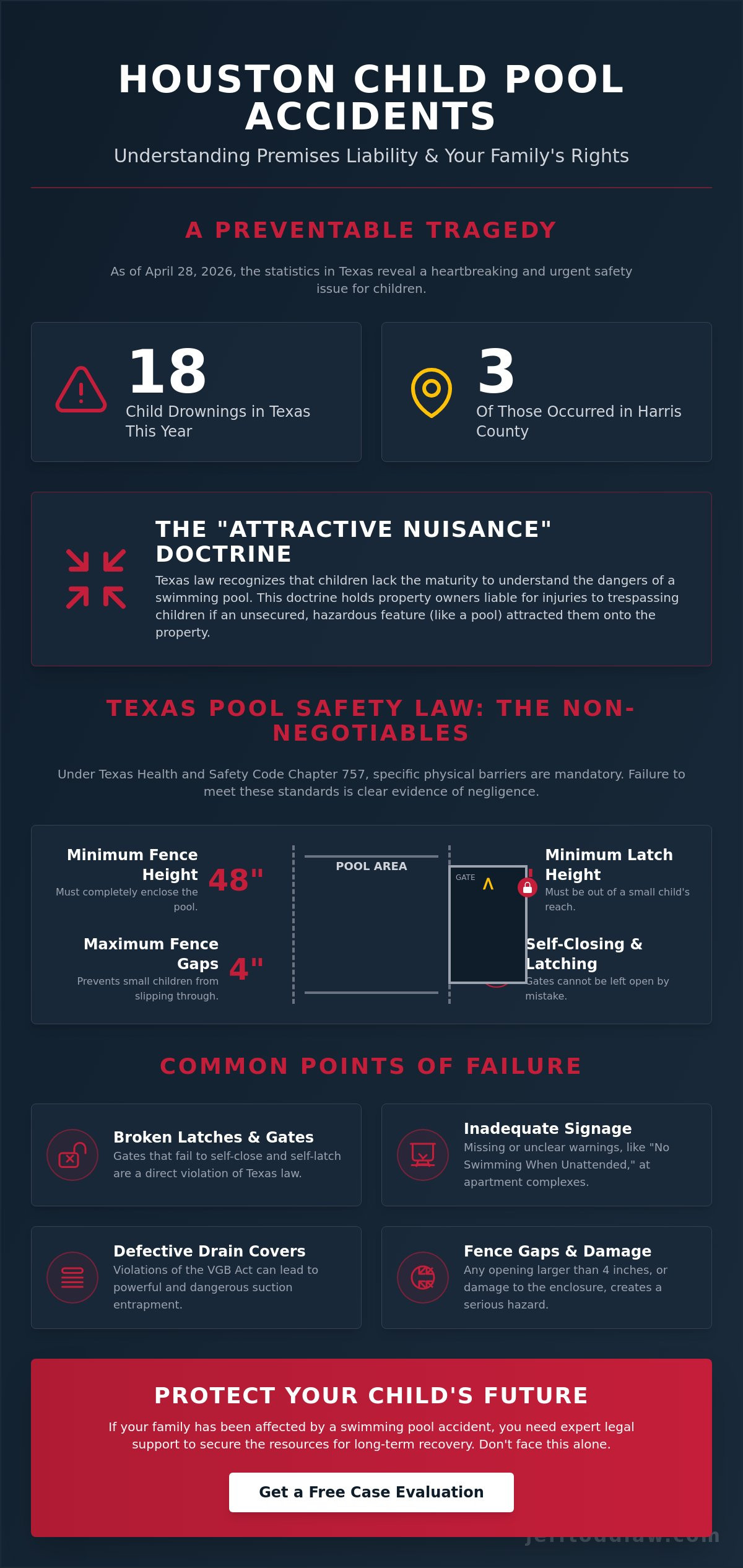
As of April 28, 2026, Texas has already recorded 18 child drownings this year, with three of those heartbreaking incidents occurring right here in Harris County. These numbers represent families facing sudden, crushing medical debt and the overwhelming confusion of Texas premises liability laws. If your family is reeling from a similar tragedy, you likely feel a mix of intense guilt and a desperate need for accountability. Partnering with a dedicated child swimming pool accident attorney Houston can help you transform that pain into a strategic path toward justice.
We understand that your primary focus is your child's physical restoration and securing the funds needed for years of specialized care. This article provides the expert guidance you need to navigate complex pool safety regulations, including the 48 inch fence height requirement and the attractive nuisance doctrine. You will learn how to identify liable parties, from property managers to maintenance companies, and ensure dangerous conditions are fixed to prevent future tragedies. Our goal is to provide a steady, compassionate hand as you begin the road to recovery, ensuring your family has the heavy hitter legal support required to protect your child's future.
Key Takeaways
- Understand how the "Attractive Nuisance" doctrine protects children by requiring property owners to secure dangerous conditions like swimming pools.
- Identify the legal differences between pursuing a claim against a private homeowner versus a large Houston apartment management company.
- Learn the immediate steps for gathering critical evidence, including documenting faulty self-latching gates and missing warning signs.
- Discover how a child swimming pool accident attorney Houston navigates complex insurance jurisdictions to secure funding for long-term rehabilitation.
- Explore the "road to recovery" framework designed to provide both financial restoration and peace of mind for your family’s future.
Understanding Child Swimming Pool Accidents in Houston
The Houston-The Woodlands-Sugar Land metro area is home to thousands of residential and commercial pools. While these provide relief from the Texas heat, they also represent a significant liability for property owners. As of April 28, 2026, Harris County has already recorded three child drowning fatalities, contributing to a statewide total of 18 this year. These aren't just statistics; they represent families whose lives have been upended. In the legal world, premises liability dictates that owners must maintain a safe environment. When a child is injured, the case often hinges on negligence. This means the owner failed to exercise reasonable care to prevent a foreseeable accident.
Under Texas law, the Attractive Nuisance Doctrine is a cornerstone of child injury cases. It recognizes that children lack the maturity to understand the dangers of a swimming pool. Therefore, property owners can be held liable even if the child was technically trespassing. If your family is facing this situation, consulting a child swimming pool accident attorney Houston is the first step in establishing accountability and securing the resources needed for the long journey ahead.
The Reality of Near-Drowning Injuries
A "near-drowning" event is often a misnomer because the physical impact can be permanent. When a child is submerged, oxygen deprivation leads to hypoxic brain injuries within minutes. These injuries often require lifelong cognitive therapy, physical rehabilitation, and around-the-clock care. Immediate medical costs at Houston emergency rooms can reach tens of thousands of dollars in just the first 48 hours. Legal action ensures that the responsible party, not the grieving family, bears the weight of these crushing expenses. We treat non-fatal injuries with the same legal gravity as fatalities because the road to recovery for a brain injury is both long and costly.
Common Causes of Pool Negligence in Harris County
Negligence in Harris County often stems from simple maintenance failures that have catastrophic results. Our investigations frequently uncover specific violations of local and federal safety standards that a child swimming pool accident attorney Houston will use to build your case. Common issues include:
- Broken Latches: Gates that don't self-close or self-latch violate Texas Health and Safety Code Chapter 757.
- Inadequate Signage: Houston ordinances require specific "No Swimming When Unattended" signs that are often missing at apartment complexes.
- VGB Act Violations: Defective drain covers can lead to powerful suction entrapment, which is a direct violation of federal safety laws.
- Fence Gaps: Any gap larger than 4 inches in a pool fence allows a small child to slip through, creating a preventable hazard.
Property owners have a dedicated responsibility to inspect these safety features regularly. When they choose to ignore a broken gate or a missing latch, they are choosing to put the community's children at risk.
Texas Pool Safety Laws and the "Attractive Nuisance" Doctrine
Texas law places a heavy burden on property owners to protect the most vulnerable members of our community. Under the Texas Health and Safety Code Chapter 757, every residential pool must be enclosed by a fence at least 48 inches tall. These barriers aren't suggestions; they're mandatory safety requirements. The gates must be self-closing and self-latching, and they must open outward, away from the water. To ensure small hands can't reach the mechanism, the latch must be positioned at least 60 inches from the ground. If a property owner fails to meet these specific measurements, they have breached their duty of care. A child swimming pool accident attorney Houston can use these code violations as clear evidence of negligence during a claim.
While the state focuses on physical barriers, the CDC emphasizes that comprehensive drowning prevention strategies also include layers of protection like pool alarms and rigid covers. By May 2026, these additional safety measures have become standard benchmarks in liability cases. If a pool lacked a functioning alarm or a secure cover, it suggests the owner didn't take every reasonable step to prevent a tragedy. In many cases, the absence of these 2026-standard technologies can be the turning point in proving that a property was not as safe as it could have been. A child swimming pool accident attorney Houston will investigate whether these modern safeguards were ignored.
Property Owner Responsibilities in Houston
In Houston, a pool is only considered "secured" if it meets both state laws and local municipal ordinances. Foreseeability is the key legal concept here. If a landlord knows children live in an apartment complex but leaves a gate propped open for maintenance, the law considers the resulting accident foreseeable. After an incident, Houston building inspectors often conduct a rigorous review of the site. They look for gaps in the fence larger than 4 inches or signs that don't meet the city's legibility standards. These inspectors provide critical reports that serve as the foundation for your legal recovery.
When the Victim is a Trespasser
Many parents worry that their child's status as a trespasser will bar them from seeking justice. This is rarely the case for minors. The law recognizes that a shimmering pool is dangerously alluring to a child who doesn't understand the risk of drowning. Under Texas law, the Attractive Nuisance doctrine holds that property owners are legally obligated to protect children from hazardous conditions that might draw them onto the premises. If your child was injured in an improperly secured pool, you should consult with a legal professional to understand your rights regardless of how the child entered the property. The Attractive Nuisance doctrine is a legal principle that creates a special duty of care for property owners to protect children from dangerous, man-made conditions they are likely to investigate.
Determining Liability: Private Homes vs. Houston Apartment Complexes
Liability for a pool injury changes dramatically depending on where the accident occurred. In a private residential setting, claims generally target a homeowner's insurance policy. These cases are often sensitive because the property owner might be a neighbor or a family friend. However, the legal focus remains on whether the owner adhered to the safety standards discussed earlier. In contrast, accidents at Houston apartment complexes involve Commercial General Liability policies. These commercial entities often have multi-layered ownership structures, including property management firms and out-of-state investment groups. A child swimming pool accident attorney Houston must peel back these layers to identify the entity with the ultimate duty of care.
Insurance dictates the strategy. While a homeowner's policy might have a cap of $300,000, a commercial policy at a high-density complex often provides millions in coverage. This is vital when a child requires long-term rehabilitation for a brain injury. Central to these claims is the Attractive Nuisance Doctrine, which Cornell Law School defines as a rule that holds property owners liable for injuries to children trespassing on their land if the injury is caused by an object likely to attract children. In a city as dense as Houston, where apartment pools are often just steps away from playground areas, the risk of a child wandering into an unsecured area is high and entirely foreseeable.
Negligence in Houston Multi-Family Housing
Property managers in Houston are often responsible for "broken window" safety failures. This occurs when a gate is left unlocked or a fence is allowed to fall into disrepair. To win a case, we must prove the manager had "notice" of the defect. This means they either knew about the broken latch or should have known through regular inspections. We investigate the history of the specific Houston complex, looking for past safety violations or citations from municipal inspectors. These records often reveal a pattern of neglect that led directly to the accident.
The Role of Pool Maintenance Contractors
Liability isn't always limited to the property owner. Third-party maintenance companies can be held responsible if they failed to maintain water clarity or ignored a defective drain cover. Murky water can prevent a parent or lifeguard from seeing a child at the bottom of the pool until it's too late. Texas uses "joint and several liability," which means multiple parties can share the blame. A child swimming pool accident attorney Houston will meticulously review service contracts and maintenance logs to ensure every negligent party is named in the lawsuit.
Your Child’s Road to Recovery: Steps to Take After an Injury
The aftermath of a pool accident is a blur of emergency responders and medical jargon. While your child's immediate health is the only thing that matters in those first hours, the window to capture critical evidence closes quickly. Property owners often rush to repair broken gates or install missing signs once an incident occurs. Taking high-quality photos of the gate, the latch, and the surrounding fence line before these "remedial measures" are taken is essential. If you're able, collect the names and phone numbers of other pool users or neighbors who saw the incident. These accounts are often the only way to counter a property owner’s claim that a gate was functioning correctly at the time of the injury.
One of the most important steps you can take is to avoid speaking with insurance adjusters. They may call you within 24 hours, offering a "quick settlement" or asking for a recorded statement while you're still in shock. These statements are designed to trap parents into admitting a lack of supervision. Adjusters use these admissions to shift blame away from the property’s safety failures and onto the family. Contacting a child swimming pool accident attorney Houston immediately allows a professional to handle these high-stakes communications on your behalf, ensuring your rights are protected while you focus on your family's stability.
Documenting the "Road to Recovery"
We view legal representation as a holistic part of the healing process rather than just a financial transaction. To support your claim for non-economic damages, we recommend keeping a "recovery journal." This daily log tracks your child’s physical progress, pain levels, and emotional milestones. It provides a concrete narrative that medical records alone can't capture. For serious injuries, we work with life care planners who use current data to estimate the cost of future surgeries, home modifications, and specialized therapy. This ensures the settlement covers your child’s needs for the next several decades, not just the immediate medical bills.
Navigating Insurance Tactics
Insurance companies use sophisticated tactics to minimize payouts. They often rely on the fact that most families don't understand the nuances of Texas premises liability. A recorded statement can be picked apart to undermine your claim, even if you're telling the truth. Having a corporate-trained attorney who understands the intellectual rigor of insurance carriers gives you a distinct advantage. We anticipate their moves and push back against attempts to devalue your child's future. If you need immediate assistance preserving evidence or managing adjuster calls, contact The Todd Law Group for a dedicated consultation today.
Why The Todd Law Group is Houston’s Choice for Pool Injury Claims
Choosing a child swimming pool accident attorney Houston means finding a partner who balances high-level legal strategy with genuine empathy. At The Todd Law Group, we don't just see a case number. We see a family on a difficult road to recovery. Jeff Todd brings over 30 years of experience to the table, having transitioned from a prestigious corporate legal career in Washington, D.C., to dedicated personal advocacy in Texas. This background gives our clients a unique advantage. We understand how large insurance corporations and property management firms operate because we've worked in those high-stakes environments. We use that intellectual rigor to ensure your child’s physical and financial restoration is never compromised by aggressive defense tactics.
Our firm operates on a contingency-fee basis. This means there are no upfront costs for your family. We only receive a fee if we successfully recover compensation for your child’s injuries. This model ensures that every family in Harris County has access to elite legal representation, regardless of their current financial situation. We are deeply invested in the Houston community and believe that holding negligent pool owners accountable makes our neighborhoods safer for everyone. By removing the financial barrier to entry, we allow you to start the legal process immediately. This is vital for preserving evidence before it disappears or is altered by the property owner.
A "Heavy Hitter" with a Compassionate Heart
Elite corporate experience isn't just a line on a resume. It translates to a meticulous, proactive approach to investigation. While other firms might wait for a police report, we immediately dig into property records, past municipal citations, and maintenance contracts. This "heavy hitter" mentality allows us to handle high-volume, complex litigation while still providing the personalized care your family deserves. We apply the same intellectual rigor once used in billion-dollar mergers to your child's injury claim. You can learn more about our premises liability expertise to see how we build cases that stand up in the courtroom.
Starting Your Family’s Legal Journey Today
The initial consultation at our Houston office is designed to be simple and stress-free. We understand you're dealing with immense emotional trauma and confusion. Our role is to handle the logistical "heat" of the legal process. We manage the filings, the expert testimonies, and the constant back-and-forth with adjusters. This allows you to focus on the "heart" of the matter: your child’s healing and rehabilitation. If you're ready to take the first step toward securing your family's future, schedule your free consultation with Jeff Todd. Let us help you navigate the complex path ahead with steady, battle-tested reassurance.
Secure Justice for Your Child's Future
Securing your family's future after a pool accident requires more than just emotional endurance; it demands a strategic legal approach. You now understand how the Attractive Nuisance doctrine and Texas Health and Safety Code Chapter 757 provide a framework for holding negligent property owners accountable. Whether the incident occurred at a private residence or a high-density apartment complex, identifying every liable party is the only way to ensure your child receives the long-term care they deserve. Jeff Todd has been licensed in Texas since 1994 and applies an elite corporate litigation background to every personal injury claim. This intellectual rigor ensures that insurance adjusters don't devalue your family's suffering.
The Todd Law Group operates on a contingency-fee basis, meaning you pay nothing unless we recover money for you. We handle the logistical heat of the legal system so you can focus on the heart of your child's healing process. Partnering with a seasoned child swimming pool accident attorney Houston provides the steady reassurance you need to move forward with confidence. We're dedicated to helping your family navigate this difficult chapter and reach a place of physical and financial restoration.
Start Your Child’s Road to Recovery – Contact Jeff Todd Today
Frequently Asked Questions
How long do I have to file a pool accident lawsuit in Houston?
The general statute of limitations for personal injury in Texas is two years from the date of the incident. For a minor child, this timeline is "tolled," meaning the two-year clock doesn't officially start until their 18th birthday. However, parents seeking to recover medical expenses must still file within the standard two-year window. Missing these specific deadlines can permanently bar your family from seeking the financial restoration you need.
Can I still sue if my child was technically trespassing in a neighbor’s pool?
Yes, you can still pursue a claim under the "Attractive Nuisance" doctrine. Texas law recognizes that children don't always understand the dangers of a swimming pool. Property owners have a legal obligation to take reasonable steps, such as installing a 48 inch fence, to prevent children from accessing the water. If the owner failed to secure the area, they may be held liable even if the child entered the property without an invitation.
What if the gate was closed but my child still managed to get in?
A closed gate doesn't always meet the legal definition of "secured" under Texas Health and Safety Code Chapter 757. Houston regulations require gates to be self-closing, self-latching, and to open outward away from the pool. If a latch was faulty or the gate didn't close automatically, the owner is still negligent. A child swimming pool accident attorney Houston will investigate the hardware to determine if it met these mandatory safety standards.
Who is responsible for a drowning at a Houston apartment complex?
Liability at a multi-family complex often involves several parties, including the property management company, the owner, and third-party pool maintenance contractors. We examine whether the complex followed local ordinances, such as the requirement for legible "No Swimming When Unattended" signs. If a maintenance worker left a gate propped open or failed to fix a broken latch, that individual and their employer may share the legal responsibility for the accident.
How much does it cost to hire a child swimming pool accident attorney in Houston?
Hiring a child swimming pool accident attorney Houston at our firm involves no upfront costs or hourly fees. We work on a contingency fee basis, which means our payment is a percentage of the final recovery. If we don't secure a settlement or verdict for your family, you don't owe us anything. This structure allows families facing crushing medical debt to access elite legal representation without any additional financial risk.
What kind of compensation can I recover for a near-drowning injury?
You can recover compensation for immediate emergency care, ongoing rehabilitation, and future medical needs. Near-drowning incidents often lead to hypoxic brain injuries that require specialized therapy for decades. Settlements also cover non-economic damages like emotional trauma and physical pain. We work with life care planners to calculate the total cost of your child's road to recovery, ensuring no future expense is overlooked during negotiations.
What is the "Attractive Nuisance" doctrine in Texas?
This doctrine is a legal principle that protects children from dangerous, man-made conditions they're likely to investigate. In 2024, 36 of the 101 drowning fatalities in Texas involved children between the ages of 1 and 4 in backyard pools. Because pools are naturally alluring to young children, Texas law requires owners to prioritize safety over trespassing defenses. It forces property owners to be proactive in securing their pools against curious minors.
Will my case go to trial or will it settle out of court?
Most premises liability cases in Harris County are resolved through a settlement before reaching a jury. However, our firm prepares every case with the intellectual rigor required for a courtroom trial. This "heavy hitter" approach signals to insurance companies that we're ready to fight for the maximum recovery. If the insurer refuses to offer a settlement that covers your child’s long-term care, we have the experience to litigate the matter to a verdict.


