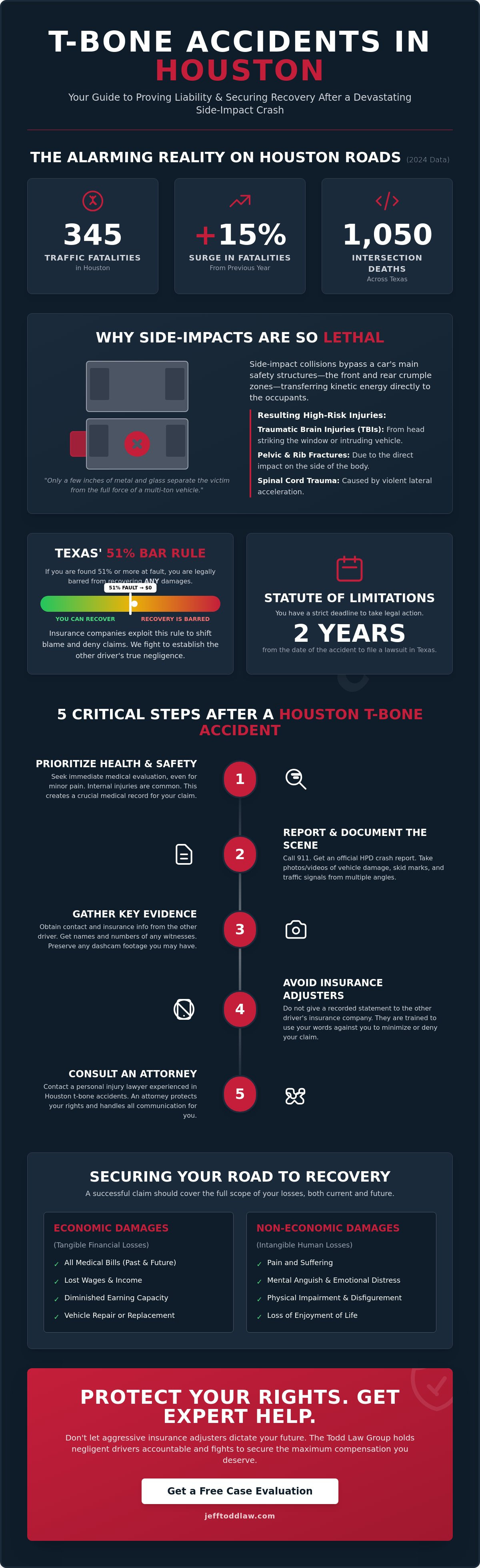
Did you know that Houston traffic fatalities surged by 15% in 2024, reaching a record high of 345 deaths? In Harris County, intersection collisions remain a primary threat, contributing to a significant portion of the 1,050 intersection-related fatalities recorded across Texas that same year. If you've been hit, you're likely struggling with the sharp physical pain of a side-impact injury while trying to block out aggressive calls from insurance adjusters. It's exhausting to manage financial stress when you can't work, especially when the other driver refuses to admit they ran the red light.
We understand that your priority is a stable road to recovery. This 2026 guide provides the exact steps you need to prove liability and secure the maximum compensation you deserve after a t-bone accident in Houston. We'll explain how Texas's 51% bar rule for modified comparative negligence affects your claim and provide a clear roadmap for both your legal and physical restoration. From preserving digital evidence to meeting the two-year statute of limitations mandated by the Texas Civil Practice and Remedies Code, you'll gain the intellectual rigor and dedicated support needed to hold negligent drivers accountable.
Key Takeaways
- Understand why the lack of vehicle crumple zones in a t-bone accident leads to severe injuries and how to document your specific medical needs for a claim.
- Learn why the driver who struck the other vehicle is not always legally liable under Texas duty of care and right-of-way standards.
- Follow a specialized 5-step guide for Houston drivers to secure essential evidence, including a formal crash report from the HPD.
- Discover how to navigate the Texas "51% bar rule" to prevent insurance companies from shifting blame and barring your financial compensation.
- Identify the full scope of your road to recovery by calculating both immediate medical costs and long-term lost earning capacity.
Understanding T-Bone Accidents in Houston: Why Side-Impact Crashes Are Deadly
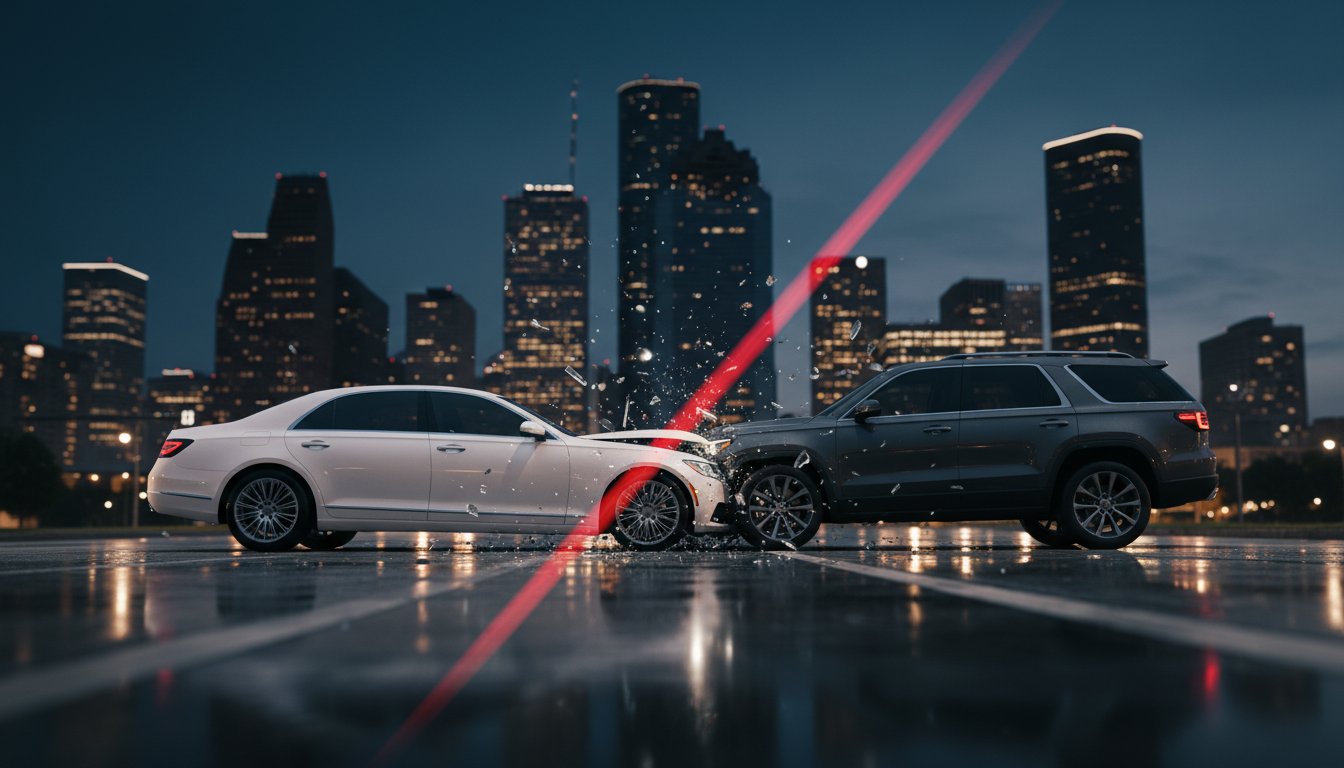
A T-bone accident, technically referred to as a broadside or side collision, occurs when the front of one vehicle strikes the side of another at a perpendicular angle. These crashes are among the most dangerous events on Texas roads because they bypass the primary safety features of a modern car. In 2024, Houston recorded 345 traffic fatalities, which was a 15% increase from the previous year. Harris County continues to lead the state in traffic deaths, and intersection-related crashes remain a primary contributor to these tragic numbers. While a head-on collision allows a vehicle's engine block and front-end "crumple zones" to absorb the impact, a side-impact crash offers no such protection.
The physics of these collisions are unforgiving. When a multi-ton vehicle strikes a car door, there are only a few inches of steel and glass between the point of impact and the passenger. Even at moderate speeds, the force can crush the cabin, pinning occupants and causing life-altering injuries. This lack of structural buffer is why side-impact collisions account for nearly 22% of passenger vehicle occupant deaths nationally, a statistic that hits home for many families in the Greater Houston area.
The Anatomy of a Broadside Collision
Modern vehicles have made strides with side-curtain airbags, but these systems offer limited protection compared to the heavy-duty safety cages found at the front and rear. In a t-bone accident, the sudden lateral acceleration often causes the head to strike the window or the intruding vehicle. This frequently results in traumatic brain injuries (TBIs), complex pelvic fractures, and spinal trauma. "In a T-bone accident, only a few inches of metal and glass separate the victim from the full force of a multi-ton vehicle." These injuries don't just cause immediate pain; they often require months of intensive physical therapy on the road to recovery.
Why Houston Intersections Are T-Bone Hotspots
Houston’s unique infrastructure creates a perfect storm for broadside crashes. Our sprawling 8-lane intersections, particularly along Westheimer Road and near the I-10/610 interchange, can be overwhelming for even the most attentive drivers. Many collisions occur when a driver attempts to beat a "stale yellow light" or fails to yield the right-of-way during a left turn. Additionally, the METRO rail intersections in the Downtown and Medical Center areas present a specific risk. Drivers who aren't familiar with the specialized signal timing often turn directly into the path of oncoming trains or traffic, leading to devastating side-impact results. These high-volume zones require constant vigilance, yet distracted driving remains a persistent threat to everyone on the road.
Determining Fault in a Texas T-Bone Accident: Who Is Liable?
Assigning liability in a broadside collision is rarely as simple as identifying which vehicle struck the other. Many victims assume that if they were hit, the other driver is automatically at fault. However, Texas law focuses on which party breached their "Duty of Care." This legal obligation requires every driver in Houston to operate their vehicle in a reasonably safe manner and obey all traffic control signals. Proving a breach of this duty is the cornerstone of any successful personal injury claim. Under Texas negligence laws, an adjuster or jury will look for evidence of "Failure to Yield," which occurs when a driver fails to give the right-of-way to another vehicle as required by the Texas Transportation Code.
While driver error causes the vast majority of crashes, mechanical failures sometimes play a role. If a vehicle's brakes fail or a steering component snaps, the driver might be unable to avoid a t-bone accident despite their best efforts. In these complex cases, liability might shift to a vehicle manufacturer or a negligent maintenance shop. If you suspect a mechanical defect contributed to your crash, it's vital to have an experienced legal team secure the vehicle for a professional inspection before evidence is lost.
Scenario 1: Running Red Lights and Stop Signs
Proving who ran a red light often becomes a "he-said, she-said" dispute. To resolve this, we analyze the timing patterns of Houston traffic signals. By comparing the "yellow change interval" and "red clearance interval" with witness statements and dashcam footage, we can often prove which driver had the legal right-of-way. Texas law establishes a presumption of negligence when a driver ignores a traffic control device, making this data critical for your recovery. If you're facing conflicting stories from the other driver, consulting with a dedicated attorney can help uncover the digital evidence needed to break the stalemate.
Scenario 2: Left-Hand Turns Across Oncoming Traffic
In Texas, the driver making a left-hand turn is almost always presumed at fault if a collision occurs. Consider a driver attempting to turn left onto a busy stretch of Richmond Ave. They must wait until oncoming traffic is clear enough to cross safely. If they turn into the path of an oncoming car, they have failed to yield. There are rare exceptions, however. If the oncoming driver was traveling at 20 miles per hour over the speed limit or was drag racing, they may share significant liability. Proving these exceptions requires meticulous accident reconstruction to show that the turning driver could not have reasonably anticipated the other vehicle's excessive speed.
How to Handle a T-Bone Accident in Houston: A 5-Step Guide
If you've just been involved in a side-impact collision on a busy thoroughfare like I-45 or the West Loop, your adrenaline is likely surging. However, the actions you take in the next sixty minutes will dictate the success of your legal and physical restoration. First, prioritize safety. If your vehicle is operable and you aren't severely incapacitated, move it out of active Houston traffic lanes to avoid a secondary pile-up. Texas law requires reporting any crash resulting in injury, death, or property damage exceeding $1,000. Contact the Houston Police Department (HPD) immediately to ensure an officer attends the scene and creates a formal record.
While waiting for HPD, identify and secure witnesses. Because a t-bone accident often hinges on who had the green light, having a third-party witness who saw the signal sequence is invaluable. Simultaneously, seek an immediate medical evaluation at a local trauma center such as Memorial Hermann. Even if you feel fine, high-impact collisions often cause latent internal trauma or traumatic brain injuries. A Transportation Research Board study underscores that the severity of side-impact collisions is frequently underestimated by victims at the scene. Establishing a medical record within hours of the crash is a vital part of your road to recovery.
Step-by-Step Scene Documentation
Digital evidence is perishable. Use your smartphone to capture the intersection from multiple angles, focusing on skid marks, debris patterns, and the placement of traffic signals. If it's safe, take a photo of the other car’s interior. Evidence of distractions, such as a glowing phone in the cup holder or open containers, can be a game-changer for your claim. When interacting with HPD officers, remain calm and factual. Provide your version of events clearly, but don't admit fault or speculate on your speed. Let the physical evidence tell the story.
The "Crash Report" Signature Service
In some instances, HPD may not be able to attend a scene due to high call volumes. If an officer doesn't arrive, you must file a Blue Form (CR-2) to document the incident for insurance purposes. You can find detailed instructions in our Guide to obtaining your Houston Crash Report. This document is essential for your legal team to begin their investigation. "A police report is the cornerstone of a T-bone claim, providing an unbiased third-party account of the intersection dynamics." Having this report allows us to apply the intellectual rigor necessary to challenge aggressive insurance adjusters and prove the true cause of the t-bone accident.
Proving Your Case: Evidence and Texas Modified Comparative Negligence
Securing a settlement after a side-impact collision requires more than just a police report. In Texas, your recovery is governed by the "Proportional Responsibility" law, found in the Texas Civil Practice & Remedies Code § 33.001. This modified comparative negligence system allows you to recover damages only if you are 50% or less at fault for the incident. If an insurance adjuster or a jury determines you are 51% responsible, you are barred from recovering any compensation. Because a t-bone accident often occurs in the "gray area" of a changing traffic light, insurance companies frequently use this complexity to shift the majority of the blame onto the victim.
To counter these tactics, we utilize sophisticated data from your vehicle’s Event Data Recorder (EDR), commonly known as the "Black Box." This device captures critical metrics such as your exact speed, braking patterns, and steering input at the moment of impact. When paired with footage from the City of Houston’s traffic camera network or private dashcams, this data creates an undeniable timeline. This level of intellectual rigor is necessary to prove that the other driver breached their duty of care, ensuring your road to recovery remains on track.
Digital Evidence in 2026: Beyond the Police Report
Modern litigation relies heavily on hyper-local digital footprints. In residential Houston neighborhoods, doorbell cameras like Ring or Nest have become essential tools for proving fault. These cameras often catch the split second a driver ignores a stop sign or speeds through a quiet intersection. We also work to subpoena cell phone records to identify if distracted driving played a role in the t-bone accident. You must act quickly, however. Digital data on private servers or city traffic loops is often overwritten or deleted within 24 to 48 hours of the crash. Securing this evidence immediately is vital for your claim.
The 51% Bar: Protecting Your Settlement
The difference between 50% and 51% fault is the difference between a full recovery and zero compensation. Consider a hypothetical scenario where your total damages equal $100,000. If a jury finds you 20% at fault because you were traveling slightly over the speed limit, your award is reduced to $80,000. However, if the insurance company successfully argues you were 51% at fault, you receive nothing. Jeff Todd’s background in elite corporate litigation provides a unique advantage in these disputes. We understand the reinsurance and risk-assessment strategies insurance companies use to devalue claims. Before you provide a recorded statement that could be used against you, contact our Houston office to ensure your statement is handled with professional precision.
Navigating the Road to Recovery: Maximizing Your Compensation
The journey following a t-bone accident involves much more than simply resolving a property damage claim. We view your recovery as a dedicated partnership where professional legal advocacy supports your physical and emotional healing. To maximize your compensation, we look beyond the initial emergency room visit. We analyze the total impact on your livelihood, including non-economic damages like mental anguish and loss of consortium. These intangible losses are often the most significant part of a claim, yet insurance adjusters routinely ignore them without aggressive intervention.
Our "Heart and Heat" philosophy ensures we handle your case with the empathy you deserve while applying intense pressure to the insurance companies. We use our sophisticated corporate background to anticipate how adjusters will try to devalue your suffering. By treating your case as a holistic restoration process rather than just a financial transaction, we ensure every potential avenue for recovery is explored. This approach is vital in high-volume jurisdictions like Harris County, where a quick, lowball settlement offer is the standard tactic for many insurers.
Calculating the True Cost of a T-Bone Injury
Side-impact collisions frequently result in complex orthopedic injuries or neurological trauma that requires years of specialized treatment. We collaborate with expert life care planners to project these long-term expenses accurately. It's not enough to settle for today's bills; your settlement must account for future surgeries, ongoing physical therapy, and potential home modifications. Understanding how to prove negligence in a Texas case is the foundation for securing these future-focused damages and ensuring your financial stability.
Why a Dedicated Houston PI Lawyer Makes the Difference
The Todd Law Group, PLLC operates on a contingency fee model, ensuring you have access to elite legal representation without any upfront costs. You don't pay us unless we successfully recover money for you. This approach allows you to focus on your health while we apply the intellectual rigor of a former corporate litigator to your file. We understand the local Houston court dynamics and are personally committed to your total restoration. If you're ready to protect your future, you can start your road to recovery with a free consultation today.
Secure Your Financial and Physical Restoration
Recovering from a t-bone accident requires a blend of immediate action and long-term legal strategy. You now understand how Texas’s 51% bar rule can jeopardize your claim and why securing digital evidence within the first 48 hours is critical. Whether you were struck on Westheimer Road or a busy intersection near the 610 Loop, the road to recovery involves holding negligent drivers accountable for their failure to yield.
Attorney Jeff Todd has been licensed since 1994 and brings elite corporate litigation experience to every personal injury case. Our Houston-based advocacy is built on a contingency-based model; there's no fee unless we win your case. We provide the intellectual rigor of a high-stakes firm with the compassionate support you need to rebuild your life. Begin Your Road to Recovery: Schedule a Free T-Bone Accident Consultation.
You don't have to face aggressive insurance adjusters alone. We're here to guide you toward the settlement you deserve and ensure your future is protected.
Frequently Asked Questions
Who is usually at fault in a T-bone accident at a four-way stop?
At a Houston four-way stop, the driver who arrives first has the legal right-of-way. If two vehicles arrive at the same time, the driver on the left must yield to the driver on the right per Texas Transportation Code § 545.151. Fault is typically assigned to the driver who fails to yield. Investigating these crashes often requires analyzing vehicle damage patterns to confirm which car entered the intersection first.
Can I still get a settlement if I was partially at fault for the crash in Houston?
You can still recover a settlement if you were 50% or less at fault for the incident. Under Texas Civil Practice & Remedies Code § 33.001, your total compensation is reduced by your specific percentage of responsibility. However, if an insurance adjuster proves you were 51% at fault, you're legally barred from any recovery. This makes professional legal advocacy essential to protect your settlement from unfair blame.
What are the most common injuries from a side-impact collision?
Side-impact collisions often cause traumatic brain injuries (TBIs), pelvic fractures, and spinal cord damage. Because car doors lack the massive crumple zones found in the front and rear, occupants absorb the full force of the impact. These injuries frequently require long-term rehabilitative care. National data from 2022 shows these crashes account for 22% of passenger vehicle occupant deaths, highlighting their extreme physical severity.
How long do I have to file a T-bone accident lawsuit in Texas?
In Texas, you generally have two years from the date of the t-bone accident to file a personal injury lawsuit. This deadline is strictly enforced under Texas Civil Practice and Remedies Code § 16.003. If your claim involves a government vehicle, such as a METRO bus, you must provide written notice within six months. Missing these deadlines permanently forfeits your right to seek financial compensation for your injuries.
Do I need a lawyer if the other driver clearly ran a red light?
Even if the other driver clearly ran a red light, you still need a lawyer to manage aggressive insurance tactics. Adjusters often claim you were speeding or distracted, trying to shift enough fault onto you to trigger the 51% bar rule. A dedicated attorney uses digital evidence and signal timing data to prove your innocence and ensure you receive the maximum settlement for your medical costs and lost wages.
How much is the average settlement for a T-bone accident in Houston?
There is no fixed average settlement because every case depends on specific medical bills, lost wages, and insurance coverage. Texas law requires a minimum 30/60/25 liability policy, but many Houston drivers carry higher limits. We calculate your claim’s value by analyzing your long-term care needs and lost earning capacity. This ensures your road to recovery is fully funded rather than settled for a lowball amount.
What happens if the driver who T-boned me does not have insurance?
If the at-fault driver is uninsured, you can seek compensation through your own Uninsured Motorist (UM) coverage. If you don't have UM protection, you might have to file a personal lawsuit against the driver, though collecting assets from individuals can be difficult. We investigate all potential defendants, such as vehicle manufacturers or employers, to find every available source of recovery for your suffered losses.
Will my dashcam footage help my T-bone accident case?
Dashcam footage is one of the most effective tools for proving fault in a t-bone accident. It provides objective, third-party evidence of traffic signal colors and the other driver's behavior. This footage prevents the case from becoming a "he-said, she-said" dispute and often forces insurance companies to settle more quickly. We recommend securing this digital data immediately before it's overwritten by the device.


