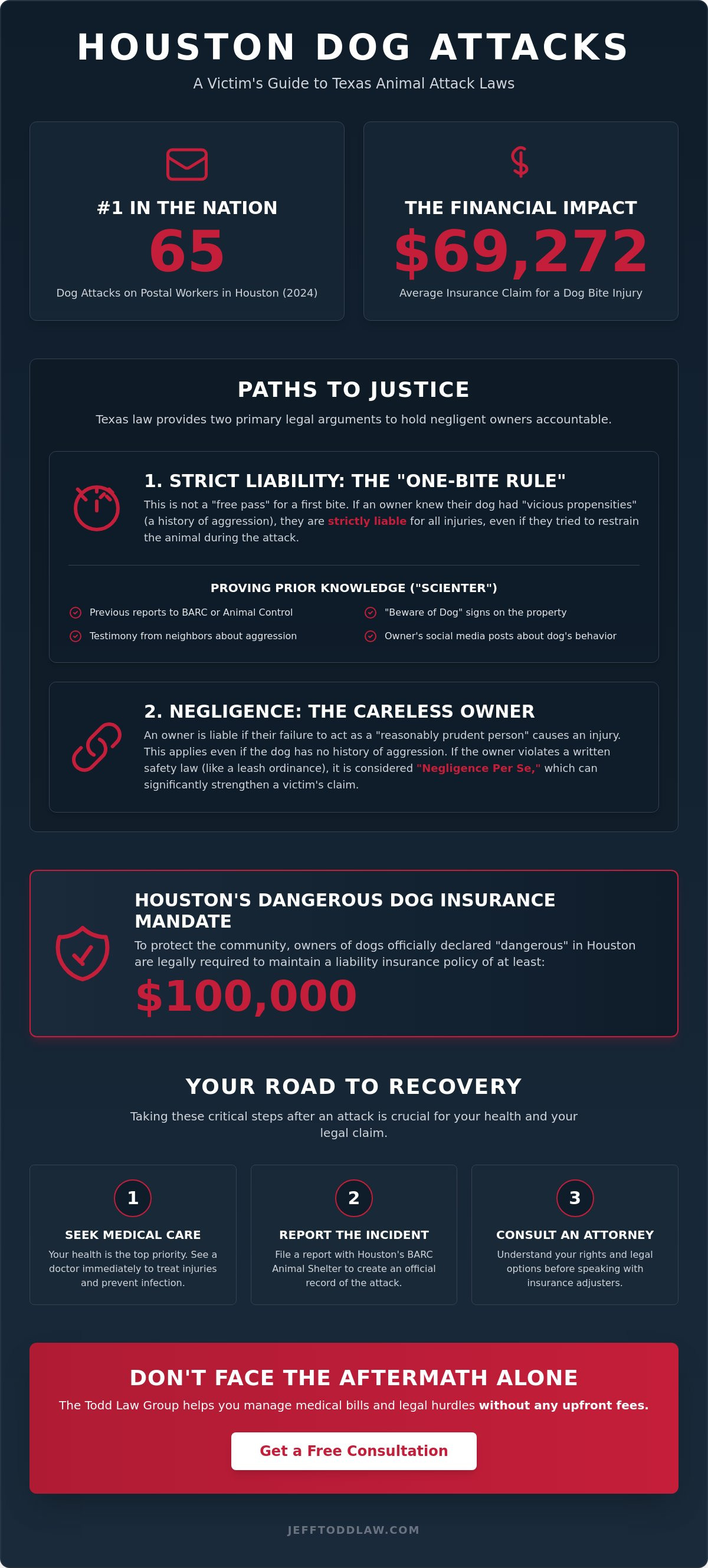
In 2024, Houston earned a troubling distinction as the city with the highest number of dog attacks on postal workers in the nation, reporting 65 separate incidents. For many residents, a sudden encounter with an aggressive animal leads to a $69,272 average insurance claim and the fear of permanent scarring. You might wonder if you can hold an owner liable if their dog hasn't bitten anyone before. While the "one-bite rule" is a common defense, modern Texas animal attack laws and Houston local ordinances provide several paths to accountability that go beyond a pet's history.
It's natural to feel hesitant about seeking legal help, especially if the dog belongs to a neighbor or friend. However, the rising costs of medical treatment and the need for specialized surgery shouldn't fall on your shoulders. We understand that your priority is a full physical and financial restoration. This guide promises to simplify the legal complexities of your situation and help you understand your rights in Harris County. We'll preview the steps to report an incident to BARC, explain how to establish negligence, and show you how to secure medical care without upfront costs.
Key Takeaways
- Learn the legal requirements for proving "scienter" and how the Texas "one-bite rule" applies to your specific injury claim.
- Understand how violating local leash or safety codes can lead to a "negligence per se" ruling under Texas animal attack laws.
- Identify the Houston-specific ordinances that require owners to register dangerous animals and maintain high-value liability insurance.
- Follow a clear protocol for reporting attacks to Houston’s BARC Animal Shelter to ensure the incident is documented for your recovery.
- Discover how the right legal advocacy helps you manage medical bills and legal hurdles without paying any upfront fees.
Understanding the Texas "One-Bite Rule" in 2026
Many victims believe a dog owner gets a pass the first time their pet attacks someone. This is a dangerous misconception. Under Texas animal attack laws, the legal framework is built on a foundation established decades ago. It isn't about giving the dog a free pass; it's about determining when an owner becomes strictly liable for the harm their animal causes. We use the term one-bite rule to describe this standard. If you've suffered an injury, proving the owner knew their dog was dangerous allows you to hold them responsible for your medical bills and suffering. This applies even if they tried to restrain the animal during the attack.
The Marshall v. Ranne Precedent
In 1974, the Texas Supreme Court decided the landmark case of Marshall v. Ranne. This case shifted how our state handles animal liability by moving away from general negligence in specific scenarios. The court ruled that if an animal has "vicious propensities" and the owner is aware of them, the owner is strictly liable for any injuries. In a Houston court, vicious propensities refer to a history of snapping, growling, or lunging that would put a reasonable person on notice. Strict liability means that if the owner knew the dog was a risk, they're legally responsible for the damages without you having to prove they were careless in that specific moment.
Proving Prior Knowledge (Scienter)
The legal term for this prior knowledge is "scienter." Winning a case under this standard requires concrete evidence that the owner had a reason to fear an attack before it happened. We look for specific markers of a dog's history to build your case. Common evidence includes:
- Previous reports filed with BARC Animal Shelter or Harris County Animal Control.
- Testimony from neighbors who witnessed the dog acting aggressively toward people or other pets.
- The presence of "Beware of Dog" or "Aggressive Animal" signs on the owner's property.
- Social media posts where the owner discusses the dog's behavioral issues or past "close calls."
In complex cases, we may employ animal behavior experts to evaluate the dog's temperament and history. These experts provide the intellectual rigor needed to prove that the animal's behavior wasn't a one-time fluke but a documented pattern of aggression. If an owner knew their pet was a threat and failed to protect the community, they must be held accountable for your road to recovery.
Negligence: The Alternative Path to Liability
Even if a dog has never snapped at anyone before, you can still seek compensation if the owner was careless. While the one-bite rule focuses on the dog's history, the principle of negligence focuses on the owner's actions. Under Texas animal attack laws, every pet owner owes a duty of care to pedestrians, guests, and mail carriers. If an owner fails to act as a reasonably prudent person would, they're responsible for the resulting harm. This path to liability is essential for victims who don't have access to the animal's prior history but have clearly suffered due to an owner's lack of oversight.
We often use a legal concept called "negligence per se" to simplify these cases. This occurs when an owner violates a written safety law, such as a local leash ordinance or a containment requirement. In these instances, the violation itself serves as proof of negligence. The Texas Health and Safety Code provides the state-level framework for these regulations, but Houston's specific rules are often even stricter regarding how animals must be restrained in public spaces. Proving a violation of these codes can significantly strengthen your claim for damages.
A common concern for our clients is the anxiety of confronting a neighbor or friend. It's important to realize that in most cases, you aren't seeking money directly from your neighbor's personal savings. Instead, we're pursuing a claim against their homeowner's or renter's insurance policy. These companies exist to provide financial restoration after accidents. For example, Houston owners of dogs officially declared "dangerous" are required to maintain at least $100,000 in liability insurance to cover potential attacks. By filing a claim, you're ensuring your medical bills are covered without putting your neighbor in a personal financial crisis.
Failure to Restrain and Leash Law Violations
Houston's suburban layout often leads to incidents where dogs escape through broken fence slats or open gates. If an owner knows their fence is rotting but does nothing, that's ordinary negligence. If they intentionally let a known aggressive dog roam free, it might rise to gross negligence. When navigating Texas animal attack laws in a local court, proving a failure to restrain can be the difference between a dismissed claim and a successful recovery. Our team at The Todd Law Group, PLLC meticulously reviews animal control records to see if the owner was previously cited for similar restraint issues.
Premises Liability for Houston Property Owners
In a city with thousands of apartment complexes and gated communities, landlords often share the blame. If a property manager knows a tenant keeps a dangerous animal but fails to take action, they may be liable under premises liability. Our team investigates whether the complex followed its own safety protocols to keep common areas safe for all residents. We look at lease agreements and previous complaints made to the management office. If you've been hurt on someone else's property, we can help you determine the best path forward on your road to recovery.
Local Houston Ordinances and Dangerous Dog Laws
While state-level Texas animal attack laws establish the baseline for liability, Houston’s municipal code adds specific layers of protection for city residents. Under Chapter 6 of the Houston Code of Ordinances, the city defines how pets must be managed within our unique urban environment. One of the most significant provisions involves the mandatory registration of animals that have already displayed aggressive behavior. If a dog is officially declared "dangerous" by the city, the owner must comply with strict containment rules and maintain at least $100,000 in liability insurance. This financial requirement ensures that if the animal attacks again, there is a guaranteed source of recovery for the victim's medical treatment.
Enforcement of these local rules falls under the jurisdiction of the Bureau of Animal Regulation and Care (BARC) and Harris County Public Health. These agencies investigate incidents to determine if an owner has violated city-specific safety standards. Understanding how these city-specific rules interact with Texas animal attack laws is essential for a successful claim. When an owner fails to meet these administrative requirements, it provides powerful evidence for your legal case. Our firm focuses on identifying these local violations to ensure you aren't left carrying the financial burden of someone else's failure to follow city safety codes.
Houston Chapter 6 Enforcement
Section 6-101 of the Code, often referred to as the city's leash law, explicitly prohibits dogs from "running at large." This means that any dog off the owner's property must be under the direct control of a person capable of restraining it. Unlike general state negligence, violating this specific Houston ordinance carries clear municipal penalties and fines. These local rules establish a definitive standard of care that owners must meet to keep our sidewalks and parks safe. If a dog escapes a yard or is let off a leash in a public space, the owner is in direct violation of the city's safety framework.
Dangerous Dog Designations in Harris County
The process of having an animal legally declared "dangerous" is a formal administrative procedure handled by BARC. It begins when a victim or witness submits a sworn, notarized affidavit detailing the attack or aggressive behavior. Once this designation is made, the owner’s legal responsibilities increase significantly. They must notify animal control within 24 hours if the dog moves to a new address or is sold. These Local Houston Ordinances are designed to provide a public record of high-risk animals, helping victims secure their road to recovery by proving the owner was on notice of the pet's history.
The Road to Recovery: Steps to Take After an Attack
The moments following a traumatic encounter are often a blur of pain and confusion. Your immediate priority must be professional medical care. Beyond treating visible wounds, physicians must evaluate the risk of rabies and secondary infections like cellulitis or tetanus. Once you are physically stable, the focus shifts to preserving the evidence necessary to navigate Texas animal attack laws. This includes taking clear photographs of the injury site, the animal involved, and the specific property where the incident occurred. Evidence can disappear quickly, so capturing these details before a fence is repaired or a dog is moved is vital for your claim.
One critical error victims often make is engaging with insurance adjusters too soon. You should never sign a medical release or accept a settlement offer within the first 48 hours of an attack. Adjusters frequently attempt to close files before the full extent of nerve damage or permanent scarring becomes apparent. If you're feeling pressured to settle, contact an experienced Houston dog bite lawyer at The Todd Law Group, PLLC to ensure your future needs are protected. We provide the steady reassurance and legal authority needed to push back against aggressive insurance tactics.
Reporting to BARC and Harris County
Houston residents must report any bite incident to the city’s 311 service or the BARC Animal Shelter within 24 hours. This triggers a mandatory 10-day quarantine period for the animal, which is essential for rabies monitoring and public safety. A formal report creates an official timeline and identifies the owner, providing the intellectual rigor needed to support your legal claim. Without this government record, an owner might later deny the attack ever took place or claim they weren't the owner of the animal involved.
Documenting Your Physical and Financial Losses
As you move along the road to recovery, keep a meticulous record of every expense related to the injury. This includes emergency room bills, costs for specialized plastic surgery consultations, and proof of lost wages from missed shifts. We also recommend maintaining a pain journal to track the daily impact of your injuries. Documenting how a scar or a new fear of being outdoors affects your quality of life helps us quantify non-economic damages that a simple medical bill cannot capture. This documentation ensures that your eventual settlement reflects the true cost of your physical and financial restoration.
- Medical Bills: Keep every invoice from hospitals, pharmacies, and physical therapy sessions.
- Employment Records: Track missed work hours and any changes in your job duties during healing.
- Wound Progression: Take weekly photos of your injuries to document the healing or scarring process.
How The Todd Law Group Protects Houston Victims
Securing your future after a traumatic injury requires more than just a basic understanding of Texas animal attack laws. It demands a legal partner who possesses the intellectual rigor to take on multi-billion dollar insurance corporations. Jeff Todd brings over 30 years of legal experience to every case, having built a prestige history that spans from the high-stakes corporate environments of Washington, D.C., to the local courtrooms of Harris County. Our firm operates on a dedicated contingency fee model. This means you'll never face upfront costs or hourly billing. If we don't secure a financial recovery for you, you owe us nothing. This commitment ensures that every Houstonian has access to elite legal representation, regardless of their current financial situation.
We understand that the path following a dog bite is often overwhelming. Between rising medical costs for surgery and the anxiety of dealing with insurance adjusters, you need a stable partner. The Todd Law Group provides a calculated blend of professional authority and compassionate advocacy. We treat your legal claim as a vital part of your holistic road to recovery, managing the logistical and legal burdens so you can focus entirely on your physical healing.
The Advantage of Elite Corporate Experience
Many firms rely on aggressive billboard marketing and high-volume turnover, but Jeff Todd offers a different level of sophistication. His background in complex corporate litigation gives our clients a distinct advantage during negotiations. We apply that same level of meticulous attention to detail to animal attack cases that we once applied to corporate mergers and reinsurance disputes. We know the tactics insurance companies use to devalue claims. We have the battle-tested experience to counter them. Our presence in Houston means we're personally invested in this community and remain a grounded, accessible resource for our neighbors.
Your Free Consultation and Case Evaluation
Starting your journey toward restoration shouldn't be difficult. We offer a comprehensive case review at no cost to you. During this consultation, we'll evaluate the facts of your incident, discuss how Texas animal attack laws apply to your specific situation, and outline a strategy for your recovery. We move quickly from identifying the problem to offering a solution. You can connect with us easily by using our Houston personal injury lawyer contact form. We're here to be your dedicated partner, providing the quiet confidence and legal heat necessary to resolve your case efficiently. Let us help you navigate the legal hurdles so you can move forward with your life.
Secure Your Restoration and Legal Rights
Navigating the aftermath of an animal attack involves more than just medical healing; it requires a clear strategy to address your financial and emotional losses. You've learned that Texas animal attack laws provide multiple paths to accountability, whether through the strict liability of the one-bite rule or the specific safety standards set by Houston’s Chapter 6 ordinances. By reporting the incident to BARC and documenting your injuries, you create the foundation needed to secure a fair recovery from insurance providers. You don't have to face the complexities of the legal system or the pressure of insurance adjusters alone.
Jeff Todd has been licensed in Texas since 1994, bringing elite corporate-level rigor to personal injury advocacy. Our dedicated Houston-based legal team prioritizes your physical and financial restoration, ensuring you have the resources needed for surgeries or long-term care. We operate on a contingency model, which means there is no fee unless we win your case. Start your Road to Recovery with a free Houston animal attack case evaluation. We are committed to being your stable partner throughout this process, helping you move forward with confidence and peace of mind.
Frequently Asked Questions
Does Texas have a leash law that covers the entire state?
No, Texas does not have a statewide leash law; instead, it leaves these regulations to local cities and counties. In Houston, Section 6-101 of the Code of Ordinances mandates that all dogs must be restrained when off the owner's property. If an unrestrained dog causes an injury within city limits, the owner’s violation of this local ordinance can be used as proof of negligence in your claim.
What is the "one-bite rule" in Texas and does it still apply in 2026?
The "one-bite rule" remains the primary standard for Texas animal attack laws in 2026. This rule generally requires a victim to prove the owner had prior knowledge of the dog’s aggressive tendencies, a concept known as "scienter." However, you can still secure compensation through negligence claims if the owner failed to properly secure the animal, regardless of the dog's past behavior.
Can I recover compensation if I was bitten by a dog while working as a delivery driver in Houston?
You can absolutely recover compensation if you're injured while performing delivery duties in Houston. Delivery drivers are considered "invitees" under premises liability law, meaning property owners must ensure a safe environment. In 2024, Houston reported 65 dog attacks on postal workers, the highest number in the nation. We help drivers hold negligent owners accountable for medical bills and lost wages.
How long do I have to file an animal attack lawsuit in Texas?
You have exactly two years from the date of the injury to file a lawsuit in a Texas court. This deadline is set by the statute of limitations for personal injury cases. If you fail to file within this 24-month window, you'll likely lose your right to seek compensation. We recommend starting the legal process immediately to ensure all evidence, such as BARC reports and witness testimony, is preserved.
Is a landlord liable if a tenant’s dog bites someone in a Houston apartment complex?
Landlords can be held liable in Houston if they knew a tenant was harboring a dangerous animal and failed to take action. For a successful claim, we must prove the landlord had actual knowledge of the dog's vicious propensities and possessed the authority to remove the animal from the premises. This is a common factor in cases involving apartment complexes where management ignores safety complaints.
What happens if a dog is declared "dangerous" by the City of Houston?
When BARC declares a dog "dangerous," the owner must comply with several strict requirements to keep the animal. They are legally required to maintain a $100,000 liability insurance policy and keep the dog in a government-approved secure enclosure. The owner must also notify animal control within 24 hours if the dog is moved or sold, ensuring the community remains protected from known threats.
Can I sue for a dog bite if there was a "Beware of Dog" sign posted?
You can still sue even if the property had a "Beware of Dog" sign posted. While owners use these signs as a defense, the sign actually serves as evidence that the owner was aware of the animal’s dangerous nature. Under Texas animal attack laws, a sign doesn't exempt an owner from their duty to keep visitors safe or follow local leash and containment ordinances.
Will the dog be put down if I report the bite to BARC?
Reporting a bite to BARC does not automatically mean the dog will be euthanized. The primary purpose of a report is to initiate a mandatory 10 to 14-day quarantine to monitor the animal for rabies. Euthanasia is typically reserved for cases where a dog causes serious bodily injury in an unprovoked attack or if the owner refuses to comply with dangerous dog registration requirements.


