
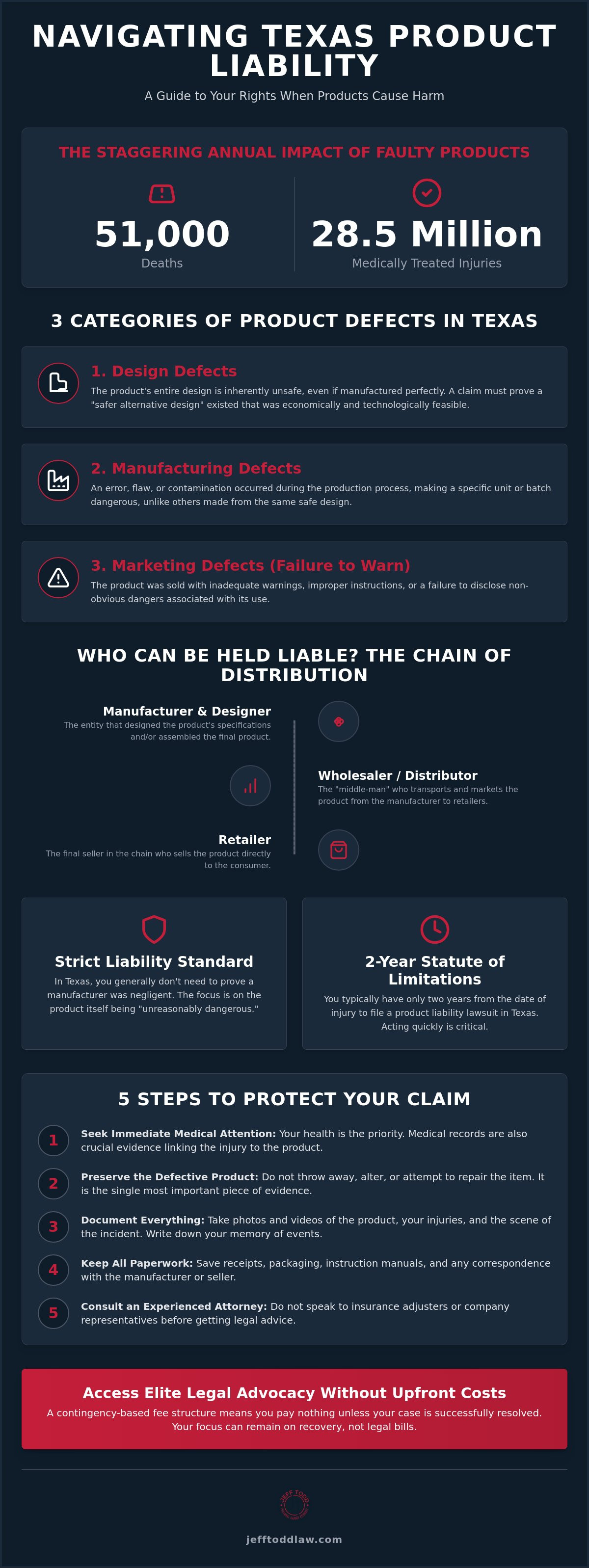
Did you know that faulty consumer products are associated with nearly 51,000 deaths and 28.5 million medically treated injuries every year? When a product you trust fails, the impact isn't just physical; it's a financial and emotional weight that can feel impossible to carry alone. You might find yourself staring at rising medical expenses and wondering how a single person can stand up against a massive manufacturer. It's a daunting position, but you don't have to navigate these complex legal waters without a steady partner. Consulting an experienced Houston product liability lawyer is the first step toward reclaiming your stability and holding negligent parties accountable.
This guide provides the clarity you need to understand your rights under current Texas statutes, including the strict liability standards outlined in Chapter 82. We'll explore how to identify design or manufacturing defects, the implications of the two year statute of limitations, and the latest 2026 legal updates affecting vehicle and solar equipment claims. By the end of this article, you'll know exactly how to protect your rights and how a contingency based approach ensures you receive elite legal advocacy without upfront costs. Our goal is your total restoration, moving you from the confusion of an injury to the confidence of a clear legal path.
Key Takeaways
- Identify the three specific categories of product defects recognized under Texas law, including design, manufacturing, and marketing, to determine if you have a valid legal claim.
- Learn why liability often extends beyond the manufacturer to include designers and retailers, helping you hold every responsible party in the distribution chain accountable.
- Understand how Texas Chapter 82 and the "unreasonably dangerous" standard impact your case; a seasoned Houston product liability lawyer can help you navigate these complex legal requirements.
- Discover the critical steps for evidence preservation, such as securing immediate medical documentation and retaining the defective item to protect your rights.
- Explore how a contingency based legal strategy allows you to access high caliber advocacy for your total restoration without any upfront financial burden.
Understanding Product Liability: Who is Responsible for Your Injury?
The legal framework of Product liability ensures that when a consumer is injured by a defective good, the financial responsibility falls on those who designed, built, and sold it. It's a vital protection for individuals who find themselves facing massive corporations after a catastrophic failure. Whether it's a household appliance or a complex piece of industrial machinery, the law recognizes that you shouldn't bear the cost of a manufacturer's oversight. Securing total restoration after such an event requires a deep understanding of how these claims are built against sophisticated legal teams. An experienced Houston product liability lawyer applies elite intellectual rigor to trace the failure back to its source, ensuring accountability across the entire commercial chain.
The Chain of Distribution in Houston
Identifying the liable parties in a product claim is rarely a simple task because goods pass through many hands before reaching your home. In the legal world, this is known as the chain of distribution. Liability can rest with a component manufacturer who provided a faulty part, the primary manufacturer who assembled the final product, or the wholesaler who distributed it. Even a local Houston retailer can sometimes be held responsible, though Texas law provides specific protections for "non-manufacturing" sellers. Under Chapter 82 of the Texas Civil Practice and Remedies Code, a seller who didn't participate in the design or manufacture is generally shielded from liability unless they altered the product or provided incorrect safety information. We look at every link in this chain to find where the safety protocols broke down.
Strict Liability vs. Negligence
Most personal injury cases rely on proving negligence, which means showing the defendant was careless. Product liability is different because it often operates under the standard of strict liability. This means you don't have to prove the manufacturer intended to be reckless or even that they were aware of the flaw. Instead, the focus shifts entirely to the product itself. Strict liability is the legal standard where the product, not the manufacturer's conduct, is on trial. To establish a successful claim, your legal team must prove five key elements:
- The defendant sold the product in a commercial capacity as a regular part of their business.
- The product was in a defective condition when it left the defendant's control.
- The defect rendered the product "unreasonably dangerous" to the user.
- The product reached you without any substantial changes to its condition.
- The defect was the direct cause of your physical or financial injuries.
It's important to distinguish between commercial sellers and casual sellers. If you buy a used lawnmower at a local garage sale and it malfunctions, that individual is a "casual seller" and usually isn't subject to strict liability. These laws are designed to hold professional entities to a higher standard of care because they have the resources and the duty to ensure their products are safe for the public. If a commercial entity fails in this duty, the path to recovery involves proving the product was dangerous regardless of the company's "intent" or "carefulness."
The Three Types of Product Defects Under Texas Law
Texas law provides a specific framework for categorizing how a product fails its user. These categories aren't just academic; they dictate the type of evidence your legal team must gather to prove your case. Under the Texas Civil Practice and Remedies Code Chapter 82, defects are generally classified into three distinct areas. Understanding which category your injury falls into is essential for building a successful claim. Whether you were hurt by a medical device in the Medical Center or a household tool in your garage, a dedicated Houston product liability lawyer can help you pinpoint the exact nature of the failure to ensure total restoration of your rights.
Design Defects and the "Safer Alternative" Rule
A design defect occurs when the product's very blueprint is inherently unsafe. Even if the item is manufactured perfectly according to those plans, it remains dangerous for its intended use. In Texas, proving a design defect requires meeting the "safer alternative design" standard. This means you must show there was a way to build the product that would have prevented the injury, was economically feasible, and wouldn't have destroyed the product's primary purpose. Common examples include SUVs with high centers of gravity prone to rollovers or power saws lacking modern safety guards. Proving this often requires the intellectual rigor of expert engineers who can testify that a better way existed. This high level of technical proof is where the experience of a seasoned Houston product liability lawyer becomes indispensable.
Manufacturing and Marketing Failures
Manufacturing defects differ because the design itself might be safe, but something went wrong on the factory floor. A "one-in-a-million" error, such as a contaminated batch of medication or a poorly welded car frame, is still the manufacturer's responsibility. The company is strictly liable for these deviations from the intended design. It doesn't matter how many quality control checks they performed; if the unit that reached you was flawed and caused harm, the law provides a path for compensation.
Marketing defects, often called a "failure to warn," occur when a product is sold without adequate instructions or warnings about non-obvious risks. If a manufacturer knows a product has potential side effects or requires specific handling to avoid injury, they have a legal duty to disclose that information. This duty to maintain high safety standards is similar to the obligations found in premises liability cases, where property owners must warn of hidden dangers. If you suspect a manufacturer skipped these vital steps, it's worth speaking with a legal partner who understands the nuances of these complex Texas statutes.
Navigating Texas Statutes: Chapter 82 and Your Rights
Texas Civil Practice and Remedies Code Chapter 82 serves as the primary legal framework for holding manufacturers accountable. This statute codifies the strict liability standards we discussed earlier, but it also introduces specific hurdles and protections that can make or break a claim. Understanding these technicalities requires more than just a surface level reading of the law. It demands the intellectual rigor that a seasoned Houston product liability lawyer brings to the table. When you're facing a corporation with vast resources, knowing your rights under the Products Liability framework is your first line of defense.
Beyond strict liability, Texas law also recognizes breach of warranty claims under the Business and Commerce Code. These fall into two categories. Express warranties are specific promises made by the manufacturer, such as a "shatterproof" claim on a phone screen. Implied warranties are unwritten promises that a product is fit for its intended use and is of merchantable quality. If a product fails to meet these basic standards, you may have grounds for a claim even if you can't prove a specific design defect. However, Texas also applies "proportionate responsibility." If a jury finds you were partially responsible for your injury, your compensation is reduced by your percentage of fault. If you're found to be 51% or more responsible, you're barred from recovering any damages at all.
The Texas Statute of Limitations and Repose
Timing is everything in a legal claim. In Texas, you generally have a two year window from the date of your injury to file a lawsuit. This is known as the statute of limitations. While two years might seem like a long time, the process of investigating a defect and securing expert testimony is time intensive. Waiting too long can jeopardize your ability to secure the evidence needed for total restoration. Texas also enforces a 15 year statute of repose. This is a "hard limit" that prevents lawsuits if the product was first sold more than 15 years ago, regardless of when the injury occurred. Some exceptions exist for latent injuries, like those involving asbestos or toxic chemicals, where the harm doesn't appear for decades.
Proving "Unreasonable Danger" in Court
For a product to be considered defective, it must be "unreasonably dangerous." Texas courts primarily use the risk-utility test to determine this. This test weighs the magnitude of the danger against the utility of the product and the feasibility of a safer design. A jury will also consider "ordinary consumer expectations." They ask if the product failed to perform as safely as an average person would expect when used in a foreseeable manner. A dedicated houston personal injury lawyer uses these specific legal benchmarks to build a narrative of corporate failure. By proving that the risks of the design far outweighed its benefits, we can secure the compensation you deserve to move forward with your life.
Evidence Preservation: 5 Steps to Protect Your Claim
Success in a defective product claim isn't just about what happened; it's about what you can prove. When a product fails, the manufacturer's legal team will look for any reason to shift blame or discredit your story. Protecting your right to total restoration starts the moment the incident occurs. A Houston product liability lawyer needs clear evidence to overcome corporate defenses and prove that the item was "unreasonably dangerous." Following these five tactical steps ensures that your legal partner has the tools necessary to build a high-impact case.
- Seek Immediate Medical Care: Ensure your injuries are documented by professionals right away. This creates a medical paper trail that links your physical harm directly to the product failure.
- Preserve the Product: Do NOT throw away the defective item, its broken parts, or the original packaging. These are the most critical pieces of evidence in your case.
- Gather Documentation: Locate every physical receipt, digital order confirmation, and instruction manual related to the product.
- Capture Visual Evidence: Take extensive photos and videos of the product, the scene of the injury, and the injury itself from multiple angles.
- Consult Specialized Counsel: If your injury involves a commercial vehicle or faulty automotive part, you should also speak with a houston truck accident lawyer to address the specific federal regulations involved.
Maintaining the Chain of Custody
The physical product is the most important piece of evidence you possess. In legal terms, failing to keep it safe can lead to "spoliation" claims. This occurs when a manufacturer argues that you tampered with or destroyed evidence, making it impossible for them to defend themselves fairly. Store the item in a secure, dry place and don't attempt to repair it yourself. You must save all digital records of the purchase to verify the chain of ownership. When your Houston product liability lawyer takes your case, they'll often use expert engineers to examine the item in its post-accident state to prove the defect.
Documenting the Holistic Impact
Healing is a process that involves more than just a check for medical bills. It's about your entire life's restoration. Keep a daily journal of your pain levels and any physical limitations you experience during recovery. Track every out-of-pocket cost, from specialized medical equipment to transportation for doctor appointments. Don't forget to document lost wages and the specific ways your injury has changed your family dynamic. If you're struggling to manage the aftermath of an injury, contact our team for a consultation to discuss how we can help you secure the compensation you deserve.
Choosing The Todd Law Group, PLLC for Your Product Liability Claim
Taking legal action against a multinational corporation requires more than just passion; it requires a level of intellectual rigor usually reserved for the boardroom. Just as we apply this rigor to personal injury, international business owners launching new ventures in the U.S. often rely on an E-2 visa lawyer for Italian investors to handle the intricate legalities of their immigration and corporate setup. Attorney Jeff Todd has spent his career refining this approach, transitioning from elite corporate environments to dedicated personal advocacy. Since being licensed in 1994, he's applied high-level legal strategies to ensure individual victims aren't overmatched by massive manufacturing entities. When you choose a Houston product liability lawyer from The Todd Law Group, PLLC, you're gaining a stable partner who understands the internal processes of the companies we're holding accountable. We don't just see a case number; we see a path toward your total restoration.
We recognize that the fear of legal costs often prevents people from seeking the justice they deserve. That's why we operate on a "No Fee Unless We Win" basis. This contingency based model removes the financial barriers to high impact legal representation, allowing you to focus on your recovery while we handle the heavy lifting. Our team is battle tested in negotiations and in the courtroom, standing firm against insurance teams that try to minimize your suffering. We view your legal journey as a holistic healing process. Our goal is to secure the resources you need for medical care, lost wages, and the long term support required to move past this incident.
Expert Coordination and Litigation
Proving a defect often hinges on technical details that go beyond standard legal research. We bridge this gap by coordinating with world class engineers, safety analysts, and medical experts who can testify to the "unreasonably dangerous" nature of the product. Having a lawyer licensed since 1994 means working with someone who deeply understands the nuances of the Houston court system and the specific requirements of Texas Chapter 82. We maintain a proactive communication style to ensure you're never left wondering about the status of your claim. This meticulous attention to detail is what allows us to build cases that stand up to the most rigorous corporate defenses.
Take the First Step Toward Justice
You shouldn't have to carry the weight of a manufacturer's mistake alone. A free, confidential case evaluation is the most effective way to determine if you have a valid claim and what steps you need to take next to protect your rights. With physical office locations in Houston, Austin, and Galveston, we're positioned to serve injured Texans across the region with the accessibility and care they expect from a local firm. Don't let a statute of limitations expire while you're still struggling with the aftermath of an injury. Schedule your free case evaluation with The Todd Law Group, PLLC today and let us help you begin the journey toward recovery and accountability.
Secure Your Path to Total Restoration
Navigating the aftermath of a defective product injury is a heavy burden, but you don't have to carry it alone. By understanding the three types of defects and the strict liability standards of Texas Chapter 82, you've already taken the first step toward accountability. Remember that preserving the physical evidence and acting within the two year statute of limitations are critical to protecting your rights. You deserve a partner who applies elite corporate rigor to your individual advocacy, ensuring that no manufacturer is too large to face justice.
With over 30 years of legal experience in Texas, The Todd Law Group, PLLC provides the battle tested representation necessary for complex claims. We maintain physical offices in Houston, Austin, and Galveston to serve our local communities with dedicated care. You can move forward with confidence knowing there are no legal fees unless we recover money for you. If you're ready to hold negligent parties responsible and begin your holistic healing process, a seasoned Houston product liability lawyer is ready to help.
Get a Free Case Review from a Houston Product Liability Attorney
Your recovery is our priority, and we're committed to standing by you every step of the way.
Frequently Asked Questions
What is the difference between a design defect and a manufacturing defect?
A design defect means the product's blueprint is inherently dangerous for every unit produced, regardless of how well it was built. In contrast, a manufacturing defect occurs when a specific unit deviates from its intended design due to a factory error. While the design itself might be safe, the individual item that reached you was flawed. Proving these differences requires technical analysis from experts who can pinpoint exactly where the safety failure originated.
Can I still sue if I do not have the original box or receipt for the product?
You can still pursue a claim even if you no longer have the original packaging or a physical paper receipt. Digital order confirmations, credit card statements, and store loyalty program records often serve as sufficient proof of purchase to establish ownership. While the physical box is helpful for identifying specific manufacturing batches, a Houston product liability lawyer can use other investigative methods to trace the product's origin and verify the chain of distribution.
How long do I have to file a product liability lawsuit in Texas?
Texas law generally requires you to file a lawsuit within two years from the date the injury occurred or was discovered. However, the state also enforces a 15 year statute of repose, which acts as an absolute deadline based on when the product was first sold to a consumer. Acting quickly is essential to ensure evidence is preserved and your legal rights remain protected. Missing these strict deadlines will likely result in your case being dismissed by the court.
What if I was using the product incorrectly when I got hurt?
Using a product incorrectly doesn't automatically bar you from seeking compensation, but it may impact your final settlement amount. Texas follows a proportionate responsibility rule, meaning your recovery is reduced by your percentage of fault. If a jury determines you were more than 50% responsible for the incident due to misuse, you won't be able to recover any damages. We focus on proving the product's inherent defect was the primary cause of your harm.
Who can be held liable in a Texas product liability case?
Liability can extend to any party involved in the product's chain of distribution, including the designer, component part manufacturer, and the primary assembly company. Wholesalers and retailers may also be held responsible if they altered the product or provided incorrect safety information. Identifying every potential defendant is a complex process that requires the intellectual rigor of an experienced legal team. We look at every commercial link to ensure all negligent parties are held accountable for your restoration.
Do I have to pay upfront legal fees to hire a product liability lawyer?
You don't have to pay any upfront legal fees or out of pocket costs to hire our firm. We work on a contingency fee basis, which means our payment is a percentage of the final settlement or court award we secure for you. If we don't recover money on your behalf, you don't owe us any attorney fees at all. This approach allows you to access high caliber legal representation and hold massive corporations accountable without any financial risk to your family.
What kind of damages can I recover in a defective product claim?
Victims can recover economic damages, such as medical bills, future rehabilitation costs, and lost wages from time missed at work. You may also seek non economic damages for physical pain, emotional distress, and loss of enjoyment of life. In cases involving extreme negligence, punitive damages might be available to punish the manufacturer for their conduct. A Houston product liability lawyer works to quantify these holistic losses to ensure you receive the compensation necessary for a full recovery.
What should I do if the manufacturer issues a recall after I have already been injured?
If a manufacturer issues a recall after your injury, it serves as significant evidence that the product was "unreasonably dangerous." While a recall notice doesn't provide an automatic win in court, it can strongly support your claim that a defect existed. You should still follow the standard evidence preservation steps, including keeping the product and documenting your medical treatment. This new information often strengthens the argument for corporate accountability and helps clarify the path to your total restoration.


