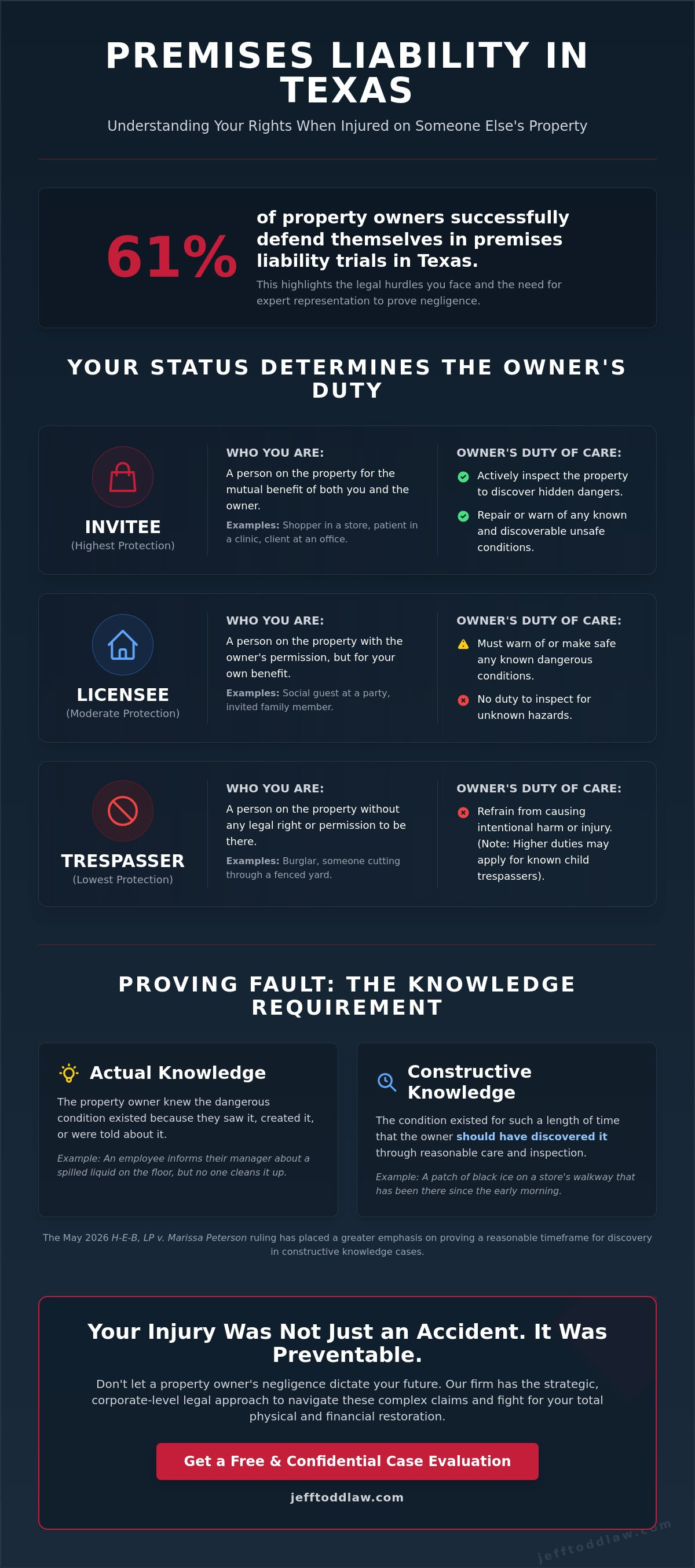
Did you know that property owners in Texas successfully defend themselves in 61% of premises liability trials? This statistic isn't meant to discourage you, but rather to highlight the sophisticated legal hurdles you face after a serious injury. When you're dealing with physical pain and mounting medical bills, the last thing you should have to worry about is whether a landlord or business owner will take responsibility for a preventable hazard. It's natural to feel anxious about confronting a powerful entity, especially when you're trying to decode complex terms like "invitee" or "constructive knowledge" while focusing on your own recovery.
You deserve a clear path toward restoration and the peace of mind that comes with understanding your legal standing. This guide provides a comprehensive look at your rights and the specific duties property owners owe you under current Texas law. We'll explore the critical impact of the May 2026 H-E-B, LP v. Marissa Peterson ruling on proving fault and outline the exact steps you can take to move your case forward. Whether you were a customer in a store or a guest on private property, knowing your status is the first step toward holding the right parties accountable.
Key Takeaways
- Learn how the legal concept of "duty of care" serves as the foundation for holding negligent property owners accountable for your injuries.
- Discover how your specific legal status as an invitee or licensee significantly impacts your rights under Texas premises liability law.
- Identify the rigorous evidence required to prove a property owner had "actual" or "constructive" knowledge of a hazard before your incident occurred.
- Understand the complexities of recovery in scenarios ranging from retail slip and falls to negligent security claims at apartment complexes.
- Gain insight into how the strategic, corporate-level legal approach at The Todd Law Group, PLLC can help you navigate the path toward total physical and financial restoration.
What is Premises Liability? Understanding the Duty of Care in Texas
When you step onto someone else's property, you shouldn't have to worry about hidden hazards. In the legal world, What is Premises Liability? refers to the specific set of rules that hold property owners and occupiers accountable for injuries that occur on their land. Texas law is clear. If you possess or control a property, you have a legal obligation to ensure it's reasonably safe for those who enter. This obligation is known as a "duty of care," and it serves as the cornerstone of Texas tort law. It's not just about who owns the deed. Often, property managers, commercial tenants, or maintenance companies are the ones legally responsible because they're the ones with the power to fix the problem.
Understanding premises liability requires distinguishing between an unfortunate accident and a preventable tragedy. Not every fall leads to a legal claim. A "dangerous condition" is a specific hazard that poses an unreasonable risk of harm, such as a rotted floorboard, a liquid spill left for hours, or a broken security gate in a high-crime area. If a property owner ignores these issues, their inaction moves from simple oversight into the territory of negligence.
The Core Elements of a Texas Premises Claim
Success in these cases depends on proving three specific factors. First, there must be a condition on the premises that posed an unreasonable risk of harm. Second, the owner or occupier must've had "actual" or "constructive" knowledge of that condition. This means they either knew about it or should've discovered it through a reasonable inspection. Finally, the owner must've failed to exercise reasonable care to reduce or eliminate the risk. This failure is what creates the legal bridge between your injury and their responsibility.
Why 'Negligence' is the Deciding Factor
Texas courts don't follow a "strict liability" standard for property injuries. Simply being hurt on someone's property doesn't mean they automatically owe you compensation. The deciding factor is always negligence. A "breach of duty" occurs when a property owner fails to act as a "reasonable person" would in the same situation. A reasonable store manager, for example, would ensure that a leaking refrigerator is cordoned off immediately. If they chose to leave it unmarked for an entire shift, they've breached their duty. Our goal is to demonstrate that your injury wasn't a stroke of bad luck, but a direct result of someone else's failure to maintain a safe environment.
The Three Classes of Visitors: How Your Status Determines Your Rights
Texas law does not apply a single, uniform standard of safety to every person on a property. Instead, your legal rights are dictated by your "status" at the moment of the injury. This traditional, status-based approach means the court first asks why you were on the premises before determining if the owner failed you. Your classification can mean the difference between a successful claim and a dismissed case. Because these distinctions are so rigid, it is vital to understand where you stand before pursuing a premises liability claim.
Your status isn't always permanent. It can shift based on your actions. If a customer wanders past a "Staff Only" sign into a warehouse area, they may legally transition from an invitee to a trespasser. This shift significantly reduces the property owner's legal obligations toward them. If you are unsure how your specific situation might be classified, discussing the details of your visit with a premises liability attorney can help clarify your standing.
Invitees: The Highest Level of Protection
Most commercial injury cases involve "invitees." These are individuals who enter a property for the mutual benefit of themselves and the owner, such as a shopper at a grocery store or a patient at a medical clinic. For invitees, Texas property owners owe the highest duty of care. They must not only warn of known dangers but also actively inspect the premises to discover hidden hazards. When courts look at Proving Fault: Actual vs. Constructive Knowledge, they hold commercial owners to a standard of what a "reasonable inspection" should have revealed.
Licensees and Trespassers: Lower Standards of Care
Licensees are typically social guests or people entering a property for their own convenience with the owner's permission. In these instances, the owner's duty is more limited. They are only required to warn you of dangerous conditions they actually know about. They generally have no legal obligation to inspect the property for unknown problems before you arrive.
Trespassers receive the least protection under the law. Generally, a property owner only owes a duty to refrain from causing intentional injury or acting with gross negligence. However, Texas provides a critical exception known as the "attractive nuisance" doctrine. This protects children who are drawn to a property by a dangerous, artificial condition, like an unsecured swimming pool or heavy machinery. Even if the child was technically trespassing, the owner can be held liable if they knew children were likely to be attracted to the hazard and failed to secure it.
Proving Fault: Actual vs. Constructive Knowledge in 2026
Proving fault in a Texas premises liability case often comes down to a single, pivotal question: Did the property owner have notice of the hazard? This "notice requirement" is frequently the most difficult hurdle for an injured person to overcome. Even if you suffered a life-altering injury, Texas courts require evidence that the owner had either actual or constructive knowledge of the dangerous condition. Understanding the Duty of Care in Texas involves recognizing that the law protects property owners from being held liable for hazards that appear and cause injury before the owner has a reasonable chance to fix them.
Actual knowledge is straightforward. It exists when evidence shows the owner or an employee was specifically told about the hazard or saw it personally. For example, if a store clerk walked past a spill and did nothing, they had actual knowledge. Constructive knowledge is more complex. Under the "Time-Notice Rule" reaffirmed by the Texas Supreme Court in the May 2026 case H-E-B, LP v. Marissa Peterson, you must prove the hazard existed long enough that a reasonable owner should have discovered it. If a hazard sat on a floor for thirty minutes, that might be enough time for constructive knowledge. If it appeared thirty seconds before you stepped on it, the law often favors the owner.
The Role of Evidence in Proving Knowledge
Security camera footage serves as one of the most powerful tools for establishing how long a hazard existed. We also look for "spontaneous statements" from employees, such as a worker saying, "I told them to fix that leak an hour ago," which can instantly establish actual knowledge. Maintenance logs are equally vital. If a business claims they inspect floors every hour but the logs show no entries for four hours, that gap provides a strong foundation for proving a failure to inspect the premises.
Common Defenses: Open and Obvious Hazards
Property owners often use the "Open and Obvious" defense, arguing that the risk was so clear that any reasonable person would've avoided it. Additionally, Texas follows a modified comparative fault rule under Chapter 33 of the Civil Practice and Remedies Code. If you're found to be 51% or more at fault for your injury, perhaps because you were distracted by your phone, you cannot recover any damages. Finally, the "Natural Accumulation" rule generally protects owners from liability for naturally occurring ice or water, unless their own actions made the condition more dangerous. Identifying these defenses early is a critical part of the strategy we use to protect your right to recovery.
Common Premises Liability Scenarios in Houston and Beyond
In a sprawling metropolitan area like Houston, the risks you face change depending on whether you're at a grocery store, an apartment complex, or an industrial site. Retail and restaurant hazards remain the most frequent source of premises liability claims. These often involve liquid spills, falling merchandise from high shelves, or poor lighting that masks a trip hazard. If you've suffered a moderate injury in one of these settings, settlement ranges in Texas typically fall between $25,000 and $100,000. Severe injuries can exceed $500,000 depending on the long-term impact on your quality of life.
With the rapid growth of the rental market in the local area, there is increased scrutiny on the safety obligations of property management companies. Negligent security is a critical area here. If an apartment complex or parking garage has a history of criminal activity but fails to maintain working gates or adequate lighting, they may be liable for assaults or robberies that occur on their property. This isn't just about the crime itself. It's about the owner's failure to provide the security that a reasonable person would expect. Similarly, swimming pool accidents often stem from a failure to secure gates or provide proper supervision, leading to tragic, preventable outcomes.
Workplace injuries on third-party property also fall under this umbrella. If you're a delivery driver or a contractor injured on a site you don't own, you may have a claim against the property owner separate from any workers' compensation benefits. This distinction is vital for ensuring you receive the full scope of support you need for your recovery.
Industrial and Oil Rig Hazards in Galveston
The Gulf Coast economy relies heavily on the maritime and energy sectors. If you work in these fields, you need to understand the difference between employer negligence and the liability of the platform or property owner. For those seeking clarity on these environments, an oil rig injury lawyer Houston can help determine if a defective condition on the rig itself caused your accident. Safety standards for offshore and industrial environments are incredibly strict. Any deviation can constitute a breach of duty.
Slip and Fall Incidents in Public Spaces
Retail environments present unique challenges for slip and fall lawyers because of the high volume of foot traffic. Whether it's uneven pavement in a parking lot or the 'crumbling curbs' often found in older shopping centers, physical evidence disappears quickly. You should document the scene immediately with photos of the hazard and any surrounding signage. This documentation is often the only way to counter the 61% success rate defense teams enjoy in Texas trials. If you're struggling with medical bills after a fall, reach out to us to begin your journey toward total restoration.
Starting Your Road to Recovery: The Todd Law Group, PLLC Approach
Pursuing a legal claim after a serious injury is about more than just a financial transaction. It's a vital step toward your total restoration. When you're recovering from the physical and emotional trauma of an accident, the weight of medical bills and legal terminology shouldn't hinder your progress. At The Todd Law Group, PLLC, we view our role as a stable partner in your healing process. By taking the legal burden off your shoulders, we allow you to focus entirely on your medical treatment and well-being. Legal representation shouldn't feel like an added stress; it should feel like a dedicated commitment to getting your life back on track.
Jeff Todd brings the intellectual rigor of an elite corporate legal background to every case he handles. Having transitioned from high-stakes corporate environments in major metropolitan hubs to personal advocacy in Houston, he understands the specific strategies insurance companies use to minimize your suffering. This experience provides a sophisticated advantage during negotiations and formal proceedings. We don't just process claims. We build premises liability cases with the meticulous attention to detail required to challenge powerful property owners and their insurers. This persona of a seasoned, battle-tested professional ensures that your case is handled with both speed and intellectual depth.
Financial anxiety shouldn't prevent you from seeking justice. The Todd Law Group, PLLC operates on a contingency model, which means there's no fee unless we win your case. This approach reduces the barrier to high-quality legal representation and ensures our interests are perfectly aligned with your success. You can move forward with quiet confidence, knowing you have a versatile specialist who is personally invested in your local community and your individual recovery. We handle the complexities of the law so you can handle the complexities of healing.
How We Investigate Your Claim
Our team moves quickly to identify the problem and secure the solution. We dispatch experienced investigators to gather physical evidence and witness statements before they disappear or are altered by the property owner. We also consult with forensic safety experts to determine if the owner breached specific industry standards or building codes. By analyzing your medical records in depth, we prove the full extent of the physical and emotional impact the injury has had on your life, ensuring no detail of your suffering is overlooked during the litigation process.
Your Next Steps After an Injury
You should seek professional medical attention immediately to document the full extent of your injuries and establish a clear timeline for your recovery. It's also vital that you don't give a recorded statement to the property owner's insurance company. These statements are often designed to trap you into admissions that undermine your claim later. If you're ready to take the next step toward healing, contact The Todd Law Group, PLLC for a personalized case evaluation.
Protecting Your Rights and Your Future
Understanding the nuances of Texas premises liability is the first step toward reclaiming your life after a serious injury. Your legal standing and the duty owed to you depend heavily on your status as a visitor and the specific notice the owner had of the hazard. While proving these elements is a complex hurdle, it's a necessary part of ensuring that those responsible for your safety are held accountable. You deserve a legal partner who understands the intellectual rigor required to challenge sophisticated defense teams and insurance providers.
Attorney Jeff Todd has been licensed in Texas since 1994. He brings a unique background in elite corporate advocacy to personal injury cases, providing a strategic advantage for individuals in distress. We operate on a contingency basis, which means you'll face no fees unless we win your case. This structure allows you to prioritize your physical and emotional healing while we manage the heavy lifting of your legal claim with meticulous attention to detail.
Start Your Road to Recovery with a Free Case Evaluation
You don't have to navigate this journey alone. We're here to serve as your stable partner and advocate for the total restoration you deserve.
Frequently Asked Questions
What is the statute of limitations for premises liability in Texas?
You generally have two years from the date of your injury to file a formal lawsuit in a Texas court. However, if your claim is against a government entity, you must provide a formal notice of the incident within six months. Failing to meet these strict deadlines will likely result in the permanent loss of your right to seek compensation for your injuries.
Can I still sue if there was a 'Wet Floor' sign present?
You may still have a valid claim depending on whether the warning was legally adequate and visible. A "Wet Floor" sign is intended to fulfill the owner's duty to warn, but if it was placed poorly or didn't cover the specific area of the hazard, it might not protect the owner from liability. We examine the specific placement and timing of the warning to determine if the owner remained negligent.
What happens if I was partially at fault for my own fall?
Texas follows a "modified comparative fault" rule, meaning you can still recover damages if you were 50% or less at fault. Your total compensation will be reduced by your percentage of responsibility for the incident. If a court determines you were 51% or more responsible, perhaps due to significant distraction, you're barred from recovering any damages at all under the Texas Civil Practice and Remedies Code.
Are landlords responsible for criminal acts committed against tenants?
Landlords can be held responsible under a negligent security claim if the criminal act was foreseeable and they failed to provide reasonable safety measures. This often requires proving a history of similar crimes on or near the premises. If a landlord ignored broken locks, unlit parking lots, or faulty gates, they may be liable for the resulting physical and emotional trauma you experienced.
What kind of compensation can I recover in a premises liability case?
You can recover economic damages like medical bills and lost wages, as well as non-economic damages for pain and suffering. While Texas doesn't cap compensatory damages in most premises liability cases, there are specific limits on punitive damages. These "exemplary damages" are generally capped at the greater of $200,000 or twice the amount of your economic damages plus an amount equal to non-economic damages up to $750,000.
Do I have a case if I was injured at a friend's house?
You may have a case, but social guests are classified as "licensees," which carries a lower standard of care than a business customer. The homeowner is only liable if they failed to warn you about a dangerous condition they actually knew existed. Unlike a commercial business, a friend or neighbor generally isn't required to inspect their property for hidden hazards before you arrive.
What is 'Chapter 95' and how does it affect my claim as a contractor?
Chapter 95 is a specific section of Texas law that provides significant protections to property owners when contractors are injured on site. To overcome this defense, you must prove the owner exercised control over the manner of your work and had actual knowledge of the hazard. This statute makes contractor claims particularly complex, requiring a sophisticated legal strategy to establish the owner's responsibility for the environment.
How long does it typically take to settle a premises liability claim in Houston?
The timeline for settling a claim varies based on the complexity of the evidence and the duration of your medical recovery. It's vital to wait until you've reached maximum medical improvement so that your total future costs are fully understood before negotiations begin. We focus on moving the premises liability process forward with momentum while ensuring every detail of your restoration is documented and addressed.


