
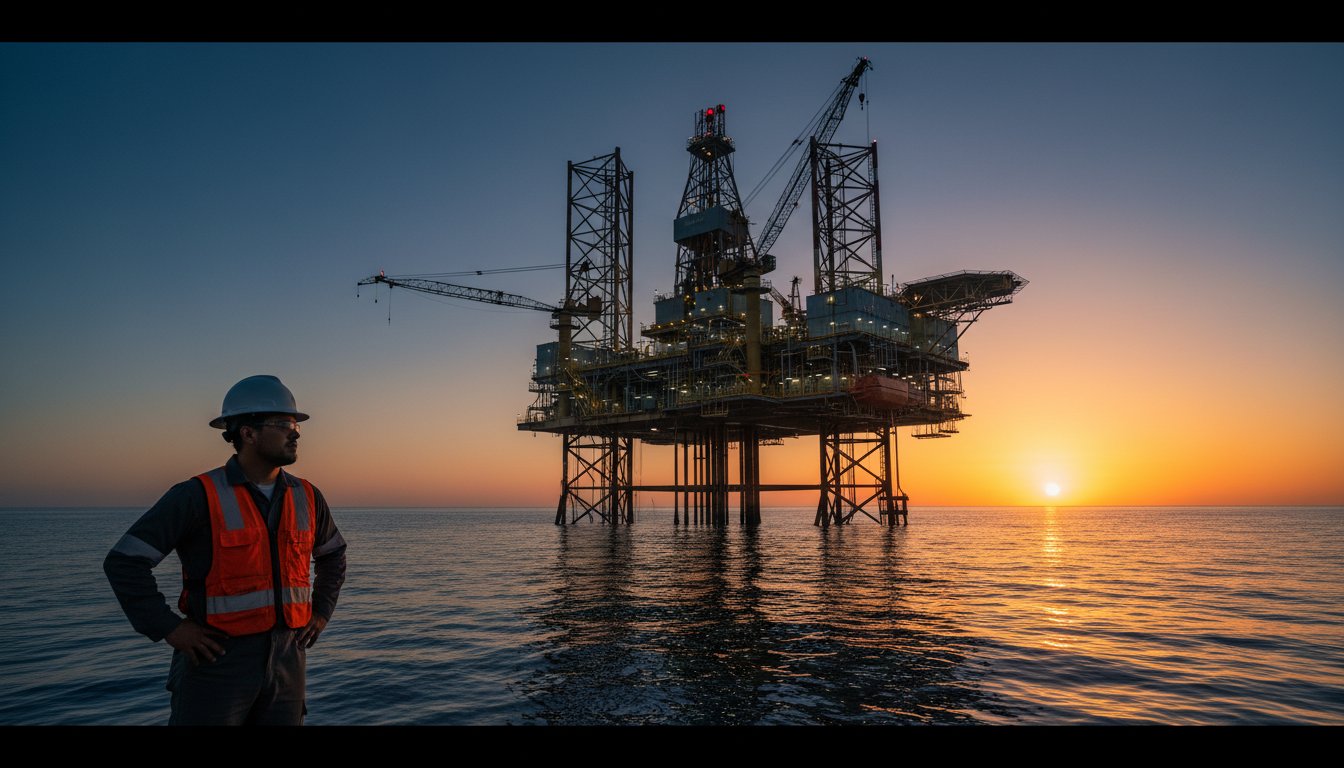
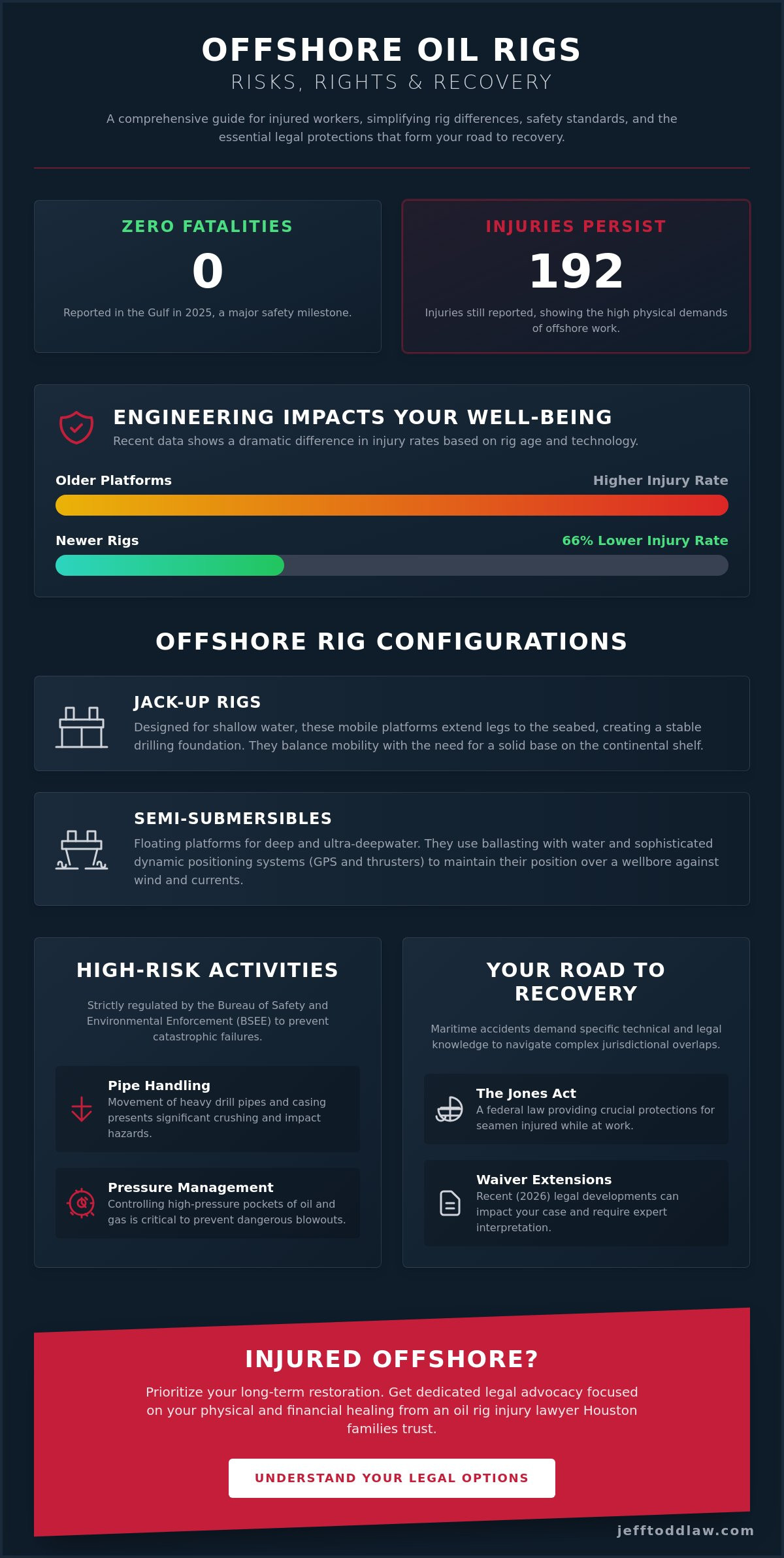
Did you know that while fatalities in the Gulf reached zero in 2025, the Bureau of Safety and Environmental Enforcement still reported 192 injuries across offshore platforms? It's a sobering reminder that even as technology advances, the physical demands of the energy industry remain high. If you or a loved one has been hurt while working offshore, speaking with an oil rig injury lawyer Houston families rely on can help you understand your options for physical and financial restoration. You likely feel that the complex web of industry jargon and evolving safety regulations is designed to keep workers in the dark, especially when accidents happen.
We agree that every worker deserves a clear understanding of the environment they're stepping into. This comprehensive guide simplifies the differences between Jack-ups and Semi-submersibles, explains the rig hierarchy, and details the latest 2026 safety standards. Recent data shows that injury rates on newer rigs are 66 percent lower than on older platforms, highlighting how engineering impacts your well-being. You'll gain a thorough overview of modern drilling operations and the essential legal protections, including the Jones Act and recent 2026 waiver extensions, that form your road to recovery after an incident.
Key Takeaways
- Distinguish between the drilling and production phases to better understand the specific mechanical risks and environmental challenges present on various industrial structures.
- Navigate the offshore personnel hierarchy and "hitch" work schedules to identify who holds ultimate authority over safety standards during your time at sea.
- Identify high-risk activities like pipe handling and pressure management that are strictly regulated by the Bureau of Safety and Environmental Enforcement to prevent catastrophic failures.
- Learn why maritime accidents demand the specific technical knowledge of an oil rig injury lawyer Houston families turn to when navigating complex jurisdictional overlaps.
- Explore how the "road to recovery" approach prioritizes your long-term restoration by combining dedicated legal advocacy with a focus on your physical and financial healing.
What is an Oil Rig? Understanding the Mechanics of Energy Extraction
An oil rig is much more than just a piece of machinery. It's a massive, self-contained industrial city designed to withstand the harshest environments on earth. At its core, an Oil platform is a complex engineering feat built to reach energy reservoirs trapped thousands of feet beneath the surface. These structures are essential for global energy production, but they also represent some of the most dangerous workplaces in existence. If you've been hurt on one of these sites, consulting an oil rig injury lawyer Houston trusts is a vital first step in protecting your rights. Each rig is a precision tool designed to tap into high-pressure pockets of oil and gas while keeping the workforce and the environment safe.
It's vital to distinguish between the two primary functions of these rigs. The exploration phase involves mobile units that drill temporary wells to locate oil or gas. Once a viable source is found, the extraction phase begins. This is where production rigs take over, focusing on the long-term removal and processing of resources. In the Gulf of Mexico, these structures can house hundreds of workers at a time. They provide living quarters, medical facilities, and helipads to support 24/7 operations. The sheer scale of these operations means that any mechanical failure can have devastating consequences for everyone on board.
Onshore vs. Offshore Rigs
Onshore rigs are typically modular and designed for mobility. In Texas shale plays, these units move from site to site on trucks. Offshore rigs are far more permanent or massive in scale. They are either fixed to the seabed or utilize sophisticated floating technology to remain stable in deep water. Logistically, offshore life is much more isolated. Waste management and transport rely on a constant rotation of supply boats and helicopters. Because of these unique risks, working with an oil rig injury lawyer Houston workers rely on is essential if an accident occurs in federal waters where maritime laws apply.
The Life Cycle of an Oil Well
The journey of a well begins with exploration, where seismic data helps geologists find potential pockets. Next comes drilling, where a wellbore is bored and lined with steel casing to prevent collapse. The final stage is completion. This involves installing the equipment needed to control the flow of oil and gas for years to come. Each of these stages presents unique hazards, from high-pressure blowouts to heavy machinery failures. Understanding these phases helps clarify who is responsible when safety protocols are ignored.
Comparing Platforms Offshore: A Guide to Rig Configurations
Choosing the right rig configuration isn't just about efficiency; it's a critical safety decision based on the specific conditions of the Gulf. Engineers categorize these structures by their water depth capabilities. Shallow water rigs generally operate on the continental shelf, while Deepwater and Ultra-Deepwater units push into depths exceeding 5,000 feet. Each environment requires a different approach to stationkeeping, which is the method used to keep the rig precisely over the wellbore. While shallow rigs might use heavy anchors, deepwater vessels often rely on dynamic positioning. This technology uses computer-controlled thrusters and GPS to maintain coordinates against wind and current. If a failure in these complex systems causes a workplace accident, an oil rig injury lawyer Houston families trust can help determine if equipment maintenance or operator error played a role.
Environmental ratings are another vital factor. In the hurricane-prone waters off the Texas coast, rigs must be rated for extreme wind and wave heights. There's always a trade-off between mobility and stability. A rig that's easy to move might be less stable in a storm, while a highly stable platform may take weeks to relocate. All these designs must strictly follow OSHA standards for oil and gas extraction to ensure the structural integrity of the workspace. When companies prioritize speed over these stability trade-offs, the results can be catastrophic for the crew on board.
Fixed Platforms and Jack-Up Rigs
Fixed platforms are the workhorses of shallow water. They feature steel or concrete legs anchored directly to the seabed. These are permanent structures intended for decades of production. In contrast, Jack-Up rigs are mobile. They're towed to a site with their legs up. Once in position, the legs are lowered to the seafloor, and the hull is jacked up above the waves. These are common in the shelf areas of the Texas coast because they provide a stable, bottom-supported work surface for drilling. However, the jacking process itself is a high-risk operation that requires precise coordination.
Floating Rigs: Semi-Submersibles and Drillships
As the industry moves into deeper water, floating rigs become necessary. Semi-submersibles float on submerged pontoons. This design offers incredible stability in rough seas because the bulk of the structure is below the wave action. Drillships are essentially high-tech vessels with a drilling derrick in the center. They offer the highest mobility and are the primary choice for ultra-deepwater exploration. You might also encounter FPSO units, which act as floating factories that process and store oil until it can be offloaded. If you've suffered an injury on any of these complex vessels, finding a dedicated partner for your legal journey is essential for your road to recovery. An oil rig injury lawyer Houston workers rely on understands the specific mechanical failures unique to these floating environments.
Common Oil Rig Occupations and the Personnel Hierarchy
Life on a rig is defined by the "hitch." Most crews work 14 days on followed by 14 days off, or 21-day rotations. During these weeks, the rig is their entire world. It's a 24/7 operation where the sun never sets on productivity. This constant motion requires a rigid hierarchy to prevent accidents. At the top sits the Offshore Installation Manager (OIM). They hold ultimate authority over everything from drilling operations to emergency evacuations. The living quarters culture is intense, with workers sharing tight spaces and eating together between long shifts. This environment fosters a unique brotherhood, but it also means that fatigue is a constant shadow. If a supervisor ignores signs of exhaustion and an accident occurs, the legal implications are significant.
Understanding this hierarchy is vital if you've suffered a workplace injury. Often, the rig is owned by a drilling contractor but operated for a major oil company. This multi-employer environment can make it difficult to determine who is at fault after an accident. Is the contractor responsible for a mechanical failure, or did the oil company's representative push for unsafe speeds? An oil rig injury lawyer Houston families rely on knows how to pierce through these layers of corporate responsibility. They ensure that every negligent party is held accountable for your road to recovery. We prioritize your physical and financial restoration by investigating the specific breakdown in the chain of command.
Entry-Level and Labor Roles
Roustabouts are the backbone of the deck, handling general maintenance, cleaning, and essential labor. Floorhands, often called "roughnecks," perform the grueling physical labor on the drill floor during active operations. Above them, Derrickmen work high on the derrick platform, managing the drill string with incredible precision. These roles must strictly follow OSHA safety standards to mitigate the risks of falls, pipe strikes, and crush injuries. Each person must work in perfect sync to maintain a safe environment. When one person fails to follow protocol, the entire crew is put at risk.
Technical and Supervisory Roles
The Driller is the lead operator responsible for the complex drilling machinery and the safety of the floor crew. Above them, the Toolpusher oversees the entire drilling crew and ensures equipment maintenance is up to date. Finally, the "Company Man" is the on-site representative for the oil company, making the final calls on production goals. When communication breaks down between these roles, or when production goals are prioritized over human safety, catastrophic injuries often follow. If you've been caught in the middle of a supervisor's mistake or a contractor's negligence, an oil rig injury lawyer Houston workers trust can provide the steady reassurance you need. We help you navigate the complex jurisdictions of maritime and state law to secure the compensation you deserve.
Safety Standards and Hazards: Protecting Workers on the Rig
Offshore safety is a matter of life and death. High-risk activities like heavy lifting, pipe handling, and high-pressure management are daily realities for crews. In the federal waters of the Gulf, the Bureau of Safety and Environmental Enforcement (BSEE) serves as the primary regulatory body. Their data provides a clear picture of the risks involved. For the 2024 calendar year, BSEE reported 223 injuries and one fatality. As of May 2026, the agency has already documented 192 injuries for the 2025 calendar year. If you've been caught in these statistics, an oil rig injury lawyer Houston workers trust can provide the legal weight needed to hold negligent companies accountable. Every worker on a rig possesses "Stop Work Authority." This is the absolute right to halt any operation that appears dangerous without fear of retaliation. While BSEE monitors the ocean, the Texas Railroad Commission provides the safety oversight for onshore drilling operations across the state.
Safety is a shared responsibility, but the ultimate burden lies with the companies that own and operate these massive structures. When they prioritize production speed over worker well-being, the "road to recovery" becomes a necessary path for the injured. If you've suffered because of a safety breach, contact our dedicated legal team to start your physical and financial restoration. We understand the complex interplay between federal oversight and the daily hazards you face on the deck.
Common Causes of Rig Accidents
Equipment failure remains a top concern for offshore crews. Blowouts and mechanical malfunctions of the drill string can lead to catastrophic events in seconds. Human error also plays a significant role. Long hitches and high-pressure environments often lead to fatigue-related mistakes. In February 2026, BSEE proposed new revisions to the Blowout Preventer Systems and Well Control Rule to address these ongoing equipment risks. Environmental hazards like gas leaks, fires, and the unpredictable weather of the Gulf add another layer of danger to an already volatile workspace.
Safety Protocols and Essential PPE
Rigorous safety protocols are the only thing standing between a routine shift and a disaster. Personal Protective Equipment (PPE) is mandatory. This includes fire-resistant clothing (FRC), impact-rated gloves, and steel-toed boots. Crews must participate in "Toolbox Talks" before every shift to discuss specific hazards and conduct regular emergency drills to keep their skills sharp. A Blowout Preventer (BOP) is the critical failsafe designed to seal the well and manage extreme pressure. When these failsafes or protocols are ignored, an oil rig injury lawyer Houston families rely on can help investigate the breakdown in safety management.
Legal Protections and the Road to Recovery for Injured Workers
Rig injuries represent a life-altering crisis that demands a specialized understanding of both maritime and state law. These cases are significantly more complex than those handled by land-based slip and fall lawyers. When a worker is hurt offshore, the jurisdictional overlaps between federal and state waters can be dizzying. The Todd Law Group, PLLC serves as a stable partner for your road to recovery. We prioritize your physical and financial restoration through a dedicated and committed persona that avoids aggressive tropes. Our firm operates on a contingency model; you don't pay any legal fees unless we win your case. This commitment allows Texas families to focus on healing while an oil rig injury lawyer Houston workers trust handles the heavy lifting of the legal process.
The Jones Act vs. Texas Workers' Comp
The legal path you take depends entirely on the type of rig and its location. The Jones Act provides federal protection for those classified as "seamen" on mobile units like jack-ups or drillships. This act allows you to seek damages for employer negligence or an unseaworthy vessel. If your accident occurred on a fixed platform, your claim likely falls under the Longshore and Harbor Workers’ Compensation Act (LHWCA). Workers on land-based rigs in the Permian or Eagle Ford basins fall under Texas state personal injury law. Each of these paths requires an oil rig injury lawyer Houston relies on to manage the sophisticated details of jurisdictions and reinsurance. We use our corporate background to ensure every negligent party is held accountable.
Immediate Steps After a Rig Injury
Reporting the incident immediately is the foundation of your future claim. You must document the conditions, the equipment involved, and any witnesses to the event. Don't rely on company-provided doctors for your primary care. These medical professionals often have a conflict of interest, as their goal may be to minimize the employer's liability. Seeking independent medical care ensures your injuries are documented accurately for your road to recovery. To protect your rights and explore your options, Contact The Todd Law Group, PLLC for a confidential consultation. We provide the steady reassurance and intellectual rigor needed to move your case forward with speed and meticulous attention to detail.
Securing Your Future After an Offshore Accident
Understanding the mechanical complexity of an oil rig and the strict hierarchy of its crew is the first step in recognizing when safety has been compromised. Whether you're navigating the differences between a fixed platform and a drillship or deciphering 2026 BSEE regulations, knowledge is your strongest asset. If a failure in these systems has led to a serious injury, you don't have to face the legal aftermath alone. An oil rig injury lawyer Houston workers have trusted for decades can help bridge the gap between an accident and your long-term physical restoration.
Jeff Todd has been licensed to practice in Texas since 1994, bringing a career of sophisticated advocacy to every case. With dedicated offices in Houston, Austin, and Galveston, we are personally invested in our local communities. We operate on a contingency basis, so there are no legal fees unless we win your case. Injured on a rig? Start your Road to Recovery with Jeff Todd today. You've worked hard to power the world. Now, let us work hard to protect your future and ensure your recovery is handled with the meticulous attention to detail you deserve.
Common Questions Regarding Offshore Safety and Legal Rights
Is an oil rig a dangerous place to work?
Yes, an oil rig remains one of the most high-risk industrial environments in the world. According to the Bureau of Safety and Environmental Enforcement (BSEE), there were 223 injuries in 2024 and 192 reported for the 2025 calendar year as of May 2026. Hazards include heavy machinery, high-pressure systems, and extreme weather conditions. If you've suffered a workplace injury, an oil rig injury lawyer Houston families trust can help you navigate the road to recovery.
What is the difference between an oil rig and an oil platform?
The primary difference lies in the phase of energy extraction and the mobility of the structure. An oil rig is typically a mobile unit used for the exploration and drilling of new wells. An oil platform is a more permanent structure designed for the long-term production and processing of oil and gas. While the terms are often used interchangeably, their mechanical functions and the specific safety regulations governing them can vary significantly.
How deep can an offshore oil rig drill?
Modern ultra-deepwater rigs are capable of drilling in water depths exceeding 5,000 feet. Once the drill bit reaches the seafloor, it can bore several miles into the earth's crust to reach energy reservoirs. These extreme depths require sophisticated dynamic positioning systems and blowout preventers to maintain stability. Operating at such depths increases the technical complexity and the potential for catastrophic equipment failure if maintenance is neglected.
Do oil rig workers live on the rig during their hitch?
Yes, workers live in self-contained living quarters on the rig for the entire duration of their hitch. These facilities include dormitories, cafeterias, and recreational areas to support 24/7 operations. This isolated environment means that medical care is often limited to on-site medics until a helicopter transport can be arranged. It's vital to seek an independent medical evaluation as soon as you return to shore to document any injuries.
What happens if I am injured on an oil rig in the Gulf of Mexico?
If you're injured in the Gulf of Mexico, your first priority is to report the incident and seek immediate medical attention. The legal jurisdiction of your claim depends on whether the accident occurred in state or federal waters. Because these cases often involve complex maritime statutes, consulting an oil rig injury lawyer Houston families rely on is essential. They will ensure your rights are protected under the appropriate legal framework for your specific location.
Can I sue my employer for an oil rig accident under the Jones Act?
You can sue your employer under the Jones Act if you qualify as a "seaman" on a mobile vessel. This federal law allows maritime workers to seek compensation for injuries caused by employer negligence or the unseaworthiness of the rig. Unlike standard workers' compensation, the Jones Act provides a path to recover damages for pain, suffering, and lost future earning capacity. It's a vital protection for those working on mobile offshore units.
What are the most common oil rig occupations for beginners?
Roustabouts and stewards are the most common entry-level positions for those new to the offshore industry. Roustabouts handle general maintenance and deck labor, while stewards manage the living quarters and galley. These roles provide essential experience with rig safety protocols before moving into more technical positions like floorhands. Even in entry-level roles, the risk of injury from heavy lifting or equipment strikes remains high, requiring constant vigilance.
How long do oil rig hitches typically last in Texas?
Oil rig hitches in Texas typically follow a 14/14 or 21/21 schedule. This means you work for 14 or 21 consecutive days followed by an equal amount of time off at home. These long shifts often lead to extreme fatigue, which is a primary contributor to human error and workplace accidents. Understanding the "hitch" system is key to recognizing how exhaustion might have played a role in an injury during a high-pressure operation.


