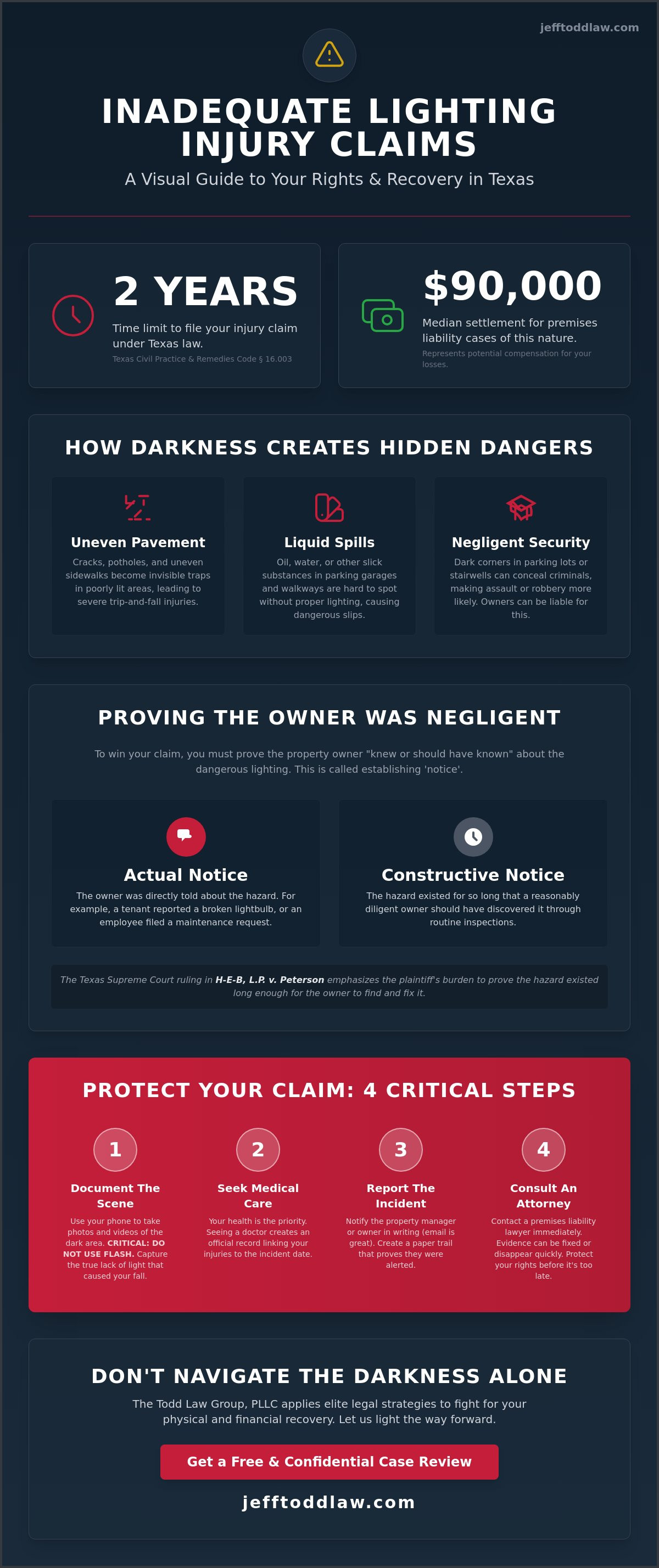
A single burnt-out lightbulb in a Houston parking lot isn't just a maintenance oversight; it's a dangerous safety violation that can change your life in seconds. If you've suffered a fall or an injury due to darkness, you're likely wondering if you can actually hold a property owner liable for your mounting medical expenses. The answer is yes, but the window for action is narrow. Under Texas Civil Practice and Remedies Code § 16.003, you have exactly two years from the date of the incident to file your inadequate lighting injury claim Texas before your right to compensation expires.
We understand the anxiety of watching bills pile up while worrying that a landlord will quietly fix the hazard before it's documented. You deserve a stable partner to help navigate the complexities of premises liability and keep your road to recovery on track. This guide will show you exactly how to prove negligence and secure the compensation you need for your physical and financial restoration. We'll examine the April 10, 2026, Texas Supreme Court ruling in H-E-B, L.P. v. Peterson, explain why the median settlement for these cases is approximately $90,000, and detail the specific steps to take to protect your rights before evidence disappears.
Key Takeaways
- Understand how inadequate lighting creates hidden traps on Houston properties by masking common hazards like uneven pavement or liquid spills.
- Learn the legal requirements for a successful inadequate lighting injury claim Texas, including how to prove the owner had "actual notice" of the danger.
- Discover the critical steps for documenting dark scenes without camera flash to preserve evidence before a landlord can correct the defect.
- Gain a clear roadmap for filing insurance claims and drafting demand letters that reflect the true value of your physical and financial losses.
- See how applying elite corporate legal strategies to personal injury cases helps you navigate the road to recovery with confidence.
The Hazards of Inadequate Lighting in Houston Properties
Inadequate lighting is more than a minor inconvenience. In a legal context, it's defined as a property owner's failure to provide the visibility necessary for visitors to navigate a space safely. When you're walking through a commercial property, you rely on light to reveal potential dangers. If that light is missing, the property owner may have breached their duty of care. This concept is the foundation of Premises liability, which holds owners accountable for injuries occurring on their land due to negligence.
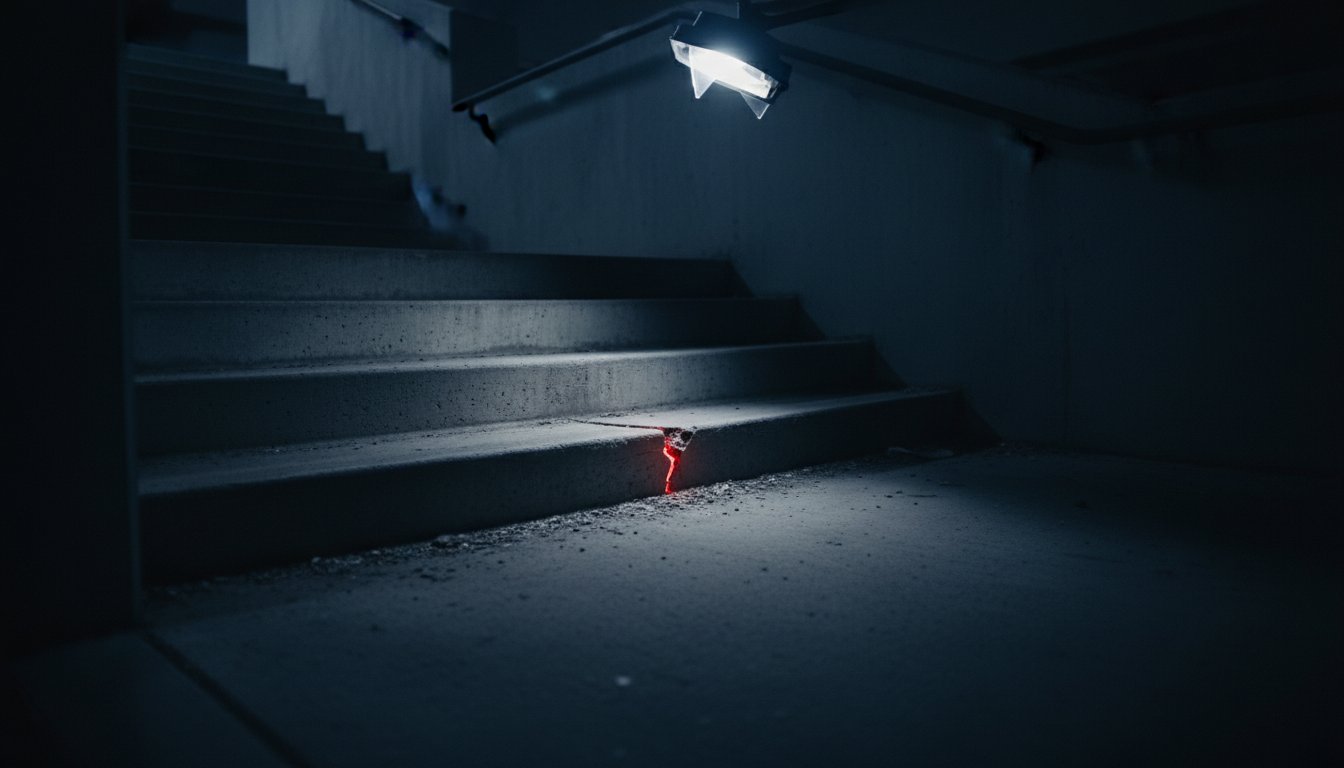
In Houston, poor lighting often masks specific environmental hazards. Our region's shifting clay soil frequently causes sidewalks and walkways to crack or become uneven. During the day, these are easy to spot. At night, without proper illumination, they become "invisible" traps. Similarly, the high humidity in our parking garages can cause automotive oils to pool and remain slick for long periods. If you can't see the shimmer of oil on the concrete, a slip is almost inevitable. Identifying these hazards is the first milestone on your road to recovery, as it allows us to pinpoint exactly where the owner failed you.
It's vital to distinguish between "aesthetic" and "safety" lighting. A restaurant in Montrose might use dim, atmospheric lighting to set a mood, but that doesn't excuse a pitch-black exit corridor or a dark bathroom entryway. Safety lighting must remain functional regardless of the building's style. If you've been hurt, filing an inadequate lighting injury claim Texas requires showing that the lack of light was the direct cause of your accident.
Common Houston Locations for Lighting Accidents
Certain areas in our city are prone to these incidents due to high foot traffic and aging infrastructure. We frequently see accidents in:
- Apartment complex stairwells: High-density residential zones like the Galleria or Midtown often suffer from neglected maintenance, leaving residents to climb stairs in total darkness.
- Parking garages: Large structures near the Theater District or major sporting venues like Minute Maid Park often have "dead zones" where bulbs haven't been replaced in months.
- Storefronts and strip malls: Smaller retail centers often defer maintenance to save on costs, creating dangerous conditions for evening shoppers.
Beyond Falls: Lighting and Negligent Security
The dangers of darkness extend beyond physical trips and falls. Poorly lit areas are magnets for criminal activity, including robbery and assault. Under Texas law, property owners have a duty to provide enough light to deter foreseeable crime. If a business knows their parking lot is in a high-crime area but refuses to fix the lights, they may be liable for any resulting harm. A "broken bulb" is rarely a valid excuse. Following the April 10, 2026, Texas Supreme Court ruling, the burden is on the plaintiff to show the hazard existed long enough for a reasonable owner to find it. This makes immediate documentation essential for a successful inadequate lighting injury claim Texas.
Proving Liability: The 'Knew or Should Have Known' Standard in Texas
To succeed with an inadequate lighting injury claim Texas, you must do more than prove you fell. You have to demonstrate that the property owner failed to meet the legal standards set forth in the Texas Civil Practice and Remedies Code Chapter 75. This statute requires owners to maintain reasonably safe premises for those they invite onto their land. Proving a breach of this duty hinges on the concept of "notice." You must show that the owner either had actual notice or constructive notice of the dangerous condition.
Actual notice is straightforward. It occurs when a tenant, employee, or customer has already reported a flickering or broken bulb to the management. Constructive notice is more complex. It requires proving that the light was out for such a duration that a diligent owner should have discovered it through routine inspections. While OSHA's lighting standards provide clear, measurable benchmarks for safety in industrial settings, Texas courts apply a "reasonableness" test to commercial properties. The April 10, 2026, Supreme Court decision in H-E-B, L.P. v. Peterson reinforces this burden. The ruling clarifies that plaintiffs must provide evidence of the hazard's duration. If you can't prove how long the area was dark, the court may rule the owner didn't have a reasonable opportunity to fix it. If you're unsure how to gather this evidence, consulting with an experienced advocate can help you secure the necessary documentation for your road to recovery.
The Invitee vs. Licensee Distinction
Your legal status on the property dictates the level of care you're owed. Most victims in these cases are "Invitees." These are customers at a grocery store or guests at a Houston hotel. Owners owe Invitees the highest duty of care, including a duty to inspect for hidden dangers. "Licensees," such as social guests, are owed a lower standard. In those cases, you must prove the owner actually knew about the dark stairwell or broken fixture but failed to warn you. Understanding your status is a vital component of a successful inadequate lighting injury claim Texas.
Identifying the Responsible Parties
In the complex Houston real estate market, the building owner isn't always the only liable party. Many commercial leases in areas like the Energy Corridor or Downtown shift maintenance duties to property management companies. Additionally, third-party contractors may be responsible for the lighting grids in parking structures. If your injury occurred on a public sidewalk or in a city park, government entities might be involved. Each of these parties has different insurance limits and filing requirements, making it essential to identify every negligent actor early in the process.
Documenting the Scene: Evidence Needed for a Houston Lighting Claim
The moments immediately following an accident are critical for your road to recovery. In Houston, property owners and management companies often move with surprising speed to replace a burnt-out bulb or repair a flickering fixture once an injury occurs. While this makes the property safer for others, it can effectively destroy the primary evidence needed for your inadequate lighting injury claim Texas. You must act quickly to document the conditions exactly as they were when you fell.
Establishing the level of darkness is the cornerstone of your case. While Texas courts look at "reasonableness," we often use OSHA lighting requirements as a professional benchmark to prove that a space was objectively unsafe. Beyond photos, you should also seek official documentation. If the injury was severe, call for assistance. A report from the Houston Police Department or the Harris County Sheriff’s Office provides a third-party account of the scene. Additionally, visit a Houston emergency room or urgent care facility immediately. Medical records created on the same night as the accident serve as an essential link, proving that the darkness caused the specific trauma you suffered.
Effective Low-Light Photography Tips
Capturing darkness on a smartphone is challenging because modern cameras automatically "brighten" the image. To build a strong case, take photos both with and without your flash. A flash might reveal the hazard, like a hidden curb, but a non-flash photo shows the "true" lack of visibility you faced. If a light was flickering or buzzing, use your phone to record a video. Always include nearby landmarks in your shots, such as a street sign or a recognizable storefront in the Heights or Downtown, to verify the exact location of the incident.
Witness Statements and Maintenance Records
Don't overlook the people around you. Other shoppers or residents in an apartment complex may have complained about the same dark stairwell for weeks. Collecting their contact information is vital for proving the property owner had constructive notice. Once you involve a dedicated legal partner, we can issue "spoliation letters." These are formal legal notices that demand the property owner preserve surveillance footage and maintenance logs. These logs often reveal a pattern of neglect, showing that the owner ignored lighting issues to save on utility or labor costs, which is a powerful piece of evidence in an inadequate lighting injury claim Texas.
How to File Your Inadequate Lighting Injury Claim in Texas
Filing an inadequate lighting injury claim Texas begins with a formal notification to the property owner's insurance carrier. This is not merely a phone call; it's the commencement of a structured legal process that requires meticulous attention to detail. You must be mindful of the strict timeline imposed by the state. Under Texas Civil Practice and Remedies Code § 16.003, you have exactly two years from the date of your injury to file a lawsuit. If you miss this deadline, the court will likely dismiss your case, regardless of how clear the property owner's negligence was.
Once your legal team has gathered the necessary evidence, the next step is drafting a demand letter. This document serves as a professional presentation of your case, outlining the facts of the accident, the evidence of poor illumination, and the total damages you've suffered. In Houston, a "fair value" for your claim depends on the severity of your injuries and the clarity of the owner's negligence. While the median settlement for premises liability cases is approximately $90,000, every situation is unique. Our firm's approach is to guide you through the entire road to recovery, providing steady reassurance from the initial consultation to the final settlement check.
Calculating the Value of Your Claim
Your claim is divided into economic and non-economic damages. Economic damages cover tangible, verifiable losses like hospital bills, physical therapy sessions at Houston medical centers, and lost wages if you're unable to work during your recovery. Noneconomic damages are subjective losses that reflect the victim's diminished quality of life. This includes pain, suffering, and the emotional distress that follows a traumatic event. Our intellectual rigor ensures that every dollar of your financial and physical restoration is accounted for in the final demand.
Navigating Insurance Company Tactics
Insurance adjusters often use calculated tactics to devalue an inadequate lighting injury claim Texas. They might suggest you should've used a smartphone flashlight or claim you weren't watching your path closely enough. These arguments are designed to exploit Texas’s "proportionate responsibility" rule. If an adjuster can shift 51% or more of the fault onto you, you're barred from recovering any damages under the 51% bar rule. You should never provide a recorded statement to an insurance representative without your lawyer present. They often look for specific phrasing that can be used to suggest you were distracted at the time of the fall. If you've been pressured by an adjuster, contact us immediately for a professional evaluation of your case to protect your interests.
Choosing a Houston Premises Liability Lawyer: The Todd Law Group, PLLC Advantage
Selecting the right legal representation is the most critical decision you'll make after a fall caused by darkness. You need more than just a lawyer; you need a stable partner who understands the intellectual rigor required to dismantle a property owner's defense. Jeff Todd brings a unique perspective to every inadequate lighting injury claim Texas. Having transitioned from high-stakes corporate environments in Washington, D.C., to personal advocacy in the heart of Houston, he applies the same level of meticulous detail once used in complex mergers to your physical and financial restoration. This sophisticated background allows our firm to act as a heavy hitter in the courtroom while remaining a compassionate guide for your family.
The Todd Law Group, PLLC operates on a contingency fee structure, ensuring that elite legal counsel is accessible to everyone in our community. We've designed our practice around the "No Fee Unless We Win" principle, meaning you face no upfront costs or hourly billing as we build your case. This structure ensures that our goals are perfectly aligned with yours. We focus on the legal hurdles so you can focus entirely on your road to recovery. If you're ready to take the first step toward holding a negligent landlord accountable, Schedule a free consultation for your Houston injury claim today.
A 'Heavy Hitter' for the Houston Community
Jeff Todd has been a dedicated fixture in the Texas legal system since 1994. Over these decades, he has developed a deep understanding of how local Houston courts handle premises liability disputes. While we manage a high volume of cases, we never sacrifice the meticulous attention to detail that a successful inadequate lighting injury claim Texas requires. We know the specific tendencies of Harris County judges and the tactics used by defense firms representing Houston’s largest commercial real estate holders. This local experience is often the deciding factor in securing a settlement that reflects the true cost of your care.
Start Your Road to Recovery Today
Immediate legal intervention is the only way to ensure that critical evidence, such as the "true" lighting conditions and surveillance footage, isn't lost forever. Once you partner with us, we take over all communication with insurance adjusters. You won't have to worry about high-pressure phone calls or traps designed to make you admit fault. We handle the logistical burdens of the claim from start to finish. Contact The Todd Law Group, PLLC today to hold negligent Houston property owners accountable and ensure your financial future is protected.
Take the Next Step Toward Your Restoration
The darkness that caused your injury shouldn't be allowed to fade into a forgotten maintenance log. By acting quickly to document the scene and understanding the legal standards for notice, you've already taken the first steps on your road to recovery. Successfully navigating an inadequate lighting injury claim Texas requires a combination of intellectual rigor and local courtroom experience. You don't have to face the insurance companies or their legal teams alone.
Attorney Jeff Todd has been licensed in Texas since 1994 and provides dedicated Houston-based advocacy for premises liability victims. Because our firm operates on a contingency basis, you don't pay a fee unless we recover compensation for you. We're here to handle the complex communication with adjusters and property managers so you can focus entirely on healing. We've applied our elite corporate background to helping individuals for decades, ensuring your case is handled with the meticulous detail it deserves.
Get your free Houston injury case evaluation from Jeff Todd today and hold negligent property owners accountable for their failures. Your physical and financial restoration is our priority, and we're ready to help you move forward with confidence.
Frequently Asked Questions
Can I sue if I was partially at fault for not seeing the hazard in the dark?
Yes, you can still pursue a claim if you were only partially responsible. Texas follows a modified comparative fault rule, often called the 51% bar rule. This means your compensation is reduced by your percentage of fault. If a jury finds you 20% at fault for not using a phone light, you'd still receive 80% of the damages. However, if your fault reaches 51%, you are barred from any recovery.
How much is an inadequate lighting claim worth in Texas?
Settlement values depend on your specific medical costs and lost wages. Data shows the median settlement for premises liability cases is approximately $90,000. While the median personal injury settlement in Texas is $12,281, the average is much higher at $826,892. This significant difference is often due to high-value verdicts involving severe, life-altering injuries that require long-term care and extensive physical restoration.
What if the light was working earlier in the day but went out right before I fell?
It is more difficult to prove liability if the bulb failed moments before your accident. The Texas Supreme Court’s April 10, 2026, ruling in H-E-B, L.P. v. Peterson reinforces that plaintiffs must show the hazard existed long enough for a reasonable owner to discover it. If the owner didn't have a reasonable time to find and fix the light, they might not be legally negligent.
Does the property owner have to know the light was out for me to have a case?
Yes, the owner must have had notice of the hazard to be held liable. For a successful inadequate lighting injury claim Texas, you must prove they either had actual notice or constructive notice. This means they either were told the light was out or it was dark for so long they should've known through regular inspections. Demonstrating this notice is a vital part of your road to recovery.
Is a landlord responsible if I am mugged in a dark apartment parking lot in Houston?
Houston landlords can be held liable for criminal acts if they failed to provide adequate security lighting. If the parking lot has a history of crime and the landlord neglected the lighting, they may have breached their duty to protect tenants. These negligent security cases often hinge on whether the crime was foreseeable and if better illumination would have deterred the attacker from the premises.
How long do I have to file a poor lighting lawsuit in Texas?
You have exactly two years from the date of your injury to file a lawsuit in Texas. This strict deadline is established by the Texas Civil Practice and Remedies Code § 16.003. If you wait even one day past this two-year mark, you'll lose your legal right to seek compensation. It's vital to begin your legal restoration process as early as possible to preserve critical evidence.
What should I do if the property owner fixes the light right after my accident?
If the owner fixes the light, it doesn't ruin your case, but it makes your initial documentation even more important. This is why we recommend taking photos immediately. We use "spoliation letters" to ensure the owner preserves maintenance logs and surveillance footage. These records can prove the light was out for a long period before the repair, even if the physical hazard is gone.
Do I need a lawyer for a slip and fall caused by poor lighting?
Professional advocacy is essential for navigating complex premises liability laws. Insurance adjusters often use the 51% bar rule to deny claims entirely by blaming the victim for the fall. An experienced lawyer understands how to counter these tactics and gather the evidence needed to prove negligence. We provide the steady reassurance and intellectual rigor required to help you secure the funds needed for medical care.


