

The insurance company's first check for your totaled car isn't a final verdict; it's the opening bid in a negotiation they hope you don't realize you can win. If you're currently staring at a settlement offer that won't even cover a down payment on a replacement, you aren't alone. Most drivers in Houston and Austin feel a sense of dread when they realize their vehicle is a total loss, especially when the payout is thousands less than what they actually owe. It's deeply frustrating to lose your reliable transportation and then feel like you're being penalized for an accident that wasn't your fault.
You don't have to accept a lowball valuation just because it's on official letterhead. You'll learn exactly how to secure the maximum compensation for your vehicle by using the 2026 Texas appraisal clause to your advantage. We'll walk through the steps to challenge unfair valuations, coordinate with your gap insurance provider, and ensure your settlement covers the full replacement cost plus the 6.25% state sales tax you're entitled to recover. From understanding the 100% total loss formula to meeting the two year statute of limitations, you'll gain the tools needed to restore your mobility and your financial stability.
Key Takeaways
- Understand the specific "Total Loss Formula" Texas insurers use to determine if your vehicle is a total loss based on repair costs and salvage value.
- Discover how to document your car's pre-accident condition and maintenance history to effectively challenge low Actual Cash Value (ACV) offers.
- Learn the strategic steps to coordinate with gap insurance providers if your remaining loan balance exceeds the insurance settlement.
- Identify why the physical force required to total a vehicle often necessitates a medical evaluation for underlying personal injuries.
- Master the process of using the 2026 Texas appraisal clause to break a valuation deadlock and secure a settlement that reflects true replacement costs.
Understanding Total Loss: When Does Texas Law Say Your Car is Totaled?
Texas law provides a specific, rigorous framework for determining when a vehicle is no longer economically or safely viable to repair. The Texas Department of Insurance (TDI) oversees these standards to ensure that carriers don't arbitrarily decide the fate of your property. For many drivers in Dallas or San Antonio, the news that their vehicle is a total loss comes as a shock, especially if the car still looks drivable. However, the legal definition relies on a specific mathematical equation rather than just visual damage. If you've ever wondered, What is a total loss? in the eyes of the law, it's essentially a point where the cost of restoration outweighs the vehicle's pre-accident worth.
Major insurers like Progressive and GEICO use what's known as the Total Loss Formula (TLF). This isn't a suggestion; it's a calculated procedure required by state regulations. When an adjuster inspects your car, they aren't just looking at the dented bumper. They're calculating the Actual Cash Value (ACV), the estimated cost of every necessary part and labor hour, and the projected salvage value of the remains. If those repair costs and the salvage value combined reach the magic number set by the state, the vehicle's life as a clean-titled asset is over. This structured approach aims to provide consistency across the thousands of claims filed daily in the Lone Star State.
The 100% Rule in Texas
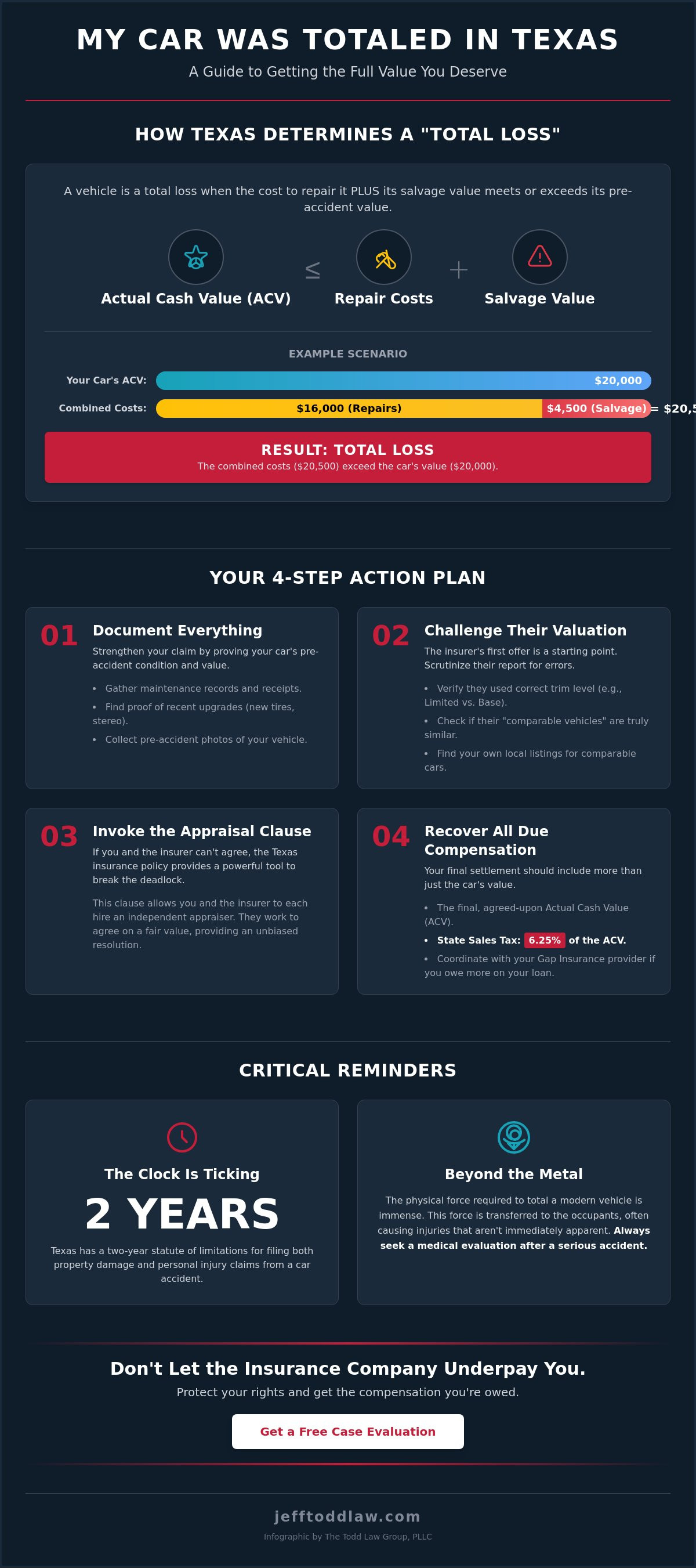
Unlike some states that use a "Total Loss Threshold" of 75% or 80%, Texas typically utilizes a 100% threshold. This means a vehicle is legally totaled only when the cost of repairs plus the salvage value equals or exceeds 100% of its ACV. It's a common misconception that the car must be completely destroyed to qualify. In reality, if your truck is worth $20,000 and the repairs cost $16,000 while the salvage value is $4,500, the total of $20,500 exceeds the value. Even though the repairs alone were only 80% of the value, the inclusion of salvage value pushes it over the limit. Insurers often "total" a car even if repairs are only 75% of the value if they anticipate "supplemental" damage once the mechanics begin the teardown process.
Constructive Total Loss: Safety and Structural Integrity
Sometimes, a car is declared a total loss even if the repair bill is relatively low. This is known as a constructive total loss. It occurs when the damage to the vehicle's frame or structural integrity is so severe that it's impossible to return it to a safe operating condition. Adjusters have a professional responsibility to evaluate whether a "repaired" vehicle would protect occupants in a future collision. If the crumple zones are compromised or the high-strength steel pillars are bent, the insurer may choose to total the car to avoid the massive future liability of putting an unsafe vehicle back on the road. Constructive total loss is a balance between repair costs and future liability.
Calculating Actual Cash Value (ACV): How Texas Insurers Value Your Car
When your car is declared a total loss, the number on the settlement check often feels like a second accident. The gap between what you think your car is worth and what the insurance company offers usually stems from the difference between replacement cost and Actual Cash Value (ACV). Texas law doesn't require insurers to buy you a brand-new car. Instead, they must pay you the fair market value of your vehicle as it existed a split second before the collision. This value accounts for depreciation, mileage, and wear, which can be a bitter pill to swallow if you've meticulously maintained your vehicle.
Adjusters often use third-party software to generate "valuation reports" based on comparable vehicles, or "comps," sold in your area. However, these reports frequently contain errors. An adjuster might compare your top-tier King Ranch or Limited trim truck to a base model XLT, failing to account for thousands of dollars in premium upgrades. Knowing what to do when your car is totaled includes verifying every line of that report. If they missed your new leather interior or advanced safety tech, the valuation is fundamentally flawed. If you're struggling to get the adjuster to recognize these critical details, the team at jefftoddlaw.com can help you push back against an inaccurate assessment.
The Role of Local Market Data
Geography plays a major role in vehicle valuation. A four-wheel-drive truck often commands a higher price in Houston or San Antonio than it might in a different region. Don't simply trust the insurer's "local data," which often relies on low-cost auctions rather than retail prices. You should pull your own comps from dealerships within a 50-mile radius of your zip code. If you've performed major maintenance, such as a transmission flush or installing a new set of tires within the last six months, provide those receipts. While maintenance doesn't increase value dollar-for-dollar, it proves your car was in "excellent" rather than "average" condition.
The "Invisible" Factors: Taxes and Fees
A fair total loss settlement must look beyond the metal and rubber. In Texas, the law requires insurers to include the 6.25% motor vehicle sales tax in your settlement. If your car is valued at $20,000, that's an additional $1,250 that belongs in your pocket. You're also entitled to reimbursement for the costs associated with getting a replacement vehicle on the road. This includes the $50.75 base registration fee and the title application fee, which is typically $28 or $33 depending on your county. These "invisible" costs are non-negotiable parts of your restoration, and a settlement that ignores them is incomplete.
The Step-by-Step Guide: What to Do After Your Vehicle is Declared a Total Loss
Once the insurance carrier designates your vehicle a total loss, the process shifts from assessment to administration. You need to act quickly to protect both your personal data and your financial interests. Your first priority is to remove all personal belongings from the cabin and trunk. Don't forget the small items like garage door openers, toll tags, and sunglasses. Crucially, you must clear your electronic footprint from the vehicle's infotainment system. Modern cars store your home address, phone contacts, and even your driving history. Use the "factory reset" or "clear private data" option in the settings menu before the car is towed to a salvage yard.
While the car is still accessible, gather evidence of its pre-accident value. Dig out your maintenance folder or log into your mechanic's portal to print recent service records. Receipts for a new set of tires or a recent transmission service prove the vehicle was in superior mechanical condition compared to average market samples. If you have clear photos of the "clean" interior or the odometer taken shortly before the crash, keep them ready. These documents are your primary ammunition when the insurance company presents an offer that doesn't reflect the true state of your property.
Step 1: Scrutinize the Valuation Report
The valuation report is the foundation of the insurer's offer, and it's frequently riddled with clerical errors or biased data. Look specifically at the "Condition Ratings" for the engine, transmission, and upholstery. Adjusters often default to "Fair" or "Average" ratings to justify a lower payout, even if your car was in showroom condition. Check the "comparable vehicles" list to ensure they aren't comparing your well-maintained car to high-mileage fleet vehicles or cars with prior accident histories. You must flag any missing features like sunroofs, premium audio systems, or upgraded wheel packages that the adjuster may have overlooked.
Step 2: Invoking the Appraisal Clause
If negotiations over the total loss value reach a deadlock, you have a powerful legal remedy known as the appraisal clause. Effective January 1, 2026, Texas law requires a binding appraisal process to resolve disputes over the amount of loss for personal auto policies. This allows you to hire an independent appraiser to conduct a professional valuation of your vehicle. If your appraiser and the insurance company's appraiser cannot agree, they will select an "umpire" to make a final, binding decision. While you're responsible for your appraiser's fee, this step is often the only way to force a carrier to pay a fair market price when they refuse to budge on their initial lowball offer.
Once you reach a settlement, the final step involves the transfer of title and a limited Power of Attorney (POA). The POA is a standard document that grants the insurance company the legal authority to manage the title transfer with the Texas Department of Motor Vehicles. Before signing, verify that the final settlement amount includes the 6.25% sales tax and the necessary registration fees required by state law. Handing over the title is the final act of the property claim, allowing you to focus entirely on your physical recovery and securing a replacement vehicle.
Handling the "Gap": What if You Owe More Than the Car is Worth?
Owing more on a vehicle than its market value is a common financial trap, especially for Texas drivers who purchased with a small down payment or an extended loan term. When a vehicle is declared a total loss, the insurance company only pays the Actual Cash Value. If your loan balance is $25,000 but the car's market value is only $20,000, you're left with a $5,000 "gap" that the bank still expects you to pay. This negative equity doesn't vanish just because the car is in a salvage yard. It's a harsh reality that can stall your ability to get back on the road.
Gap insurance is specifically designed for this scenario. It's a secondary policy that covers the difference between the primary insurance payout and your outstanding loan balance. If you have this coverage, you must file a separate claim with the gap provider immediately after the primary insurer issues their valuation. You'll need to provide them with the valuation report and a payoff statement from your lender. It's vital to stay in constant communication with your bank during this time. The insurance check will typically be made out to both you and the lienholder. Until that check is processed and the loan is officially closed, you must continue making your monthly car payments. Missing a payment during the claim process will damage your credit score and complicate the final settlement.
Strategies for Drivers Without Gap Insurance
If you don't have gap insurance, your best strategy is to maximize the ACV using the evidence-gathering methods we discussed earlier. Every extra dollar you secure for the vehicle's condition or local market comps reduces your out-of-pocket debt. In many cases, if you were injured in the accident, the compensation from a personal injury claim can be used to bridge this financial shortfall. If you're facing a massive deficiency balance after an accident, contact jefftoddlaw.com to discuss how we can help you navigate the intersection of property damage and injury claims. You might also talk to your lender about a "loan roll-over," where the remaining balance is added to a new loan for a replacement vehicle, though this should be a last resort due to the high interest costs.
Dealing with Totaled Leased Vehicles
Leased vehicles are handled differently because you aren't the owner; the leasing company is. Most lease agreements from major manufacturers actually include gap protection as a standard feature. In a total loss scenario, the insurance payout goes directly to the leasing company. If the payout is higher than the remaining lease obligation, you likely won't see any of that money, as the lease terms usually stipulate that any "equity" belongs to the lessor. However, if there's a shortfall, the built-in gap coverage usually absorbs it. Be wary of "early termination" fees buried in your contract. These can sometimes be negotiated away if the termination was involuntary due to an accident rather than a choice you made.
Beyond the Metal: Why a Totaled Car Often Means a Personal Injury Claim
The kinetic energy required to trigger a total loss in a modern vehicle is immense. Modern cars are engineered with sophisticated crumple zones and high-strength steel designed specifically to absorb impact. If a collision involved enough force to compromise that structural integrity beyond repair, it was certainly enough to cause significant trauma to the human body. Many drivers in Houston and Austin walk away from a wreck feeling "fine" due to the initial surge of adrenaline. However, soft tissue injuries, concussions, and internal bruising often remain dormant for several days before the full extent of the pain becomes clear.
Insurance companies are acutely aware of this physiological delay. They often push to settle the property damage claim with extreme speed because they want you to sign documents that might close the door on future medical liabilities. By resolving the vehicle issue quickly, they hope to limit their exposure to the more expensive personal injury side of the claim. A Houston personal injury lawyer understands that your restoration involves more than just a check for a new truck. True advocacy integrates property recovery with a comprehensive plan for your physical healing.
Protecting Your Rights to Total Recovery
You must be incredibly cautious before signing any document labeled a "General Release" or "Full and Final Settlement." Insurers sometimes present these as a standard requirement to receive your vehicle check. In reality, these documents can waive your right to pursue compensation for medical bills, lost wages, or future rehabilitation. The Todd Law Group, PLLC steps in to manage these aggressive adjusters on your behalf. We ensure that your property settlement is handled fairly without compromising your legal standing for an injury claim. An attorney provides the necessary weight to ensure the "total" in your recovery actually covers every facet of your loss.
The Todd Law Group, PLLC Difference
Jeff Todd brings a sophisticated perspective to personal advocacy. He transitioned from elite corporate legal environments in major metropolitan hubs to focus on helping individuals navigate life-altering incidents. This background provides the intellectual rigor and battle-tested experience required to challenge massive insurance carriers on a level playing field. We don't view your case as a mere financial transaction; we view it as a dedicated commitment to your total restoration.
Our firm is personally invested in the local community and understands the immediate, logistical needs of those who have lost their primary means of transportation. If you've been involved in a wreck that resulted in a total loss, you don't have to face the insurance company's legal department alone. We provide the steady reassurance and professional authority needed to secure a fair outcome. Contact The Todd Law Group, PLLC for a free case evaluation today to start your journey toward a full recovery.
Securing Your Financial and Physical Restoration
Navigating a total loss claim in Texas requires more than just submitting paperwork; it demands a proactive strategy to protect your financial future. You now have the tools to challenge low valuations and understand the critical link between property damage and physical recovery. While the insurance company focuses on its bottom line, you deserve a partner who focuses on your restoration. Taking the right steps today prevents the long-term burden of an unfair settlement or untreated injury.
The Todd Law Group, PLLC provides the authoritative advocacy needed to level the playing field against major carriers. Attorney Jeff Todd has been licensed in Texas since 1994, applying decades of experience to help clients in Houston, Austin, and Galveston. We're committed to your recovery and offer our services on a contingency basis for injury cases, so there's no fee unless we win. Trust a firm that treats your case as a holistic healing process rather than a mere file number.
Get a Free Consultation with a Houston Personal Injury Expert today. Let The Todd Law Group, PLLC guide you back to the road with the compensation you've earned.
Frequently Asked Questions
How long does an insurance company have to pay for a totaled car in Texas?
Texas law establishes strict deadlines for claim processing to ensure you aren't left without transportation indefinitely. Once you provide all necessary documentation, the insurer generally has 15 business days to accept or reject your claim. If they approve the settlement, they must issue your payment within 5 business days. These timelines are mandated by the Texas Insurance Code to keep the restoration process moving forward efficiently.
Can I keep my totaled car and still get a settlement check?
You have the legal right to keep your vehicle through a process known as owner retention. If you choose this path, the insurance company will deduct the car's salvage value and your deductible from the final settlement amount. You'll receive a salvage title from the state. The vehicle must then be fully repaired and pass a safety inspection before it can be legally driven with a rebuilt salvage title.
What happens if the other driver was at fault but doesn’t have enough insurance?
If the at-fault driver carries only the Texas minimum of $25,000 for property damage and your vehicle's value exceeds that amount, you'll face a shortfall. This is a common issue since approximately 14% of Texas motorists are entirely uninsured. In this situation, you must turn to your own Underinsured Motorist (UIM) coverage to bridge the gap and secure the full actual cash value of your vehicle.
Does a total loss claim affect my future insurance rates in Houston?
A total loss claim shouldn't increase your premiums if the accident wasn't your fault. Texas law generally protects drivers from rate hikes for non-at-fault incidents. However, insurance companies evaluate overall risk based on your location. Drivers in high-density areas like Houston or Austin often see higher base rates regardless of their individual claim history due to the increased statistical probability of accidents in those metropolitan hubs.
What if I disagree with the insurance company’s valuation of my vehicle?
You can challenge a low settlement offer by invoking the appraisal clause in your policy. A new law effective January 1, 2026, requires a binding appraisal process to resolve these specific valuation disputes. You'll hire an independent appraiser to conduct a professional assessment. If your appraiser and the insurer's appraiser can't agree, an umpire is selected to make a final, binding decision on the vehicle's worth.
How does gap insurance work if my car is a total loss?
Gap insurance serves as a secondary layer of protection when you owe more on your car loan than the vehicle is actually worth. After your primary insurer pays the actual cash value for the total loss, the gap policy covers the remaining balance on your finance agreement. This prevents you from being forced to pay thousands of dollars out of pocket for a vehicle that has already been sent to the salvage yard.
Should I hire a lawyer for a total loss claim if I wasn’t injured?
The Todd Law Group, PLLC focuses on cases involving physical harm rather than property-only disputes. If your accident only involved metal and glass, the cost of an attorney might exceed the benefit of a higher settlement. However, the force required to total a vehicle often causes injuries that don't appear for several days. You should always seek a medical evaluation before assuming you don't need legal help.
What happens to my custom parts and modifications after a total loss?
Custom modifications are usually only covered if you added a specific equipment endorsement to your policy before the accident. Without this rider, the adjuster will value your car based on standard factory parts. You might be allowed to remove aftermarket items like specialized rims or audio systems if you replace them with the original factory components. Always get permission from the adjuster before removing any parts from the vehicle.


