What if the workers' compensation check arriving in your mailbox is actually preventing you from receiving the full justice you deserve? In Texas, where the construction industry accounts for a significant portion of workplace fatalities, a third-party construction site injury claim is often the only way to recover what you've truly lost. You're likely feeling the strain of trying to pay a mortgage on partial wages while dealing with the physical pain of a long-term disability. It's common to feel confused about who was actually in charge of safety on a site crowded with different contractors, but that confusion shouldn't stop you from seeking accountability.
We promise to help you understand how to secure full compensation by identifying negligent parties beyond your direct employer. While the 2026 state average weekly wage of $1,271.05 limits standard benefits, a third-party claim opens the door to recovering full lost wages and damages for pain and suffering. This guide previews the steps to take, from identifying liable subcontractors to holding equipment manufacturers responsible for their failures. You'll see how a dedicated legal partner can handle the complexities of your case on contingency, allowing you to focus entirely on your physical and emotional recovery.
Key Takeaways
- Learn how to move beyond the "exclusive remedy" rule and file a third-party construction site injury claim to secure the full compensation that workers' comp often denies.
- Identify when subcontractors or equipment manufacturers are liable for your injuries, allowing you to hold the truly responsible parties accountable for their negligence.
- Find out how to recover damages that workers' compensation doesn't cover, including full lost wages, physical pain, and the loss of enjoyment of life.
- Understand the legal steps required to preserve evidence, such as securing site access and subpoenaing internal safety logs, before the scene of the accident is altered.
- Discover how a dedicated legal partner can manage your entire case on a contingency basis, focusing on your total restoration rather than just a financial payout.
Understanding Third-Party Construction Site Injury Claims in Texas
Texas construction sites are often a chaotic mix of different companies working on top of one another. When an accident happens, the immediate assumption is that workers' compensation is your only option. While it provides a basic safety net, it's rarely enough to cover the true cost of a life-altering injury. The "exclusive remedy" rule in Texas generally prevents you from suing your direct employer if they carry workers' compensation insurance. However, this rule doesn't shield every company on the job site. If a separate entity caused your accident, you have the right to file a third-party construction site injury claim.
A third-party claim is a personal injury lawsuit filed against an individual or company other than your employer. Unlike workers' compensation, which is a no-fault system, these claims are fault-based. This means you must show that another party's carelessness led to your harm. Proving Negligence is the cornerstone of these cases. You must establish that the third party owed you a duty of care, breached that duty, and that their breach was the direct cause of your injuries. This legal path is often the only way to hold the truly responsible party accountable for their actions.
The Difference Between Workers’ Comp and Third-Party Liability
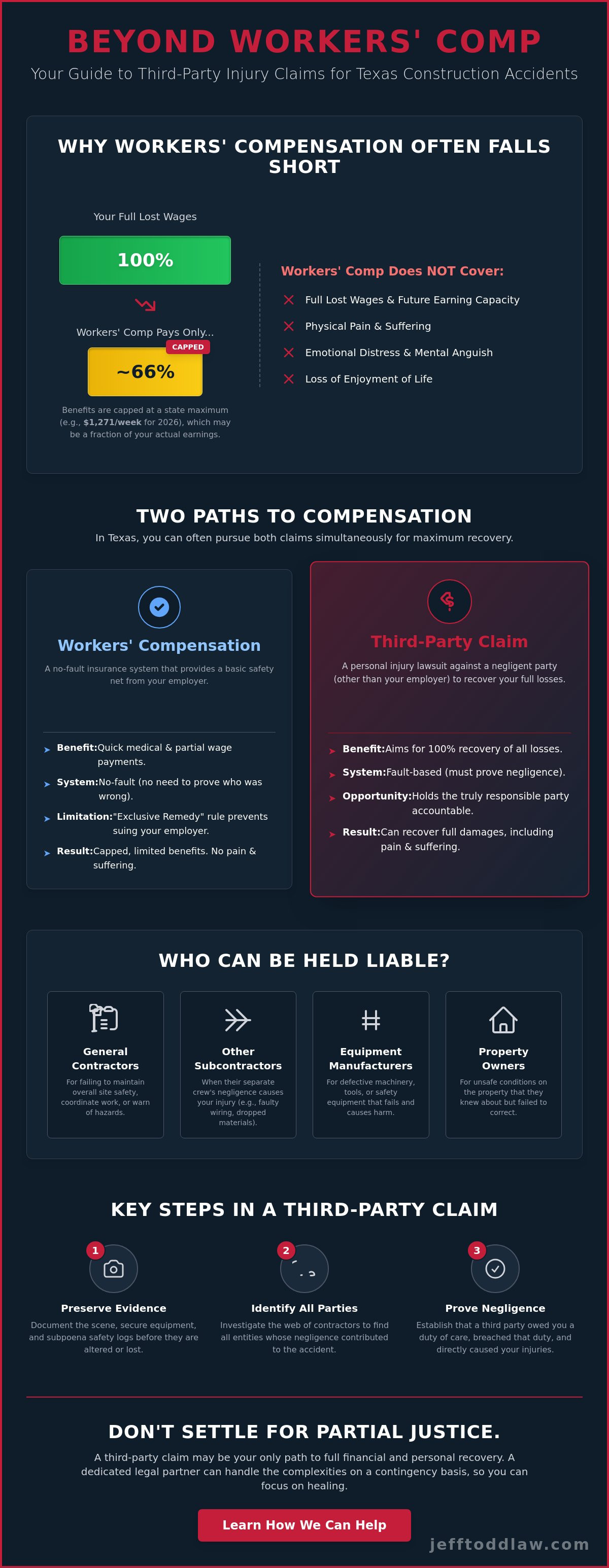
Workers' compensation is designed to pay for medical bills and a portion of your lost wages quickly. It doesn't require you to prove anyone did anything wrong. The trade-off is that the benefits are capped and don't account for your physical pain or emotional trauma. A third-party claim works differently. It allows you to pursue "non-economic" damages, such as compensation for pain and suffering or the loss of enjoyment of life. In Texas, you can often pursue both types of claims simultaneously. This dual approach ensures you receive immediate support while fighting for the full restoration of your financial future.
Why Texas Construction Sites Create Unique Legal Challenges
The sheer density of subcontractors on major projects in Houston, Austin, and Galveston makes identifying the liable party difficult. A single site might have separate crews for electrical work, plumbing, and heavy machinery. While a General Contractor is typically responsible for site-wide safety, their liability depends on how much control they exercised over the specific work being done. Additionally, Texas is unique because it's a "non-subscriber" state. If your employer doesn't carry workers' compensation insurance at all, you may be able to sue them directly for negligence. This adds another layer of complexity that requires a sophisticated legal strategy to untangle.
Why Workers’ Compensation Often Falls Short for Serious Injuries
Workers' compensation is often described as a safety net, but for many specialized tradespeople in Texas, it feels more like a tightrope. While it provides immediate medical coverage, the financial support it offers is strictly limited by state law. For a master electrician or a heavy equipment operator, the gap between their actual take-home pay and the state-mandated benefit cap can be devastating. This is why pursuing a third-party construction site injury claim is often necessary. It's the only legal mechanism available to recover the full 100% of your lost wages rather than a fraction of them.
The system also relies on "permanent impairment" ratings that frequently fail to capture the true impact of an injury. An insurance company doctor might assign a low percentage to a back injury that effectively ends your career in the field. These ratings determine your long-term benefits, but they don't account for the fact that you can no longer perform the physically demanding tasks your job requires. A third-party claim allows you to present a more accurate picture of your professional loss, ensuring that your future earning capacity is protected.
The Financial Reality of Construction Accidents
In Texas, workers' compensation typically pays only two-thirds of your average weekly wage. Even then, there's a ceiling. For injuries occurring in 2026, the maximum weekly benefit for Temporary Income Benefits (TIBs) is capped at $1,271.00. If your specialized skills earned you significantly more than that, your family is suddenly forced to live on much less while facing the rising costs of rehabilitation. You can find more details on navigating these financial hurdles in our guide for a Houston personal injury lawyer. If you're struggling to make ends meet, it's time to look at the total restoration of your income through every available legal channel.
Recovering Non-Economic Damages
Beyond the bills, serious accidents leave deep emotional scars. Workers' compensation provides zero dollars for your pain, suffering, or the loss of enjoyment of life. It doesn't matter if you can no longer play with your children or if you live with constant, grinding physical distress. These "non-economic" damages are only accessible through a lawsuit against a negligent third party. To establish this liability, we look to safety standards set by the Common Liable Parties in a Third-Party Construction Accident. This process also allows for "loss of consortium" claims, which acknowledge the profound impact your injury has had on your spouse and family life. These are not "extras" in a legal case; they are essential components of true justice.
Common Liable Parties in a Third-Party Construction Accident
Texas job sites are busy ecosystems where dozens of independent companies work in close quarters. While your employer provides your paycheck, they aren't always the ones responsible for the safety hazards that lead to an accident. When a separate entity fails to follow safety protocols, a third-party construction site injury claim becomes your primary path to accountability. Identifying these parties requires a meticulous investigation into the site’s hierarchy and daily operations to see who actually controlled the hazard.
Potential liable parties often include:
- Subcontractors: Different crews from various trades often create risks for others, such as leaving debris in common walkways or failing to secure scaffolding properly.
- Architects and Engineers: These professionals can be held liable if faulty blueprints or structural design errors lead to collapses or unstable work surfaces.
- Delivery Drivers: Third-party logistics companies moving materials through the site can cause "struck-by" incidents if they don't follow spotting protocols.
Equipment Failures and Product Liability
When a tool malfunctions, the manufacturer may be held liable through a product liability claim. This applies to everything from defective cranes and power tools to safety harnesses that fail to arrest a fall. As of January 13, 2025, OSHA regulation 29 CFR 1926.95(c) requires that all PPE must properly fit each worker. If a manufacturer provides equipment that is fundamentally flawed or fails to meet these updated safety standards, they are responsible for the resulting harm. It's critical to preserve the defective tool exactly as it was at the time of the incident. Altering or discarding a "lemon" tool can destroy your ability to prove the defect existed.
Negligent Property Owners and General Contractors
Property owners have a legal duty to disclose known hazards on their premises to invited workers. If they knew about a gas leak, unstable ground, or toxic exposure and didn't warn the crews, they may be liable under premises liability. General contractors also face scrutiny. While they often try to shift blame to smaller crews, they are responsible for site-wide safety if they maintain actual control over the work being performed. Falls, slips, and trips account for 31% of non-fatal construction incidents in Texas. Often, these are caused by property owners who fail to maintain safe walkways or general contractors who neglect to guard floor openings. We analyze internal safety logs and contracts to determine who was truly in charge of the area where you were hurt.
The Legal Process: Proving Negligence and Securing Maximum Recovery
Proving a third-party construction site injury claim requires a proactive strategy that begins within hours of the accident. While you focus on medical stabilization, we initiate a comprehensive site investigation to freeze evidence in time. This involves more than just taking photographs; it includes issuing "litigation hold" letters to all contractors on site to prevent the destruction of electronic records or the repair of faulty equipment. We move quickly to subpoena OSHA investigative reports, which often contain unbiased observations from federal inspectors that can be pivotal in establishing liability.
Hiring the right experts is the next phase of securing maximum recovery. We collaborate with mechanical engineers to reconstruct the failure of heavy machinery and vocational experts to testify about your inability to return to high-wage trades. This technical proof is essential when negotiating with multiple insurance carriers. Each company will try to shift the blame to another subcontractor to avoid a payout. By preparing every case for a potential jury trial, we demonstrate to the defense that we are ready to fight for your total restoration.
Critical Evidence You Need From the Construction Site
Evidence on an active job site is incredibly fragile; it disappears quickly as the project moves forward and new crews arrive. To protect your rights, we focus on gathering:
- Daily Site Logs and Toolbox Talks: These documents show which safety warnings were given and which hazards were ignored on the day of your injury.
- Surveillance and Dashcam Footage: Many modern job sites use security cameras or have delivery vehicles equipped with dashcams that may have captured the incident.
- Witness Statements: We interview other tradespeople immediately, before their memories fade or they are reassigned to different projects across Texas.
How We Handle Complex Multi-Party Litigation
The most common defense tactic in Texas construction cases is the "empty chair" defense, where each subcontractor points the finger at an entity not present in the courtroom. Attorney Jeff Todd uses his extensive corporate legal experience to cut through these distractions and hold the truly negligent parties accountable. A typical lawsuit moves through the discovery phase, where we exchange thousands of documents, into mediation, and finally to trial if a fair settlement isn't reached. This process ensures that no detail of your physical or financial loss is overlooked. If you're ready to hold the responsible parties accountable, let us review your case today.
How The Todd Law Group, PLLC Advocates for Injured Texas Workers
Legal representation should be more than a financial transaction; it should be a stable partnership focused on your total restoration. While previous sections detailed the technicalities of liability and evidence, The Todd Law Group, PLLC prioritizes the human element of every third-party construction site injury claim. We understand that behind the OSHA reports and insurance adjusters is a person struggling to regain their physical and financial footing. Our approach provides a steady reassurance that your legal interests are being handled with the same meticulous attention to detail that defined Jeff Todd's career in high-stakes corporate law.
By maintaining dedicated offices in Houston, Austin, and Galveston, we provide localized expertise that is personally invested in the success of Texas workers. We remove the financial barrier to justice by operating on a strict contingency fee model. This means you don't pay any upfront costs or hourly fees. We only receive a portion of the recovery if we successfully secure a settlement or verdict on your behalf. This structure ensures that our resources are fully aligned with your goal of recovering full lost wages and compensation for pain and suffering.
A Seasoned Approach to Personal Injury Law
Jeff Todd has been navigating complex litigation since 1994, bringing a battle-tested perspective to every case. After years in elite corporate environments, he transitioned to personal advocacy to apply that same intellectual rigor to helping individuals. This background gives The Todd Law Group, PLLC a unique advantage when facing large construction firms and their aggressive insurance carriers. We understand their internal processes and defense strategies, allowing us to proactively counter their attempts to undervalue your injuries. Our commitment is to manage the legal progression so you can focus entirely on your physical healing.
Take the First Step Toward Your Recovery
The window of opportunity to secure a third-party construction site injury claim is often smaller than the two-year statute of limitations suggests. As projects move toward completion, the physical landscape of the site changes, and critical witnesses often move to new jobsites across the country. Taking immediate action ensures that we can preserve the evidence necessary to prove negligence before it is lost forever. We invite you to a free, no-obligation case evaluation to determine the potential of your claim and discuss a strategy for your recovery. Contact The Todd Law Group, PLLC today for a free consultation.
Securing Your Path to Total Restoration
Recovery after a catastrophic site accident involves more than just medical stability; it requires long-term financial security. While workers' compensation provides a necessary baseline, a third-party construction site injury claim is often the only mechanism for achieving total restoration. You now understand how identifying negligent subcontractors or equipment manufacturers bridges the gap between partial wages and the full justice your family deserves. True justice isn't just about a financial transaction; it's about holding the truly responsible parties accountable for their failures on the job site.
Attorney Jeff Todd has been navigating these complex legal waters since 1994, bringing a high level of intellectual rigor to every case. With dedicated offices in Houston, Austin, and Galveston, our firm provides the regional expertise and sophisticated advocacy needed to challenge major construction entities. We believe your focus should remain entirely on your physical and emotional healing. This is why we work on a contingency basis; there's no fee unless we win your case. Get a Free Case Review with a Houston Construction Injury Lawyer today to evaluate your options and protect your rights. Your future is worth the fight.
Frequently Asked Questions
Can I file a third-party claim if I was partially at fault for the accident?
Yes, you can still pursue a claim under the Texas proportionate responsibility law. As long as you are not more than 50% responsible for the incident, you are eligible to recover damages. However, your final compensation will be reduced by your specific percentage of fault. This makes it vital to have a legal partner who can accurately frame the negligence of other parties on the site.
What is the statute of limitations for a construction injury claim in Texas?
You generally have two years from the date of the injury to file a lawsuit against a negligent third party. This deadline is set by the Texas Civil Practice and Remedies Code § 16.003. It's separate from workers' compensation deadlines, which require you to report an injury to your employer within 30 days and file an official claim within one year.
Will I lose my workers’ compensation benefits if I sue a third party?
No, you won't lose your existing benefits by pursuing additional justice. Filing a third-party construction site injury claim allows you to seek full restoration while your workers' comp medical and wage benefits continue. These two legal paths run parallel to one another. This ensures you have immediate support while we fight for the broader compensation you deserve for pain and suffering.
How much is my third-party construction site injury claim worth?
The value of your third-party construction site injury claim depends on the severity of your disability and the total amount of your lost wages. Unlike workers' compensation, which caps weekly benefits at $1,271.00 for 2026, a third-party lawsuit has no such arbitrary ceiling. We calculate the total impact on your life, including future medical needs and the emotional toll of your long-term recovery.
Do I have to pay my workers’ comp insurance back if I win a third-party settlement?
Yes, the insurance carrier typically has a right to subrogation. This means they are entitled to be reimbursed for the medical bills and income benefits they paid out from your settlement proceeds. However, a seasoned attorney can often negotiate these liens. Our goal is to ensure the largest possible portion of the settlement stays in your pocket to support your total healing process.
What happens if my employer does not have workers’ compensation insurance in Texas?
If your employer is a "non-subscriber," you have the right to sue them directly for negligence in a Texas court. In these situations, the employer is barred from using certain legal defenses, such as claiming you assumed the risk of the job. This often creates a more direct path to holding them accountable for failing to provide a safe work environment or proper equipment.
Can I sue for a construction accident if I am an independent contractor?
Independent contractors are not bound by the "exclusive remedy" rule, which gives you significant legal flexibility. You can pursue a claim against any party whose negligence led to your injury, including the general contractor or property owner. Because you aren't covered by standard workers' comp, a third-party claim is often your only way to recover lost income and medical expenses.
How long does a third-party liability lawsuit usually take to resolve?
Most complex construction cases take between 12 and 24 months to reach a resolution. The timeline depends on the number of subcontractors involved and the depth of the investigation required. While we always strive for an efficient outcome, we prepare every case for trial to ensure the insurance companies understand we are serious about securing your full financial restoration.


