
What if the workers' compensation check you were promised is actually a legal shield designed to protect a negligent contractor rather than your family's future? In Texas, many injured workers believe that accepting these benefits means they've reached the end of their legal options. However, when a fall occurs because a site manager ignored OSHA's strict scaffolding load capacities or guardrail heights, you may have grounds for a scaffolding fall lawsuit Texas. You're likely feeling the weight of mounting medical bills and the stress of lost income while you recover from surgery. It's a difficult position, especially when you're facing pressure from an employer to move on quickly.
We believe in a holistic approach to your recovery that prioritizes your total restoration over a quick insurance payout. This article will show you how to identify third-party liability to secure the maximum compensation you deserve. We'll examine how to hold negligent parties accountable and ensure you have the funds for long-term rehab and future medical care. By understanding your rights under the 2026 Texas liability standards, you can move from a place of uncertainty to a position of strength and stability.
Key Takeaways
- Identify how third-party liability allows you to hold negligent general contractors and subcontractors accountable for safety failures.
- Understand the specific legal grounds required to file a scaffolding fall lawsuit Texas, even if you've been told workers' compensation is your only option.
- Learn the critical differences between the "Exclusive Remedy" rule and non-subscriber laws to determine your true path to full financial recovery.
- Discover why the first few hours after an incident are vital for securing evidence before a job site is altered or scaffolding is dismantled.
- Explore how a holistic legal strategy manages the complexities of your claim so you can focus on physical restoration and long-term healing.
Common Causes of Scaffolding Falls on Texas Job Sites
A scaffolding fall is rarely a simple accident. It is often the result of a systemic failure to respect basic scaffolding safety standards. While many people imagine a total structural collapse, most injuries occur during routine tasks because of a missing guardrail or a slippery platform. In a scaffolding fall lawsuit Texas, we look beyond the immediate incident to find the root cause of the negligence. Whether it was a structural failure or a simple slip, the impact on your life is just as severe.
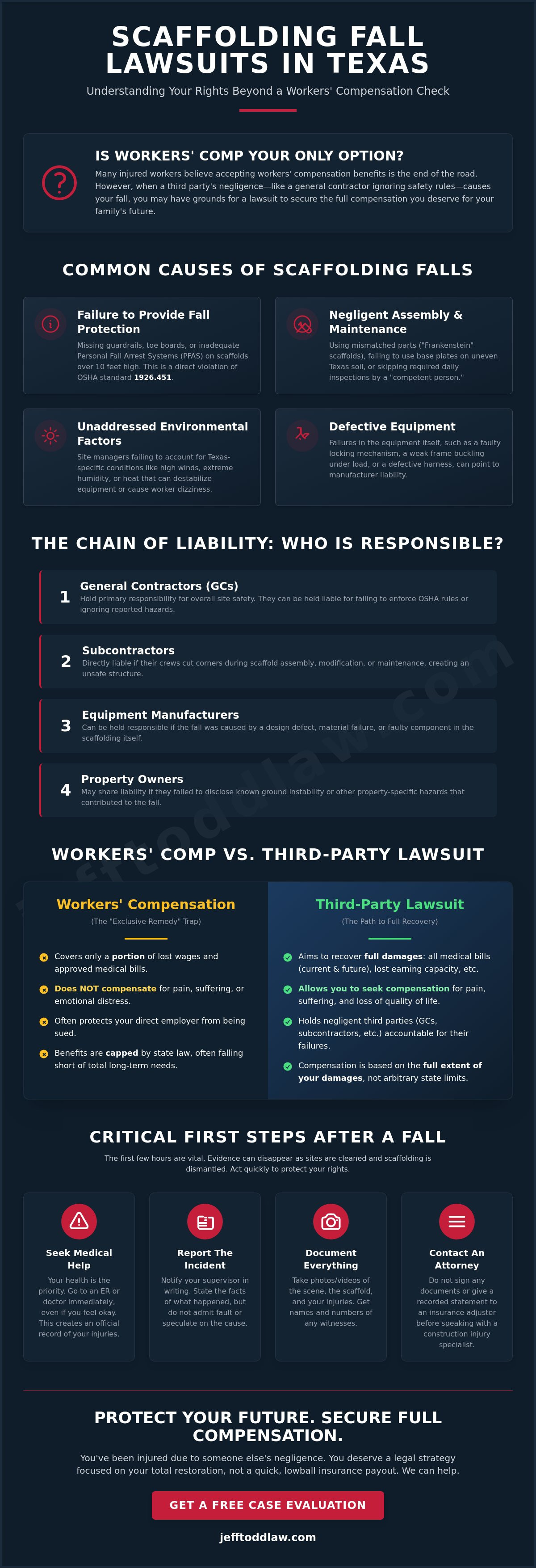
Legal teams use OSHA 1926.451 as the benchmark for proving negligence in Texas courts. This federal standard dictates everything from load capacities to the specific height of guardrails. When a contractor ignores these rules to save time, they put every worker on that site at risk. Texas weather also plays a significant role. High winds in the Panhandle or the oppressive humidity of the Gulf Coast can destabilize equipment or cause heat related dizziness. If a site manager fails to account for these environmental factors, they may be held liable for the resulting injuries.
Failure to Provide Fall Protection
Missing guardrails and toe boards are among the most common negligence factors we see. OSHA requires fall protection for anyone working on a scaffold more than 10 feet above a lower level. However, confusion often arises between the "4 foot rule" for general industry and the "6 foot rule" for general construction. Regardless of the specific height, subcontractors must provide a reliable Personal Fall Arrest System (PFAS) when guardrails aren't feasible. If your harness failed or an anchor point was improperly installed, you have a right to seek justice.
Negligent Assembly and Maintenance
Stability saves lives. Unfortunately, many Texas job sites use mismatched components from different manufacturers. This creates "frankenstein" structures that are inherently unstable. On the uneven soil found throughout the state, the failure to use proper base plates or mud sills can lead to a dangerous tilt. Texas law requires a "competent person" to inspect every scaffold daily before the shift begins. When these inspections are skipped or performed by unqualified personnel, the risk of a catastrophic failure increases. Identifying these maintenance gaps is a critical step in building a strong scaffolding fall lawsuit Texas.
Determining Liability: Who Is Responsible for Your Injuries?
Determining who is at fault after a construction accident requires a deep dive into the contracts and daily logs of the job site. In a scaffolding fall lawsuit Texas, liability is rarely limited to a single person. General Contractors (GCs) typically hold the primary responsibility for safety across the entire site. If a GC fails to enforce OSHA scaffolding regulations or ignores a reported hazard, they can be held accountable for the resulting injuries. Their duty is to maintain a safe environment for every worker, regardless of which company signs the paycheck.
Subcontractors also face significant liability, especially when their specific crews are tasked with erecting or moving the scaffolding. If they cut corners during assembly, the structure becomes a ticking time bomb. Beyond the people on site, equipment manufacturers may be responsible if a locking mechanism fails or a frame buckles due to a design defect. Property owners can even be pulled into the litigation if their specific negligence, such as failing to disclose a known ground instability, contributed to the fall. Identifying every potential defendant is the first step toward a total restoration of your livelihood.
Third-Party Liability Claims
Suing a third party is often the only way to recover full damages in Texas because workers' compensation benefits are frequently capped. These claims target entities other than your direct employer, such as safety consultants or independent inspectors who failed to spot obvious risks. These third party actions interact directly with your premises liability rights. This legal strategy allows you to seek compensation for pain, suffering, and future medical costs that workers' comp simply won't cover. If you're unsure who is at fault, speaking with an experienced construction injury specialist can help clarify your options.
The "Profit Over Safety" Argument
Companies often prioritize deadlines over human lives. The legal fallout from the Port Arthur LNG incident serves as a stark reminder of what happens when speed is valued more than stability. We use corporate emails, safety logs, and meeting minutes to prove that management had prior knowledge of scaffolding risks but chose to proceed anyway. This evidence is vital for building a compelling case against a negligent corporation. In Texas, proving that a defendant acted with gross negligence can lead to punitive damages intended to punish the company for its reckless disregard of human life.
Texas Workers’ Comp vs. Scaffolding Fall Lawsuits
The "Exclusive Remedy" rule often feels like a legal wall for injured workers. If your employer carries workers' compensation insurance, Texas law generally prevents you from suing them directly for simple negligence. This system was designed to provide quick medical coverage, but it frequently leaves families struggling with the true cost of a catastrophic injury. When benefits don't cover the full scope of your trauma, a scaffolding fall lawsuit Texas becomes the necessary path to bridge the gap between basic support and total restoration.
Texas is unique because it allows private employers to opt out of the workers' compensation system entirely. These companies are known as "non-subscribers." If your employer chose this path, they lose significant legal protections. They cannot argue that you were partially at fault or that the incident was just an inherent risk of the job. This opening allows us to hold them strictly accountable for failing to meet OSHA scaffolding safety standards. Even with the state average weekly wage for 2026 set at $1,271.05, these statutory benefits rarely suffice for a worker facing a lifetime of rehab.
A narrow but vital exception exists for cases involving gross negligence. If a company’s reckless disregard for safety leads to a fatal fall, the "Exclusive Remedy" rule can be bypassed. Families in these heartbreaking situations often need the guidance of a wrongful death attorney austin to pursue exemplary damages. This legal route is intended to punish the employer for their conduct and provide the financial security a grieving family needs to move forward.
Suing a Non-Subscriber Employer
Non-subscriber cases offer a distinct tactical advantage. Because these employers opted out of the state system, they are vulnerable to direct litigation where they cannot use "contributory negligence" as a defense. We focus on proving the company failed to provide a "reasonably safe" workplace. Our team investigates employer insurance status immediately to determine the best strategy. If they aren't subscribers, we move quickly to secure site access and witness testimony before the company can attempt to dismantle the evidence.
Recovering Damages Beyond Medical Bills
Workers’ comp is strictly transactional. It pays for doctors and a fraction of your paycheck, but it ignores your pain, suffering, and mental anguish. For a construction professional, a fall can end a career. We calculate your "loss of earning capacity" by looking at your potential career trajectory, not just your current hourly rate. Partnering with a houston personal injury lawyer ensures that these non-economic damages are quantified and fought for with the same rigor as your medical expenses.
Steps to Take Immediately After a Scaffolding Fall
The moments following a fall are often chaotic, but your actions during this time can define the success of a future scaffolding fall lawsuit Texas. Your first priority is seeking immediate medical attention. Even if you feel stable, internal injuries or concussions may not be apparent right away. When you speak with doctors, ensure they document the "mechanism of injury" in detail. This medical record serves as the foundational link between the construction site's failure and your physical condition, preventing insurance companies from claiming your injuries happened elsewhere.
Speed is critical because of what we call the "Evidence Window." On a busy Texas job site, scaffolding is often dismantled, "fixed," or moved within hours of an incident. If the structure is altered before it can be inspected, vital proof of negligence may be lost forever. You should report the incident to your supervisor to create an official paper trail, but remain cautious. Avoid admitting fault or signing any documents that look like liability waivers. Your goal is to report the facts of the fall without providing the company's legal team with ammunition to use against you later.
Documenting the Scene
If you are physically able, or if you can ask a trusted coworker to help, capture the scene through photos and video immediately. Physical evidence changes quickly, so focus on these specific details:
- Scaffold Tags: Photograph the green, yellow, or red tags that indicate the last inspection date.
- Base Plates and Soil: Document if the scaffold was resting on uneven ground or lacked proper mud sills.
- Safety Rails: Take clear photos of missing or loose guardrails.
- Faulty PPE: Keep any snapped lanyards or damaged harnesses; do not let the employer take them "for testing."
Gathering contact information for coworkers who witnessed the safety breach is equally important. Their testimony can counter the corporate narrative that "all safety protocols were followed."
Avoiding Insurance Traps
Commercial insurers move quickly to protect their bottom line. You might receive a call from an adjuster asking for a recorded statement. You aren't required to provide one, and doing so without counsel can be a costly mistake. These professionals are trained to elicit responses that shift blame onto the worker. Commercial insurance tactics are remarkably consistent across different industries; for example, a houston truck accident lawyer often deals with the same aggressive defense strategies used in construction litigation. Under Texas law, the statute of limitations for filing a personal injury lawsuit is typically two years from the date of the incident. However, waiting that long to seek legal guidance often results in lost evidence and faded witness memories.
Be wary of "quick settlement" offers that arrive before you know the full extent of your future medical needs. These offers almost always require you to waive your right to sue third parties who may be the truly negligent actors. Consult with our legal team immediately to ensure your right to full compensation remains protected while you focus on your recovery.
How The Todd Law Group Fights for Texas Construction Workers
Stability is our priority. Jeff Todd brings a unique perspective to every scaffolding fall lawsuit Texas, having transitioned from a high-stakes corporate legal career in major metropolitan hubs to dedicated personal advocacy. This background allows our firm to apply elite corporate-level rigor to individual injury claims. We understand how massive construction firms and their insurers operate because we've seen their strategies from the inside. This intellectual rigor ensures that no detail is overlooked during your pursuit of justice.
Our firm operates on a holistic healing philosophy. We recognize that a legal case is just one part of your recovery journey. While we manage the complex legal burdens and paperwork, you can focus entirely on your physical restoration. We provide local, personalized support through our offices in Houston, Austin, and Galveston. This regional presence allows us to be physically present when it matters most. To ensure our services are accessible to those in distress, we offer a no-fee guarantee. You won't pay us anything unless we successfully win your case.
Our Case Investigation Process
Success in a scaffolding fall lawsuit Texas depends on the quality of the evidence. We don't just wait for the company to hand over files. Our team proactively subpoenas site records, daily inspection logs, and safety meeting minutes to uncover the truth. We collaborate with expert witnesses, including structural engineers and OSHA specialists, to reconstruct the mechanism of the fall. By holding massive construction firms accountable through aggressive litigation, we ensure that safety failures are brought to light and properly compensated.
Contact a Texas Scaffolding Lawyer Today
Evidence on a construction site is fragile. As work continues, the conditions that caused your injury can be altered or erased within days. Acting fast is the best way to preserve your rights and secure your family's future. We're here to provide the steady reassurance and professional guidance you need during this difficult time. If you're ready to take the next step toward your total restoration, Contact The Todd Law Group for a free consultation. We'll provide a confidential case evaluation to help you understand your legal options.
Secure Your Path to Total Restoration
Navigating the aftermath of a construction site accident is an overwhelming process that requires more than just medical attention. By identifying third party liability and understanding the unique non-subscriber laws in our state, you can move beyond the limitations of basic insurance. A scaffolding fall lawsuit Texas is often the only way to hold negligent site managers accountable and secure the funds needed for long term rehabilitation. You've already taken the first step by learning about your rights and the importance of preserving evidence before it's altered.
Attorney Jeff Todd has been licensed in Texas since 1994, bringing decades of intellectual rigor and corporate legal experience to every case. With offices in Houston, Austin, and Galveston, our team provides the local, dedicated advocacy you need during this transition. We operate on a contingency basis, meaning you'll never face a fee unless we win your case. Our goal is to handle the legal complexities so you can focus entirely on your physical and emotional healing. Get a Free Case Review from The Todd Law Group today to begin your journey toward justice. You don't have to face this progression alone.
Frequently Asked Questions
Can I sue for a scaffolding fall if I was partially at fault?
Yes, you can still recover compensation under the Texas modified comparative negligence rule. As long as you are not more than 50% responsible for the incident, you are eligible to collect damages. Your final award will be reduced by your percentage of fault. For example, if a jury finds you 10% responsible, you can still recover 90% of the total settlement value.
What is the average settlement for a scaffolding accident in Texas?
Settlement amounts vary significantly because they are based on your specific medical bills, lost income, and the severity of your trauma. There is no fixed average, but cases involving catastrophic injuries often result in high value recoveries. Some notable Texas settlements for construction falls have reached $5 million or more, depending on the insurance policies and the number of negligent parties involved.
How long do I have to file a scaffolding lawsuit in Houston?
You generally have two years from the date of the injury to file a scaffolding fall lawsuit Texas. This deadline is strictly enforced by the Texas Civil Practice & Remedies Code. If you don't file your claim within this two year window, you will likely lose your legal right to seek any compensation. It's vital to start the investigation early while evidence is still fresh.
Can an undocumented worker file a scaffolding fall lawsuit in Texas?
Yes, your immigration status does not affect your right to seek justice for a workplace injury in Texas. Every worker is entitled to a safe environment regardless of their residency status. You have the same legal standing to pursue medical expenses and lost wages as any other person on the job site. We focus on the negligence of the contractor, not your background.
What if my employer doesn’t have Workers’ Compensation insurance?
If your employer is a "non-subscriber," you have the right to sue them directly for their negligence. Non-subscribers lose the ability to argue that you were partially at fault or that the injury was an inherent risk. This often provides a tactical advantage, as it removes many of the legal shields that usually protect employers from direct litigation after a fall.
What kind of experts are needed for a scaffolding collapse case?
We typically employ structural engineers and OSHA safety specialists to reconstruct the mechanism of the fall. These experts identify specific violations in assembly or load capacity that led to the failure. Additionally, we use medical experts and life care planners to quantify the long term costs of your rehab. This technical proof is essential for holding large construction firms accountable.
Will I have to go to court for my scaffolding injury claim?
Most claims are resolved through out of court settlements or mediation before a trial becomes necessary. However, we prepare every case with the intellectual rigor required for a courtroom presentation. This proactive approach gives us more leverage during negotiations. If the insurance company refuses to offer a fair settlement that covers your total restoration, we are ready to fight for you in court.
Can I sue the scaffolding manufacturer if the equipment was defective?
Yes, you can file a product liability claim if the equipment itself was poorly designed or manufactured. This often happens when locking mechanisms fail or the metal frames buckle under a standard load. These third party claims are a vital part of a scaffolding fall lawsuit Texas. They allow you to pursue additional compensation that may not be available through your employer's insurance coverage.


