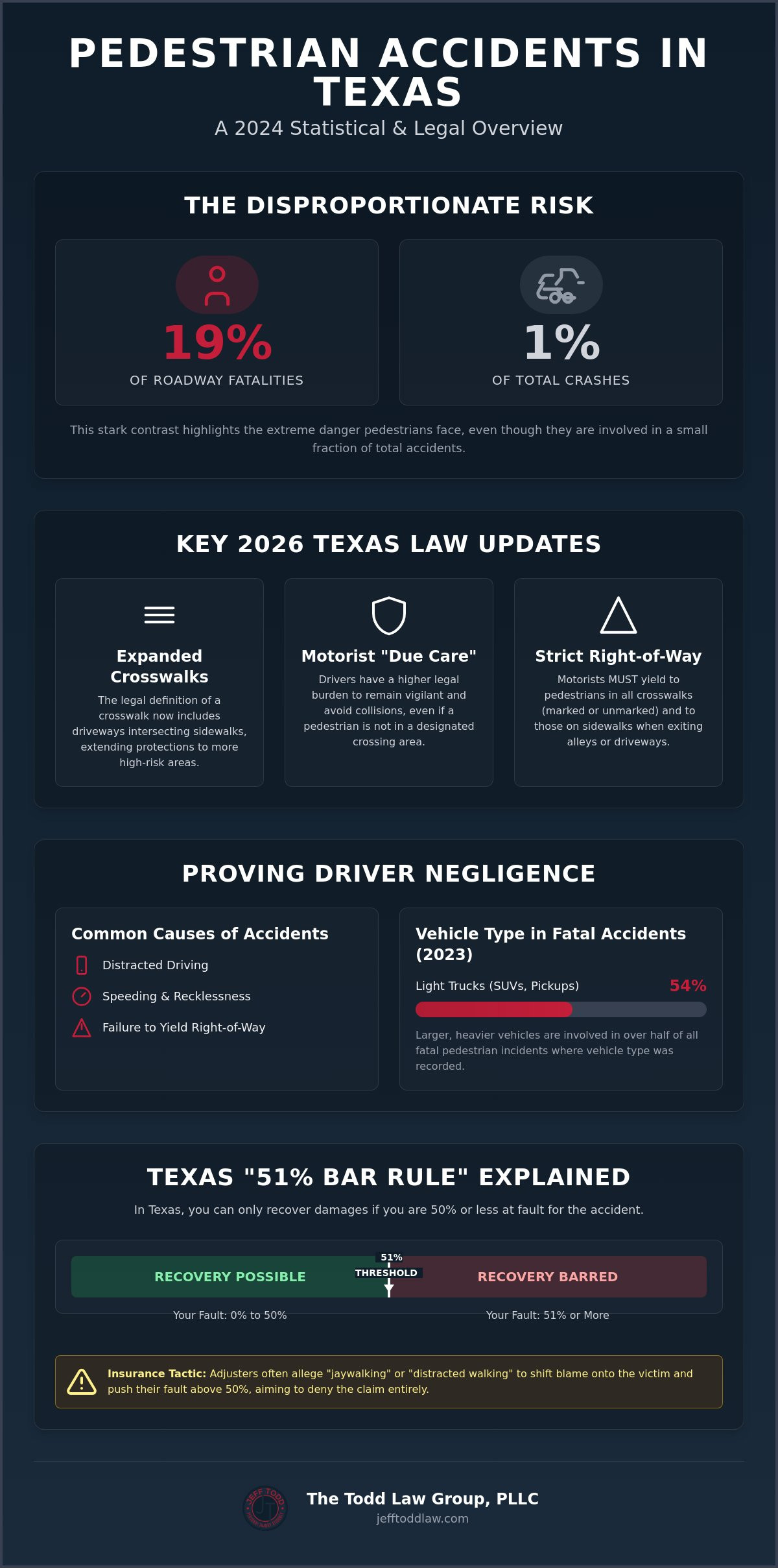
In 2024, pedestrians accounted for 19% of all roadway fatalities in Texas, despite being involved in only 1% of total traffic crashes. These numbers highlight a sobering reality for residents in Houston, Austin, and Galveston. When a vehicle strikes a person, the physical and financial consequences are almost always catastrophic. If you've been injured in one of these pedestrian accidents, you're likely facing mounting medical expenses and the heavy pressure of insurance adjusters seeking a quick, low settlement while you're still trying to heal.
We understand that the path to recovery feels overwhelming when you're unable to work and worried about your future care. You deserve a partner who views your legal case as a vital component of your holistic healing process. This guide will help you understand your rights under updated Texas laws, including the 2025 definitions for sidewalk users and expanded crosswalk protections. You'll learn how to hold negligent drivers accountable and navigate the legal landscape to secure the maximum financial recovery you need for a full restoration.
Key Takeaways
- Understand the latest 2026 legal updates regarding "sidewalk users" and the expanded definition of crosswalks under the Texas Transportation Code.
- Learn the critical steps to take immediately following an incident to preserve evidence and protect your right to a full recovery.
- Discover how to accurately calculate both economic and non-economic damages to ensure your settlement covers long-term care and emotional distress.
- Identify the common forms of driver negligence in pedestrian accidents and the evidence required to hold at-fault parties accountable.
- Explore how a dedicated legal partner can manage insurance adjusters and complex filings, allowing you to focus on your physical and emotional healing.
Understanding Pedestrian Rights and Texas Traffic Laws (2026)
The Texas Transportation Code serves as the foundational legal framework for establishing liability after a collision. Recent legislative changes, effective as of late 2025 and into 2026, have significantly strengthened protections for those on foot. Senate Bill 1013, for instance, expanded the legal definition of a "crosswalk" to include portions of driveways that intersect sidewalks. This change ensures that the criminal and civil protections of the Lisa Torry Smith Act now apply to these high-risk areas, where vehicles often cross pedestrian paths without looking. Whether you're walking through a residential neighborhood in Galveston or a busy commercial district in Houston, these statutes dictate who had the legal right to be in that space at that moment.
Texas Right-of-Way Statutes
State law is clear: drivers must yield the right-of-way to pedestrians in crosswalks, whether those markings are painted on the asphalt or exist as "unmarked" extensions of the sidewalk. Maintaining Pedestrian safety requires a shared responsibility, but the law places a "Due Care" requirement on motorists. This means drivers have a higher legal burden to remain vigilant and avoid a collision, even if a pedestrian is not in a designated crossing area. Under the 2026 legal landscape, failing to yield isn't just a traffic violation; it's a primary indicator of negligence in pedestrian accidents.
- Yielding at Intersections: Drivers must stop for pedestrians who have already entered the half of the roadway the vehicle is traveling on.
- Sidewalk Protections: Vehicles emerging from alleys or driveways must stop and yield to all sidewalk users before proceeding.
- Blind Pedestrians: Texas law mandates extra precautions and immediate yielding for pedestrians using white canes or service animals.
Proportionate Responsibility in Texas
Texas operates under a "51% bar rule" for proportionate responsibility. This means you can still recover compensation even if you were partially at fault for the incident, provided your share of the blame doesn't exceed 50%. Insurance companies frequently use "jaywalking" or "distracted walking" as a strategy to shift blame onto the victim and deny valid claims. They want to push your percentage of fault above that 51% threshold to avoid paying anything at all.
Countering these aggressive tactics requires a sophisticated legal approach. An experienced houston personal injury lawyer can investigate the scene, gather traffic camera footage, and use accident reconstruction to prove the driver had the last clear chance to avoid the collision. In many pedestrian accidents, what the insurance company calls "jaywalking" is actually a situation where the driver was speeding or looking at a phone, making them the primary negligent party. We focus on ensuring the facts are presented accurately so your right to recovery remains protected.
Common Causes of Pedestrian Accidents and Proving Negligence
Driver inattention and speeding remain the primary catalysts for trauma on Texas roads. In 2023, light trucks, including SUVs and pickups, were involved in 54% of fatal pedestrian accidents where the vehicle type was documented. This trend is particularly evident in Houston, where larger vehicles often dominate the landscape. Modern distractions, such as complex infotainment systems and smartphone notifications, frequently pull a driver's focus away from the road at critical moments. These lapses in judgment often manifest as a failure to yield during right-hand turns at busy city intersections or speeding through high-density areas like Downtown Galveston and local school zones.
Establishing liability requires proving that the motorist violated the Texas Transportation Code Chapter 552. Whether the driver was operating under the influence or simply failed to maintain a proper lookout, their negligence creates a path for your civil recovery. While criminal proceedings focus on punishment, your civil claim is designed to secure the financial resources necessary for your total restoration and long-term care.
Evidence Needed to Prove Driver Fault
Objective proof is the cornerstone of a successful claim. We move quickly to secure "Ring" doorbell footage from residential areas and high-definition security feeds from nearby businesses. This visual evidence often captures the moments leading up to the impact, providing undeniable proof of vehicle speed and driver behavior. While the official police crash report provides a baseline, it's rarely enough on its own. We frequently collaborate with accident reconstruction experts who use vehicle telemetry data and physical evidence from the scene to demonstrate exactly how the driver's negligence led to the collision. If you're feeling overwhelmed by the logistics of gathering this data, a dedicated legal partner can manage the investigation while you focus on your physical recovery.
The Role of Commercial Vehicles
When a delivery van, rideshare driver, or corporate vehicle is involved, the case moves into the realm of vicarious liability. These commercial entities are often responsible for the actions of their drivers, but they also employ aggressive legal teams to protect their bottom line. Proving corporate negligence involves examining maintenance logs, driver training records, and employment history. In cases involving heavy commercial vehicles or semi-trucks, it's essential to work with a houston truck accident lawyer who understands federal motor carrier regulations. These high-stakes pedestrian accidents require a sophisticated approach to ensure that a large corporation is held fully accountable for the damage caused to an individual's life.
Calculating Damages: What is Your Pedestrian Accident Claim Worth?
The financial impact of being struck by a vehicle extends far beyond the initial emergency room visit. When we evaluate the worth of a claim, we look at the total trajectory of your life before and after the incident. Economic damages serve as the measurable foundation of your recovery. These include your current medical bills, the cost of specialized rehabilitation, and the loss of future earning capacity if your injuries prevent you from returning to your profession. We meticulously document every expense to ensure that the settlement reflects the actual cost of your physical restoration.
Non-economic damages address the profound, intangible losses that often accompany pedestrian accidents. These include physical pain, emotional distress, and a diminished loss of enjoyment of life. Our firm utilizes a holistic healing approach; we view legal recovery not just as a financial transaction, but as a stable partner in your journey toward emotional and physical stability. In specific instances involving gross negligence or extreme recklessness, we may also pursue punitive damages. These awards are intended to punish the at-fault party and serve as a deterrent to others, reinforcing the standards set by the Texas Department of Transportation pedestrian safety guidelines.
Long-Term Medical Needs for Pedestrian Victims
Catastrophic injuries such as Traumatic Brain Injuries (TBI) or spinal cord damage require a lifetime of care. The projected costs for future surgeries, long-term physical therapy, and home modifications must be captured in your initial claim, as you cannot reopen a case once it's settled. Having the insight of a medical malpractice attorney Texas perspective is vital in these scenarios. It ensures that the medical evidence is presented with the technical rigor necessary to prove the necessity of high-cost, long-term interventions to insurance adjusters and juries alike.
Wrongful Death Claims for Pedestrians
When pedestrian accidents result in a fatality, the Texas Wrongful Death Act provides a legal pathway for surviving family members to seek justice. Spouses, children, and parents have the right to recover compensation for funeral expenses, the loss of the deceased's future earnings, and the loss of companionship and emotional support. While no amount of money can replace a loved one, a successful claim provides the financial security your family needs to move forward. If you've lost a family member, a wrongful death attorney austin can provide the compassionate advocacy and experienced guidance required to hold the negligent driver accountable during this difficult time.
Critical Steps to Take After Being Hit by a Car in Houston
Adrenaline is a powerful biological response that often masks severe internal trauma or spinal injuries immediately after pedestrian accidents. You might feel "fine" in the moments following an impact, but this is a deceptive physiological state. Seeking immediate medical attention is the most critical step for your physical health and your legal recovery. A professional medical evaluation creates a contemporaneous record of your injuries, which prevents insurance companies from claiming your condition was caused by a later, unrelated event.
While at the scene, if your physical condition allows, you must prioritize documentation. Use your smartphone to take high-resolution photos of the vehicle that hit you, focusing on the license plate and any visible damage. Capture the surrounding road conditions, including obscured traffic signs, fading crosswalk paint, or lack of lighting. These images serve as objective anchors for your claim, ensuring that the reality of the scene is preserved before the road is cleared or weather conditions change.
You should also be prepared for the concept of subrogation. This is a legal mechanism where your health insurance provider may seek reimbursement for the medical bills they paid on your behalf out of your final settlement. Managing these competing financial interests is a complex part of the recovery process. We focus on these logistical hurdles so you can concentrate on your holistic healing and total restoration.
Dealing with Insurance Companies
Insurance adjusters from major Texas carriers often reach out within 24 to 48 hours of an incident. They may offer a quick settlement that seems helpful when medical bills are mounting, but these initial offers are almost always a fraction of what you'll need for long-term care. They might also pressure you for a recorded statement. Don't provide one. These recordings are carefully reviewed for any phrasing that could be used to shift the percentage of fault onto you. Remember, the driver's insurance company is not your partner; they're a corporate entity protecting their own bottom line.
The Importance of Timely Filing
Under Texas Civil Practice & Remedies Code § 16.003, the statute of limitations for filing a personal injury lawsuit is two years from the date of the injury. However, the legal clock is much shorter when it comes to evidence. In high-traffic corridors like I-10 or the busy intersections of Downtown Houston, physical evidence like skid marks and vehicle debris is lost within hours. Digital evidence, such as traffic camera feeds or business security footage, is often overwritten within days. Waiting to hire a lawyer can jeopardize your ability to recover maximum compensation and hold the negligent party fully accountable. If you need assistance navigating these immediate challenges, reaching out to a stable legal partner can ensure your rights are protected from day one.
Why The Todd Law Group, PLLC is the Choice for Texas Pedestrians
Choosing legal representation is a pivotal decision in your recovery journey. Jeff Todd has been licensed since 1994, bringing over three decades of legal experience to every case. His career path involved a transition from elite corporate environments to personal advocacy, a shift driven by a desire to apply high-level intellectual rigor to helping individuals in distress. This background means we don't just understand the law; we understand the sophisticated tactics used by corporate defense teams in pedestrian accidents. At The Todd Law Group, PLLC, we view your case as a component of a holistic healing process, ensuring that your legal victory supports your total physical and emotional restoration.
Our firm operates on a contingency-based model, which we call our "No Fee Unless We Win" promise. This removes the financial barrier to elite legal help, ensuring that your access to justice isn't limited by your current medical expenses or inability to work. We prioritize your recovery through aggressive investigation and a commitment to holding every negligent party accountable. Whether the driver was distracted or a commercial entity failed in its safety duties, we provide the steady reassurance and stable partnership you need to secure the compensation you deserve.
A Seasoned Approach to Pedestrian Litigation
Negotiating with major insurance carriers requires a stable partner who is battle-tested in formal proceedings. Our corporate legal background provides a distinct edge during these negotiations, as we're intimately familiar with the internal processes insurance companies use to undervalue claims. With offices in Houston, Austin, and Galveston, The Todd Law Group, PLLC provides local, face-to-face support that is grounded in the specific needs of our communities. We also investigate whether external factors, such as poor road maintenance or hazardous walkway conditions, played a role in the incident. In these instances, our focus on premises liability ensures that every negligent party, from private drivers to property owners, is held accountable for the trauma caused by pedestrian accidents.
Start Your Recovery Today
We've streamlined the process of seeking help so you can focus on healing. Scheduling a free case evaluation is simple and carries no obligation. During your first meeting with our legal team at The Todd Law Group, PLLC, we'll listen to your story, review the evidence, and provide a clear, goal-oriented roadmap for your recovery. You'll leave with a better understanding of your rights and the momentum needed to move forward. We handle the speed and meticulous attention to detail required for your case, providing the quiet confidence you need during a difficult time. Contact The Todd Law Group, PLLC for a free consultation.
Secure Your Path to Restoration
You've navigated the immediate shock of the incident and begun the difficult process of physical healing. The legal complexities surrounding pedestrian accidents shouldn't be an additional burden on your family during this time. From understanding the nuances of the Lisa Torry Smith Act to countering aggressive insurance adjusters, every decision you make now defines your financial and medical future. Securing a stable partner ensures that the technical details of your claim are handled with the meticulous attention they require.
Since 1994, Jeff Todd has provided a seasoned perspective for victims across Houston, Austin, and Galveston. By choosing contingency-based representation, you ensure that high-caliber legal advocacy is available without any upfront costs or financial risk. We're dedicated to your total restoration and remain committed to holding negligent parties accountable for the trauma they've caused. Get a Free Consultation with The Todd Law Group, PLLC and start your journey toward a full recovery today.
Frequently Asked Questions
Can I still sue if I was hit by a car while not in a crosswalk in Texas?
Yes, you can still pursue a legal claim if you were struck outside of a designated crosswalk. Texas law mandates that every driver must exercise "due care" to avoid colliding with anyone on the roadway, regardless of where they are crossing. While the insurance company may attempt to shift blame, you can still recover compensation as long as your share of the responsibility is 50% or less.
How much is the average settlement for a pedestrian accident in Houston?
Settlement amounts vary significantly because they're based on your unique medical expenses, lost wages, and the severity of your long-term trauma. There is no universal "average" as a recovery for a minor injury differs greatly from a catastrophic brain injury claim. We focus on meticulously documenting your specific losses to ensure your settlement reflects the true cost of your physical and emotional restoration.
What happens if the driver who hit me doesn’t have insurance?
If the at-fault driver is uninsured, you may be able to seek recovery through your own Uninsured Motorist (UM) insurance policy. Many Texans don't realize their own auto coverage often protects them while they're walking or cycling. Our team also investigates whether other parties, such as a vehicle manufacturer or a commercial employer, share liability for the pedestrian accidents to find alternative sources of compensation.
How long do I have to file a pedestrian accident lawsuit in Texas?
You generally have two years from the date of the injury to file a lawsuit under the Texas statute of limitations. If you're filing a wrongful death claim, the two-year period begins on the date of your loved one's passing. It's vital to begin the legal process quickly because physical evidence at the scene and nearby security footage can disappear within days of the incident.
Who pays for my medical bills immediately after a pedestrian accident?
You're responsible for your medical bills as they arrive, usually through your health insurance or Personal Injury Protection (PIP) coverage. The negligent driver's insurance company won't pay your doctors directly during your treatment; instead, they provide a settlement at the end of the legal process. We assist in managing medical liens and subrogation to ensure your providers are paid fairly from your final recovery.
What if a city vehicle or bus hit me in Houston?
Claims involving government vehicles are subject to the Texas Tort Claims Act, which includes very strict notice deadlines. In many cases, you must provide formal notice of your intent to sue to the city or municipality within six months or less. These cases are more complex than standard pedestrian accidents and require a legal team experienced in navigating sovereign immunity and specific government filing requirements.
Can a pedestrian be found 100% at fault for an accident in Texas?
While it's legally possible for a pedestrian to be found entirely at fault, it's rare in cases involving professional legal investigation. Most collisions involve some level of driver negligence, such as speeding, distraction, or failing to yield. We use accident reconstruction to prove that the motorist had the opportunity to avoid the impact, ensuring your right to recover damages isn't unfairly barred by the insurance company.


