

What if the very laws designed to regulate healthcare in our state actually make it harder for you to find justice after a surgical error or misdiagnosis? If you're currently buried under mounting bills from "fixing" a provider's mistake, you're likely feeling the weight of a system that seems stacked against you. It's exhausting to deal with permanent physical pain while questioning if the legal battle is even worth the effort. Securing a seasoned medical malpractice attorney texas is vital because the path to recovery in 2026 is filled with procedural hurdles that can disqualify a claim before it even reaches a courtroom.
You deserve to know that your injury wasn't your fault and that holding a negligent provider accountable is still possible. We'll help you understand your rights under current Texas law and show you how to secure the long-term care your family needs. This article provides a clear look at the 120-day expert report mandate, the $250,000 non-economic damage caps, and the strategic steps necessary to navigate the Texas Tort Reform landscape successfully. By understanding these complexities, you can move toward total restoration with confidence.
Key Takeaways
- Learn how to distinguish between an unfortunate medical outcome and actionable legal negligence by understanding the "Standard of Care" in Texas.
- Discover how an experienced medical malpractice attorney texas navigates strict procedural hurdles, including the two-year statute of limitations and non-economic damage caps.
- Identify common malpractice scenarios in major metropolitan areas like Houston and Austin, ranging from nursing errors to hospital-acquired infections.
- Understand the step-by-step progression of a claim, from the initial evaluation of medical records to the formal investigation phase.
- See how a high-impact legal advocate uses a sophisticated corporate background to prioritize your family's total restoration and long-term healing.
What Qualifies as Medical Malpractice in Texas?
Not every medical complication justifies a lawsuit. Medicine is inherently risky, and sometimes patients don't recover even when doctors do everything right. To move forward with a claim, you must first establish that a formal physician-patient relationship existed. This foundational requirement proves the provider owed you a specific legal duty of care. Once that relationship is confirmed, the focus shifts to whether the provider's actions fell below the accepted professional threshold. A disappointing medical result is not the same as legal negligence.
To understand What Qualifies as Medical Malpractice, we must look at the element of causation. Even if a doctor made a clear mistake, you don't have a case unless that specific error was the direct cause of your injury. If the harm would have occurred regardless of the provider's actions, the legal bridge of causation is broken. If you suspect your family has suffered due to a provider's failure, consulting a medical malpractice attorney texas is the first step toward validating your experience and determining if the error meets these strict legal criteria.
The Standard of Care: The Invisible Benchmark
Texas law judges healthcare providers against an invisible benchmark known as the "Standard of Care." This asks what a reasonably prudent doctor with similar training would have done under the same circumstances. This standard isn't a one-size-fits-all rule; it varies significantly by specialty and geography. A neurosurgeon in Dallas is held to a different expectation than a general practitioner in a rural clinic. Simple mistakes don't always equal malpractice. A breach of duty only occurs when the provider's choices deviate so far from accepted norms that they create an unnecessary risk of harm.
Recognizing Common Forms of Medical Negligence
Negligence often manifests in ways that aren't immediately obvious to a grieving family. Diagnostic errors are frequent, such as failing to recognize a specific symptom of head injury after a fall or accident. These delays in treatment can lead to permanent disability or death. Other common scenarios include:
- Surgical Errors: This includes "wrong-site" surgeries, where a surgeon operates on the incorrect limb, or leaving foreign objects like sponges inside a patient.
- Medication Mistakes: Administering the wrong dosage or failing to check for dangerous drug interactions.
- Improper Monitoring: Failing to track vital signs during post-operative care, leading to preventable infections or respiratory failure.
When these errors occur, the path to recovery requires a meticulous review of medical records to prove that the provider's "conscious indifference" led to your current suffering.
Navigating 'The Texas Hurdle': Statutes and Caps in 2026
Many individuals ask a difficult question: "Is it even possible to win a malpractice case in Texas?" It's a fair concern. Since the landmark tort reform of 2003, the state has implemented some of the most restrictive medical liability laws in the country. These regulations wasn't designed to make your recovery easy; they were built to shield providers. However, while the path is narrow, it remains open for those who approach it with meticulous legal strategy. Winning requires more than just proving a mistake. It requires surviving a series of procedural traps found within the Texas Civil Practice and Remedies Code.
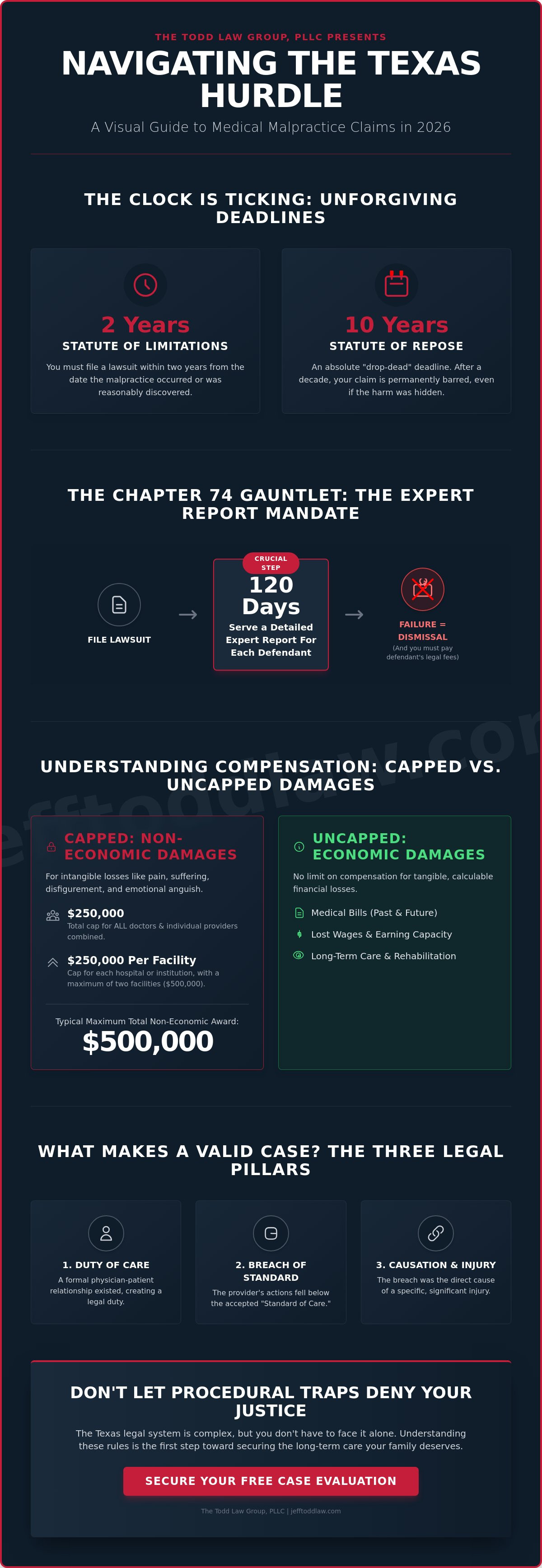
The first hurdle is the strict two-year statute of limitations. In most cases, you must file your lawsuit within two years of the negligent act or the completion of the treatment. While a rare "discovery rule" might extend this if the injury was impossible to find immediately, it's rarely granted. Texas also enforces an absolute ten-year statute of repose. This means if a decade passes, your claim is barred regardless of when you discovered the harm. Because these deadlines are unforgiving, contacting a medical malpractice attorney texas early is the only way to ensure your family's future isn't forfeited to a calendar error.
The Chapter 74 Expert Report Requirement
The most common reason cases fail in Texas isn't a lack of evidence, but a failure of process. Under Chapter 74, you must serve a detailed expert report for each defendant within 120 days of them filing an answer to your suit. This report must explicitly state the standard of care, how it was breached, and exactly how that breach caused your injury. If a judge deems the report "deficient," your case can be dismissed permanently. We prioritize vetting top-tier medical experts early in the process to ensure every report we file is battle-tested and immune to these dismissal tactics. If you're worried about these technicalities, it's helpful to partner with a firm that understands these procedural nuances.
Understanding Damage Caps for Texas Victims
Texas law places a "cap" or limit on non-economic damages, which includes compensation for physical pain, mental anguish, and loss of companionship. As of 2026, these limits are strictly enforced:
- $250,000 per claimant for all involved physicians or individual practitioners.
- $250,000 per claimant for a single healthcare facility like a hospital.
- $500,000 total cap for multiple facilities, though no single facility pays more than $250,000.
It's vital to remember that economic damages are generally not capped. This includes your mounting medical bills, the cost of future "corrective" surgeries, and your lost earning capacity. While the state limits your "pain," it doesn't limit your right to recover the actual financial costs of your long-term care.
Common Malpractice Claims in Texas Hospitals
Patients in major metropolitan hubs like Houston and Austin often assume that high-profile medical centers guarantee absolute safety. However, even the most prestigious institutions struggle with systemic pressures that can lead to devastating errors. In 2026, we continue to see a high volume of claims involving hospital-acquired infections and nursing staff errors, often stemming from understaffing or inadequate training protocols. These aren't just "accidents" but are frequently the result of administrative decisions that prioritize volume over patient safety. Understanding the landscape of Houston hospitals can help you identify if your injury was part of a broader pattern of negligence.
Obstetrical negligence is another area where we see significant harm, including controversial practices like the "Husband Stitch." This unauthorized and medically unnecessary procedure, performed after childbirth, represents a profound breach of trust and physical autonomy. When these systemic failures occur, the legal path forward is governed by the Texas Medical Liability Law (Chapter 74). Because the burden of proof is so high, a medical malpractice attorney texas must look beyond the individual error to find the root cause of the failure. This investigative depth is what separates a standard personal injury claim from a successful malpractice recovery.
Surgical Malpractice and Post-Operative Care
The operating room is a high-stakes environment where even a minor lapse in communication can be fatal. Anesthesia errors, such as improper intubation or dosage miscalculations, can result in permanent brain damage or "anesthesia awareness." Beyond the surgery itself, the recovery phase is equally critical. We often see cases where staff fail to monitor vital signs or ignore early indicators of internal bleeding or sepsis. Central to these claims is the concept of "informed consent." If a surgeon fails to disclose the specific risks of a procedure, and you suffer one of those undisclosed complications, you may have a valid claim even if the surgery was performed technically well.
Birth Injuries and Obstetrical Negligence
Birth injuries are perhaps the most heartbreaking form of malpractice because they carry a lifelong financial and emotional weight. Conditions like Cerebral Palsy or Brachial Plexus injuries often result from a physician's failure to perform a timely C-section when fetal distress is evident. When a baby is deprived of oxygen during delivery, every second counts. The resulting disability can require millions of dollars in long-term care, specialized education, and physical therapy. We focus on securing settlements that account for these future needs, ensuring your child's quality of life is protected despite the provider's negligence.
The Step-by-Step Process of a Texas Malpractice Claim
Entering the legal system after a medical injury can feel like entering a second trauma. To reach a successful resolution, you need a clear roadmap that accounts for the state's unique procedural traps. The process begins with an initial consultation where we evaluate the merits of your medical records. We don't just look for errors; we look for the legal weight required to overcome the hurdles discussed earlier. Securing a medical malpractice attorney texas ensures that this evaluation is grounded in years of case experience and an understanding of how local judges interpret liability.
After the initial audit, we move into the investigation phase. This involves gathering comprehensive records, pharmacy logs, and facility staffing charts. Once the evidence is organized, we secure the mandatory Chapter 74 expert report from a qualified physician. This is the "gatekeeper" document required to move your case forward. Following the filing of the lawsuit under the Texas Civil Practice and Remedies Code, we enter discovery and mediation. This is where we attempt to reach a fair settlement that covers your long-term care needs before a trial becomes necessary.
Phase 1: Record Gathering and Initial Audit
Our team goes beyond the standard paper files provided by a hospital. We investigate the "audit trails" within electronic medical records. These digital footprints are essential because they reveal exactly when a provider accessed your file and if any entries were modified after the injury occurred. This level of scrutiny is vital for uncovering the truth behind a "poor outcome." While we handle the heavy lifting of dealing with hospital legal departments, your personal timeline of events remains a critical tool. Your perspective helps us bridge the gap between what the records say and what actually happened in the room.
Phase 2: Litigation and the Path to Recovery
If a settlement isn't reached early, we move into the heart of litigation. Depositions play a central role here. These are formal interviews where we question doctors and nurses under oath to uncover what happened behind closed doors. These sessions often reveal the systemic failures that led to the individual error. We also spend significant time preparing you for mediation. This structured negotiation is designed to reduce trial anxiety while putting maximum pressure on the insurance companies. We maintain a "no fee unless we win" commitment to remove financial barriers from your path to justice. If you're ready to hold a negligent provider accountable, contact our team to begin your case evaluation.
Why The Todd Law Group, PLLC Is Your Partner in Restoration
Choosing a medical malpractice attorney texas is a decision that impacts your family's long-term stability and emotional well-being. Many firms treat these cases as purely financial transactions, focusing only on the final settlement number. At The Todd Law Group, PLLC, we take a different path. Our firm views legal representation as a holistic healing process. We understand that while a check can pay for medical bills, true restoration requires holding negligent parties accountable and securing the resources needed for a lifetime of care. This commitment to your total recovery is what defines our practice.
Attorney Jeff Todd brings a unique perspective to personal advocacy, having transitioned from an elite corporate legal environment to help individuals in distress. This high-caliber background provides The Todd Law Group, PLLC with the intellectual rigor necessary to match the sophisticated defense teams hired by major hospital systems. We maintain deep roots in Houston, Austin, and Galveston, ensuring we understand the local medical landscape and the specific challenges of each jurisdiction. You aren't just another case file; you're a neighbor seeking justice in our shared community.
We also recognize the immense financial pressure that follows a medical error. Grieving families shouldn't have to worry about legal fees while trying to "fix" a provider's mistake. The Todd Law Group, PLLC operates on a contingency fee structure, which means there are no upfront costs for our services. We take on the financial risk of the investigation and litigation phases, allowing you to focus on your physical and emotional recovery. If we don't secure a recovery for you, you don't owe us a fee.
Battle-Tested Experience in Texas Courts
Since his licensure in 1994, Jeff Todd has developed a prestigious professional history across major metropolitan legal hubs. This extensive case experience means The Todd Law Group, PLLC is comfortable in formal proceedings and efficient in its internal processes. We know how to navigate the "Texas Hurdle" because we've been doing it for decades. Our team is battle-tested and ready to advocate for the maximum compensation available under the law. We don't back down from complex litigation because we believe every patient deserves an elite level of representation.
Start Your Journey to Justice Today
Time is a critical factor in medical malpractice claims. Evidence can disappear, and the memories of witnesses can fade quickly. Taking immediate action is the best way to preserve the facts of your case before the hospital's legal department begins its defense. The Todd Law Group, PLLC offers a steady, reassuring hand through every step of the legal progression, from the initial record audit to the final resolution. You don't have to walk this path alone. Contact The Todd Law Group, PLLC today for a free case evaluation and begin your journey toward total restoration.
Take Control of Your Legal Path to Restoration
The journey through a medical injury is physically and emotionally draining, but the legal path doesn't have to be a source of additional stress. By understanding the rigorous Chapter 74 expert report requirements and the specific damage caps in our state, you've already taken the first step toward reclaiming your future. Remember that while Texas law limits non-economic compensation, your right to recover the full cost of medical bills and lost wages remains protected. Partnering with a skilled medical malpractice attorney texas ensures that every procedural detail is handled with the precision your case deserves.
Jeff Todd has been licensed in Texas since 1994 and maintains a dedicated presence with offices in Houston, Austin, and Galveston. We operate on contingency-based fees, so you pay nothing unless we win your case. Our goal is your total restoration, applying the intellectual rigor of a corporate background to your personal advocacy. You don't have to face the healthcare system's legal teams alone. Secure your dedicated advocate—Schedule your free consultation with Jeff Todd today. We are here to provide the steady reassurance and battle-tested experience you need to move forward with confidence.
Frequently Asked Questions
How long do I have to file a medical malpractice claim in Texas?
You generally have two years from the date of the negligent act or the completion of treatment to file a formal claim. Texas also enforces an absolute ten-year statute of repose, which bars any lawsuit regardless of when you discovered the injury. Because these deadlines are strictly enforced by state courts, consulting a medical malpractice attorney texas as soon as you suspect an error is vital to preserving your legal rights.
What is the "Standard of Care" and how is it proven?
The standard of care is the level of skill and treatment that a reasonably prudent healthcare provider would offer under similar circumstances. In Texas, this benchmark is proven through the testimony of medical experts who practice in the same or a similar specialty. These experts analyze your records to determine if your provider’s actions deviated from accepted professional norms, directly leading to your physical harm or disability.
Can I still sue if I signed an informed consent form?
Yes, signing a consent form doesn't give a provider permission to be negligent or provide substandard care. While you acknowledge the inherent risks of a procedure, you don't waive your right to competent medical treatment. If a surgeon makes a mistake that falls below the standard of care or fails to disclose a specific, known risk that later occurs, you may still have a valid legal claim for damages.
Are there caps on how much money I can receive in a Texas malpractice suit?
Texas law places a $250,000 cap on non-economic damages, such as pain and suffering, against individual physicians or practitioners. There are separate $250,000 caps for hospitals, with a total potential non-economic recovery of $500,000 if multiple healthcare facilities are involved in the negligence. It's important to remember that economic damages, including your actual medical bills and lost wages, are generally not subject to these caps.
What is a Chapter 74 expert report and why is it mandatory?
A Chapter 74 report is a written summary by a qualified medical expert that details how a provider breached the standard of care and caused your specific injury. It's mandatory under the Texas Civil Practice and Remedies Code and must be served to the defendant within 120 days of their initial answer to your lawsuit. If the report is deemed deficient or is filed late, a judge will likely dismiss your case permanently.
How much does it cost to hire a medical malpractice attorney in Texas?
Most reputable firms work on a contingency fee basis, which means you pay nothing upfront for legal representation. The attorney's fees are calculated as a percentage of the final settlement or court award, typically ranging from 33% to 40% depending on the case's complexity. This structure ensures that families can access high-caliber legal advocacy without the burden of hourly billing or the need for an initial retainer during a crisis.
Can I sue a state-owned or university hospital in Texas?
You can sue state-owned facilities, but these cases are governed by the Texas Tort Claims Act, which involves much stricter notice requirements and lower damage caps. You must often provide formal notice of your claim within six months of the injury, which is significantly shorter than the standard two-year statute of limitations. These cases require a sophisticated legal strategy to overcome specific immunity protections granted to government entities.
What happens if the medical error resulted in a wrongful death?
If a medical error leads to a fatality, the surviving spouse, children, or parents can file a wrongful death claim to seek justice. These cases allow families to recover compensation for lost financial support, funeral expenses, and the loss of emotional companionship. While non-economic damage caps still apply, the specific cap for wrongful death in medical malpractice is adjusted for inflation to help families secure their financial future after a loss.


