

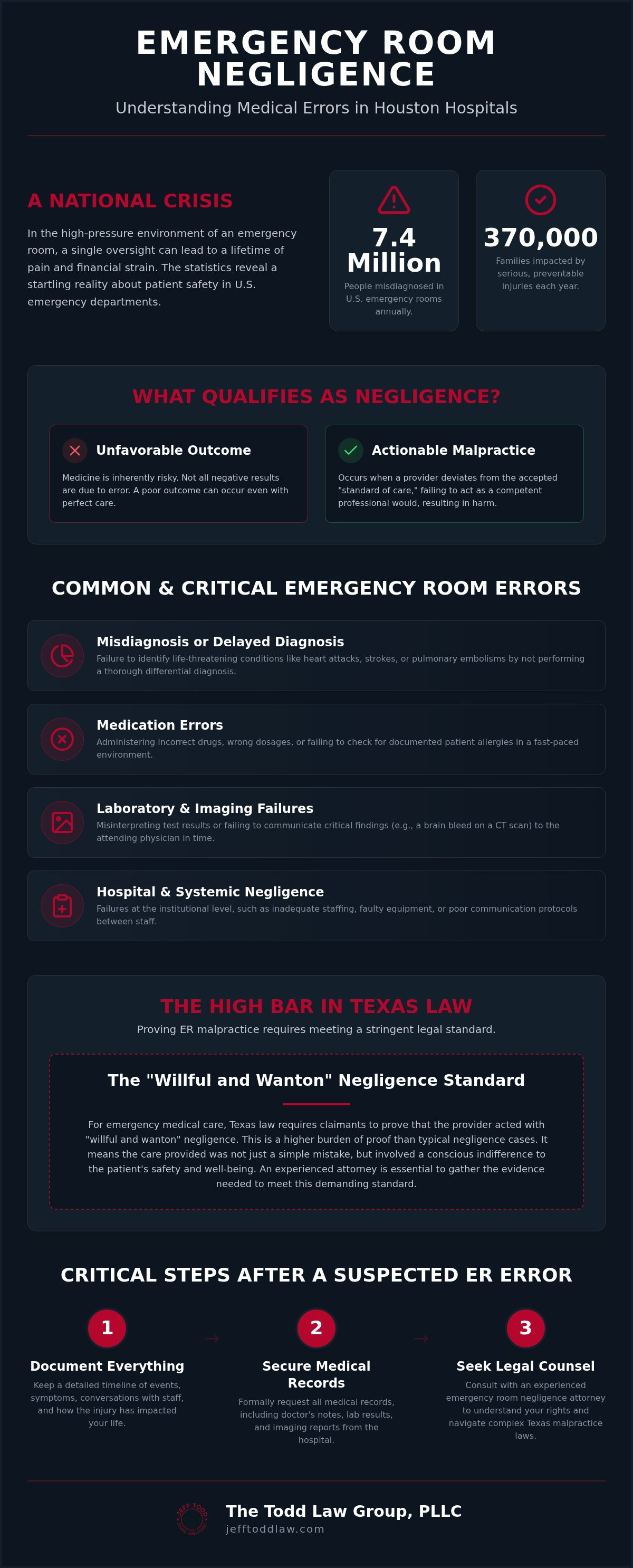
Did you know that approximately 7.4 million people are misdiagnosed in American emergency rooms every year, leaving 370,000 families to grapple with serious, preventable injuries? In the high-pressure environment of a hospital, a single oversight can lead to a lifetime of physical pain and financial strain. If you have suffered due to a provider's mistake, partnering with a seasoned emergency room negligence attorney Houston residents rely on is the first step toward restoring your quality of life and securing your family's future.
It's understandable to feel overwhelmed by the weight of mounting medical bills and the confusion of complex Texas malpractice laws. You deserve to focus on your physical recovery while a professional manages the intellectual rigor of your legal claim. We'll show you how to navigate the "willful and wanton" negligence standard used in Texas courts and what it takes to secure the maximum compensation for your care. This article provides a clear roadmap through the litigation process, from meeting expert report deadlines to understanding damage caps, ensuring you have the knowledge to hold negligent institutions accountable.
Key Takeaways
- Learn the legal distinction between an unfavorable medical outcome and actionable malpractice to determine if you have a valid claim against a Houston hospital.
- Identify common emergency room errors, such as misdiagnosed heart attacks or medication mistakes, that frequently lead to serious patient harm.
- Understand how the "willful and wanton" standard under Texas law impacts your case and why an experienced emergency room negligence attorney Houston residents trust is essential to meet this high burden of proof.
- Discover the critical steps to take immediately following a medical error, including how to properly document your care timeline and secure vital medical records.
- Explore how a holistic approach to legal advocacy can help your family manage mounting bills while focusing on physical and emotional restoration.
What Qualifies as Emergency Room Negligence in Houston?
Emergency room negligence occurs when a healthcare provider's actions deviate from the accepted standard of care in a Houston medical setting. It's a specific legal threshold that goes beyond a simple mistake; it involves a failure to provide the level of care that a competent professional would have offered under similar circumstances. When these failures result in serious injury or death, it may be necessary to consult an emergency room negligence attorney Houston residents rely on to investigate the specific details of the incident.
It's vital to understand the difference between an "unfavorable outcome" and actionable Medical malpractice. Medicine is inherently risky, and even with perfect care, patients don't always have a positive result. However, when a provider ignores a clear symptom or fails to follow established protocols, the line is crossed. The Texas Medical Board plays a central role here, as they establish the ethical and professional standards that all licensed physicians in the state must follow. If those standards are ignored, the provider or the facility may be held liable for the resulting harm.
Determining liability also requires looking at the roles of different entities within the hospital environment. Negligence can be attributed to an individual physician's poor judgment, or it can be classified as hospital negligence. The latter often involves systemic issues that compromise patient safety, such as:
- Inadequate staffing levels that lead to dangerous wait times in the lobby.
- Failure to maintain or properly calibrate essential diagnostic equipment.
- Poor communication protocols between triage nurses and attending doctors during shift changes.
The Standard of Care in Texas Emergency Rooms
The standard of care isn't a fixed rule; it's a flexible benchmark based on what a "reasonably prudent" professional would do in a similar situation. In a city like Houston, this benchmark is heavily influenced by the facility's resources and designation. A doctor working in a high-intensity environment like a Level 1 Trauma Center is held to a different standard than a provider at a small, standalone urgent care clinic. In Houston, the standard of care is defined by what a competent healthcare provider with similar training would have done when faced with the same emergency circumstances in a comparable local facility.
Duty of Care and the Patient-Provider Relationship
A legal duty of care typically begins the moment you present yourself for treatment in a Houston ER lobby. This relationship is reinforced by the Emergency Medical Treatment and Labor Act (EMTALA), which requires hospitals to provide a stabilizing examination to anyone with an emergency medical condition regardless of their ability to pay. However, the path to legal recovery can change based on the type of facility. Claims against private hospital systems follow standard civil procedures, while cases involving county facilities like Ben Taub may involve stricter notice requirements under the Texas Tort Claims Act. Your emergency room negligence attorney Houston advocate will navigate these distinctions to ensure your rights are protected throughout the legal and healing process.
Common ER Errors Leading to Malpractice Claims
The emergency room is a place of triage and rapid decision-making. While the pace is fast, the legal obligations remain firm. Many families find themselves needing an emergency room negligence attorney Houston advocate after a provider fails to identify a critical condition. Misdiagnosis of life-threatening events like heart attacks, strokes, or pulmonary embolisms remains a leading cause of litigation. These errors often occur because a physician failed to perform a thorough differential diagnosis. This is the process of ruling out the most dangerous possibilities before settling on a minor one.
Medication errors also plague busy ERs. In the rush to treat trauma, staff may administer incorrect dosages or fail to check for documented allergies. Similarly, surgical errors can occur during emergency interventions when surgeons bypass standard safety checks. Laboratory and imaging failures are equally devastating. If a radiologist identifies a brain bleed but the attending physician fails to read the report or communicate the results, the window for life-saving treatment closes. Proving that these mistakes constitute legal negligence requires a deep understanding of Texas Civil Practice and Remedies Code § 74.153, which sets the specific standards for emergency care liability.
Diagnostic Errors: The Most Frequent ER Failure
An ER doctor’s primary responsibility is to ensure a patient isn't in immediate danger. When they miss a subtle symptom of head injury in a Houston trauma patient, the results are often catastrophic. These diagnostic failures frequently happen when staff are distracted or when they dismiss a patient’s concerns due to implicit biases. "Ruling out" the most dangerous condition isn't just a best practice; it's the primary job of any emergency professional. If a doctor fails to order a CT scan for a patient with clear neurological deficits, they've arguably breached their duty of care.
Systemic Failures: Staffing and Overcrowding
Not every error is the fault of a single doctor. Systemic issues in Houston hospitals, such as chronic nursing shortages, often lead to a failure to monitor patients properly. If a hospital’s policies prioritize patient throughput over safety, they create a dangerous environment. Administrative negligence can manifest as improper discharge, where a patient is released before they are medically stable. This "failure to stabilize" is a common ground for malpractice claims that many generic legal guides overlook. If you suspect your injury was caused by a hospital's chaotic environment, speaking with an emergency room negligence attorney Houston professional can help you identify if the facility's policies were to blame.
Proving Malpractice: The 'Willful and Wanton' Standard in Texas
Texas law is notoriously difficult for plaintiffs in ER cases. Under Chapter 74 of the Texas Civil Practice and Remedies Code, victims must prove more than a simple mistake. While ordinary medical malpractice requires showing a breach of the standard of care, emergency care requires proving "willful and wanton negligence." This means the provider acted with a conscious indifference to a substantial risk of harm. An emergency room negligence attorney Houston families trust must be able to demonstrate that the doctor knew about a risk but chose to ignore it anyway.
This higher burden of proof exists to shield providers from liability during life-saving, high-pressure situations. However, it doesn't mean hospitals have a free pass. The Emergency Medical Treatment & Labor Act (EMTALA) still requires every facility to provide a stabilizing examination. If a hospital fails this basic federal duty, the "willful and wanton" standard becomes the central battleground of the lawsuit. It's the highest hurdle in Texas medical law, and overcoming it requires meticulous evidence gathering.
The Role of Expert Witnesses in Houston Cases
You can't simply claim a doctor was reckless; you need a peer to verify it. In Texas, you must file an "Expert Report" within 120 days of the defendant's answer. This report must be written by a board-certified ER physician who understands the specific pressures of a Houston trauma center. The Todd Law Group maintains relationships with top-tier medical experts to ensure your case meets this rigorous technical requirement. Without a precise report that links the provider's actions to your specific injury, the court will likely dismiss your case before it ever reaches a jury.
Overcoming the "Chaos Defense"
Hospitals often rely on the "chaos defense," arguing that the stress of a busy ER justifies a missed diagnosis or a treatment delay. They attempt to use the high volume of patients in Houston facilities as a shield for poor performance. Our strategy focuses on proving the error wasn't a byproduct of a busy night but a conscious disregard for patient safety. Texas law protects doctors from the consequences of split-second decisions, but it does not grant them immunity for reckless disregard. We analyze staffing logs and medical records to show that the failure was a calculated choice to bypass safety protocols.
Steps to Take Following an ER Error in Houston
When a medical error occurs, the immediate aftermath is often a blur of pain and confusion. Taking proactive steps today is essential for protecting your legal rights later. Start by documenting everything while the details are fresh. Create a detailed timeline of events that includes the names of triage nurses, technicians, and attending physicians you encountered. This record becomes a vital piece of evidence for your emergency room negligence attorney Houston advocate when they begin investigating the standard of care provided during your visit.
Preserving physical evidence is equally critical for your case. Keep all discharge papers, hospital wristbands, and prescriptions exactly as they were given to you. It's also important to maintain silence during this period. Avoid the temptation to share your experience on social media or speak with hospital risk management teams without legal representation. These teams are trained to minimize the facility's liability, and statements made in the heat of the moment can inadvertently damage your potential claim.
Securing Your Houston Medical Records
Navigating the Health Information Management (HIM) departments of major Houston systems can be a bureaucratic challenge. You have a legal right to your complete file, including physician progress notes and raw imaging results. Beyond the standard summary, your legal team will look for "audit trails" in the electronic health records. These trails show exactly who accessed your file and at what time, which can reveal if records were altered after an error was discovered. For more general evidence preservation tips, consult our Houston personal injury lawyer guide.
Consulting a Houston Emergency Room Negligence Attorney
The initial consultation is your most powerful tool for assessing the high Chapter 74 hurdles previously mentioned. When you meet with Jeff Todd, who has been licensed in Texas since 1994, bring every document you have gathered. This includes medical bills, insurance correspondence, and your personal timeline. Texas law generally requires you to file a medical malpractice claim within two years of the incident. Waiting too long can permanently bar you from seeking justice. Acting quickly allows your legal team to secure witness statements and expert reviews before memories fade or evidence is lost. If you're ready to hold a negligent facility accountable, speak with us regarding your case today.
Why Choose The Todd Law Group for Your ER Malpractice Case?
Selecting the right legal partner is a pivotal decision in your family's recovery journey. Jeff Todd has been licensed to practice law in Texas since 1994, bringing over three decades of experience to every case. This tenure provides a deep understanding of the specific statutes and local court procedures that govern the Houston legal community. We've built our reputation on a foundation of intellectual rigor, transitioning the same high-level strategy used in elite corporate environments to the personal advocacy of individuals injured by medical errors.
Our firm is deeply rooted in the Houston, Austin, and Galveston areas. We don't view your case as a mere financial transaction; instead, we approach legal representation as a holistic healing process. We recognize that the physical pain of a medical error is compounded by the stress of mounting medical bills and the confusion of navigating a complex legal system. By serving as your stable partner, we manage the logistical burdens so you can focus on your total restoration. You'll never face an upfront financial barrier when seeking justice, as our litigation is entirely contingency-based. You pay nothing unless we win your case and recover the compensation you deserve.
A Battle-Tested Advocate for Houston Families
Houston is home to some of the largest medical institutions in the world, including the prestigious Texas Medical Center. While these facilities provide essential care, they are backed by massive legal teams designed to protect their interests at all costs. We aren't intimidated by these organizations. Our firm applies battle-tested rigor to hold even the largest hospital systems accountable for their mistakes. For a broader look at how we navigate these challenges across the state, explore our medical malpractice attorney Texas pillar. We combine sophisticated professional history with a dedicated, personal touch to ensure no detail is overlooked.
Contact a Houston Emergency Room Negligence Attorney Today
Our service-first philosophy means we prioritize your immediate logistical needs from the moment we begin our partnership. We understand that time is of the essence when dealing with Chapter 74 deadlines and evidence preservation. If you suspect that a deviation from the standard of care caused your injury, don't wait to seek professional guidance. Our team is ready to evaluate your situation with the intellectual rigor and compassionate advocacy your family deserves. Contact an emergency room negligence attorney Houston expert today for a free case evaluation and take the first step toward securing your future stability.
Securing Your Family’s Future After an Emergency Room Error
Recovery from a medical error is a long road, but you don't have to walk it alone. We've explored how the "willful and wanton" standard makes Texas ER cases uniquely challenging and why immediate evidence preservation is critical for your claim. By understanding your rights and the local standards of care, you can transition from a victim of negligence to an empowered advocate for your own restoration.
Attorney Jeff Todd has been licensed since 1994 and applies corporate-level rigor to every medical malpractice case he handles. Our firm provides personalized advocacy with a no-recovery, no-fee guarantee, ensuring your financial stability remains protected while we pursue justice. If you're ready to hold a hospital accountable, an experienced emergency room negligence attorney Houston families trust can help you navigate the complex path to healing.
Contact The Todd Law Group, PLLC today for a free evaluation of your Houston ER negligence case. We're here to help you move forward with confidence and peace of mind.
Frequently Asked Questions
Is it hard to sue an emergency room in Texas?
Yes, suing an ER in Texas is significantly more difficult than other medical malpractice claims because of specific statutory protections for emergency care providers. Texas law requires plaintiffs to meet a much higher burden of proof than ordinary negligence. This legal barrier is designed to protect doctors making split-second decisions. You'll need a seasoned emergency room negligence attorney Houston expert to navigate these obstacles and identify if the provider's actions crossed the line into actionable legal liability.
What is the "willful and wanton" standard for Texas ER cases?
The "willful and wanton" standard is a legal threshold requiring proof that a provider acted with conscious indifference to a substantial risk of harm. Unlike ordinary negligence, which covers simple mistakes, this standard requires showing the doctor knew a risk existed but chose to ignore it. This standard generally applies to care provided in a hospital emergency department. It does not typically apply to non-emergency care or treatment provided in certain freestanding emergency rooms throughout the Houston area.
How long do I have to file an ER negligence lawsuit in Houston?
You generally have two years from the date of the negligent act or the completion of treatment to file a lawsuit in Texas. There is also a ten-year statute of repose, which serves as an absolute deadline regardless of when the injury was discovered. Because medical malpractice cases require extensive investigation and expert reports, you should contact an emergency room negligence attorney Houston advocate immediately. Missing these deadlines will permanently bar you from seeking compensation.
Can I sue the hospital if the ER doctor was an independent contractor?
You can often hold a hospital liable even if the physician is an independent contractor through the legal doctrine of "ostensible agency." If the hospital led you to believe the doctor was an employee, or if they failed to clearly disclose the contractor status, they may still be vicariously liable for the negligence. This is a complex area of litigation that requires reviewing hospital contracts and intake forms. We investigate these relationships to ensure all responsible parties are held accountable.
What damages can I recover in a Houston medical malpractice case?
You can recover both economic and non-economic damages, though Texas law imposes strict limits on the latter. Economic damages include medical bills, lost wages, and future care costs, which are not capped. Non-economic damages for pain and suffering are capped at $250,000 for all healthcare providers combined. For institutions, the cap is $250,000 per facility, with a maximum aggregate cap of $500,000. These limits make maximizing your economic recovery a top priority for our team.
What happens if the ER failed to diagnose my heart attack?
Failing to diagnose a heart attack is one of the most common grounds for a malpractice claim in Houston. If the ER staff ignored classic symptoms or failed to perform an EKG, they may have breached the standard of care. To succeed, you must demonstrate that the delay in diagnosis directly caused a worse outcome, such as permanent heart muscle damage. We analyze triage logs and cardiac enzyme tests to prove that the failure was a result of gross negligence.
Do I need an expert witness for an ER negligence claim?
Yes, Texas law strictly requires an expert report from a qualified physician to proceed with any medical malpractice claim. This report must be served on the defendant within 120 days of their initial answer to the lawsuit. The expert must be board-certified in a relevant field and have experience in emergency medicine. Without this testimony, the court will dismiss your case. We coordinate with highly qualified medical experts to ensure your claim meets these technical requirements.
Will my ER malpractice case have to go to trial in Houston?
Most medical malpractice cases settle before reaching a courtroom, but your case must be prepared as if a trial is inevitable. Insurance companies for major Houston hospitals are more likely to offer a fair settlement if they see your legal team is ready for litigation. Jeff Todd, who has been licensed since 1994, uses his extensive experience to build a trial-ready case. This proactive approach creates the leverage needed to secure a favorable outcome during mediation or at trial.


