
If you trip on a broken walkway or slip on a spill at a local shop, is the resulting medical debt yours to carry alone? Many Texans feel a sense of hesitation or even guilt when considering a claim against a business owner or a neighbor. It's natural to feel overwhelmed by physical pain while also struggling to decipher complex legal terms like invitee or licensee. You shouldn't have to manage this burden while focusing on your physical recovery. Partnering with a dedicated Texas premises liability lawyer ensures that your case is handled with the intellectual rigor of a corporate background and the compassion of a local advocate.
We recognize that an injury is more than just a legal case; it's a disruption to your life and financial stability. This article provides a clear path forward, explaining how Texas property laws protect you and what steps are necessary to hold negligent parties accountable. You'll learn about the strict two-year filing deadline and how the state's modified comparative negligence rules affect your compensation. By understanding the legal timeline and your specific status as a visitor, you can move from a place of uncertainty toward a holistic healing process and the total restoration you deserve.
Key Takeaways
- Understand how the Texas Civil Practice and Remedies Code defines a property owner's legal obligation to maintain a safe environment for all visitors.
- Learn why your legal classification as an invitee or licensee determines the specific level of care you're owed and your right to recover damages.
- Identify common dangerous conditions, from structural defects to liquid spills, that often provide the legal grounds for a negligence claim.
- Discover the critical actions you should take during the "Golden Hour" after an injury to preserve evidence and protect your legal rights.
- Find out how a Texas premises liability lawyer uses forensic investigation and corporate-level rigor to hold negligent parties accountable for your recovery.
What Is a Premises Liability Claim in Texas?
In Texas, Premises liability refers to the legal responsibility a property owner holds when someone is injured due to a dangerous condition on their land. These cases are governed by the Texas Civil Practice and Remedies Code, which establishes that ownership comes with a mandate to maintain a safe environment. It's vital to distinguish between a simple, unavoidable accident and legally actionable negligence. While an accident might involve a person tripping over their own feet, negligence occurs when a property owner fails to address a foreseeable risk they knew about.
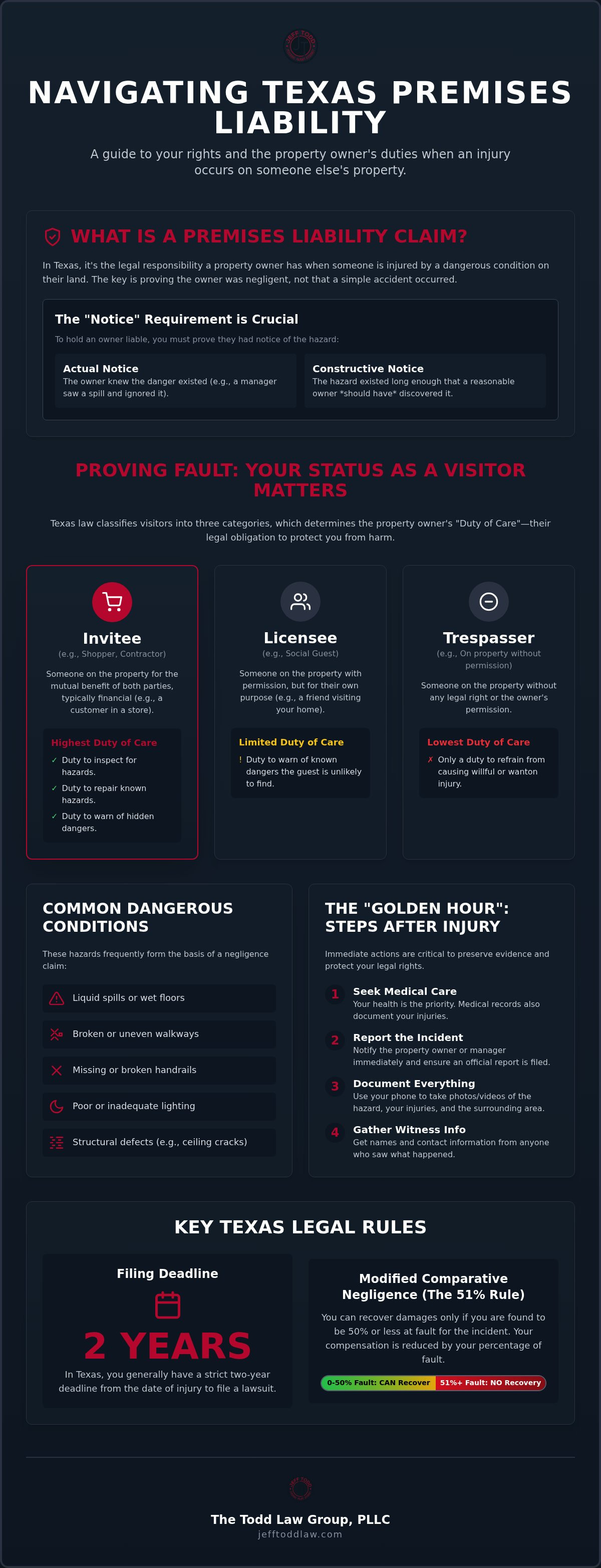
The "notice" requirement is the central pillar of any successful claim. For a property owner to be held liable, you must prove they had actual or constructive notice of the hazard. Actual notice means they knew the danger existed, like a manager seeing a leak and walking past it. Constructive notice means the hazard existed for so long that a reasonable owner should have discovered it. Proving this requires the meticulous investigation that only an experienced Texas premises liability lawyer can provide.
The Legal Duty of Care
Duty of Care is the standard of conduct a reasonable person would follow to prevent foreseeable harm. In Texas, this duty shifts depending on whether the property is commercial or residential. Businesses that invite the public in for profit generally face a more rigorous standard than a private homeowner. Texas law is particularly demanding regarding the evidence needed to prove a breach of this duty. You need more than just a description of the injury; you need proof that the owner's failure to act was the direct cause of your suffering.
Premises Liability vs. General Negligence
Premises liability is a specific subset of personal injury law, and it's often confused with general negligence. The difference lies in what caused the injury. General negligence involves an ongoing activity, such as a store clerk hitting a customer with a cart. Premises liability involves a static condition on the property, like a missing handrail or a poorly lit stairwell. Selecting the correct legal theory is a critical step for your Houston personal injury lawyer. If the wrong theory is applied, the defense can move for a summary judgment to dismiss your case. Relying on a Texas premises liability lawyer with elite corporate rigor ensures that every technical detail of your filing is accurate from the start.
Proving Fault: The Three Categories of Visitors Under Texas Law
Not all individuals who enter a property are entitled to the same level of protection. Texas law divides visitors into three distinct legal categories. Your status at the exact moment of your injury is the primary factor that dictates whether you can recover damages. This classification system is part of the broader Texas Civil Practice and Remedies Code. If you're unsure where you fit, consulting with a Texas premises liability lawyer early in the process is essential to prevent the defense from mischaracterizing your presence on the land.
Invitees, Licensees, and Trespassers
Invitees are owed the highest duty of care. These are usually business guests, such as shoppers in a grocery store or contractors hired for repairs. Property owners have an active duty to inspect the premises, repair known hazards, and warn of any hidden dangers that a reasonable inspection would have revealed. If you were on the property for the owner's financial benefit, you likely fall into this bucket.
Licensees are social guests who have permission to be on the property but are visiting for their own purposes. For these individuals, the owner's responsibility is more limited. They only have a duty to warn of known dangerous conditions that the licensee is unlikely to discover. Finally, trespassers are on the property without any legal right. In these cases, the owner's only obligation is to refrain from causing willful or wanton injury. Because the stakes are so high, property owners frequently attempt to "demote" an invitee to a licensee or trespasser to escape their legal obligations.
Texas Modified Comparative Negligence
Texas follows a proportionate responsibility rule, often called the 51% Rule. This means you can still secure compensation as long as your own fault for the incident doesn't exceed 50%. If a jury finds you 51% responsible, you're barred from any recovery. Insurance companies often exploit this by using "open and obvious" defenses. They'll claim you should have seen the hazard and avoided it yourself, effectively shifting the blame to the victim. A skilled premises liability attorney counters the "comparative fault" argument by proving the owner's negligence was the primary catalyst for the harm.
Proving your status and rebutting claims of shared fault requires a proactive, evidence-based approach. If you've been injured and face an insurance company trying to shift the blame, you should contact an experienced advocate to ensure your rights remain protected throughout the legal process.
Common Dangerous Conditions Leading to Property Injury Claims
Premises liability isn't limited to a single type of accident. While many people associate these claims strictly with slip and fall incidents, the reality involves a wide array of hazards that property owners often overlook. From structural failures like broken staircases and crumbling walkways to environmental issues like poor lighting in a parking garage, these conditions create significant risks for unsuspecting visitors. A seasoned Texas premises liability lawyer understands that these hazards are rarely random; they're often the result of systemic maintenance failures.
Specific dangers that frequently lead to actionable claims include:
- Liquid spills and waxed floors without appropriate warning signs.
- Loose floor mats, bunched carpeting, or uneven transitions between flooring types.
- Unsecured swimming pools or construction sites that act as an "attractive nuisance" to children.
- Structural defects like rusted handrails or rotting balcony supports.
Retail and Commercial Hazards
In retail settings, the timing of a response is everything. If a spill remains on the floor for an unreasonable amount of time, the business is likely liable for any resulting injuries. Big-box stores also present unique risks from improperly shelved merchandise that can fall and cause severe trauma. Exterior hazards are just as critical. Potholes, poor drainage, and inadequate lighting in parking lots frequently lead to broken bones or head injuries. These cases require a sophisticated legal approach to prove that the owner failed in their duty to inspect the premises regularly.
Negligent Security and Third-Party Crimes
Property owners in certain areas have a duty to provide adequate protection for their guests. If an owner fails to provide functional gate locks, bright security lighting, or visible guards, they may be held responsible for third-party crimes like assault or robbery. Under the Texas Civil Practice and Remedies Code, proving liability for a crime requires showing that the event was foreseeable. This usually involves analyzing past incidents at the location to establish a pattern of danger that the owner ignored.
Proving these cases requires more than just showing an injury occurred. It involves demonstrating that a specific condition was dangerous and that the owner failed to mitigate that risk despite having the opportunity to do so. When you're facing overwhelming medical debt due to a property owner's oversight, a Texas premises liability lawyer provides the intellectual rigor needed to hold the negligent party accountable and secure the compensation you deserve.
Steps to Protect Your Rights After an Injury on Someone Else’s Property
Shock and pain often cloud the moments following a serious injury. However, the actions you take during this "Golden Hour" are the foundation of your future recovery. Your first priority is always immediate medical care. Not only does this ensure your safety, but it also creates a formal medical record that links your injuries directly to the incident. Once you're stable, you must report the injury to the property manager or owner. Request a written copy of the report, but do not provide any detailed statements about fault or blame at this stage.
Insurance adjusters often reach out shortly after an accident to request a "recorded statement." You should politely decline. These representatives are trained to elicit comments that can be used to shift blame onto you, potentially triggering the 51% bar on recovery discussed earlier. Before speaking with any insurance entity, consult a Texas premises liability lawyer to ensure your words aren't twisted to undermine your claim.
Evidence Collection Checklist
Physical evidence on a property can disappear in minutes. Spills are mopped up and broken equipment is repaired as soon as an owner realizes liability is a factor. To protect your case, follow this checklist:
- Capture the Hazard: Take clear photographs and video of the exact condition that caused your fall from multiple angles.
- Identify Witnesses: Secure the names and phone numbers of anyone who saw the incident or the dangerous condition.
- Preserve Your Gear: Save the clothing and shoes you were wearing. Do not wash them. The condition of your footwear is a common target for defense attorneys trying to prove the accident was your fault.
The Legal Timeline and Recovery
Under the Texas Civil Practice and Remedies Code § 16.003, you generally have a two-year window from the date of the injury to file a lawsuit. If you miss this deadline, your right to seek compensation is likely lost forever. This recovery includes economic damages for medical bills and lost wages, as well as non-economic damages for physical pain and emotional distress. You should never sign a settlement release without a Houston car accident lawyer or personal injury specialist reviewing the terms. These documents often waive your right to future claims if your injuries worsen.
Securing your financial stability requires a proactive approach and meticulous attention to detail. If you're ready to hold a negligent party accountable, reach out to our experienced legal team for a thorough evaluation of your case.
How a Texas Premises Liability Lawyer Secures Your Maximum Recovery
Securing the maximum recovery in a complex property injury case requires more than just identifying a hazard. It demands a sophisticated legal strategy that anticipates the specific tactics insurance companies use to devalue your suffering. By choosing a Texas premises liability lawyer with a background in elite corporate law, you gain an advocate who understands how to dismantle high-stakes defense arguments. We operate on a contingency fee basis, meaning there is no fee unless our firm wins a recovery for you. This "No-Fee Guarantee" ensures you have access to top-tier representation without any upfront financial burden.
To prove a property owner had constructive notice or that a condition was truly dangerous, we often deploy forensic experts. These specialists conduct slip-resistance testing on flooring or perform lighting analysis to demonstrate that a staircase or parking lot was unsafe. This technical evidence is vital for overcoming the "open and obvious" defenses frequently used by property owners to shift blame. We don't guess about the cause of your injury; we prove it through meticulous investigation and data-driven proof.
Strategic Litigation and Negotiation
Jeff Todd has been licensed in Texas since 1994, bringing over 30 years of experience to every case. This deep history in the Texas court system allows us to navigate local procedural nuances that less experienced firms might miss. We aren't intimidated by multi-million dollar insurance companies or their massive legal teams. Our firm maintains physical offices in Houston, Austin, and Galveston to provide dedicated local support for our neighbors. We treat your case with the intellectual rigor of a corporate merger while maintaining the heart of a personal advocate. This battle-tested approach ensures that we negotiate from a position of strength, ready to take your case to trial if a fair settlement isn't offered.
Holistic Advocacy for Your Future
Our "Total Restoration" philosophy views legal representation as part of a broader healing process. We don't just focus on the financial transaction; we focus on your physical and emotional well-being. This includes connecting you with top-tier medical specialists who can provide the advanced care needed for your specific injuries. We manage the overwhelming logistical burden of insurance paperwork, medical billing, and evidence collection so you can devote your energy to healing. You aren't just another file in our system. You're a member of our community who deserves a stable partner during a difficult time.
Schedule your free consultation with Jeff Todd today to take the first step toward your recovery and hold the negligent parties accountable.
Take the First Step Toward Your Total Restoration
Navigating the aftermath of a property injury is a heavy burden, but you don't have to carry it alone. By understanding your legal visitor status and the importance of the two-year statute of limitations, you've already taken the first step toward securing your future. Whether your injury resulted from a structural defect or a retail hazard, the law exists to hold negligent parties accountable for the harm they cause. Your recovery is about more than just a financial transaction; it's about regaining your mobility and financial stability.
Partnering with a dedicated Texas premises liability lawyer ensures that your case is handled with the intellectual rigor of a corporate background and the heart of a local advocate. Jeff Todd has been licensed in Texas since 1994, providing battle-tested representation across Houston, Austin, and Galveston. We operate on a contingency fee basis, so you pay no fee unless we win a recovery for you. Don't let medical debt or legal confusion stall your healing process. Get a Free Case Evaluation from Jeff Todd today and let us handle the logistical weight while you focus on your physical recovery. You deserve a stable partner in this journey.
Frequently Asked Questions
Is the property owner always at fault for a slip and fall in Texas?
No, property owners aren't automatically liable for every fall on their land. To win a case, you must prove the owner knew about a dangerous condition or should have discovered it through reasonable inspection. Under the Texas Civil Practice and Remedies Code, the owner's responsibility hinges on their "notice" of the hazard. If an accident was unavoidable or the danger was open and obvious, the owner might successfully defend against the claim.
How much is a typical premises liability settlement in Texas?
Settlement values vary based on the severity of your injuries and the impact on your lifestyle. Factors include total medical debt, lost wages, and long-term mobility issues. While Texas doesn't cap damages in most private cases, claims against government entities have strict limits, such as a $250,000 cap per person for bodily injury against a municipality. Every case is unique, so a Texas premises liability lawyer must evaluate your specific losses to determine a fair value.
Can I sue for a slip and fall if there was a "Wet Floor" sign?
You may still have a valid claim if the warning was inadequate or poorly placed. A sign doesn't provide absolute immunity to a business owner if it was obscured, placed too far from the hazard, or if the floor remained dangerous for an unreasonable amount of time. The court will determine if the warning was sufficient to protect a reasonable visitor. If the owner failed to properly cordone off a high-risk area, liability might still apply.
What if I was injured at a friend’s house; will I be suing them personally?
While the lawsuit technically names the property owner, you're primarily seeking a recovery from their homeowner's insurance policy. These policies exist specifically to provide financial stability for guests injured on the premises. Most cases are settled directly with the insurance carrier without ever depleting your friend's personal savings. It's a professional legal process aimed at ensuring your medical treatments are covered through the appropriate insurance channels rather than personal conflict.
How long do I have to file a premises liability lawsuit in Texas?
Under Texas Civil Practice and Remedies Code §16.003, the statute of limitations is generally two years from the date of the injury. If you fail to file within this window, you'll likely lose your right to any compensation. However, claims against local or state government agencies often have much shorter notice deadlines, sometimes as brief as six months. It's critical to consult a Texas premises liability lawyer early to ensure all procedural requirements are met.
Do I need a lawyer if the insurance company offered me a settlement?
It's vital to have a professional review any offer before you sign a release. Insurance companies often propose quick settlements that don't account for future medical needs or the full extent of your physical pain. A seasoned attorney uses corporate-level rigor to calculate the true cost of your recovery. Once you accept an offer and sign the paperwork, you're barred from seeking more money, even if your injury requires additional surgery or therapy later.
What is the "Attractive Nuisance" doctrine in Texas?
This doctrine protects children who are injured while trespassing because they were drawn to a dangerous feature on a property. Common examples include unsecured swimming pools, fountains, or heavy machinery. Owners have a duty to secure these items because children may not grasp the inherent risks. If an owner fails to provide adequate fencing or locks for an "attractive" hazard, they can be held liable for any resulting injuries to a child on their land.
Can I still recover damages if I was partially distracted when I fell?
Yes, you can recover damages as long as you're found to be 50% or less at fault for the incident. Texas follows a modified comparative negligence rule, meaning your final compensation is reduced by your percentage of responsibility. For instance, if a jury finds you 20% responsible for your fall, you'll receive 80% of the total award. However, if your fault reaches 51%, state law prevents you from recovering any compensation from the other party.


