
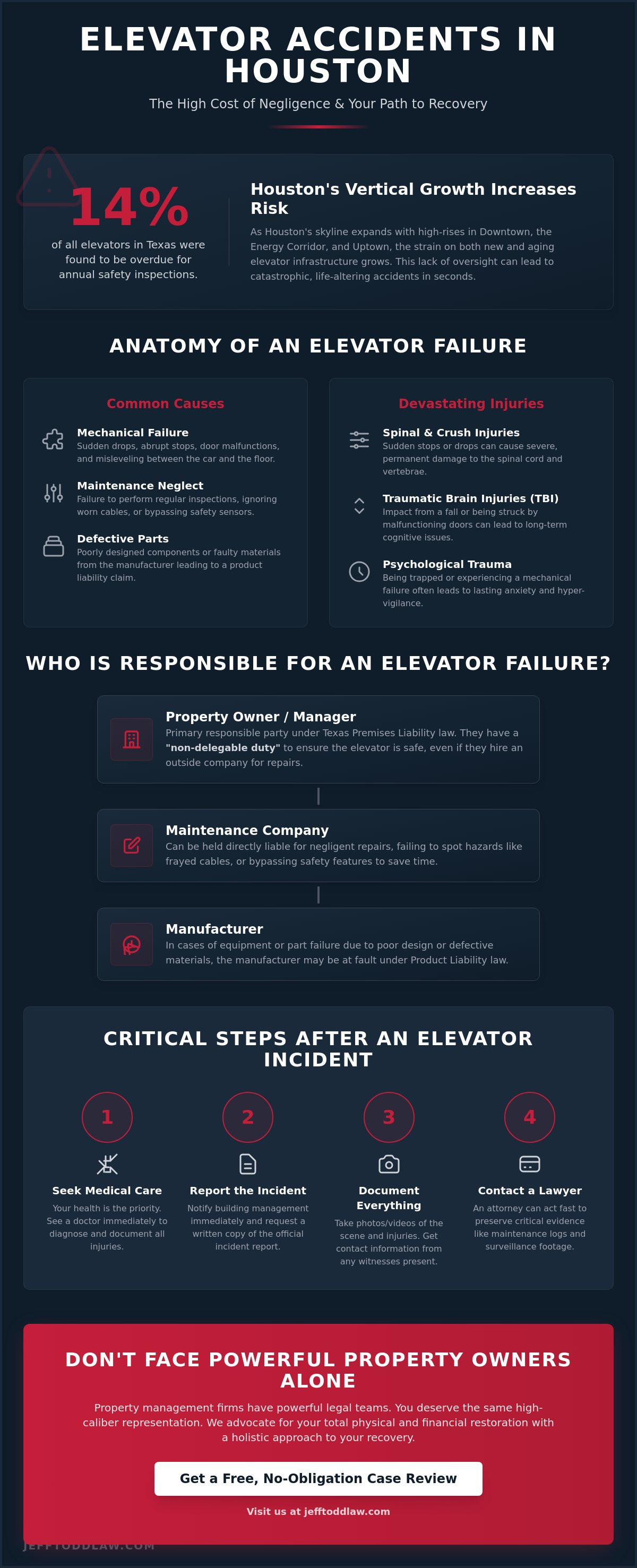
Did you know that 14% of all elevators in Texas were once found to be overdue for their annual safety inspections? In a city like Houston, where high-rises define the skyline, this lack of oversight can lead to life-altering accidents in a matter of seconds. If you have been hurt, a dedicated Houston elevator accident lawyer can help you navigate the complex path to recovery while you focus on healing.
You rely on these machines to get to work or reach your home safely. When an elevator fails, the resulting crush injuries or spinal trauma don't just cause physical pain; they create a mountain of medical debt and the stress of missing work in a competitive city. It's natural to feel overwhelmed when facing powerful corporate property owners and their legal teams alone.
This article explains how to hold negligent parties accountable and secure the maximum compensation you need for long-term care. You'll learn about the latest 2026 reporting requirements, how to identify who is truly at fault for your injuries, and why a holistic approach to your legal claim is essential for your total restoration.
Key Takeaways
- Understand how Houston’s rapid vertical expansion and aging infrastructure in areas like Downtown and the Energy Corridor contribute to rising elevator safety risks.
- Learn how a Houston elevator accident lawyer identifies responsible parties under Texas premises liability law to hold negligent property owners accountable.
- Identify specific mechanical failures, such as misleveling or sudden deceleration, that frequently lead to catastrophic spinal and joint injuries in commercial properties.
- Discover the essential steps to take immediately following an incident in Harris County to protect your health and preserve critical evidence for your claim.
- Explore a holistic approach to legal representation that prioritizes your total physical and financial restoration through a dedicated no-fee guarantee.
Houston's Vertical Growth and the Rising Risk of Elevator Accidents
Houston is reaching higher than ever before. From the sprawling corporate campuses in the Energy Corridor to the dense clusters of office towers in Downtown, our city’s growth is defined by its verticality. This rapid expansion places an immense strain on both new and existing infrastructure. While new construction boasts cutting-edge technology, many older buildings throughout Harris County still rely on aging components that are prone to failure. When these systems aren't maintained with the highest level of care, the results are often catastrophic for the people inside. Malfunctioning equipment can lead to severe crush injuries, spinal damage, or head trauma in an instant. The Todd Law Group, PLLC is dedicated to protecting those injured in these vertical transit incidents.
The Reality of Elevator Safety in Harris County
Accidents aren't confined to construction sites. They happen in the places we visit every day: medical complexes in the Texas Medical Center, luxury apartments in Uptown, and high-rise office buildings. While modern elevator safety systems are designed to prevent free-falls, they are not infallible. A sudden drop or an abrupt stop can cause severe spinal trauma or joint damage. Beyond the physical pain, there is a profound psychological toll. Being trapped in a dark, confined space or experiencing a mechanical failure creates a lasting sense of hyper-vigilance. While property owners often dismiss these incidents as "freak accidents," they are frequently the predictable result of long-term maintenance neglect.
Why Legal Advocacy Matters for Houston Residents
If you've been injured, you aren't just fighting a mechanical failure; you're often fighting a massive property management firm with deep pockets. These companies move quickly to "repair" the elevator after an incident, which can inadvertently destroy the evidence needed to prove negligence. This is why involving a Houston elevator accident lawyer immediately is critical. We step in to secure maintenance logs, sensor data, and surveillance footage before they disappear. Jeff Todd’s background in elite corporate legal environments provides a unique advantage. He understands the internal bureaucracies of these large firms and uses that intellectual rigor to advocate for your total restoration. The Todd Law Group, PLLC is committed to leveling the playing field, ensuring that individuals receive the same high-caliber representation usually reserved for corporate giants.
Determining Liability: Who is Responsible for an Elevator Failure in Texas?
Liability in these cases isn't always straightforward. In Texas, these incidents usually fall under premises liability law. This means the person or entity that controls the property is responsible for keeping it safe for visitors and tenants. A unique aspect of Texas law is the "non-delegable duty" doctrine. While a building owner might hire a third-party company to handle repairs, they can't shift the legal responsibility for your safety to that contractor. They remain the primary party accountable for the elevator's condition. If they fail to maintain the equipment, they are responsible for the outcome.
Beyond the property owner, maintenance companies often share the blame. If a technician fails to spot a frayed cable or bypasses a safety sensor to save time, their negligence is a direct cause of harm. According to elevator and escalator injury statistics, mechanical failures and maintenance errors are leading factors in serious transit injuries. In some cases, the fault lies with the manufacturer if a part was poorly designed or built with defective materials. This creates a complex product liability claim that requires a sophisticated legal approach. A seasoned Houston elevator accident lawyer understands how to untangle these overlapping layers of responsibility.
The Role of the Texas Department of Licensing and Regulation (TDLR)
The TDLR sets the safety standards for every lift in the state. Recent changes, such as HB2450, have adjusted inspection frequencies for certain buildings, but the core requirement remains: elevators must be safe. If a building is operating with an expired certificate or missed an inspection, it's a major red flag for negligence. We look for emergency orders or past violations that prove a pattern of neglect. Requesting maintenance logs and TDLR records is often where we find the evidence that confirms the owner knew about a problem but didn't fix it. These records are vital for proving that your injury wasn't a random event but a preventable failure.
Identifying Negligent Parties in Your Case
Determining who to sue can be difficult when properties are owned by shell companies or managed by global conglomerates. Your houston personal injury lawyer investigates the chain of command to find every liable party. This might include the building owner, the property management firm, or even the manufacturer of a faulty braking system. This thorough investigation ensures all sources of compensation are identified to cover your long-term medical needs. If you're unsure who is at fault for your accident, it's wise to consult with a legal professional about your specific situation. We help you navigate the corporate bureaucracy so you can focus on your physical restoration.
Common Causes of Elevator Injuries in Houston Commercial Properties
Houston’s commercial landscape is a mix of high-traffic shopping centers and bustling office hubs. In these environments, elevators are the invisible workhorses of daily life. However, when property owners prioritize speed or cost-cutting over safety, the mechanics of vertical transit can quickly turn dangerous. A skilled Houston elevator accident lawyer will investigate the specific mechanical failure that led to your injury. Many accidents aren't the result of a single fluke, but rather a series of ignored warnings and technical oversights that culminate in a life-altering event.
One of the most severe incidents involves sudden deceleration or "free-fall" scenarios. While safety clamps usually prevent a total drop, a sudden jerk or a rapid descent of even a few floors can cause catastrophic spinal and joint injuries. Equally common is misleveling, a hidden trip hazard where the elevator car fails to stop flush with the floor. This creates a dangerous threshold that causes severe falls, often resulting in broken bones or head trauma. We also see frequent cases of door malfunctions. When sensors fail, doors can pin or strike passengers, leading to crush injuries or entrapment that causes deep psychological distress. These incidents are often direct violations of OSHA elevator safety standards, which mandate specific safety devices and load limits for commercial equipment.
Mechanical vs. Electrical Failures
The "nightmare scenario" of a pulley system failure or a cable snap is rare but devastating. More frequently, injuries are caused by control board glitches that lead to erratic movement or sudden, violent stops. In high-rise environments, these electrical faults can be difficult to diagnose without expert technical analysis. Perhaps the most egregious cause of injury is the use of bypassed safety circuits. During "quick fix" repairs, negligent technicians might temporarily disable a safety sensor to keep the elevator running. If they forget to reactivate that circuit, the elevator continues to operate in a compromised state, placing every passenger at risk of a preventable accident.
The Impact of Negligent Maintenance
Negligent maintenance is often the root cause of elevator failures in Houston retail centers and medical complexes. High foot traffic requires rigorous upkeep, yet many owners skip monthly inspections to save on service fees. We often find that property managers ignored "red flag" reports from tenants about strange noises, jerky movements, or frequent stalling. Using uncertified or unqualified technicians for complex repairs further compounds the danger. Retaining a Houston elevator accident lawyer ensures that these technical details are brought to light. We look for the paper trail of neglect that building owners try to hide, ensuring your claim is built on a foundation of solid, technical proof.
Critical Steps to Take After an Elevator Incident in Harris County
The moments following an elevator malfunction are often chaotic and frightening. Whether you experienced a sudden drop in a Downtown high-rise or a trip-and-fall due to misleveling in a medical complex, your actions in the first few hours are vital. Taking the right steps ensures your physical health is prioritized while protecting your legal rights. Building owners and their insurance companies move quickly to minimize their liability, so you must be equally proactive.
- Seek immediate medical attention: Even if you believe your injuries are minor, see a doctor. Adrenaline often masks the pain of concussions, internal bruising, or soft tissue damage that may not surface for days.
- Report the incident: Notify building security or property management immediately. Ensure they create an official incident report and ask for the report number or a physical copy before you leave.
- Document the scene: If you are physically able, use your phone to capture the state of the elevator. Evidence of mechanical failure can be repaired within hours, so real-time documentation is essential.
- Identify witnesses: Collect the names and contact information of other passengers or bystanders who saw the elevator’s erratic behavior. Their testimony provides an unbiased account of the event.
- Contact a specialized attorney: Before you speak with insurance adjusters or sign any documents, consult a Houston elevator accident lawyer to understand the true value of your claim.
Gathering Evidence at the Scene
Your smartphone is the most powerful tool you have for documenting a property owner's negligence. If the car didn't stop flush with the floor, take a photo of the "gap" or misleveling alongside a common object, like a shoe, to show the height difference. Be sure to photograph the elevator car number, usually found on a small plaque near the buttons, and the building’s physical address. Avoiding the "it’s fine" trap is critical. Adrenaline is a powerful chemical that can hide serious spinal or joint trauma. Without a medical record established on the day of the accident, insurance companies will later argue that your injuries were caused by something else. If you have been hurt, you should contact our team for a professional case evaluation to ensure your recovery is handled with the care it deserves.
Navigating the Texas Statute of Limitations
In Texas, the law is very specific about timing. Under the Texas Civil Practice & Remedies Code §16.003, you generally have a two-year window from the date of the injury to file a personal injury lawsuit. While two years may seem like a long time, waiting even a few weeks can be a mistake. Security footage in Houston office towers is often overwritten every 30 days. Furthermore, effective April 22, 2026, all elevator incidents must be reported to the TDLR within 24 hours using form ELE216N. Early legal intervention allows your Houston elevator accident lawyer to send "spoliation letters" that legally bar the property owner from destroying maintenance logs or "cleaning" the digital evidence of a malfunction. Acting quickly is the best way to preserve your right to maximum compensation.
How The Todd Law Group, PLLC Advocates for Your Holistic Recovery
Legal representation is more than just a financial transaction. At The Todd Law Group, PLLC, we view your case as a critical component of your physical and emotional restoration. When you hire a Houston elevator accident lawyer from our firm, you aren't just getting an advocate; you're gaining a partner who understands the total impact of your injury. We move quickly to handle the corporate bureaucracy and insurance red tape so you can focus on the hard work of getting better. Our goal is to ensure you have the resources necessary for a complete recovery.
We operate on a no-fee guarantee. This means you don't pay us anything unless we successfully recover money for you. This commitment ensures that high-quality legal representation is accessible to everyone in Harris County, regardless of their current financial situation. Jeff Todd’s approach is deeply personal. He transitioned from elite corporate legal environments to personal advocacy because he believes individuals deserve the same intellectual rigor usually reserved for global conglomerates. Our extensive experience with medical malpractice allows us to accurately value complex injuries, ensuring that your settlement covers not just current bills, but a lifetime of potential care.
A Sophisticated Approach to Complex Litigation
Winning an elevator accident case requires more than just filing paperwork. It demands technical proof. We utilize a network of expert witnesses, including mechanical engineers and certified safety inspectors, to dissect exactly how a machine failed. Because we understand how corporate defense teams operate, we can anticipate their tactics and negotiate from a position of strength. We fight for full coverage of your future needs; we refuse to let insurance companies settle for less than what your total restoration requires. This proactive approach ensures that no detail of your mechanical or electrical failure is overlooked during negotiations.
Your Partner in the Houston Community
Our firm is deeply rooted in Texas, with offices in Houston, Austin, and Galveston. We take pride in holding negligent property owners accountable for the safety of our neighbors. If you’ve been injured in a vertical transit incident, you don't have to face the recovery process alone. A dedicated Houston elevator accident lawyer from The Todd Law Group, PLLC can provide the steady reassurance and legal expertise you need to move forward. We are personally invested in the local community and the safety of the buildings that define our skyline. Schedule your free consultation with Jeff Todd today to start your journey toward justice and healing.
Take the Next Step Toward Your Total Restoration
We've explored the complexities of vertical transit safety in Houston, from identifying the non-delegable duty of property owners to the vital importance of immediate documentation after an incident. Navigating the aftermath of a mechanical failure requires more than just a claim; it requires a strategy that addresses your long-term physical and financial needs. By securing maintenance logs and TDLR records early, you protect your right to hold negligent parties accountable and ensure the evidence of their oversight isn't lost.
The Todd Law Group, PLLC brings the intellectual rigor of an elite corporate background to your personal advocacy. Attorney Jeff Todd has been licensed in Texas since 1994 and operates on a contingency-based model, ensuring you have access to high-caliber representation without the burden of upfront costs. Partnering with a dedicated Houston elevator accident lawyer allows you to focus on healing while we manage the corporate bureaucracy and technical litigation. We treat your legal case as a vital component of your holistic recovery process.
Contact The Todd Law Group, PLLC for a Free Elevator Accident Case Review
Your recovery is our priority. We are here to provide the steady reassurance and legal expertise necessary to restore your peace of mind and secure your future in the Houston community.
Frequently Asked Questions
What is the most common cause of elevator accidents in Houston office buildings?
Maintenance neglect is the primary driver of incidents in Houston high-rises. While many people fear a dramatic free-fall, the most frequent issues are actually misleveling and door sensor failures. These glitches often stem from property managers skipping monthly service checks to cut operational costs. A Houston elevator accident lawyer investigates maintenance logs to prove that the malfunction was a predictable result of poor upkeep rather than a random technical error.
Can I sue if I was stuck in an elevator but not physically injured?
You generally need to prove physical injury or extreme psychological trauma to file a successful lawsuit in Texas. Simply being stuck for a short period without physical harm rarely meets the legal threshold for a claim. However, if the entrapment led to severe claustrophobia or PTSD that requires professional medical treatment, you may have a case. It's best to consult an attorney to evaluate the specific emotional and physical impact of the event.
How much is my Houston elevator accident case worth?
The value of your claim depends entirely on the severity of your injuries and the financial losses you've incurred. We consider your past and future medical expenses, lost wages from missed work, and the long-term impact on your quality of life. Because every case involves unique medical and technical details, we don't provide average settlement numbers. Instead, we focus on securing the total funds needed for your physical and financial restoration.
Who is liable if an elevator was recently inspected but still failed?
The building owner is still the primary liable party due to their non-delegable duty to keep the premises safe. Even if an inspection occurred recently, the owner cannot pass the blame to the inspector. However, if the inspection company was negligent or missed a glaring defect, they might also be held responsible. We investigate the entire chain of command to identify every entity that contributed to the mechanical failure.
What if my elevator injury happened at my workplace in Houston?
You may have both a workers' compensation claim and a third-party personal injury lawsuit. If your employer doesn't own the building, you can often sue the property owner or the maintenance company for negligence. This is a vital distinction because a third-party claim allows you to seek damages for pain and suffering, which workers' comp doesn't cover. We help you navigate these overlapping legal paths to maximize your recovery.
How long do I have to file an elevator accident lawsuit in Texas?
You have two years from the date of the accident to file a lawsuit in Texas. This deadline is strictly enforced under the Texas Civil Practice & Remedies Code. If you miss this window, you lose your right to seek compensation forever. Because evidence like security footage and maintenance records can disappear quickly, it's important to start the legal process as soon as your medical condition is stable.
Does a "Warning: Elevator Out of Service" sign protect the building owner from liability?
A sign provides a warning, but it doesn't grant the owner total immunity from liability. If the warning was poorly placed, difficult to read, or if the elevator was not properly locked out, the owner may still be negligent. Texas law requires property owners to take reasonable steps to prevent access to known hazards. If a person was still able to enter a dangerous elevator car, the sign alone might not be a sufficient defense.
Why do I need a lawyer for an elevator claim instead of just filing with insurance?
Insurance adjusters work for the insurance company, not for you. Their goal is to settle your claim for the lowest possible amount. A lawyer handles the technical investigation, hires expert engineers, and manages the corporate bureaucracy. We ensure that you aren't pressured into a quick settlement that fails to cover your long-term medical needs. Having professional representation levels the playing field against powerful corporate legal teams.


