

What if the true cost of your recovery isn't measured in months of physical therapy, but in the 1.4 million dollars required to maintain your mobility over a lifetime? When you are facing the aftermath of a catastrophic accident, filing an amputation injury lawsuit Texas becomes more than a legal procedure; it's a necessary battle for your autonomy and long-term restoration. You're likely dealing with crushing medical debt and the heavy anxiety of future employability, all while navigating the persistent reality of physical and phantom pain. It's a weight no one should carry alone.
We understand that you're looking for a clear path toward financial stability and justice against those responsible for your loss. This article will show you how to navigate the complex Texas legal landscape to secure maximum compensation for the lifelong costs associated with traumatic limb loss. We'll explore the strict two year statute of limitations, the impact of modified comparative fault rules, and how to account for the sophisticated prosthetic technology you deserve. You'll discover a roadmap for securing the resources needed for your holistic healing and future security.
Key Takeaways
- Learn why Texas law classifies limb loss as a catastrophic injury and how this specific legal designation impacts the potential value of your claim.
- Understand how to identify liable parties in complex scenarios, such as commercial trucking accidents or workplace incidents, when filing an amputation injury lawsuit Texas.
- Discover the critical components of calculating lifetime damages, including the recurring costs of advanced prosthetic technology and non-economic suffering.
- Protect your legal rights by mastering specific Texas hurdles, such as the strict two year statute of limitations and the 51% modified comparative fault rule.
- Find a path toward total restoration through a legal strategy that prioritizes your medical autonomy and financial stability without the burden of upfront fees.
Understanding Amputation as a Catastrophic Injury in Texas
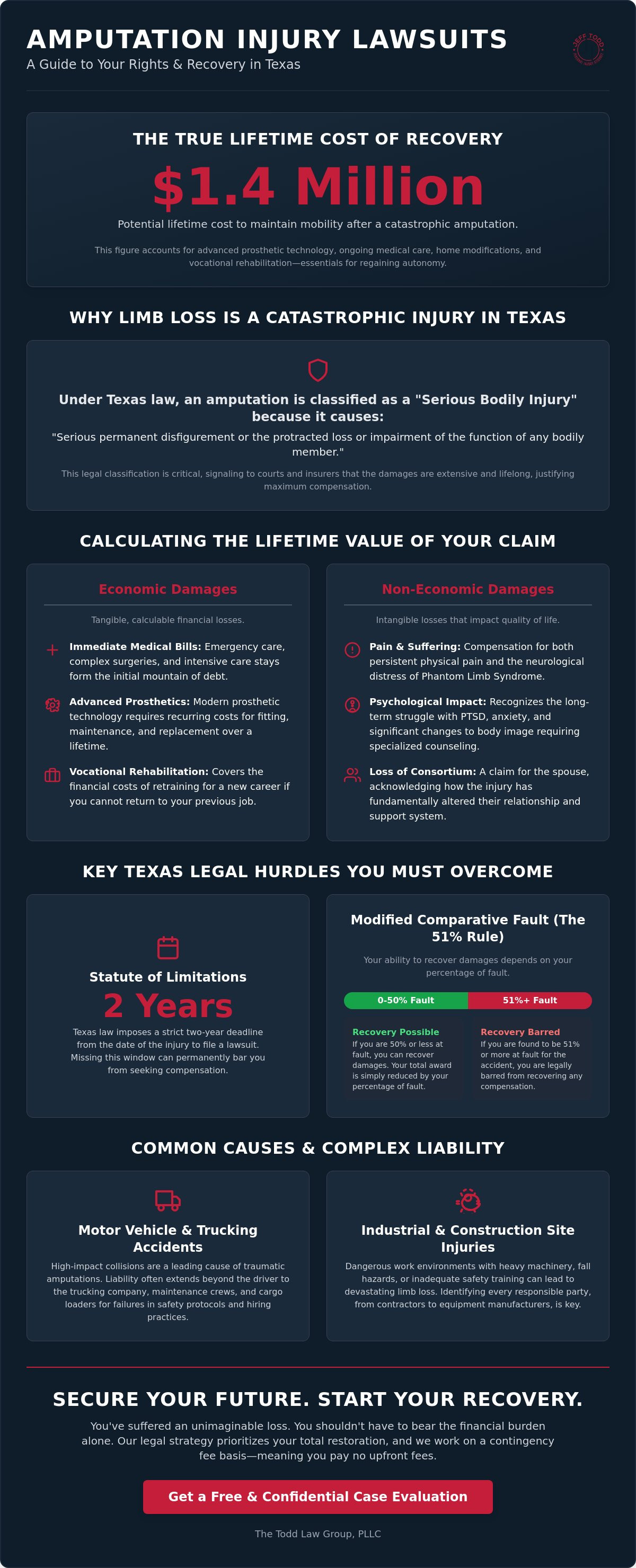
When a person loses a limb, the legal system recognizes this as a life-altering event that goes far beyond a standard injury claim. In Texas, legal professionals often look to the standard of "serious bodily injury" found in the Texas Penal Code. This definition includes any injury that causes serious permanent disfigurement or the protracted loss or impairment of the function of any bodily member. Because an amputation is permanent, it's almost always classified as a catastrophic injury in the eyes of the court. This classification is the foundation for an amputation injury lawsuit Texas, as it signals to the court and insurance companies that the damages involved are extensive and lifelong.
The immediate aftermath of such an injury brings a staggering financial shock. Before a patient even begins to process the trauma, they're met with the costs of emergency room visits, complex stabilization surgeries, and intensive care stays. These initial medical interventions are necessary to save the patient's life, but they often leave families buried under a mountain of debt. This early financial pressure is why we prioritize a proactive legal approach. We aim to secure the resources needed for your immediate stabilization while building a case for your long-term recovery.
Traumatic vs. Medical Amputation
Traumatic amputation occurs instantly at the scene of an accident, often involving heavy machinery, commercial truck collisions, or high-impact motorcycle crashes. In contrast, a surgical or medical amputation happens in a hospital setting when doctors determine a limb is beyond saving due to infection, severe crushing, or irreparable vascular damage. From a legal perspective, both scenarios are equally devastating. Understanding Personal Injury Law is essential here, as it helps establish that the negligent party is responsible for the final outcome, regardless of whether the limb was lost at the scene or in the operating room. We view both through a lens of holistic healing, ensuring that the legal strategy accounts for the total physical and emotional transition you're forced to make.
The Long-Term Impact on Quality of Life
The damage from limb loss extends deep into a person's psychological well-being and family life. Many survivors struggle with PTSD and significant changes to their body image, which can require years of specialized counseling. Family dynamics also shift, often leading to "loss of consortium" claims in an amputation injury lawsuit Texas. These claims recognize that a spouse's relationship and daily support system have been fundamentally altered. Physically, many patients deal with phantom limb syndrome, where the brain continues to receive pain signals from the missing limb. To move forward, vocational rehabilitation is often a necessity. If you can't return to your previous career, you'll need the financial means to retrain for a new role. We focus on securing a future where you have the tools and support to regain your independence.
Common Causes and Liability in Texas Amputation Lawsuits
Establishing liability is the most critical phase of an amputation injury lawsuit Texas. It requires a meticulous investigation to pinpoint exactly where the chain of safety broke. Whether your injury occurred on a busy Houston freeway, a high-risk construction site, or due to a structural failure on a negligent property owner's premises, the path to justice starts with identifying every responsible party. We don't just look at the person who caused the accident; we look at the systems and organizations that failed to protect you.
Motor Vehicle and Trucking Accidents
High-impact collisions on Texas highways like I-10 and I-35 are leading causes of traumatic limb loss. These accidents often involve commercial vehicles where liability extends far beyond the driver. We look at the trucking company's hiring practices, vehicle maintenance logs, and even the cargo loading team. If a carrier forced a driver to exceed their hours of service, they share the blame for the resulting catastrophe. For those navigating the aftermath of a commercial wreck, consulting a Houston truck accident lawyer is vital for identifying these layers of corporate negligence. Our goal is to ensure no stone is left unturned in your pursuit of accountability.
Industrial and Construction Site Injuries
In Houston’s manufacturing and oil sectors, heavy machinery accidents are a constant threat. These sites are governed by strict safety regulations, yet OSHA violations remain common. When structural failures or unguarded equipment lead to a loss of limb, we must act quickly to preserve evidence. Texas is unique. It allows employers to be "non-subscribers" to workers' compensation. If your employer opted out of the state system, you have the right to sue them directly for negligence. This often provides a better path to full compensation than the limited benefits provided by standard workers' comp. If you're struggling to understand who's responsible for your life-changing injury, requesting a professional case evaluation can provide the clarity you need to move forward.
Medical Negligence and Surgical Errors
Not all amputations happen at the scene of an accident. Some are the result of preventable medical errors. A Medical Overview of Limb Loss highlights how mismanaged infections or vascular issues can necessitate surgical removal if not treated promptly. If a surgeon operates on the wrong site or a hospital fails to monitor a post-operative infection, it may constitute a breach of the standard of care. Proving this requires a sophisticated understanding of both medicine and law. Working with a medical malpractice attorney Texas ensures that these technical failures are clearly presented to a jury, holding the medical facility accountable for their oversight.
Calculating the Lifetime Value of a Limb Loss Claim
A successful amputation injury lawsuit Texas isn't just about covering the immediate medical bills that pile up after an accident. While the initial ER visit and surgery are expensive, they represent only a fraction of the total financial impact. To secure your future, we must look at the next 30 to 50 years of your life. According to data from the Department of Veterans Affairs, the average lifetime cost for medical care and prosthetics for a single leg amputation can exceed 1.4 million dollars. If we don't account for every recurring expense now, you could be left to pay for your own care just a few years down the road.
Quantifying these damages requires a two-pronged approach. First, we calculate economic damages, which are the objective financial losses you've suffered. This includes lost wages, reduced earning capacity, and the high cost of specialized medical equipment. Workplace Amputation Statistics show that machinery is involved in more than half of work-related limb losses, often ending a person's ability to work in high-paying industrial roles. Second, we address non-economic damages. These are the human costs, such as physical pain, mental anguish, and the loss of the ability to enjoy life as you once did. While these are harder to put a price on, they're often the most significant part of a catastrophic injury claim.
To ensure we reach a fair value, we frequently work with Life Care Planners. These experts create a comprehensive roadmap of every medical and personal need you'll have for the rest of your life. They bridge the gap between your current medical status and your long-term restoration, ensuring that no future complication is overlooked during negotiations.
Prosthetic Technology and Recurring Costs
Modern bionic and robotic limbs offer incredible mobility, but they come with a significant price tag. A basic prosthetic might cost around $5,000, but advanced computerized limbs can reach $70,000 or more. It's not a one-time purchase. These devices generally need to be replaced every 3 to 5 years due to wear and tear. When filing an amputation injury lawsuit Texas, your settlement must include the funds for these replacements, along with the costs of sockets, liners, and regular maintenance. You shouldn't have to settle for older technology because an insurance company wants to save money.
Home and Vehicle Modifications
Restoring your independence often requires significant changes to your physical environment. This might mean retrofitting your home with ramps, widened doorways, or a modified kitchen. It also includes the cost of adaptive driving equipment so you can stay mobile. Life Care Planning serves as a precise tool to project these modifications and medical expenses into 2040 and beyond. We fight to make sure your settlement covers the full cost of these transitions, allowing you to live with dignity and autonomy.
Navigating Texas Legal Hurdles: Statutes and Fault
The legal path following a catastrophic injury is paved with strict deadlines and complex procedural rules. In Texas, time is your most significant adversary. Under the Texas Civil Practice and Remedies Code § 16.003, you have exactly two years from the date of the incident to file an amputation injury lawsuit Texas. While two years might seem like a substantial window, the reality of medical recovery often consumes months of that time. If you miss this deadline, the court will likely bar you from seeking any compensation, regardless of how clear the other party's negligence might be. Acting quickly allows your legal team to preserve evidence, interview witnesses, and build a foundation for your lifetime of care.
Beyond the timeline, you'll encounter the "Modified Comparative Fault" rule. This is a "51% bar" standard, meaning you can only recover damages if you're found to be 50% or less responsible for the accident. If a jury decides you're 51% at fault, you walk away with nothing. This rule creates a high-stakes environment where the defense will work tirelessly to shift the blame onto you. We anticipate these tactics by conducting exhaustive investigations that leave no room for insurance companies to distort the facts of your case.
The 51% Bar Rule in Texas
In a high-value amputation injury lawsuit Texas, insurance adjusters often use "victim-blaming" to protect their bottom line. They might argue that you weren't wearing the proper safety gear at a construction site or that you were distracted during a collision. Their goal is to push your percentage of fault just over that 51% threshold. This is particularly common in premises liability cases, where property owners may claim you should've seen a hazard before the accident occurred. We counter these arguments with forensic evidence and expert testimony to ensure the blame stays where it belongs: on the negligent party.
Sovereign Immunity and Government Liability
If your injury involved a government vehicle, such as a city bus or a state-owned truck, the rules change significantly. The Texas Tort Claims Act provides a limited waiver of "sovereign immunity," allowing you to sue government entities under specific conditions. However, these cases come with incredibly short notice requirements. While the standard statute of limitations is two years, some Texas municipalities require a formal "notice of claim" within just six months, or even 90 days, of the injury. Missing this notice period can end your case before it even begins. If you believe a government entity is responsible for your loss, you should speak with an experienced advocate immediately to protect your right to recovery.
Finally, it's vital to understand damage caps. While Texas doesn't cap economic damages like medical bills or lost wages, it does impose strict limits on non-economic damages in medical malpractice cases. These caps are currently set at $250,000 for claims against individual physicians. However, if we can prove "Gross Negligence"—showing the defendant acted with a conscious indifference to your safety—we may be able to pursue punitive damages, which serve to punish the wrongdoer and prevent future tragedies.
Why The Todd Law Group is the Right Choice for Your Recovery
Jeff Todd transitioned from a prestigious career in elite corporate law to personal advocacy because he saw a need for high-impact representation for individuals facing life-altering injuries. When you partner with The Todd Law Group, PLLC, you're getting more than just a legal representative; you're gaining an advocate with the intellectual rigor to challenge the most sophisticated insurance defense teams. We understand the internal strategies these corporations use to devalue catastrophic claims. By applying our corporate-level precision to your amputation injury lawsuit Texas, we ensure that every future medical need and vocational challenge is documented and fought for with unwavering dedication.
We believe that your focus should be on your physical and emotional progression, not on how to afford a lawyer. This is why The Todd Law Group, PLLC operates on a "No Recovery, No Fee" basis. We remove the financial barriers to justice, taking on all the upfront costs of investigation and expert testimony. Our goal is your total restoration, and we don't get paid unless we successfully secure the compensation you need to rebuild your life. This commitment allows us to build a stable, trust-based partnership from the very first day of your case.
Experience That Levels the Playing Field
Catastrophic injury cases involving limb loss require a level of detail that many general practice firms simply can't provide. We utilize our extensive case experience to anticipate defense tactics, such as attempts to shift blame or minimize the cost of future prosthetic technology. As a houston personal injury lawyer, Jeff Todd applies a battle-tested philosophy to every claim, ensuring that the human element of your story is never lost in the legal process. We're comfortable in formal proceedings and efficient in our internal processes, giving you the best possible chance at a full recovery.
Getting Started with a Free Consultation
Your journey toward financial stability begins with a clear understanding of your legal rights. During your initial case review at The Todd Law Group, PLLC, we'll listen to your story and explain how the Texas legal system applies to your specific situation. We begin our investigation immediately to protect your rights and preserve evidence that might otherwise be lost. You deserve a team that is personally invested in your community and your future. Schedule your free consultation with The Todd Law Group, PLLC today to start the process of securing your lifetime of care.
Take the First Step Toward Your Restoration
The path forward after limb loss isn't just about adapting to a new physical reality; it's about reclaiming the lifestyle and dignity you enjoyed before the accident. Successfully managing an amputation injury lawsuit Texas requires more than just filing paperwork. It demands a legal strategy that anticipates future prosthetic advancements and counters the aggressive tactics insurance companies use to shift blame. While the legal hurdles in Texas are significant, they don't have to define your future when you have a dedicated partner managing the complexities for you.
At The Todd Law Group, PLLC, we provide the steady reassurance and technical expertise needed to secure your total restoration. Attorney Jeff Todd has been licensed since 1994 and brings the intellectual rigor of a corporate legal background to every client's advocacy. With accessible offices in Houston, Austin, and Galveston, we offer personalized support tailored to the regional nuances of your case. We operate with no upfront legal fees, ensuring that your financial situation never stands in the way of your right to justice.
Contact The Todd Law Group, PLLC for a Free Amputation Case Review. We're here to help you move from a place of distress to a future of financial stability and holistic healing. Don't let a negligent party's oversight dictate the rest of your life.
Frequently Asked Questions
How long do I have to file an amputation lawsuit in Texas?
You have exactly two years from the date of your injury to file a lawsuit in Texas. This deadline is established by the Texas Civil Practice and Remedies Code § 16.003. If you're pursuing a claim against a government entity, you may have as little as 90 days to provide formal notice. It's vital to act quickly to ensure your legal team can preserve evidence and interview witnesses while memories are fresh.
What is my amputation case worth?
The value of your case depends on the lifetime costs of your medical care and lost earning capacity. A study by the Department of Veterans Affairs estimated the average lifetime cost for medical care and prosthetics for a single leg amputation at over $1.4 million. When we handle an amputation injury lawsuit Texas, we work with life care planners to ensure your settlement covers every recurring expense you'll face over the next several decades.
Can I still sue if the accident was partially my fault?
You can still recover compensation as long as you are 50% or less responsible for the accident. Texas follows a modified comparative fault rule, often called the 51% bar. If a jury finds you 20% at fault, your total compensation will be reduced by 20%. However, if your fault is determined to be 51% or higher, you are legally barred from recovering any damages from other parties.
What if my amputation was caused by a workplace accident?
Your legal options depend on whether your employer carries workers' compensation insurance. If they are a "non-subscriber," you have the right to sue them directly for negligence, which can lead to a more comprehensive recovery. If they do have workers' comp, your recovery is generally limited to those benefits unless a third party, such as an equipment manufacturer, also shared responsibility for the incident.
Do I have to go to trial for an amputation injury claim?
Most amputation injury claims are settled out of court before a trial begins. However, we prepare every case with the intellectual rigor required for a courtroom appearance. This proactive approach often provides the leverage needed to secure a fair settlement from insurance companies. If the negligent party refuses to offer maximum compensation for your life-long needs, we are fully prepared to advocate for you before a jury.
How much does it cost to hire an amputation injury lawyer in Houston?
We work on a contingency fee basis, meaning there are no upfront costs or hourly fees for our services. We only receive payment if we successfully recover a settlement or jury award for you. This "No Recovery, No Fee" commitment ensures that you have access to high-caliber legal representation without adding to your financial stress. Our goal is to remove every barrier between you and the justice you deserve.
What kind of damages can I recover in a Texas limb loss case?
You can recover both economic and non-economic damages to address the total impact of your injury. Economic damages cover objective costs like surgeries, prosthetic maintenance, and lost wages. Non-economic damages address more personal losses, including physical pain, mental anguish, and the loss of the ability to enjoy previous hobbies. An amputation injury lawsuit Texas seeks to provide a holistic financial foundation for your long-term restoration and healing.
How long does an amputation injury lawsuit typically take to settle?
These cases generally take between 12 and 24 months to reach a resolution. The timeline is often dictated by your medical progress, as we cannot accurately calculate your lifetime needs until your condition has stabilized. We must wait for your doctors to determine the specific prosthetic technology and rehabilitation you'll require. Rushing a settlement can leave you without the funds needed for future medical complications or equipment replacements.


