

If the law cannot return the person you lost, why is a legal claim the most critical step you can take for your family's survival? When you are grappling with a sudden loss, a wrongful death lawyer serves as both a shield against insurance tactics and a guide through the intricate Texas civil courts. This process is not merely about a settlement. It is a structured path toward holding negligent parties accountable and ensuring those left behind are not abandoned to financial ruin.
You likely feel that no amount of litigation can address the emotional trauma or the sudden loss of a primary breadwinner. It's a heavy burden to balance profound grief with the need to understand complex probate and liability laws. We promise to help you understand your legal rights under the Texas Civil Practice and Remedies Code, identifying exactly who can file a claim and how to seek the justice your loved one deserves.
This guide details the specific requirements for Texas claims in 2026, from proving negligence in vehicle accidents to addressing workplace fatalities. You'll learn how to secure your family's financial future by partnering with a compassionate advocate who handles the heavy legal lifting while you focus on the holistic healing of your household.
Key Takeaways
- Identify the specific legal requirements under Texas Chapter 71 that transform a tragic accident into a valid civil claim.
- Clarify which family members qualify as statutory beneficiaries and when a personal representative must step in to lead the litigation.
- Distinguish between compensation for your family's loss and the deceased person's own personal injury claim via the Survival Act.
- Learn how a wrongful death lawyer conducts immediate investigations and secures technical evidence like black box data to build a robust case.
- Explore the methodology for calculating pecuniary losses and non-economic damages to ensure your family's long-term stability is protected.
What Qualifies as a Wrongful Death Under Texas Law?
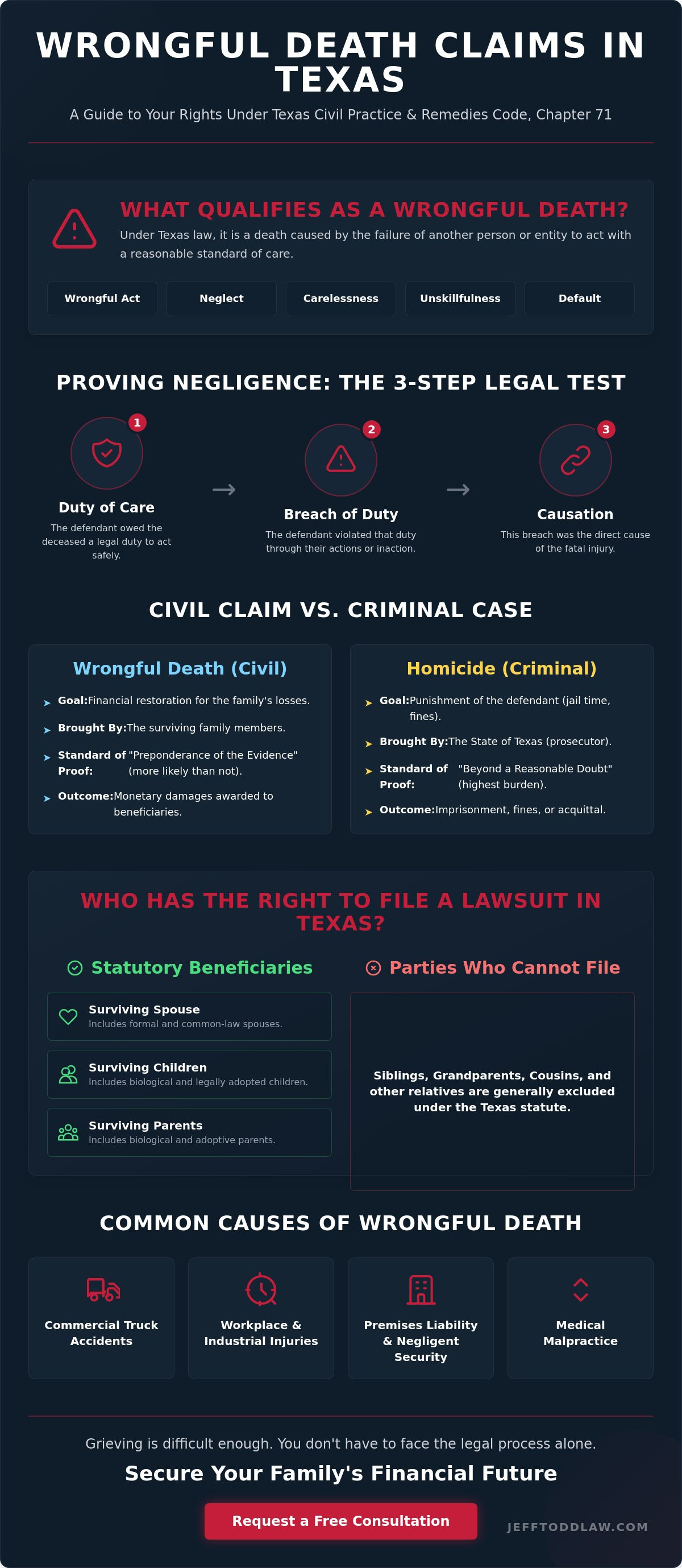
Under the Texas Civil Practice and Remedies Code Chapter 71, a wrongful death is defined as a death caused by the "wrongful act, neglect, carelessness, unskillfulness, or default" of another person or entity. This legal framework ensures that the responsible party's accountability doesn't vanish simply because the victim is no longer present to testify. Instead, the law transfers the right to seek justice to the surviving family members. A wrongful death is a statutory cause of action created to provide a legal remedy for specific beneficiaries when a loved one's life is cut short by someone else's failure to act safely.
To succeed in a claim, a wrongful death lawyer must establish that the defendant's behavior met the legal definition of negligence. This requires proving that the defendant owed the deceased a duty of care, breached that duty, and that the breach directly caused the fatality. It's a technical process that relies on a "preponderance of the evidence" standard. This means we must show it's more likely than not that the defendant's actions were the cause of the loss. This civil standard is lower than the "beyond a reasonable doubt" requirement found in criminal courts, which is why a family can often win a civil suit even if a criminal trial results in an acquittal.
It's vital to distinguish between criminal homicide and a civil wrongful death claim. While the state handles criminal prosecution to punish a defendant with jail time, a civil claim is a private action brought by the family to secure financial restoration. These two paths can move forward simultaneously. A civil judgment focuses on the family's total restoration, addressing the loss of household income and the profound emotional trauma that follows a sudden tragedy.
The Legal Threshold for Negligence
Texas civil courts use the preponderance of the evidence standard to weigh the facts of a case. In most scenarios, this involves proving the defendant was careless, such as a distracted driver or a negligent property owner. However, in cases involving defective products, "strict liability" may apply. In these situations, your wrongful death lawyer doesn't necessarily have to prove the manufacturer was "negligent" if the product itself was inherently dangerous and caused the death. Wrongful death is a statutory cause of action specifically reserved for the benefit of a surviving spouse, children, and parents of the deceased.
Common Causes of Action in Houston and Austin
Texas families often face life-altering losses due to the high volume of commercial traffic and industrial activity in our state. Fatal commercial truck accidents are frequent on high-traffic corridors like I-10 in Houston and I-35 through Austin. If a loved one was lost in a collision, consulting a Houston car accident lawyer is often the first step in preserving critical evidence like black box data. Other common scenarios include premises liability cases involving fatal falls or negligent security, as well as workplace injuries in the energy and construction sectors. We also see claims arising from medical malpractice where a breach in the standard of care leads to a fatal outcome.
Who Has the Right to File a Wrongful Death Lawsuit in Texas?
Texas law limits who can bring a claim to a narrow group known as "statutory beneficiaries." This group includes the surviving spouse, children, and parents of the deceased. If you don't fall into one of these categories, you generally cannot initiate a lawsuit under the Texas Wrongful Death Act. For instance, siblings, grandparents, and cousins are excluded from filing, regardless of their emotional or financial closeness to the deceased. This often feels unfair to brothers and sisters who've lost a lifelong companion, but the statute is rigid. The law prioritizes the immediate nuclear family to ensure that those most directly dependent on the deceased receive primary consideration for restoration.
The list of eligible filers includes:
- The Surviving Spouse: This includes both formally married and common-law partners.
- Surviving Children: This includes biological children and legally adopted children, regardless of their age.
- Surviving Parents: Both biological and adoptive parents have the right to seek justice for the loss of a child.
Rights of the Surviving Spouse and Children
The law is inclusive regarding the definition of "spouse" and "child." In Texas, a common-law spouse has the same legal standing as a traditionally married spouse, provided the relationship meets the state’s legal requirements for informal marriage. Similarly, legally adopted children possess the same rights as biological children. When a settlement is reached, the funds aren't always split equally. Instead, they're divided based on the specific losses each individual suffered. For minor children, the court typically appoints a guardian ad litem. This neutral third party ensures the child's portion of the recovery is protected and managed in their best interest until they reach adulthood.
If you're unsure where you stand in this hierarchy or how to begin the process, consulting a Texas wrongful death lawyer can provide the clarity needed to move forward.
When the Estate Must Step In
What happens if the statutory beneficiaries don't file within three months of the death? This is where the "Three-Month Rule" applies. If no family member has initiated a claim within 90 days, the personal representative or executor of the estate is legally permitted to file the suit. The only exception occurs if all statutory beneficiaries specifically request that the claim not be filed. This ensures that the negligent party is still held accountable even if the immediate family is too overwhelmed by grief to act quickly.
Managing these timelines while dealing with probate requirements can be exhausting. Working with an experienced wrongful death lawyer allows your family to focus on healing while a professional handles the procedural hurdles. The personal representative’s role is to act on behalf of the estate, but the ultimate goal remains the restoration of the family’s stability. If you find yourself in this position, prompt action is necessary to preserve your rights before the statute of limitations or these procedural windows close.
Wrongful Death Act vs. Survival Act: Understanding the Difference
The distinction between the Texas Wrongful Death Act and the Texas Survival Act is vital for any family seeking total restoration. While these two legal paths often run parallel, they serve entirely different purposes and cover different types of losses. Texas law recognizes that a single tragedy creates two distinct categories of harm: the suffering of the person who passed away and the ongoing struggle of the family left behind. A seasoned wrongful death lawyer will typically pursue both actions simultaneously to ensure no aspect of your family's loss is overlooked by the court or the insurance company.
The Wrongful Death Act is designed to compensate the living. It focuses on the "hole" left in your household, addressing the financial and emotional support that vanished with your loved one. Conversely, the Survival Act allows a personal injury claim to "survive" the victim's death. It treats the case as if the deceased person were still here to file it themselves. Both actions generally fall under a two-year statute of limitations in Texas. Failing to file within this window can permanently bar your family from seeking justice, making prompt legal intervention a necessity.
The Survival Action: Seeking Justice for the Deceased
Under Texas Civil Practice and Remedies Code Section 71.021, the estate can recover damages for the pain and suffering the deceased experienced prior to their passing. If there was any period of consciousness between the injury and the death, those moments of physical and mental agony are compensable. This action also covers the medical expenses incurred during that interval, as well as funeral and burial costs. These funds are paid to the estate and are eventually distributed to heirs or according to a will. This ensures the negligent party remains responsible for the immediate costs of the tragedy.
The Wrongful Death Action: Supporting the Survivors
This action belongs directly to the statutory beneficiaries: the spouse, children, and parents. It does not look at the victim's pain, but rather at the survivors' future. Your wrongful death lawyer will focus on lost earning capacity, which replaces the income the deceased would have provided to the household. It also addresses non-economic damages, such as the loss of companionship, society, and the emotional guidance a parent provides to a child. Mental anguish is a significant component here, acknowledging the deep psychological trauma caused by a sudden, preventable loss. These damages are paid directly to the family members to help secure their long-term financial stability.
Calculating Damages: What is a Wrongful Death Claim Worth?
Quantifying the value of a human life is a task the law approaches with a specific, structured framework. While no financial award can replace a loved one, the Texas legal system aims to provide a path toward total restoration for the survivors. Determining the "worth" of a claim involves a meticulous analysis of both tangible financial losses and the intangible emotional void left behind. A skilled wrongful death lawyer will typically engage forensic experts to build a valuation that reflects the full scope of your family's future needs.
Texas also follows a "modified comparative negligence" rule. This means the court evaluates whether the deceased person contributed to the incident. If they were partially at fault, the final award is reduced by their percentage of responsibility. However, if their fault exceeds 50%, the law bars any recovery. This rule makes the investigation phase critical, as insurance companies often attempt to shift blame to the victim to avoid paying the full value of the claim.
Economic vs. Non-Economic Recovery
Pecuniary losses, or economic damages, focus on the measurable financial support that vanished with the deceased. We utilize expert economists to project lost future wages, retirement benefits, and the value of services like childcare or household maintenance. Non-economic damages address the loss of companionship, comfort, and the "society" of the relationship. Texas courts evaluate these by examining the depth of the emotional bond and the nature of the daily interactions lost. Texas has no general cap on wrongful death damages, except in medical malpractice cases where specific statutory limits apply to non-economic recovery.
The Role of Punitive Damages in Accountability
When a death results from "gross negligence" or a willful act, the court may award exemplary, or punitive, damages. These are not intended to compensate the family but to punish the defendant and deter similar misconduct in the future. Texas sets a high legal bar for proving gross negligence, requiring evidence that the defendant was aware of an extreme risk but proceeded with conscious indifference. This often arises in commercial litigation, where a Houston truck accident lawyer might uncover evidence of a company prioritizing profit over public safety. These damages serve as a vital tool for holding corporations accountable for systemic safety failures.
Because every family's situation is unique, these calculations require a personalized approach rather than a standard formula. If you need a professional evaluation of your case, speaking with a wrongful death lawyer is the most effective way to understand the potential value of your legal claim and secure your family's financial future.
How a Wrongful Death Lawyer Navigates the Texas Legal Process
A seasoned wrongful death lawyer does more than manage paperwork; they act as the architect of your family's recovery. Applying high-impact intellectual rigor to the specific logistical needs of a grieving household is essential during this transition. This process begins with an immediate, proactive strategy to preserve your rights before evidence disappears or insurance companies attempt to control the narrative. We view legal representation as a holistic healing process, ensuring that the heavy lifting of litigation doesn't interfere with your family's emotional restoration.
Insurance carriers frequently approach families in distress with lowball settlement offers. These early offers rarely account for the long-term loss of inheritance or the full scope of future pecuniary support discussed in previous sections. Your legal partner must be prepared for trial from day one. By meticulously positioning the case for a jury, we create the leverage necessary to demand a fair settlement. If the negligent party refuses to take full responsibility, the focus shifts to an aggressive courtroom presentation that holds them accountable for the total impact of their actions.
The legal journey also involves technical coordination with the probate system. Before a claim can move forward, the estate must be properly opened to facilitate the action. This administrative step is a prerequisite for the personal representative to lead the litigation. Navigating these two separate court systems simultaneously requires a sophisticated understanding of Texas civil procedure. It's about moving quickly from identifying the problem to offering a solution, maintaining a rhythm of emotional connection followed by technical proof.
The Investigation and Evidence Phase
The first 48 hours after a fatal incident are the most critical for securing justice. During this window, we deploy accident reconstruction experts and medical investigators to the scene to preserve physical evidence that could otherwise be lost. This includes downloading black box data from commercial trucks or securing witness statements before memories fade. For a detailed look at the procedural requirements, you can read our guide on how to file a wrongful death lawsuit. This rapid response ensures that the technical foundation of your case is unshakeable.
Why the Contingency Fee Model Matters
Families shouldn't have to choose between financial stability and seeking justice. We operate on a contingency fee model, which means you pay $0 out-of-pocket for high-level legal representation. Our firm absorbs all investigative costs, expert witness fees, and court filings upfront. This removes the barrier to contact and allows you to focus on your household's immediate needs while we handle the complex litigation. If you're ready to explore your options, connect with The Todd Law Group, PLLC for a compassionate, no-obligation case review. We're personally invested in the local community and committed to your total restoration.
Securing Your Family’s Path to Restoration
Seeking justice after a sudden loss requires a balance of emotional resilience and technical precision. By understanding the distinction between the Wrongful Death Act and the Survival Act, you ensure that every aspect of your loved one's legacy and your family's future is protected. Texas law provides a structured path toward accountability, but the procedural windows are narrow. Partnering with a dedicated wrongful death lawyer allows you to navigate these complexities without the burden of managing the heavy legal lifting alone.
Jeff Todd has been licensed in Texas since 1994, bringing decades of high-caliber experience from elite legal environments to personal advocacy. Our firm operates on a contingency-based model, meaning there is no fee unless we win for you. With offices in Houston, Austin, and Galveston, we remain grounded in the local communities we serve. You don't have to face this transition in isolation. We are here to provide the steady reassurance and professional authority your case demands.
Request a Free, Compassionate Case Evaluation with Jeff Todd
Your journey toward healing and financial stability starts with a single step. Take that step today to ensure those responsible are held accountable and your family's future is secured.
Frequently Asked Questions
What is the statute of limitations for wrongful death in Texas?
The general deadline to file a claim is two years from the date of the deceased person’s death. Failure to meet this statutory window usually results in the permanent loss of your right to seek justice. Some rare exceptions exist, such as cases involving minor children who have until they turn 20 or instances where the cause of death was intentionally concealed.
Can I sue for wrongful death if there is a pending criminal case?
Yes, you can initiate a civil lawsuit while a criminal prosecution is ongoing. These are separate legal proceedings with different burdens of proof. A wrongful death lawyer can often use evidence gathered by law enforcement to strengthen your civil claim, even if the criminal case doesn't result in a conviction.
How long does a wrongful death lawsuit typically take in Houston?
Most cases in the Houston area take between 12 and 24 months to resolve if they go to litigation. Simple claims might settle faster through negotiation, but complex cases involving multiple defendants or commercial insurance often require more time. Factors like court backlogs in Harris County and the depth of the investigation will influence your specific timeline.
Can siblings or grandparents file a wrongful death claim in Texas?
No, Texas law does not grant siblings, grandparents, or cousins the right to file a claim under the Wrongful Death Act. Only the surviving spouse, children, and parents are considered statutory beneficiaries. If none of these individuals file within three months, the executor of the estate may do so instead as discussed in previous sections.
What happens if the deceased person was partially at fault for the accident?
Texas follows a modified comparative negligence rule that allows for recovery as long as the deceased was not more than 50% responsible. If the court finds they were 20% at fault, your total award will be reduced by that same 20%. However, if their responsibility exceeds 50%, the law bars any financial recovery from the other parties.
Are wrongful death settlements taxable under federal or Texas law?
Compensatory damages for physical injury or sickness are generally not taxable under IRS rules or Texas law. This includes payments for emotional distress and lost financial support. You should be aware that punitive damages and any interest earned on a settlement are usually considered taxable income and must be reported to the IRS.
What is the average settlement for a wrongful death claim in Texas?
There is no true average settlement because every life and every incident is unique. Factors such as the deceased person's age, future earning capacity, and the degree of the defendant's negligence all play a role in the final valuation. A wrongful death lawyer evaluates these specific variables to build a case for the maximum possible restoration for your family.
Do I need to open a probate estate before filing a wrongful death suit?
It's often necessary to open a probate estate, especially when pursuing a Survival Act claim for the deceased’s pain and suffering. If the family does not file a suit within 90 days, the personal representative of the estate must be legally appointed to initiate the action. Coordinating these two legal processes ensures that all potential avenues for recovery are properly managed.


