
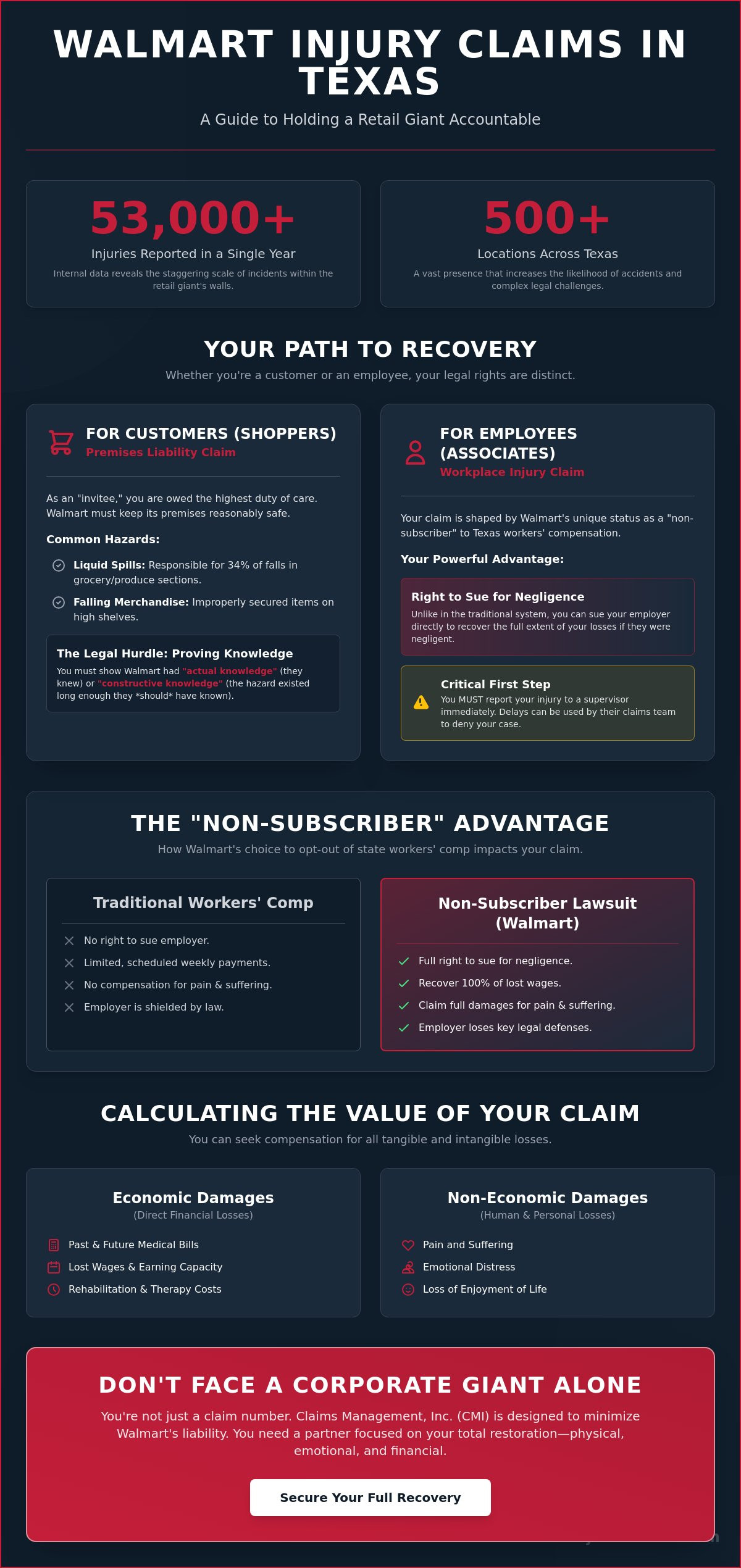
Did you know that while corporate reports might suggest a safe environment, internal data has revealed over 53,000 injuries occurring within this retail giant's walls in a single year? With over 500 locations across the state, a Walmart injury claim Texas involves more than just a simple insurance filing. You're likely facing mounting medical debt and aggressive tactics from Claims Management, Inc. (CMI). This often leaves individuals feeling like a number in a massive corporate machine designed to minimize liability.
We understand that an unexpected accident can disrupt your entire life, and you deserve a partner who views your recovery as a holistic process of healing rather than a mere financial transaction. This guide will show you how to hold a retail giant accountable and secure the compensation required for your total restoration. We will break down the complexities of Texas "non-subscriber" laws, the strict 2026 evidentiary standards for premises liability, and the strategic steps needed to achieve maximum recovery for your medical bills and lost wages.
Key Takeaways
- Distinguish between customer premises liability and associate workplace injury claims to ensure you follow the correct legal path for your situation.
- Understand how Walmart’s "non-subscriber" status in Texas empowers injured workers to seek full accountability through a negligence-based lawsuit.
- Learn how to successfully navigate a Walmart injury claim Texas by leveraging modified comparative fault rules and meeting strict 2026 evidentiary standards.
- Identify the full scope of economic and non-economic damages available to you, from immediate surgical costs to long-term emotional distress.
- Discover a strategic approach to legal representation that focuses on your total restoration—healing you physically, emotionally, and financially.
Understanding Your Rights: Customer vs. Employee Injuries at Walmart
When you enter a store with over 500 locations across the state, your legal relationship with the retailer determines the path toward restoration. Whether you are a shopper browsing the aisles or an associate stocking shelves, your Walmart injury claim Texas relies on proving that the corporation failed in its legal duty of care. Texas law creates a distinct separation between these two groups, yet both require a strategic approach to overcome the sophisticated defense tactics used by large retailers. Understanding whether your case falls under premises liability or workplace negligence is the foundation of your recovery.
Premises Liability for Texas Shoppers
Retail shoppers are classified as "invitees" under Texas law. This status grants you the highest level of legal protection available to a visitor. Walmart has an affirmative duty to inspect its stores for "dangerous conditions" and either repair them or provide an adequate warning. These hazards often include liquid spills, which cause 34% of falls in grocery and produce sections, or improperly secured merchandise that can fall from high racking.
The core of a successful claim involves proving knowledge. You must demonstrate that the store had "actual knowledge" of the hazard or "constructive knowledge," meaning the danger existed long enough that it should have been discovered. Premises liability law requires specific evidence to meet this burden. In 2026, Texas courts have become increasingly strict regarding the "constructive notice" standard. This makes it essential to follow a proven premises liability framework that prioritizes the collection of time-stamped surveillance footage and sweep logs to prove exactly how long a hazard was left unaddressed.
Workplace Injuries for Walmart Associates
If you are an employee, your Walmart injury claim Texas is shaped by the company's status as a "non-subscriber." Walmart has elected to opt out of the state's traditional workers' compensation system. This means that if you suffer a back injury from heavy lifting, a forklift accident, or a slip in the loading dock, you aren't limited to the small weekly checks provided by state insurance. Instead, you have the right to sue the company directly under Texas common law.
To succeed, you must prove that Walmart's negligence contributed to your injury. This might involve showing they failed to provide necessary safety equipment, lacked proper training protocols, or maintained an unsafe environment. Your first step is critical: you must report the injury to a supervisor immediately. Because Walmart manages its own claims, any delay in reporting gives their internal team a reason to question the validity of your incident. We focus on ensuring that your right to a safe workplace is upheld, helping you navigate the corporate bureaucracy to secure the medical care and wage replacement you need for a full return to health.
The "Non-Subscriber" Factor: Why Texas Walmart Claims Are Unique
Texas stands alone as the only state that allows employers to opt out of the traditional workers' compensation system. A non-subscriber is a Texas employer who provides private injury benefits instead of state-regulated workers’ comp. This choice by the retail giant fundamentally changes the trajectory of a Walmart injury claim Texas. While the company may offer an internal "benefit plan" to cover immediate medical needs, this plan is a corporate policy, not a legal shield that prevents you from seeking justice in a court of law.
By choosing this path, Walmart loses the "exclusive remedy" protection that typically prevents employees from suing their employers for workplace accidents. You aren't stuck with the limited, scheduled payments found in the state system. Instead, you have the right to file a lawsuit to recover the full extent of your losses. However, you'll be dealing with Claims Management, Inc. (CMI), which is Walmart’s internal third-party administrator. It's vital to recognize that CMI’s primary objective is to protect the corporation's assets, not to ensure your total restoration.
The Legal Advantage of Suing a Non-Subscriber
Litigating against a non-subscriber offers specific procedural advantages that can benefit an injured worker. In many of these cases, Texas law prohibits the employer from using "contributory negligence" as a defense. This means that if Walmart’s failure to provide a safe environment contributed to your accident, they cannot escape liability by claiming you were also partially at fault. This shift makes proving negligence a powerful tool for recovery. Unlike the state system, a successful lawsuit allows you to seek damages for pain, suffering, and emotional distress, which are usually unavailable or strictly capped in traditional workers' comp claims.
Common Pitfalls in the CMI Claims Process
The internal claims process is often a minefield of tactical hurdles. CMI adjusters frequently ask for recorded statements very early, often before you've had time to process the trauma or understand the full scope of your injuries. These statements are frequently used later in litigation to highlight minor inconsistencies and undermine your case. You might also feel significant pressure to see "company doctors" who are paid by the retailer. These medical professionals may downplay your symptoms or rush your return to work to minimize the company's financial exposure.
Simply following Walmart’s internal instructions doesn't guarantee a fair outcome. Their process is built for corporate efficiency, not individual healing. If you're struggling to get the care you need, consulting a dedicated workplace injury advocate can provide the clarity and protection required to stand up to a retail giant.
Proving Negligence: How to Build a Strong Case Against a Retail Giant
Establishing liability against a multi-billion dollar corporation requires more than just showing you were hurt. You must meet the legal burden of proof by demonstrating that Walmart failed in its duty of care. This involves technical discovery and a deep understanding of local court procedures. A Houston personal injury lawyer understands how to navigate the specific discovery rules in Harris County and surrounding District Courts, where the process for requesting internal corporate documents is strictly timed and governed by local standing orders.
Texas follows a modified comparative fault rule, often called the "51% bar rule." This means you can still secure compensation even if you were partially responsible for the incident. As long as your fault is 50% or less, you can recover damages, though your final settlement will be reduced by your percentage of responsibility. If a jury finds you 51% at fault, you're barred from recovery entirely. Walmart’s defense teams will aggressively attempt to shift the blame onto you to cross that 51% threshold, making professional advocacy essential to protect your right to restoration.
Immediate Steps Following a Walmart Incident
- Seek medical attention immediately: This documents the injury and creates a contemporaneous medical record that links the harm to the specific store incident.
- Report the incident: Notify a manager and request a copy of the internal report. Don't sign any documents that admit fault or waive your rights.
- Capture photos of the scene: Take clear pictures of the hazard, such as a liquid spill or falling merchandise, and any visible injuries.
- Identify witnesses: Obtain the names and contact information of shoppers who saw the incident occur.
Essential Evidence for Your Texas Claim
Evidence in a Walmart injury claim Texas is often time-sensitive. Retailers typically overwrite surveillance footage within 30 days; we send a formal spoliation letter immediately to demand the preservation of this video. Maintenance logs are equally critical. They reveal when an area was last inspected or cleaned, which helps prove "constructive notice" by showing how long a hazard was left unaddressed.
In complex cases, we utilize expert witnesses to reconstruct the accident or provide detailed testimony on your future medical needs. This technical proof is what often bridges the gap between a denied Walmart injury claim Texas and a successful recovery. By merging corporate-level rigor with personal advocacy, we ensure that every piece of evidence is leveraged to hold the negligent party accountable.
Calculating the Value of Your Walmart Injury Settlement
Determining the financial weight of a Walmart injury claim Texas requires a meticulous audit of your past, present, and future losses. A settlement isn't merely a reimbursement for hospital bills; it's a mechanism for your total restoration. While Claims Management, Inc. (CMI) often presents an initial low-ball offer shortly after an incident, these figures rarely account for the full scope of your recovery. True valuation categorizes damages into economic and non-economic buckets to ensure no aspect of your healing is ignored.
Economic damages represent your quantifiable financial depletion. These are the bills you can hold in your hand, including:
- Emergency room fees and hospital stays.
- Surgical costs and prescription medications.
- Physical therapy and rehabilitative equipment.
- Lost wages and diminished future earning capacity.
Non-economic damages address the subjective impact on your quality of life. This includes physical pain, mental anguish, and the loss of ability to enjoy previous hobbies or family activities. Balancing these two categories is essential for a fair outcome, as the emotional toll of a permanent injury often outweighs the immediate medical costs. If you aren't sure what your case is worth, request a professional valuation to ensure you don't leave vital compensation on the table.
Short-Term vs. Long-Term Financial Impact
A common mistake is settling before reaching "Maximum Medical Improvement" (MMI). This is the point where a doctor determines your condition has stabilized and further healing is unlikely. If you accept a check before MMI, you waive your right to seek additional funds if you later require chronic pain management or follow-up surgeries. Insurance adjusters often use a "multiplier" method to estimate pain and suffering, typically multiplying your economic damages by a number between one and five. We ensure this multiplier accurately reflects the severity of your experience rather than a corporate average.
Texas Damage Caps and Legal Reality
Texas law provides specific protections for injured parties, including the "Eggshell Skull" doctrine. This legal principle states that a defendant is liable for the full extent of your injuries even if a pre-existing condition made you more susceptible to harm. If gross negligence is proven, you may also be eligible for exemplary damages, which are intended to punish the corporation for particularly reckless behavior. For catastrophic injuries, a comprehensive life-care plan is necessary to project the costs of long-term medical needs. We move quickly from identifying these needs to offering a solution that secures your financial future.
Navigating the Legal Process with The Todd Law Group, PLLC
Selecting the right legal counsel is the most significant step following an accident. The Todd Law Group, PLLC brings a unique combination of high-level corporate experience and dedicated personal advocacy to every Walmart injury claim Texas. Jeff Todd’s professional history in major metropolitan hubs like Houston and Galveston allows our firm to anticipate the defense strategies of multi-billion dollar retailers. We don't simply process claims; we build a strategic foundation for your total restoration.
Our commitment to healing goes beyond the courtroom. We recognize that a serious incident impacts your physical health, emotional well-being, and financial security. The Todd Law Group, PLLC views legal representation as a holistic process rather than a mere transaction. To ensure justice is accessible to all, we operate on a contingency-fee basis. You pay nothing unless we successfully secure a recovery for you, removing the financial risk from your pursuit of accountability.
What to Expect During Your Free Case Evaluation
When you contact our office, you'll receive a confidential review of your incident and the evidence gathered so far. We provide a clear assessment of your chances for recovery based on current 2026 legal standards and local Texas Labor Code requirements. You'll have direct communication with a team that understands the nuances of the Houston and Galveston court systems. We move quickly from identifying the strengths of your case to offering a proactive solution for your long-term needs.
Your Partner in the Fight Against Corporate Negligence
The burden of proving a Walmart injury claim Texas is heavy, but you don't have to carry it alone. The Todd Law Group, PLLC handles all communication with corporate adjusters and internal claims managers so you can focus on your medical recovery. Our litigation strategy is designed to move your case forward with both speed and meticulous attention to detail. We're seasoned professionals who are comfortable in formal proceedings, ensuring your story is told with the authority it deserves.
Securing Your Path to Total Restoration
The journey toward healing after a retail accident involves more than just navigating paperwork. It requires a strategic understanding of how corporate giants manage liability and a commitment to your long-term well-being. By addressing the complexities of a Walmart injury claim Texas with precision, you can move from the initial shock of an injury to a state of complete restoration. This process demands a partner who understands the local legal landscape and the intellectual rigor required to challenge sophisticated defense teams.
The Todd Law Group, PLLC provides the stable, authoritative guidance necessary to secure your future. Founding attorney Jeff Todd has been licensed in Texas since 1994, bringing decades of experience to clients in Houston, Austin, and Galveston. Our contingency-based model ensures that you face no financial burden while seeking justice. We prioritize your physical, emotional, and financial recovery above all else, ensuring that your legal journey is a path toward genuine healing.
Schedule Your Free Walmart Injury Case Review Today. Let us provide the clarity and dedicated advocacy you need to hold the negligent parties accountable and reclaim your quality of life. You don't have to face this transition alone. We're here to guide you every step of the way.
Frequently Asked Questions
Is Walmart self-insured for injury claims in Texas?
Walmart is self-insured and manages its liability through an internal department or a third-party administrator called Claims Management, Inc. (CMI). This means they pay settlements out of their own corporate funds rather than using an outside insurance company. Because they're protecting their own profits, their adjusters are often highly motivated to minimize or deny your claim from the very beginning.
How long do I have to file a Walmart injury claim in Texas?
You generally have two years from the date of the incident to file a lawsuit for a Walmart injury claim Texas. This strict deadline is mandated by the Texas Civil Practice and Remedies Code § 16.003. If you don't file within this period, you'll likely lose your right to seek compensation. It's vital to act much sooner to ensure surveillance footage and store maintenance logs aren't destroyed.
Can I sue Walmart if I was an employee and they have a private benefit plan?
You can sue Walmart for negligence because the company is a "non-subscriber" to the Texas workers' compensation system. While they may provide a private benefit plan for immediate medical needs, this plan doesn't offer the "exclusive remedy" protection that prevents lawsuits. Filing a suit allows you to pursue full damages, including pain and suffering, which are never covered by their internal corporate plans.
What happens if Walmart claims the accident was my fault?
Texas follows a "modified comparative fault" rule, meaning you can still recover damages as long as you're 50% or less at fault. Your total financial recovery will be reduced by your percentage of responsibility. However, if Walmart proves you were 51% or more at fault, the law bars you from receiving any compensation at all. This is why professional advocacy is necessary to counter their defense tactics.
Do I need a lawyer to handle a claim with Walmart’s CMI?
While you aren't legally required to have a lawyer, dealing with CMI adjusters alone often leads to undervalued settlements. These adjusters are trained to secure recorded statements that can be used to undermine your case later. A seasoned attorney manages all corporate communication and ensures that you don't sign away your rights before you've reached maximum medical improvement.
How much is a typical settlement for a slip and fall at Walmart?
Settlement amounts vary significantly based on the severity of your injuries and the specific evidence of negligence. There is no standard "average" because a Walmart injury claim Texas is calculated using your unique medical bills, lost wages, and non-economic losses like emotional distress. We focus on a comprehensive valuation that prioritizes your total restoration rather than a quick, low-ball corporate offer.
What if I was injured in a Walmart parking lot in Houston?
Walmart is responsible for maintaining safe conditions in their parking lots, including proper lighting and the repair of pavement hazards. If you're hurt in a Houston lot, local discovery rules will govern how we obtain security footage and maintenance records. Proving the store knew about a parking lot danger is just as critical as proving a hazard inside the store aisles.
Can I see my own doctor after being hurt at work at Walmart?
You have the right to seek treatment from your own medical providers to ensure you receive an unbiased assessment of your injuries. While Walmart's internal benefit plan may pressure you to see "company doctors" to receive immediate benefits, these physicians often prioritize the company's bottom line. Seeing an independent specialist is a critical step in documenting the true extent of your medical needs and long-term recovery path.


