
The legal system will not pause for your grief. In the days after losing someone to another party's negligence, families across Texas find themselves buried under medical bills, fielding calls from insurance adjusters, and trying to understand terms they've never heard before, all while trying to simply breathe. Experienced Texas wrongful death lawyers exist precisely for this moment, to stand between a grieving family and a legal process that can feel designed to exhaust them into accepting less than they deserve.
You already know something is deeply wrong when a preventable act takes someone you love. What you may not know is that Texas law provides a structured path toward accountability and genuine financial recovery, and that path is far more specific than most families realize. The difference between a wrongful death claim and a survival claim, who has the legal standing to file, and how fault is established are questions that carry real financial consequences for your family's future.
This guide breaks down exactly how Texas wrongful death law works in 2026, who can pursue a claim, what you can recover, and how to find a legal partner who treats your family's restoration as the priority it deserves to be.
Key Takeaways
- Texas wrongful death law is narrowly defined by statute, and understanding whether your situation qualifies is the critical first step toward financial recovery for your family.
- Not everyone can file a wrongful death claim in Texas — only specific statutory beneficiaries have legal standing, and the rules around common-law spouses and adopted children are more nuanced than most families expect.
- Wrongful death claims and survival actions are two distinct legal tools that can often be pursued simultaneously, and knowing the difference can significantly affect the total compensation your family recovers.
- Experienced texas wrongful death lawyers know how to establish liability across complex scenarios — from commercial trucking accidents on major Texas highways to medical negligence inside large hospital systems.
- The right legal partner does more than pursue a settlement — they absorb the legal burden entirely so your family has the space to focus on grieving and rebuilding.
What is a Wrongful Death Claim Under Texas Law?
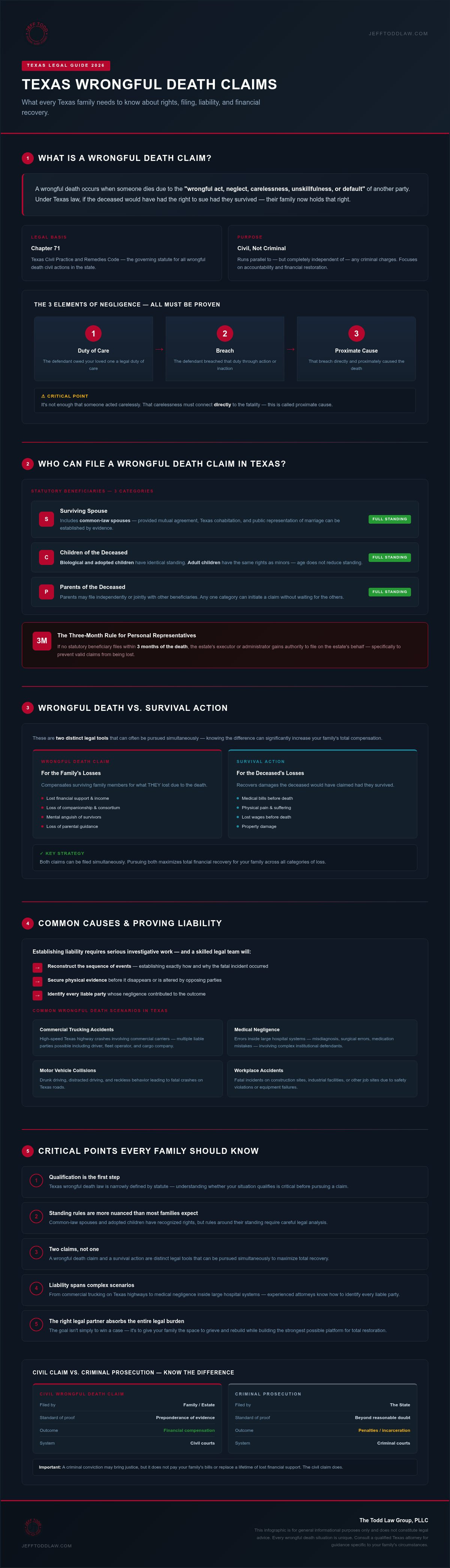
At its core, a wrongful death claim is the legal system's recognition of a simple but devastating truth: some deaths don't have to happen. Texas law defines a wrongful death as one caused by a "wrongful act, neglect, carelessness, unskillfulness, or default" of another party. That language comes directly from the statute, and every word carries weight. It means that if your loved one would have had the right to sue for their injuries had they survived, your family now holds that right in their place.
This isn't about punishment in the criminal sense. It's about accountability and restoration. The claim exists for the living.
The Legal Foundation: Chapter 71 of the Texas Civil Practice and Remedies Code
The Texas Wrongful Death Act, codified under Chapter 71 of the Texas Civil Practice and Remedies Code, is the statute that governs these claims. It's a civil action, entirely separate from any criminal proceedings that may arise from the same incident. A driver charged with vehicular manslaughter faces the criminal courts; your family's wrongful death claim runs on a parallel but independent track through the civil system. The standard of proof differs, the parties differ, and critically, the outcome differs. A criminal conviction may bring a measure of justice, but it doesn't pay your family's bills or replace a lifetime of lost financial support. That's what the civil claim is designed to do.
Why Negligence Matters in Your Case
Negligence is the engine that drives most wrongful death claims. To establish it, your legal team must demonstrate three connected things: that the defendant owed your loved one a duty of care, that they breached that duty through their actions or inaction, and that this breach was the proximate cause of the death. Proximate cause is the critical link. It's not enough that someone acted carelessly; that carelessness must connect directly to the fatality.
Establishing that connection requires serious investigative work. The approach mirrors what experienced Houston personal injury lawyers apply to complex injury cases: reconstructing the sequence of events, securing physical evidence before it disappears, and identifying every party whose negligence contributed to the outcome.
Skilled Texas wrongful death lawyers understand that this investigation isn't just a legal exercise. It's the foundation of your family's financial future, and it deserves the same rigor that elite corporate litigation demands. The goal isn't simply to win a case. It's to build the strongest possible platform for your family's total restoration.
Who Can File a Wrongful Death Lawsuit in Texas?
Texas law is precise about who holds the right to pursue a wrongful death claim, and that precision matters enormously when your family is trying to understand its options. The statute identifies three categories of statutory beneficiaries: the surviving spouse, the deceased's children, and the deceased's parents. These parties may file jointly or independently, and in most cases, any one of them can initiate the claim without waiting for the others to act.
A few nuances deserve direct attention. Common-law spouses are recognized under Texas law, provided the informal marriage can be established through evidence of a mutual agreement to be married, cohabitation in Texas, and a public representation of the marriage. If those elements exist, a common-law spouse carries the same standing as a formally married spouse. Adopted children hold full legal standing as well, treated identically to biological children under the statute. The distinction that often surprises families is this: adult children have the same filing rights as minor children. Age doesn't diminish standing. What matters is the legal relationship, not the child's dependency status at the time of death.
The Three-Month Rule for Personal Representatives
If none of the statutory beneficiaries file a wrongful death claim within three months of the death, the executor or administrator of the estate gains the authority to file on the estate's behalf. In a wrongful death context, the executor is the court-appointed or will-designated individual responsible for managing the deceased's estate, and their filing authority exists specifically to prevent valid claims from going unpursued. Importantly, the statutory beneficiaries can prevent the executor from filing by actively choosing to pursue the claim themselves, or by formally objecting to the executor's involvement. Experienced Texas wrongful death lawyers routinely advise families on how to exercise this control so the claim remains in the hands of those with the most direct stake in the outcome.
Excluded Parties: Siblings and Grandparents
Siblings, grandparents, aunts, and uncles generally have no standing to file a wrongful death claim under Texas law, regardless of how close their relationship was with the deceased. The statute doesn't create exceptions based on emotional proximity. However, these relatives aren't without options. If they were financially dependent on the deceased, a probate attorney may identify alternative legal paths through the estate. They can also play a meaningful supporting role in an active claim, providing testimony, documentation, and family context that strengthens the primary beneficiaries' case.
The two-year statute of limitations governs all wrongful death claims in Texas. Filing must occur within two years of the date of death, not the date of the underlying incident. Missing this deadline almost certainly extinguishes the family's right to recovery, which is why connecting with a legal team early protects options that can't be recovered once lost. If your family is trying to determine where it stands, speaking with a Texas wrongful death attorney sooner rather than later is the most protective step you can take right now.
Wrongful Death vs. Survival Actions: Understanding the Difference
Most families assume there is one claim to file after a wrongful death. In Texas, there are actually two distinct legal tools available, and pursuing both simultaneously can significantly increase the total recovery your family receives. The distinction isn't just technical; it determines who receives the compensation, what losses are covered, and how the money flows through your family's legal and financial future.
A wrongful death claim compensates the survivors for what they've lost. A survival action compensates the estate for what the deceased endured before dying. Both arise from the same underlying negligence. Both can be filed in the same lawsuit. But they answer fundamentally different questions.
The survival action works exactly as its name suggests: the legal claim that your loved one would have had against the negligent party doesn't die with them. It survives. It passes to the estate, which then pursues it on behalf of the deceased. This is the mechanism that ensures the responsible party can't escape accountability simply because their negligence was severe enough to cause death rather than injury.
Types of Damages Available to Survivors
Wrongful death damages are paid directly to the statutory beneficiaries, not routed through the estate. They fall into two broad categories:
- Economic damages: Lost earning capacity (the income your family would have received over the deceased's remaining working years), lost inheritance value, and the dollar equivalent of services they provided, such as childcare, household management, and home maintenance.
- Non-economic damages: Mental anguish, loss of companionship, loss of consortium for a surviving spouse, and the loss of the guidance and nurturing a parent would have provided to children.
Experienced Texas wrongful death lawyers approach these damages holistically, not as a checklist of line items. The goal is to reconstruct the full texture of what your family has lost, financially and personally, and translate that into a recovery that genuinely restores your quality of life. A spouse who managed the household, coached youth sports, and provided emotional stability contributed far more than a salary. Quantifying that full contribution requires both financial expertise and a legal team that understands people, not just numbers.
Survival Damages: Healing the Estate
Estate assets are subject to the deceased's outstanding debts before beneficiaries receive anything, which is why understanding this structure early matters for financial planning. To ensure your own family’s long-term security is just as clearly defined, you can explore Flat-Fee Legal Service Fees for comprehensive estate planning through Northeast Legal Team.
The recoverable survival damages include:
- Medical expenses incurred between the moment of injury and the time of death, including emergency care, hospitalization, and any treatment in between.
- Physical pain and mental anguish suffered by the deceased during that same window, which can be substantial in cases involving prolonged suffering before death.
- Funeral and burial expenses, which are recoverable through the estate rather than as a direct survivor benefit.
When a negligent party causes both catastrophic injury and eventual death, the survival action ensures they're held accountable for every stage of the harm they caused. Pursuing both claims together, which Texas wrongful death lawyers routinely do, builds the most complete picture of accountability and delivers the most comprehensive recovery for your family.
Common Causes and Proving Liability in Texas
Texas geography and economy create specific, predictable conditions where fatal negligence occurs. The state's sprawling highway corridors, major hospital systems, industrial worksites, and oil and gas infrastructure each carry their own risk profiles, and experienced Texas wrongful death lawyers understand that proving liability in each context requires a fundamentally different investigative approach.
The legal standard your family's case must meet is the preponderance of the evidence. That means demonstrating that it's more likely than not that the defendant's negligence caused the death. It's a lower bar than the criminal "beyond a reasonable doubt" standard, but meeting it still demands rigorous, well-organized evidence. The responsible party doesn't have to be the sole cause; they simply have to be a contributing cause that a reasonable person could have avoided.
Three scenarios produce a disproportionate share of Texas wrongful death cases:
- Commercial trucking accidents on I-10 and I-45: These corridors move enormous freight volume through Houston daily. When fatigued, improperly trained, or overloaded commercial drivers cause fatal collisions, the liability chain often extends well beyond the individual driver to include the carrier, the shipper, and maintenance contractors. Houston truck accident cases on these highways frequently involve multiple negligent parties, each with their own insurer and defense team.
- Medical malpractice in major hospital systems: Surgical errors, misdiagnosis, medication mistakes, and failures to monitor can turn treatable conditions fatal. Texas medical malpractice claims require expert witnesses who can translate clinical failures into language a jury understands, and they must clear a mandatory expert report requirement before the case can proceed.
- Premises liability and oil and gas workplace fatalities: Texas leads the country in energy production, and that industry carries serious fatality risk. When inadequate safety protocols, defective equipment, or negligent site management kills a worker, both premises liability and wrongful death claims may apply simultaneously.
Gathering Evidence: The Investigation Phase
Evidence degrades fast. In commercial trucking cases, black box data and electronic logging device records are critical to proving hours-of-service violations or sudden braking patterns, but carriers aren't obligated to preserve them indefinitely. Accident reconstruction experts can rebuild the sequence of events from physical evidence alone, but only if the scene hasn't been cleared. In medical malpractice cases, the investigation centers on complete medical record review and expert witnesses who can identify exactly where the standard of care broke down. Acting quickly isn't just strategic; it's often the difference between a provable case and one where the evidence no longer exists.
Gross Negligence and Punitive Damages
When a defendant's conduct goes beyond ordinary carelessness into something more extreme, Texas law allows for exemplary damages, what most people call punitive damages. Gross negligence means an act or omission involving an extreme degree of risk, where the defendant was actually aware of that risk and proceeded anyway. Think of a trucking company that knowingly kept a driver on the road past federal hours-of-service limits, or a hospital that ignored documented equipment failures. Texas caps exemplary damages at the greater of $200,000 or two times the economic damages plus up to $750,000 in non-economic damages, but even within those limits, they can meaningfully increase total recovery and send a clear message about accountability.
If your family's situation involves any of these scenarios, the time to build your evidentiary foundation is now. Contact the Todd Law Group to discuss what evidence exists in your case and how to preserve it before it's gone.
Why Choose The Todd Law Group for Your Texas Claim?
There's a meaningful difference between a firm that wins cases and a firm that restores families. Most legal advertising leads with verdicts and settlement totals. The Todd Law Group leads with something harder to quantify but far more important: a genuine commitment to carrying the legal burden so your family doesn't have to carry it alone.
Compassionate Advocacy with Corporate Rigor
Jeff Todd has been licensed in Texas since 1994. That's more than three decades of building the kind of institutional knowledge that only comes from handling high-stakes litigation across medical malpractice, commercial trucking, and maritime contexts. His background in elite corporate law means he understands exactly how large insurers and defense firms build their strategies, because he's operated at that level. He applies that same rigor to every family his firm represents.
What that means practically is this: your case isn't assigned to a junior associate and tracked as a case number. The attention is personal, the strategy is built around your family's specific circumstances, and the goal extends beyond a settlement figure. The firm's approach treats financial recovery as one component of total restoration, not the finish line. Families in Austin navigating this process can find additional local context through the firm's Austin wrongful death attorney resource, which details how this philosophy translates into local representation.
With offices in Houston, Austin, and Galveston, the Todd Law Group is embedded in the communities where Texas wrongful death lawyers are needed most. These aren't satellite outposts. They're working offices staffed by professionals who understand the local courts, local industries, and the specific risk environments that generate these cases.
Your Next Steps: The Consultation Process
The first conversation costs you nothing. The Todd Law Group offers a free, no-obligation case evaluation designed to give your family honest answers, not a sales pitch. From that point forward, if the firm takes your case, it operates on a contingency fee basis. No fees unless a recovery is made. Full stop.
What that also means is that the firm absorbs every interaction with insurance adjusters, defense attorneys, and opposing counsel. You won't field calls designed to minimize your claim. You won't be pressured into premature settlements. That communication runs through the legal team, where it belongs.
Your family's only job right now is to grieve and begin rebuilding. Let the legal process run in the background, handled by people who've done this for thirty years. Reach out to the Todd Law Group today and take the first step toward accountability and recovery.
Your Family Deserves More Than a Settlement: Take the First Step Today
Losing someone to another party's negligence leaves families navigating grief and a legal system simultaneously. This guide has walked through the core framework: how Texas defines wrongful death, who holds the legal standing to file, why pursuing both a wrongful death claim and a survival action matters, and how liability gets built across complex scenarios like commercial trucking accidents and medical malpractice cases.
The throughline is this: the right Texas wrongful death lawyers don't just pursue compensation. They carry the legal weight entirely so your family can focus on what actually matters right now.
Jeff Todd has been licensed in Texas since 1994, bringing decades of high-stakes litigation experience to every family the firm represents. With offices in Houston, Austin, and Galveston, and a contingency-based model that means no fees unless a recovery is made, the barrier to getting started is lower than most families realize.
Your path toward accountability starts with a single conversation. Contact The Todd Law Group today for a free, compassionate consultation on your wrongful death claim. You don't have to face this alone.
Frequently Asked Questions About Texas Wrongful Death Claims
How long do I have to file a wrongful death lawsuit in Texas?
Texas law gives statutory beneficiaries two years from the date of death to file a wrongful death claim. Missing this deadline almost always means permanently losing the right to pursue compensation, regardless of how strong the underlying case might be. There are narrow exceptions, such as cases involving minors or fraudulent concealment of the cause of death, but relying on an exception is never a safe strategy.
Don't wait to find out whether an exception applies to your situation. The earlier your legal team begins preserving evidence and building your case, the stronger your position will be.
Can I file a wrongful death claim if my loved one didn't have a will?
Yes. A will has no bearing on who can file a wrongful death claim. The right to file belongs to the statutory beneficiaries defined by Texas law: the surviving spouse, children, and parents of the deceased. These parties hold that right regardless of whether a will exists or what it says.
Where the absence of a will does matter is in the survival action. Survival damages flow to the estate, and without a will, Texas intestacy law determines how those assets are distributed among heirs. An experienced attorney can help your family understand how both streams of recovery interact with your specific estate situation.
What is the average settlement for a wrongful death case in Texas?
There's no reliable average that would be meaningful to your family's case. Wrongful death settlements vary enormously based on the deceased's age and earning capacity, the number of dependents, the severity of the defendant's conduct, and the quality of the evidence. A case involving a commercial trucking company with documented hours-of-service violations will resolve very differently than a premises liability claim with disputed facts.
What matters isn't an industry average; it's the full and accurate valuation of your family's specific losses. Experienced Texas wrongful death lawyers build that valuation from the ground up, accounting for both economic and non-economic damages rather than accepting an early offer that invariably undervalues the claim.
Can siblings or grandparents sue for wrongful death in Texas?
Generally, no. Texas law limits standing to the surviving spouse, children, and parents of the deceased. Siblings, grandparents, and other relatives don't qualify as statutory beneficiaries, regardless of how close the relationship was. The statute doesn't create exceptions based on emotional proximity or financial informality.
That said, relatives who were financially dependent on the deceased may have options through the estate itself, separate from a wrongful death claim. They can also provide meaningful support to an active case through testimony and documentation. A probate or wrongful death attorney, such as the team at lawbob.com, can clarify what paths, if any, are available given your family's specific circumstances.
What happens if the person responsible for the death is also facing criminal charges?
The civil wrongful death claim and any criminal prosecution run on entirely separate tracks. A criminal case is brought by the state; your family's civil claim is brought by the statutory beneficiaries. The two proceedings operate independently, with different standards of proof and different outcomes. A criminal acquittal doesn't bar your civil claim, because the civil standard requires only a preponderance of the evidence, not proof beyond a reasonable doubt.
In practice, criminal proceedings can generate evidence that strengthens a civil case, including police reports, witness statements, and admissions made during investigation. Your legal team will monitor the criminal process closely and use any relevant findings to support your family's claim.
How are wrongful death settlements divided among family members in Texas?
Texas law doesn't impose a fixed formula for dividing wrongful death proceeds among beneficiaries. If multiple parties file jointly, they can agree on an allocation among themselves. If they can't agree, the court may intervene to determine a fair distribution based on each beneficiary's individual losses, including their financial dependence on the deceased, the nature of the relationship, and the mental anguish each person suffered.
This is one reason why having all statutory beneficiaries represented by coordinated legal counsel matters. Disputes over allocation can delay resolution and reduce the total recovery available to the family as a whole.
Do I need a lawyer if the insurance company is already offering a settlement?
Yes, and the fact that an offer is already on the table is itself a reason to consult Texas wrongful death lawyers before accepting anything. Insurance companies move quickly with early offers precisely because those offers are typically far below what a fully developed legal claim would recover. Accepting a settlement usually requires signing a release that permanently waives your right to pursue additional compensation.
An experienced attorney will evaluate whether the offer reflects the full scope of your family's losses, including future lost income, non-economic damages, and any survival action claims that may not be captured in the insurer's initial calculation. The consultation costs nothing; the cost of accepting an inadequate settlement is permanent.
What if my loved one was partially at fault for the accident?
Partial fault doesn't automatically eliminate your family's right to recover. Texas follows a modified comparative fault rule. Your family can still pursue a wrongful death claim as long as the deceased was not more than 50 percent responsible for the incident. If fault is assigned below that threshold, the total damages are reduced proportionally by the percentage of fault attributed to the deceased.
Defense attorneys and insurers routinely argue that the deceased bore more responsibility than the evidence actually supports, because doing so reduces their exposure. A skilled legal team will challenge those characterizations directly, using accident reconstruction, witness accounts, and expert testimony to establish an accurate picture of what actually happened.


