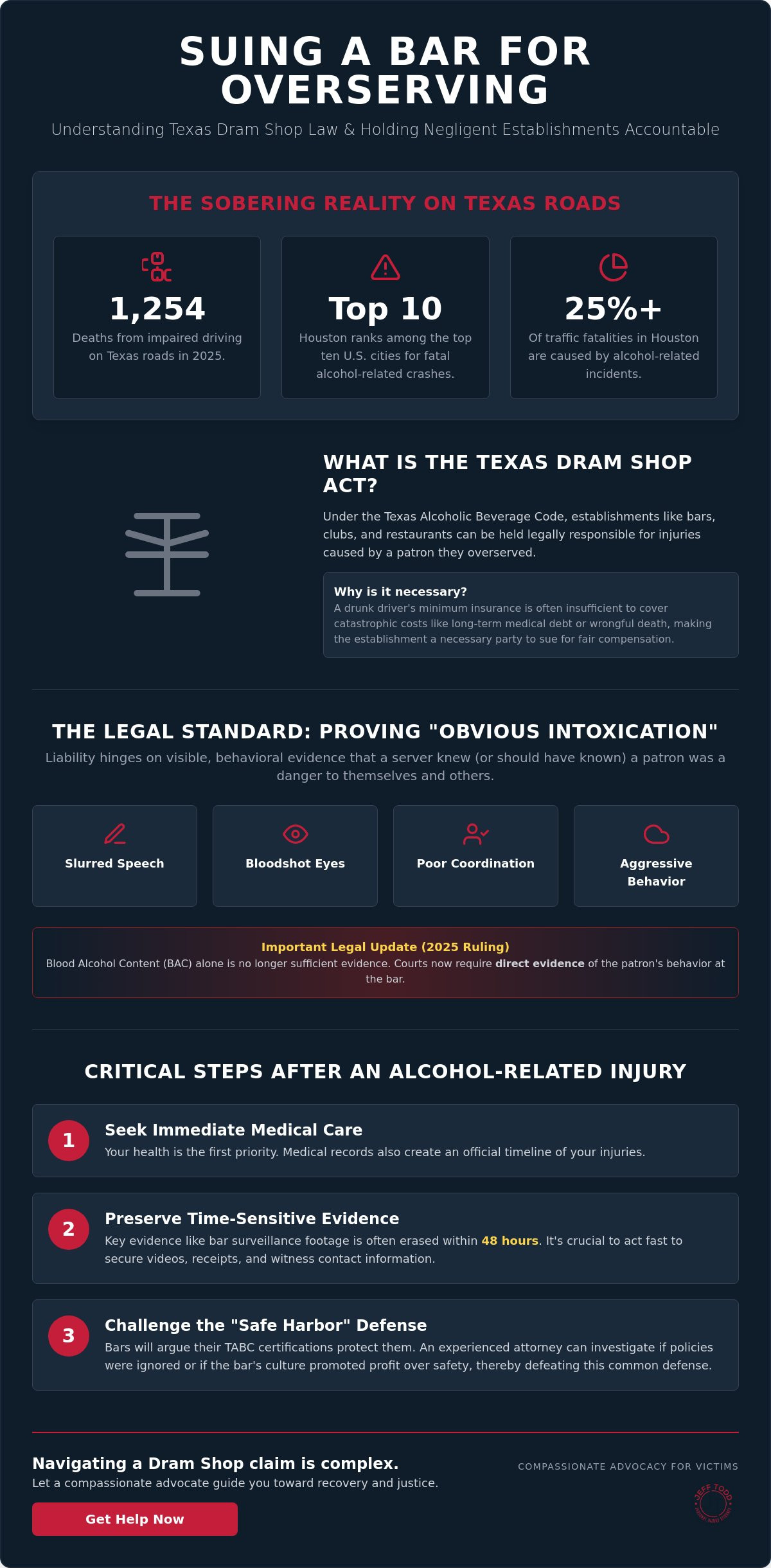
In 2025, impaired driving led to 1,254 deaths on Texas roads, and Houston continues to rank among the top ten cities in the nation for fatal alcohol-related crashes. If you or a family member were involved in one of these incidents, you may be considering suing a Houston bar for overserving the driver who caused the harm. It's a heavy burden to carry, especially when you're dealing with immense medical debt or the wrongful death of a loved one while the driver’s insurance is insufficient to cover the damage.
You shouldn't have to navigate this path to restoration alone. While Texas law often protects business owners, it's possible to hold negligent establishments accountable for their role in your injury. You'll learn how to navigate the complexities of Texas Dram Shop liability in 2026 and secure the compensation you need for a truly holistic recovery. This guide explores the specific evidence required after recent Texas Supreme Court rulings and how to challenge the "Safe Harbor" defense that many bars use to avoid responsibility.
Key Takeaways
- Understand your rights under the Texas Dram Shop Act to hold negligent establishments accountable for their role in alcohol-related accidents.
- Learn the specific indicators of "obvious intoxication" that servers must recognize to prevent dangerous overconsumption.
- Discover the evidentiary hurdles involved in suing a Houston bar for overserving, including how to challenge the common "Safe Harbor" defense.
- Act quickly to secure time-sensitive evidence like bar surveillance footage, which often disappears within 48 hours of an incident.
- Explore how a holistic legal approach can help you recover from medical debt and wrongful death losses while pursuing total restoration.
Understanding Texas Dram Shop Laws and Houston Bar Liability
While the drunk driver is the most immediate face of a tragedy, they're rarely the only party responsible. Under the Texas Alcoholic Beverage Code Chapter 2, commercial establishments that profit from the sale of alcohol carry a heavy legal burden. This statute, commonly referred to as the Texas Dram Shop Act, creates a pathway for victims to hold bars, clubs, and restaurants accountable for the devastation caused by overconsumption. In a city like Houston, where alcohol-related crashes account for over 25% of traffic fatalities, these laws are a vital tool for public safety.
Suing a Houston bar for overserving is often a necessary step for families facing catastrophic loss. Texas drivers frequently carry only the state-mandated minimum insurance, which is nowhere near enough to cover long-term medical debt or the financial void left by a wrongful death. By looking beyond the driver to the establishment that provided the alcohol, you can seek the resources required for a truly holistic recovery. Most cases involve third-party claims, where an innocent victim seeks damages from the bar. While first-party claims by the drinker themselves are possible, they're significantly harder to win because of the state's 51% bar rule, which prevents recovery if the plaintiff is mostly at fault for their own injuries.
The Statutory Standard for Liability
To succeed in a lawsuit, you must prove the patron was "obviously intoxicated" to the extent they presented a clear danger to themselves and others. This isn't just about a high blood alcohol content. It's a behavioral standard. The law requires evidence that the server could see the person was impaired but chose to continue the sale anyway. Furthermore, you must demonstrate that this intoxication was the "proximate cause" of the injuries. The Texas Alcoholic Beverage Commission (TABC) oversees the licensing of these venues, but their administrative penalties are separate from your right to seek civil justice through Dram Shop Laws.
Why Houston Nightlife Districts Present Unique Challenges
Houston’s high-density entertainment areas like Washington Ave, Montrose, and Midtown are known for a high-energy "spirit of revelry." Unfortunately, this atmosphere sometimes encourages servers to ignore safety mandates in favor of profit. High-volume environments make it easier for signs of intoxication to be missed or ignored. When establishments offer "bottomless" drink specials or aggressive happy hour pricing, the risk of overserving skyrockets. These local factors often play a central role in proving that an establishment’s culture prioritized sales over the safety of the Houston community.
The Legal Standard: Defining "Obvious Intoxication" in Houston
Proving liability in a dram shop case requires more than just showing a driver was over the legal limit. Under the Texas Alcoholic Beverage Code, the burden of proof rests on showing the patron was "obviously intoxicated" at the time of service. This is a higher bar than the criminal standard of 0.08% BAC used in DWI cases. When you're suing a Houston bar for overserving, the central question is what the server observed, or should have observed, before pouring the next drink. The law focuses on visible behavior that indicates the person is a clear danger to themselves and others.
Common indicators of this state include slurred speech, bloodshot eyes, and a noticeable lack of physical coordination. However, aggressive behavior or a sudden shift in personality can also signal impairment. It's not just about the number of drinks listed on a tab. A person's tolerance, weight, and whether they've eaten all play a role in how they present. Because of the Texas Supreme Court’s April 11, 2025 ruling in Raoger Corporation v. Barrie Myers, we can't rely solely on Blood Alcohol Content (BAC) levels or expert "estimates" of how someone likely looked. We need direct evidence of their behavior at the bar.
The Role of Expert Witnesses and Toxicologists
Expert testimony remains a cornerstone of these cases, even with stricter evidentiary rules. Toxicologists use retrograde extrapolation to calculate a patron's BAC at the time they were served based on later tests. While the 2025 ruling says this isn't enough on its own, it provides a scientific framework for the visible signs witnesses describe. An expert can explain to a jury how a "reasonable server" with TABC training should have reacted when faced with those specific physical symptoms. If you need help identifying which experts are necessary for your case, you can speak with our experienced advocates to discuss your options.
Evidence Beyond Physical Appearance
Since visible intoxication must be time-stamped to the moment of service, we look for data that reconstructs the evening. Point-of-Sale (POS) records are invaluable because they show exactly how quickly drinks were ordered. If a patron was served four double-shots in forty minutes, that supports the claim of overserving. We also analyze:
- Social Media Footprints: Check-ins, photos, or videos posted by the patron or bystanders often capture the person’s state in real-time.
- Credit Card Statements: These provide a definitive timeline of the patron’s movement between different Houston establishments.
- Witness Testimony: Statements from other patrons or valet drivers can confirm stumbling or aggressive behavior that servers ignored.
Overcoming the "Safe Harbor" Defense in Texas
When you begin the process of suing a Houston bar for overserving, you'll likely encounter a formidable legal obstacle known as the "Safe Harbor" defense. Officially termed the "Trained Server" defense in the Texas Alcoholic Beverage Code, this provision allows establishments to avoid liability for the actions of their employees. It’s designed to encourage responsible service by rewarding owners who ensure their staff is properly trained. However, many bars treat this as a "get out of jail free" card, assuming that a stack of TABC certificates makes them untouchable. This is a misconception that a seasoned legal advocate can challenge.
To qualify for this statutory immunity, a Houston establishment must meet three specific criteria. First, the employee who overserved the patron cannot be an owner or an officer of the company. Second, that employee must hold a current TABC-approved seller training certificate. Third, the employer must have written policies for responsible service and must not have encouraged the employee to violate the law. If any of these pillars crumble, the bar loses its protection. We focus on the third requirement, as it's the most common point of failure for high-volume venues in districts like Washington Ave or Midtown.
Piercing the Shield: Proving Negligent Supervision
The "Safe Harbor" shield is not impenetrable. It fails if the establishment directly or indirectly encouraged the server to continue pouring drinks for an obviously intoxicated person. We investigate whether management set "sales quotas" or held contests that rewarded servers for high alcohol tabs. In many Houston bars, the internal culture prioritizes profit over safety. When a manager sees a drunk patron and tells a server to "keep the party going," they've effectively waived their legal immunity. Proving this requires a deep dive into the bar’s daily operations and management style.
Evaluating Bar Policy vs. Bar Reality
A bar may have a pristine employee handbook, but if those policies are ignored on a busy Saturday night, the handbook is irrelevant. We look for inconsistencies between the written rules and the actual behavior of the staff. This often involves:
- Reviewing Training Records: Ensuring all servers and managers were certified within 30 days of hire, as required by law.
- Interviewing Former Employees: Whistleblowers can provide insight into "unwritten rules" where overserving was tolerated or encouraged to boost tips.
- Checking Violation History: TABC records may show a pattern of three or more violations within a 12-month period, which automatically voids Safe Harbor protection.
Actionable Steps: What to Do After an Alcohol-Related Injury
The moments following an alcohol-related incident are often chaotic, but they're also the most critical for your total restoration. Your first priority must be seeking comprehensive medical attention. Establishing a "holistic healing" baseline isn't just about your physical recovery. It creates a definitive medical record that connects your injuries directly to the incident. Without this immediate documentation, defense attorneys may later claim your condition was pre-existing or unrelated to the crash.
Time is your greatest adversary when you're considering suing a Houston bar for overserving. In the high-traffic nightlife districts of Washington Ave and Westheimer, many establishments use surveillance systems that overwrite data every 48 to 72 hours. If you don't act quickly, the most objective evidence of a patron’s visible intoxication literally vanishes. You need to identify and interview witnesses who were actually inside the bar, not just those who saw the collision. Valet attendants, bartenders, and other patrons often provide the testimony needed to prove the "obvious intoxication" standard discussed earlier.
Reporting the incident to the Texas Alcoholic Beverage Commission (TABC) is another vital step. While a TABC investigation is administrative and doesn't directly award you damages, their findings can be powerful evidence in your civil case. An official state report confirming overserving violations can significantly weaken a bar’s defense strategy.
Preserving Crucial Evidence in Houston
To stop the destruction of evidence, your legal team must send "spoliation letters" to the bar owners immediately. These formal notices legally require them to preserve video footage, Point-of-Sale records, and employee schedules. We also work to obtain the official crash report from the Houston Police Department (HPD) or the Harris County Sheriff’s Office. In many 2026 cases, we also secure "black box" data from the vehicles involved, which provides undeniable proof of speed, braking, and impact force at the time of the accident.
Avoiding Insurance Adjuster Traps
You'll likely be contacted by the bar’s insurance company shortly after the incident. They may seem helpful, but their goal is to minimize their financial exposure. Don't give a recorded statement. These adjusters are trained to lead you into admissions that shift 100% of the blame to the drunk driver, letting the bar off the hook. It's essential to consult a houston personal injury lawyer before you sign any waivers or settlement offers. Protect your right to a full recovery by letting a professional handle the complex negotiations. If you’re ready to take the next step toward justice, contact our team for a dedicated case evaluation.
The Todd Law Group: Compassionate Advocacy for Dram Shop Victims
At The Todd Law Group, PLLC, we believe that a legal claim is about more than just numbers on a settlement check. It’s about restoring your life after a preventable tragedy. Jeff Todd brings a unique perspective to these cases, applying the same intellectual rigor and corporate-caliber detail he once used in elite legal hubs to the personal advocacy of individuals. When you're suing a Houston bar for overserving, you need a partner who can match the resources of high-volume establishments and their sophisticated insurance carriers. We provide that high-impact expertise with a persona that remains grounded and approachable.
Our firm specializes in the complex litigation required for cases of wrongful death and catastrophic injury. These matters require a meticulous reconstruction of the night in question to ensure every negligent party is held accountable. Our commitment to your "Total Restoration" means we prioritize your physical, emotional, and financial recovery as one unified process. We understand the distress of medical debt and the frustration of dealing with underinsured drivers, and we're here to carry that legal weight for you.
A Seasoned Approach to Texas Litigation
Our extensive experience in premises liability is a significant asset in dram shop cases. We know how to navigate the specific standards of property owner responsibility in Texas to prove that a bar failed in its duty to the public. This background allows us to dismantle the "Safe Harbor" defense by uncovering the systemic failures and profit-driven cultures that lead to overconsumption. You aren't just a case number to us. We provide the personalized, steady reassurance you need to navigate the legal system with confidence while you focus on your healing.
Take the First Step Toward Justice
The path to justice begins with immediate action. As we've discussed, evidence in Houston’s busiest nightlife districts can disappear in a matter of days. The Todd Law Group, PLLC operates on a "No Fee Unless We Win" contingency model, which removes the financial barrier to high-quality legal representation. You don't pay anything unless we secure the compensation you deserve. During your free, confidential case evaluation, we'll listen to your story and outline a clear strategy for your recovery. Don't let a negligent establishment walk away from the damage they caused. Schedule your free consultation with Jeff Todd today and start your journey toward total restoration.
Secure Your Path to Restoration
Success in these cases hinges on more than just proving a driver’s impairment; it requires a meticulous reconstruction of the events leading up to the crash. As we’ve explored, navigating the high evidentiary standards set by the Texas Supreme Court means you must act while data like Point-of-Sale records and witness statements are still available. When you’re suing a Houston bar for overserving, the strength of your claim rests on your ability to challenge the establishment’s defenses before they have a chance to disappear.
Jeff Todd has been licensed in Texas since 1994, offering the seasoned authority needed to dismantle complex corporate legal protections. With local offices in Houston, Austin, and Galveston, The Todd Law Group, PLLC is positioned to provide the dedicated advocacy your situation demands. We work on a contingency basis, so there’s no fee unless we recover money for you. You don't have to carry the burden of medical debt or wrongful death losses alone. Contact The Todd Law Group, PLLC for a Free Case Evaluation today and take the final step toward your total restoration.
Frequently Asked Questions
Can I sue a bar if a drunk driver hit me in Houston?
Yes, you can hold a commercial establishment liable under the Texas Dram Shop Act if they served an obviously intoxicated person. If a bar or restaurant provided alcohol to a patron who was clearly a danger to themselves and others, they share legal responsibility for the resulting crash. This allows victims to seek compensation beyond the driver’s often limited insurance coverage to ensure a more complete financial recovery.
What is the statute of limitations for a dram shop claim in Texas?
You must file your lawsuit within two years of the date the injury occurred. In cases involving a wrongful death, this two-year period begins specifically on the date of the individual's death. Because evidence like bar surveillance footage and witness memories can fade or disappear within days, it is vital to begin the legal process as soon as possible to meet these strict state deadlines.
Is it possible to sue a bar if I was the one who was overserved and got hurt?
You can technically file a "first-party" claim, but these cases face significant hurdles due to the Texas 51% Bar Rule. This law prevents you from recovering any compensation if a jury determines you were 51% or more responsible for your own injuries. Since the act of consuming alcohol is a choice, many juries find the drinker primarily at fault, making these claims much harder to win than third-party victim cases.
What if the bar claims their servers were TABC certified?
TABC certification is just one requirement of the "Safe Harbor" defense and does not grant automatic immunity. When suing a Houston bar for overserving, we investigate whether management indirectly encouraged servers to ignore training in favor of higher sales. If an owner or manager pressured staff to "push" drinks or failed to enforce written safety policies, the bar loses its protection regardless of their employees' certification status.
How much is a typical settlement for a Houston overserving case?
Settlement amounts vary significantly based on the severity of your injuries and the specific insurance limits of the establishment. Every case is unique, and a recovery is intended to address your specific medical debt, lost wages, and pain and suffering. While we cannot provide a "typical" number, our goal is always total restoration, ensuring the compensation covers the full scope of your physical and emotional healing process.
Do I have to prove the bar knew the person was going to drive?
No, the law does not require you to prove the server knew the patron intended to get behind the wheel. The statutory standard only requires proof that the patron was "obviously intoxicated" to the extent that they presented a clear danger to themselves or others. The risk of injury is legally presumed to be foreseeable when an establishment continues to serve an individual who is already visibly impaired.
What kind of damages can I recover in a dram shop lawsuit?
You can recover both economic and non-economic damages, including medical expenses, lost earning capacity, and physical impairment. If the incident resulted in a fatality, families may also seek burial expenses and loss of companionship. It is important to note that the Texas Supreme Court has held that punitive damages, intended to punish the defendant rather than compensate the victim, are not available under the Dram Shop Act.
How long does a lawsuit against a bar usually take in Harris County?
Most dram shop litigations in Harris County take between 12 and 24 months to reach a final resolution or trial. The timeline depends heavily on the complexity of the evidence, such as obtaining toxicologist testimony and analyzing Point-of-Sale records. While we strive for an efficient process, we prioritize meticulous attention to detail to ensure no aspect of your claim is overlooked during the progression of your case.


