
What if the insurance company that paid your medical bills after a collision suddenly demands a large portion of your final settlement? It is a frustrating reality for many injury victims who feel like the insurer is double-dipping into their recovery. If you've received a confusing legal notice, you're likely searching for the subrogation meaning to determine if you'll actually have enough money left to cover your future needs. We agree that after the trauma of an accident, the last thing you need is more legal jargon and the fear that your medical bills will remain an anchor on your progress.
This article will clarify how these liens work and how Texas law impacts your ability to keep your settlement funds. You'll gain a clear understanding of the "made whole" doctrine and how the March 13, 2026, Texas Supreme Court ruling in S&B Engineers & Constructors, Ltd. v. Scallon Controls, Inc. affects indemnity rights. We'll preview the strategies used to protect your financial restoration, ensuring you understand the steps required to move from an initial incident to a successful legal and physical recovery.
Key Takeaways
- Gain clarity on the subrogation meaning and how insurance companies "step into your shoes" to recover their costs after an accident.
- Identify the common types of liens from health providers and auto insurers that may claim a portion of your final settlement.
- Understand how the "Made Whole" doctrine prioritizes your total restoration before an insurance company can take its share.
- Learn how the auditing of medical ledgers can expose unrelated charges and significantly reduce the amount you owe back.
- Discover the role of legal advocacy in negotiating these claims to ensure your recovery remains focused on your long-term healing.
What Is Subrogation? A Simple Definition for Injury Victims
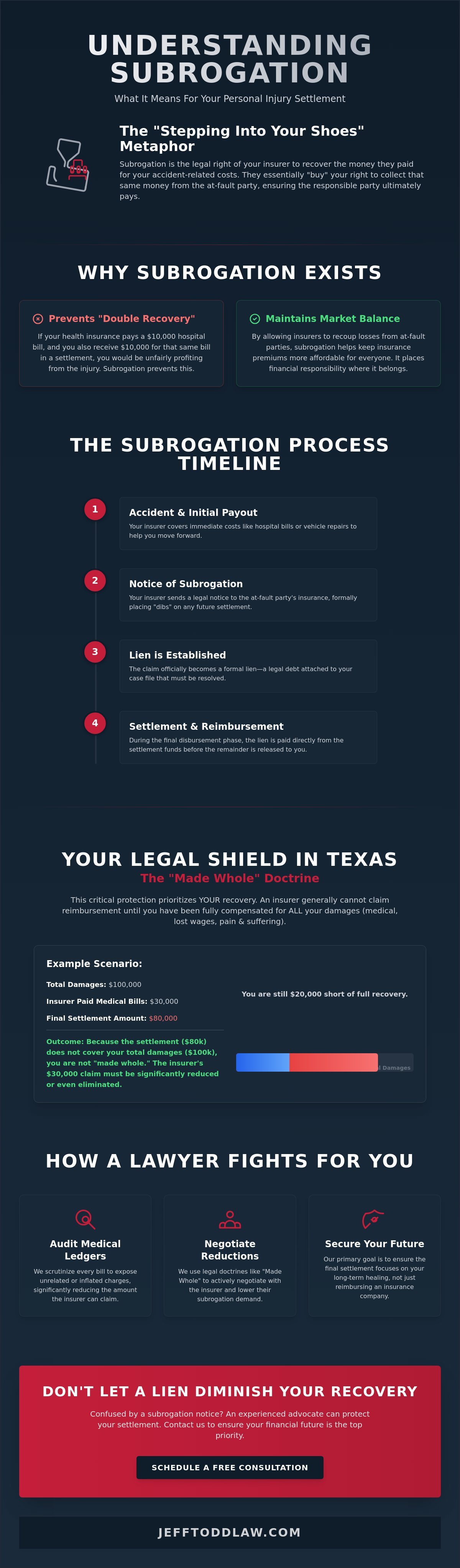
Subrogation is a term that often surfaces in the middle of a personal injury claim, usually just as you're starting to see progress in your recovery. It can feel like an unwelcome intrusion into your private legal matter. To understand the subrogation meaning, you have to look at it as a legal right of substitution. When your insurance company pays for your medical treatment or car repairs after an accident you didn't cause, they essentially "buy" your right to collect that same money from the person who is actually at fault. It is a reimbursement mechanism designed to ensure that the party responsible for the harm is the one who ultimately pays for it.
The primary reason this exists is to prevent what the legal system calls "double recovery." If your health insurance pays a $10,000 hospital bill and then you receive $10,000 for that same bill in a settlement, you would technically be profiting from the injury if you kept both. Subrogation ensures you are compensated for your losses without receiving a financial windfall. In most cases, this appears as a lien against your final settlement, meaning the insurance company gets paid directly from your recovery before the remaining funds are released to you.
The 'Stepping Into Your Shoes' Metaphor
Legal professionals often describe the process as the insurer "stepping into your shoes." This means they take on your legal standing to pursue the negligent party. Most of this happens through "contractual subrogation," which is a specific clause in your insurance policy that you likely signed without much thought years ago. There is also "equitable subrogation," which is a right granted by the court based on fairness. Because this process usually happens between two insurance companies, it often stays behind the scenes until it is time to settle your case. Understanding the subrogation meaning helps you see why your insurer is so interested in the progress of your case.
Why Subrogation Exists in the Legal System
The existence of subrogation helps maintain the balance of the entire insurance market. By allowing companies to recoup their losses from at-fault drivers or negligent corporations, insurers can keep premiums more affordable for everyone else. It follows the principle of indemnity, which focuses on restoring you to your pre-accident state. When you consult a houston personal injury lawyer, their job includes navigating these complex legal details to protect your portion of the recovery. It's about ensuring the reimbursement doesn't leave you with nothing to show for your pain and suffering. This steady management of liens is a vital part of your total restoration.
How the Subrogation Process Works After a Texas Accident
The subrogation process isn't an overnight event. It's a procedural journey that begins the moment your own insurance carrier issues a payment for a claim you didn't cause. If you've been searching for the subrogation meaning in a practical sense, it's essentially the formal "dibs" your insurer places on your future legal recovery. Once your carrier pays out for your medical care or vehicle repairs, they will typically send a "Notice of Subrogation" to the at-fault party's insurance company. This letter serves as a legal placeholder, informing the other side that your insurer expects to be reimbursed from any eventual settlement or judgment.
If your case moves into litigation, this claim often matures into a formal lien. This lien is a legal debt attached to your case file. It ensures that the "payback" happens during the final disbursement phase, which is the period after a settlement is reached but before you receive your check. Managing these competing interests requires a steady hand to ensure the insurer doesn't overreach. If you're feeling overwhelmed by these notices, speaking with a dedicated legal advocate can help clarify your obligations.
The Timeline: From Accident to Reimbursement
The sequence usually follows a predictable path. First, your insurer covers immediate costs, such as hospital bills or total loss vehicle claims, to keep your life moving forward. Next, the discovery phase begins. During this time, insurers and attorneys identify third-party liability and investigate the details of the incident. Finally, during settlement negotiations, the "lien resolution" stage occurs. This is where your legal team works to reduce the amount you owe back to the insurance company, maximizing the funds that stay in your pocket for your long-term healing.
Who Are the Key Players Involved?
There are several parties moving behind the scenes in a subrogation claim. You are the "Subrogor," the person who holds the original right to sue. Your insurance company is the "Subrogee," the entity that has assumed your rights to the extent of the payments they made. The "Third Party" is the individual or corporation that caused the houston car accident lawyer situation in the first place. You may also encounter subrogation vendors. These are third-party companies hired by insurers specifically to track, manage, and aggressively pursue these reimbursement claims. Understanding the subrogation meaning in this context helps you identify who is actually calling the shots regarding your settlement deductions.
Common Types of Subrogation Liens in Personal Injury Cases
Understanding the subrogation meaning in a practical sense requires identifying which specific entities have a legal claim to your recovery. It is rarely just one insurance company involved. Instead, multiple carriers may have their hands out simultaneously, each claiming a right to be reimbursed for the benefits they provided while your case was pending. These claims, known as liens, can significantly reduce the amount of money you actually take home if they aren't managed with precision.
In a typical injury case, you may encounter several different types of subrogation interests:
- Health Insurance Liens: Private health plans, Medicare, and Medicaid all have "payback" requirements. If they paid for surgery or physical therapy related to your accident, they will seek reimbursement from your settlement.
- Auto Insurance Subrogation: If you used your own Personal Injury Protection (PIP) or Medical Payments (MedPay) coverage, your insurer might attempt to recoup those costs from the at-fault driver's policy.
- Workers' Compensation: If you were injured while on the job, the workers' comp carrier has a statutory right to be paid back from any third-party settlement you receive.
- ERISA Plans: These are employer-sponsored health plans governed by federal law, which often makes them the most difficult liens to negotiate.
Health Insurance and the ERISA Complication
The Employee Retirement Income Security Act (ERISA) is a federal law that governs most private-sector health plans. In Texas, the subrogation meaning changes drastically when an ERISA plan is involved. If your employer "self-funds" the health plan, it may have "super-priority" status. This means the plan's language can sometimes override state laws that would otherwise protect you. Verifying whether a plan is truly ERISA-qualified is a critical step, as many insurers claim ERISA protections when they don't actually apply. These plans are notoriously aggressive and often demand 100% reimbursement regardless of the circumstances.
Workers' Comp and Third-Party Claims
When an on-the-job injury is caused by someone other than your employer, such as a negligent driver hitting your work vehicle, you essentially have two claims. While the workers' comp carrier provides immediate medical care and wage replacement, they hold a "first money" right to your third-party settlement. This means they are often the first in line to be paid back. Balancing a workers' comp claim with a personal injury lawsuit requires a strategic approach to ensure the carrier doesn't consume your entire recovery. Effective advocacy focuses on negotiating these "first money" rights down, allowing you to retain the funds needed for your total restoration.
The 'Made Whole' Doctrine: Protecting Your Recovery
When you reach a settlement after a traumatic event, the primary goal is your total restoration. However, the subrogation meaning in many insurance contracts suggests the insurer gets paid first. This is where the "Made Whole" doctrine serves as a vital legal defense. This doctrine dictates that an insurance company cannot seek reimbursement for its payments until you have been fully compensated for all your losses, including non-economic damages like pain and suffering. If your settlement does not cover the full extent of your physical, emotional, and financial damages, the insurer's right to "step into your shoes" may be legally blocked.
This principle is rooted in equity and fairness. It is fundamentally unjust for an insurance corporation to recoup its costs while you are still struggling with unpaid bills or lasting disability. In high-stakes cases involving significant loss, such as those handled by a wrongful death attorney austin, this doctrine is frequently used to protect grieving families. It ensures that the funds intended to provide for a family's future are not diverted back to a multi-billion dollar insurance carrier before the family's basic needs are met.
Texas Specific Protections for the Injured
Texas law provides several layers of protection regarding these liens. Under the Texas Civil Practice and Remedies Code, specifically Chapter 140, there are statutory limits on how much a health insurer can take from your recovery. Additionally, Texas follows a "51% bar" rule for comparative negligence. If you are found partially at fault for an accident, your total recovery is reduced, which in turn provides a strong argument for reducing any subrogation claims. Another critical protection is the "Common Fund Doctrine." This requires the insurance company to pay its fair share of your attorney's fees and legal expenses, rather than riding on the coattails of your legal team's hard work for free.
Insurance Rights vs. Victim Rights
There is often a direct conflict between the fine print in your insurance policy and these equitable principles. While insurers write contracts to give themselves "super-priority" status, Texas courts often look at the actual impact on the victim. In some instances, a "Waiver of Subrogation" within a policy might even prevent the insurer from pursuing a claim at all. Subrogation rights are not absolute and can be challenged. If an insurer is threatening to consume your settlement, you need an advocate who understands how to push back. Contact our firm today to ensure your recovery is protected from aggressive insurance liens.
How a Personal Injury Lawyer Negotiates Subrogation Claims
Negotiation is the phase where the theoretical subrogation meaning meets the reality of your bank account. While an insurance company may claim they're entitled to every penny they spent on your care, a skilled legal advocate views that number as a starting point for discussion, not a final verdict. The goal of lien resolution is to ensure that the largest possible portion of your settlement remains available for your long-term healing and financial stability. This process involves a meticulous, multi-step strategy designed to challenge the insurer's assumptions and protect your interests.
The negotiation process typically follows four critical steps:
- Step 1: Auditing the Ledger. We examine every line item in the insurer's subrogation packet. It's common to find charges for unrelated medical visits, such as routine check-ups or pre-existing condition treatments, which have no place in your accident claim.
- Step 2: Asserting Legal Doctrines. We apply the "Made Whole" and "Common Fund" doctrines discussed earlier. If you weren't fully compensated for your pain and suffering, we argue that the insurer's right to reimbursement hasn't yet been triggered.
- Step 3: Cents-on-the-Dollar Negotiations. We engage directly with subrogation adjusters to reach a compromise. Often, insurers will accept a significantly reduced amount to avoid the cost and uncertainty of further litigation.
- Step 4: Securing the Final Release. We ensure that any payment made to the insurer is accompanied by a formal release. This prevents the company from coming back months or years later to demand more money for the same incident.
Why Professional Negotiation is Essential
The complexity of these claims increases exponentially in high-stakes litigation, such as houston truck accident lawyer cases where multiple commercial insurance policies may be involved. In these situations, several different carriers might assert competing liens. A lawyer uses the attorney fee reduction rule to force the insurer to contribute to the legal costs of the recovery they're benefiting from. Ignoring a subrogation notice is never a viable option. Doing so can lead to a loss of future insurance coverage or even a direct lawsuit from your own carrier to recoup their funds.
The Todd Law Group, PLLC Approach to Liens
Our firm is committed to the total restoration of every client we represent. We don't view a case as closed until the financial health of the client is secured. Jeff Todd's background in elite corporate-legal environments provides the intellectual rigor needed to decode the sophisticated tactics insurance companies use to maximize their own recovery. We understand the subrogation meaning from the insurer's perspective, which allows The Todd Law Group, PLLC to anticipate their moves and counter them effectively. Don't let insurance companies take your settlement. Contact us for a free case review today.
Securing Your Financial Restoration
Navigating the aftermath of an accident is about more than just physical healing; it's about ensuring your financial future remains intact. We have explored how insurance companies use their right of substitution to claim a portion of your recovery and why Texas doctrines like "Made Whole" are essential for your protection. Understanding the subrogation meaning in the context of your specific case is the first step toward ensuring these liens don't consume the funds you need for long-term care. Every dollar negotiated away from a lien is a dollar that stays in your pocket for your total restoration.
Jeff Todd has been licensed to practice law in Texas since 1994, bringing decades of experience to complex medical malpractice and truck accident subrogation claims. Our firm operates on a contingency-based model, which means you pay nothing unless we win your case. We provide the intellectual rigor of a corporate background with the dedicated advocacy of a local specialist. Protect your settlement—schedule a free consultation with The Todd Law Group, PLLC today. You've worked hard for your recovery, and we are here to help you keep it.
Frequently Asked Questions
What does subrogation mean in a car accident case?
Subrogation in a car accident case is the legal process where your insurance company seeks reimbursement from the at-fault driver's insurer for the money they paid to cover your losses. If your own company paid for your vehicle repairs or medical treatments, they "step into your shoes" to collect that debt from the negligent party. This prevents you from receiving a double recovery while ensuring the responsible driver is the one who ultimately pays for the damage.
Do I have to pay back my health insurance from my settlement?
You are typically required to reimburse your health insurance provider if your policy contains a subrogation clause and you receive a settlement for the same medical expenses. This is a core part of the subrogation meaning that many victims find confusing. Under Texas law, specifically Chapter 140 of the Civil Practice and Remedies Code, there are limits on what they can take. We work to ensure you are "made whole" before the insurer receives their payback.
Can I negotiate a subrogation claim myself?
While it is possible to negotiate a subrogation claim on your own, it is rarely advisable because insurance companies employ professional subrogation vendors who specialize in maximizing their recovery. The subrogation meaning in a legal context involves complex negotiations regarding "Common Fund" credits and ledger audits that insurers are better equipped to handle. A lawyer ensures these entities don't take an unfair share of your settlement by aggressively challenging their initial demands.
What happens if I ignore a subrogation letter?
Ignoring a subrogation letter can lead to serious legal and financial consequences, including a lawsuit filed against you by your own insurance carrier. If you fail to acknowledge their lien, the insurer may also have the right to terminate your future health or auto coverage. It's better to address these notices early in the legal process to ensure the lien is resolved as part of your final settlement disbursement rather than facing a separate collection action later.
What is a waiver of subrogation and why would I need one?
A waiver of subrogation is a contractual provision where an insurance company gives up its right to seek reimbursement from a third party. You might need one in a complex settlement to ensure that the at-fault party is fully released from all future claims. This provides total finality for the case and prevents the insurance company from pursuing the negligent party once the settlement is signed and the funds are distributed to the injured victim.
How long does the subrogation process typically take in Texas?
The subrogation process in Texas typically mirrors the timeline of your personal injury case, which must be filed within two years of the accident according to Texas Civil Practice & Remedies Code § 16.003. Insurers generally have this same two-year window to file their own subrogation claims for property damage or injury. The actual resolution of the lien happens during the final stages of your settlement negotiations, often just before the final check is issued to you.
Does subrogation affect my insurance premiums?
Subrogation itself does not typically cause your insurance premiums to increase; in fact, it is designed to keep costs down for all policyholders. By recouping losses from the at-fault party's insurance, your carrier reduces its overall expenditure on the claim. If you were not at fault for the accident, the subrogation process helps demonstrate that the financial responsibility lies elsewhere, which can protect your claims history and overall premium stability over the long term.
Will my deductible be refunded through subrogation?
Your deductible should be refunded if your insurance company successfully recovers the full amount of their claim through subrogation. When your insurer wins a reimbursement from the at-fault driver's carrier, they are often required to pay you back for the out-of-pocket deductible you paid at the start of the process. This is one of the few ways the subrogation process directly puts money back into your pocket after an incident, aiding in your total restoration.


