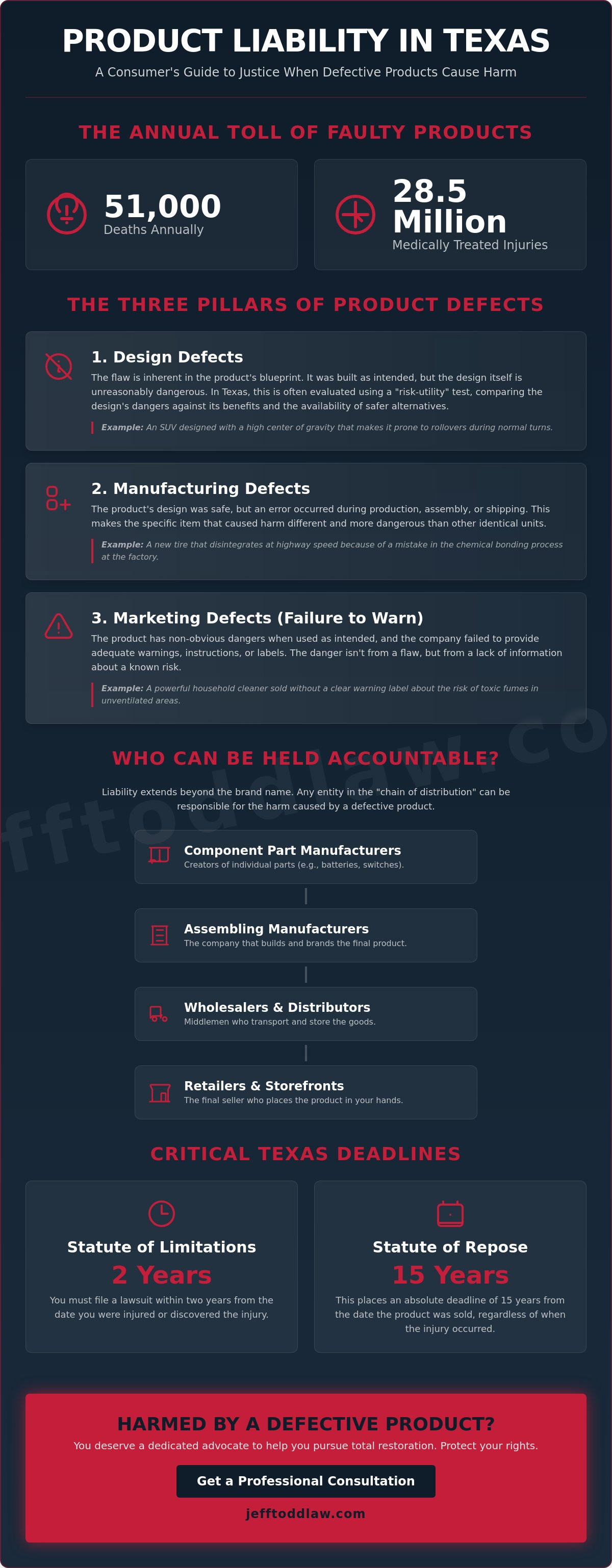
Did you know that faulty consumer products cause nearly 51,000 deaths and 28.5 million medically treated injuries every year? When a product you trust fails and causes physical pain or mounting medical bills, it's natural to feel overwhelmed. You might wonder whether the retailer or the manufacturer is at fault, or feel anxious about the cost of challenging a massive corporation. You deserve a dedicated advocate to help you pursue total restoration. This guide will teach you how product liability laws protect you from dangerous goods and outline the necessary steps to take if a defective product causes you harm.
We'll provide a clear understanding of what qualifies as a legal defect under the strict liability standards used in Texas. You'll also learn about the critical two-year statute of limitations for filing a claim and the 15-year statute of repose. This overview ensures you have the knowledge required to preserve your legal rights and the confidence to seek professional representation for your recovery.
Key Takeaways
- Identify the specific legal criteria that define a product as "unreasonably dangerous" rather than simply worn out or old.
- Understand how the Texas Civil Practice and Remedies Code Chapter 82 provides a framework for holding global supply chains accountable for your injuries.
- Learn the critical steps for preserving evidence to protect your claim against corporate attempts to destroy or "spoliate" proof of a defect.
- Discover how product liability litigation serves as a vital catalyst for your total physical and financial restoration.
- Gain clarity on how punitive damages function to deter corporate negligence and prioritize the safety of the local community.
What is Product Liability? Understanding Your Rights as a Consumer
Product liability is the legal framework that holds manufacturers, wholesalers, and retailers accountable when a dangerous or defective item enters the marketplace. It represents a fundamental shift in how our society views commerce. Decades ago, the prevailing doctrine was caveat emptor, or "buyer beware." This outdated concept placed the entire risk of injury on the consumer. If a product failed, the individual suffered the consequences alone. Today, modern consumer protection standards have reversed this burden. We recognize that manufacturers are in the best position to ensure safety and should bear the cost when they fail to do so.
This area of law balances the scales of justice between everyday people and massive corporations. When a defective item causes harm, it's not just a financial dispute; it's a disruption of your life and health. By integrating product liability into the broader scope of personal injury law, the legal system provides a path toward total restoration. It ensures that those who design, build, and sell products are legally obligated to provide goods that meet reasonable safety expectations. This protection exists because an individual cannot be expected to inspect the complex internal circuitry of a modern appliance or the chemical composition of a pharmaceutical drug before use.
What Qualifies as a 'Product' in Legal Terms?
The definition of a "product" in a legal context is broader than most people realize. It includes more than just the boxes on a store shelf. For the purposes of a claim, a product generally falls into these categories:
- Tangible Goods: This covers common items like household appliances, children's toys, vehicles, and consumer electronics.
- Intangibles and Naturals: In many legal settings, utilities like gas and electricity, or even specific navigational charts, are treated as products because they are distributed for consumer use.
- Medical and Pharmaceutical: This category includes prescription drugs and implanted medical devices. These cases often involve complex scientific evidence and represent a critical intersection of liability and healthcare.
The Chain of Distribution: Who Can Be Held Accountable?
Liability isn't limited to the name on the box. Any entity involved in the lifecycle of the item may be responsible for the harm caused. This chain of distribution typically includes:
- Component Part Manufacturers: Those who create the specific battery, switch, or chemical that ultimately failed.
- Assembling Manufacturers: The primary company that brings all the parts together and oversees the final production flow.
- Wholesalers and Distributors: The middlemen who transport and store the goods before they reach the public.
- Retailers and Storefronts: The final link in the chain. Even if a retailer didn't manufacture the item, they can still be held accountable for selling a defective good to the public.
The Three Pillars of Defects: How Products Fail
Not every product failure leads to a legal claim. To trigger a product liability lawsuit, the item must be "unreasonably dangerous." This means the product's risks outweigh its utility or that it fails to meet the safety expectations of an ordinary consumer. It's a vital distinction. A tire that wears out after 50,000 miles is not defective; however, a tire that disintegrates at highway speeds due to poor bonding is. Courts require proof that the defect was the "proximate cause" of your injury. This means the flaw, not your own actions or external factors, was the primary reason you were hurt. If you suspect a product's failure was more than just bad luck, you can reach out to a professional advocate to discuss your path forward.
Design Defects: Flaws Before the Factory Floor
Design defects are flaws that exist before the factory floor even begins production. The product was made exactly according to the blueprint, but the blueprint itself was dangerous. In Texas, these claims often hinge on the "risk-utility" test. This standard asks if a safer alternative design was available that would have prevented the injury without destroying the product's usefulness. Examples include SUVs designed with a high center of gravity that makes them prone to rolling over or top-heavy dressers that tip onto children. With the repeal of Texas vehicle safety inspections in January 2025, identifying these inherent design flaws has become even more critical for maintaining road safety.
Manufacturing Defects: Errors in the Production Process
A manufacturing defect occurs when a product departs from its intended design during assembly. While the design might be perfectly safe, a mistake in the factory makes a specific unit or batch dangerous. These are often described as "one-off" errors. Under the various legal theories of product liability, a manufacturer is strictly liable for these mistakes. You don't have to prove they were negligent, only that the product was defective when it left their control. Common examples include contaminated medication or a bicycle frame with a missing structural bolt.
Marketing Defects: Failure to Warn or Instruct
Marketing defects involve a failure to warn or provide adequate instructions. Even a well-designed product can be "unreasonably dangerous" if the manufacturer fails to alert you to non-obvious risks. This is common with space heaters that lack warnings about fire hazards or industrial equipment without proper safety labels. In pharmaceutical cases, Texas often applies the "learned intermediary" doctrine. This means the manufacturer fulfills its duty by warning the prescribing physician rather than the patient directly. This makes the clarity of side-effect data and usage instructions a critical component of consumer safety.
Legal Theories of Liability: Proving Your Case in Texas
Securing a settlement or verdict in a product liability case requires a strategic approach to the law. In Texas, these claims are primarily governed by the Texas Civil Practice and Remedies Code Chapter 82. This statute provides the essential framework for holding manufacturers and sellers accountable. Because corporate legal teams are often aggressive in their defense, your claim will typically rely on multiple legal theories simultaneously. This multi-layered approach ensures that if one path to recovery faces a hurdle, others remain viable to support your total restoration.
Texas also follows a "modified comparative fault" rule. This means that if you are found to be partially responsible for your own injury, perhaps through slight misuse of the product, your compensation may be reduced. However, as long as you are 50% or less at fault, you can still recover damages. If your fault exceeds 51%, Texas law bars you from recovery entirely. This makes the investigative phase critical, as we must prove the product's defect was the primary factor in the incident.
Strict Liability: Focusing on the Product, Not the Conduct
Strict liability is often the most direct path to justice for an injured consumer. Under this theory, the focus remains entirely on the product's condition rather than the manufacturer's behavior. You don't have to prove that the company was "careless" or "negligent" during the design or assembly process. Instead, the plaintiff only needs to prove that the product was defective, that it was unreasonably dangerous, and that the defect directly caused the injury. This removes the difficult burden of peering into a corporation's internal decision-making processes and focuses the case on the physical evidence of the failure.
Negligence and Breach of Warranty
While strict liability focuses on the product, negligence focuses on the company's conduct. A negligence claim asserts that the manufacturer failed in its duty of reasonable care. This might involve skipping safety tests, using inferior materials to save costs, or failing to monitor quality control on the factory floor. Proving negligence requires showing a direct link between the company's failure and your physical pain.
Breach of warranty claims focus on the promises made about the product. Express warranties are specific claims made in advertisements or on packaging. Implied warranties are the unwritten promises that a product is fit for its intended use. In some retail settings, a case may even overlap with premises liability if a merchant's dangerous display or storage of a product contributes to an injury. Combining these theories creates a robust foundation for your legal recovery.
Navigating the Investigation: Building the Foundation for Recovery
The investigation into a product liability claim is a meticulous process. It begins the moment an injury occurs. Large corporations often have rapid-response teams designed to minimize their exposure. They may attempt to "spoliate" or destroy evidence before it can be properly examined. In Texas, you have exactly two years from the date of the injury or discovery to file a lawsuit. If you wait too long, you lose your right to seek justice. A seasoned Houston personal injury lawyer handles these logistical burdens so you can focus on physical healing.
Building a strong foundation for your case requires moving quickly to secure the facts. Corporate defendants rely on the passage of time to cloud memories and degrade physical proof. By acting decisively, you ensure that the narrative of the incident is based on objective evidence rather than corporate spin. This proactive approach is the first step toward holding a manufacturer accountable for the harm they caused.
Preserving Evidence: A Checklist for the Injured
Physical evidence is the heart of your case. Without the item itself, proving a defect becomes exponentially more difficult. Follow these steps to protect your claim:
- Keep the product: Do not throw it away, attempt to repair it, or return it to the manufacturer for a refund.
- Document everything: Take high-resolution photos of the product, any visible defects, the surrounding scene, and your injuries.
- Save receipts and packaging: These items establish the "chain of custody." They prove you purchased the item and identify the specific model or batch number involved.
The Role of Expert Witnesses in Defect Analysis
Proving a design or manufacturing flaw requires technical knowledge beyond the scope of a typical courtroom. This is where expert witnesses become vital. Engineers can explain mechanical failures. Toxicologists analyze chemical contamination in pharmaceuticals. Safety experts reconstruct accidents to show how a product failed in real-world conditions. These professionals provide the intellectual rigor needed to challenge corporate engineers on equal footing.
The cost of hiring high-caliber experts can be significant. A dedicated law firm typically handles these upfront expenses on a contingency basis. This ensures that your financial situation never prevents you from accessing the top-tier technical analysis required for a successful product liability claim. If you need a partner to stand between you and a negligent corporation, contact our team to discuss your recovery.
The Path to Restoration: Seeking Justice and Compensation
Legal action is more than a financial transaction; it is a vital step toward your total physical and emotional recovery. When a product liability claim is successful, it provides the resources necessary for high-quality medical care and long-term rehabilitation. Beyond your personal recovery, these lawsuits serve a broader purpose. Punitive damages are designed to punish corporate negligence and deter other companies from cutting corners on safety. In Texas, these damages are capped at the greater of $200,000 or twice the amount of economic damages plus an amount equal to non-economic damages, not to exceed $750,000. This legal mechanism transforms your individual struggle into a powerful force for community safety.
Choosing a dedicated legal partner reduces the heavy emotional weight that a lawsuit often carries. You shouldn't have to battle a global manufacturer while trying to heal from a traumatic injury. A seasoned advocate acts as your stable partner, managing the complex litigation process while you focus on your health. Taking the first step with a case evaluation allows you to understand the true value of your claim without any initial pressure or financial burden.
Types of Recoverable Damages in Product Liability Suits
The compensation you seek should reflect the full scope of your losses. In Texas, you can pursue several categories of recovery to ensure you aren't left holding the bill for a manufacturer's mistake:
- Economic Damages: These cover quantifiable losses like medical bills, lost wages from missed work, and the projected cost of future rehabilitation or home modifications.
- Non-Economic Damages: These address the human side of an injury, including physical pain, emotional distress, and the loss of enjoyment of life. It is important to note that outside of medical malpractice, Texas does not currently cap non-economic damages in most personal injury claims.
- Wrongful Death: If a defective product leads to the loss of a loved one, family members can seek compensation for funeral expenses, loss of companionship, and the financial support the deceased would have provided.
Contingency Fees: Elite Advocacy Without Financial Risk
Many people hesitate to seek justice because they fear the cost of hiring a high-caliber firm. We use a "No Fee Unless We Win" model to level the playing field. This means you don't pay anything upfront for a product liability investigation or expert testimony. Our firm takes on the financial risk of the case, ensuring that even individuals facing massive corporations have access to elite representation. This commitment allows us to focus entirely on your restoration rather than billable hours.
The Todd Law Group, PLLC is dedicated to providing personalized, high-impact representation for every client. We understand that you aren't just a case number; you're a neighbor who has been wronged. If you've been hurt by a defective product, contact The Todd Law Group, PLLC today for a free case evaluation. We're ready to help you begin your journey toward justice and holistic healing.
Secure Your Future After a Defective Product Injury
You now have the tools to understand how the law protects you when a manufacturer fails in its duty of safety. From identifying the specific pillar of a defect to navigating the strict liability standards of Texas law, you can approach your recovery with clarity. Remember that the two-year statute of limitations is already running. Preserving the physical item and documenting your injuries today is the best way to protect your rights. Navigating a product liability claim is a complex journey, but you don't have to walk it alone.
Jeff Todd has been licensed in Texas since 1994 and leads The Todd Law Group, PLLC with the experience required to handle complex litigation against major manufacturers. You shouldn't have to carry the emotional or financial weight of this process while trying to heal. Our firm operates on a contingency basis; there are no upfront legal fees, and we only get paid if you win. Taking the first step toward total restoration starts with a professional evaluation of your claim.
Schedule Your Free Case Evaluation with The Todd Law Group, PLLC
You deserve a dedicated partner who prioritizes your holistic healing and holds negligent corporations accountable for the harm they cause.
Frequently Asked Questions
What is the first thing I should do if a product injures me?
Seek professional medical attention immediately to treat your injuries and create a formal record of the incident. Once your health is stable, secure the product and all its components in a safe place. Don't attempt to repair the item or return it to the manufacturer for a refund. Taking photos of the scene and your injuries as soon as possible will help preserve the details of the event.
Can I still sue if I don't have the receipt for the product?
You don't need a physical receipt to pursue a legal claim if other evidence of purchase exists. Credit card statements, bank records, and digital order histories from online retailers are excellent ways to prove ownership. In some cases, witness testimony or the serial number on the device itself can establish the chain of distribution. A thorough investigation can often uncover the necessary proof of purchase.
How long do I have to file a product liability lawsuit in Texas?
The statute of limitations for filing a product liability claim in Texas is two years from the date the injury occurred or was discovered. Texas also enforces a 15-year statute of repose. This means that if the product was sold more than 15 years ago, you generally cannot file a lawsuit even if an injury just occurred. It's vital to act quickly to ensure you meet these strict legal deadlines.
What if I was using the product incorrectly when I got hurt?
You can still seek compensation if you were partially at fault, provided your responsibility is 50% or less. Texas follows a modified comparative fault rule. If a jury finds you were 20% responsible for the accident due to misuse, your final compensation will be reduced by 20%. However, if your fault is found to be 51% or higher, you'll be barred from recovering any damages under state law.
Is a product recall required to file a liability claim?
A formal government or manufacturer recall is not a prerequisite for filing a lawsuit. While a recall can provide evidence that a product was "unreasonably dangerous," many defective items cause injuries long before a recall is ever issued. Your case depends on proving that the specific item you used was defective and caused your injury. You shouldn't wait for a recall to begin your journey toward restoration.
How much does it cost to hire a product liability lawyer in Houston?
Most firms handle these cases on a contingency fee basis, meaning there are no upfront costs for the client. You don't have to worry about hourly rates or initial retainers while you're managing medical bills. The firm only receives a percentage of the final settlement or verdict if they successfully win your case. This allows you to have a seasoned advocate by your side without any immediate financial risk.
What if the manufacturer is based in another country?
You can still hold parties accountable even if the primary manufacturer is located overseas. The product liability framework allows you to pursue claims against domestic entities in the supply chain, such as importers, wholesalers, or retailers. These businesses are responsible for ensuring the safety of the goods they bring into the local marketplace. This ensures that international borders don't prevent you from seeking justice for your injuries.
Can I sue for a defective medical device or pharmaceutical drug?
Defective medical devices and pharmaceutical drugs are common subjects of litigation when they cause unexpected harm. These cases often involve design defects or a failure to warn about dangerous side effects that weren't disclosed to doctors or patients. Because these claims involve complex scientific data, they require a legal partner who understands how to challenge large medical corporations. You have the right to hold these companies accountable for their products.


