

Imagine walking out of a Houston clinic with a clean bill of health, only to find out months later that a life-threatening condition was missed. You followed every instruction, yet your health continues to decline while medical bills for ineffective treatments pile up on your kitchen table. It's a devastating realization that the system meant to heal you has instead caused profound harm. If you're facing this reality, a misdiagnosis lawyer Houston can help you regain control of your future. You deserve a legal partner who views you as a person with a story, not just another case number in a filing cabinet.
We understand that your trust in the healthcare system is shattered, and the path to physical recovery feels steeper than ever. This article will show you how to hold negligent providers accountable and secure the financial stability required for corrective care. We'll explore the critical 2026 legal standards in Texas, including the specific damage caps and filing deadlines that impact your claim. You'll learn exactly what it takes to build a compelling case and how an experienced advocate can help restore your peace of mind and your health.
Key Takeaways
- Distinguish between a simple diagnostic error and legally actionable medical malpractice to determine if your situation warrants a formal claim for damages.
- Learn how a dedicated misdiagnosis lawyer Houston navigates the complex "Certificate of Merit" requirements and 2026 Texas damage caps to protect your future.
- Identify the specific red flags of frequently missed conditions, such as cancer or cardiovascular issues, which often lead to delayed treatment and rising medical bills.
- Discover the immediate steps you should take if you suspect a medical error, including the vital importance of securing a second opinion and preserving clinical records.
- Explore how a transition from elite corporate law to personalized advocacy ensures your case receives the intellectual rigor needed for your total restoration.
Understanding Medical Misdiagnosis and Failure to Diagnose in Houston
When you seek medical help in Houston, you trust that your physician's expertise will lead to an accurate assessment. Unfortunately, diagnostic errors are frequent. A dedicated misdiagnosis lawyer Houston can help you determine if your suffering is the result of a physician's oversight or a systemic failure. It's vital to recognize that while every medical error is frustrating, not every mistake meets the legal threshold for medical malpractice. A successful claim requires proving that the error caused actual harm and resulted from a breach of professional duties.
Misdiagnosis vs. Failure to Diagnose: Key Differences
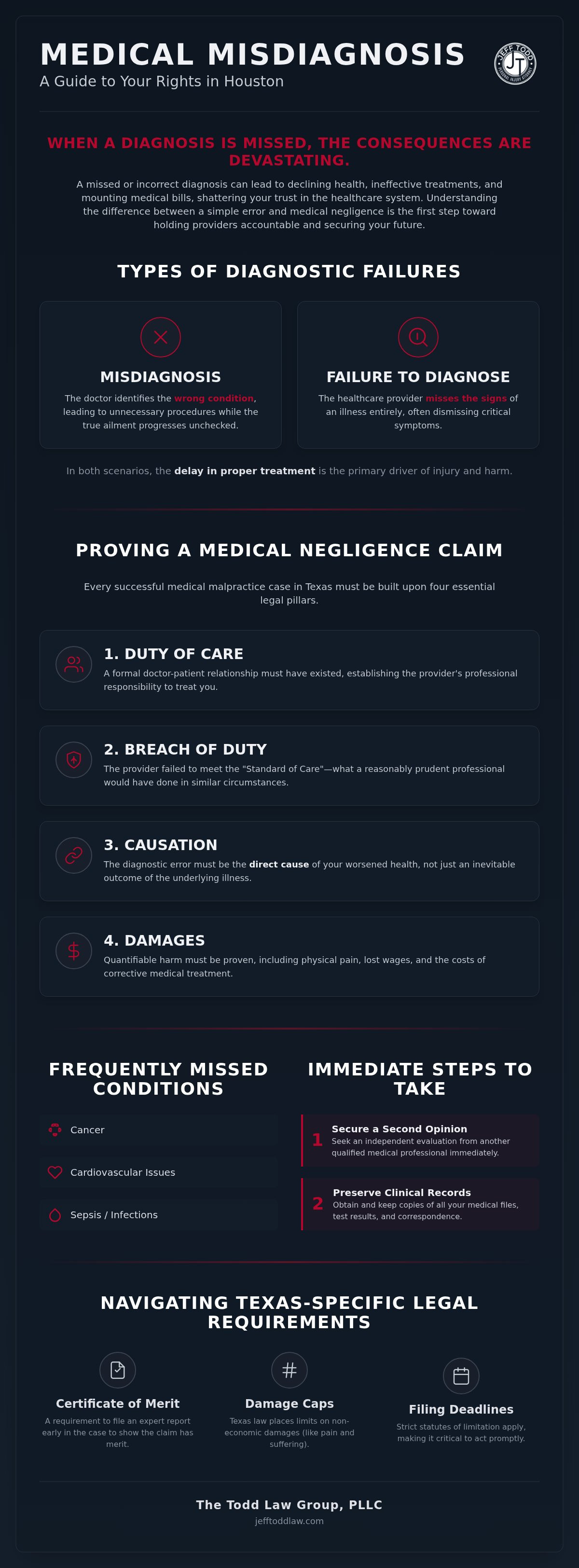
These terms are often used interchangeably, but they represent distinct legal challenges. Misdiagnosis occurs when a doctor identifies the wrong condition. This often leads to unnecessary procedures and medications while the true ailment progresses unchecked. For instance, a patient might be treated for a persistent cough while an underlying tumor continues to grow. Understanding Medical Misdiagnosis requires looking at how these mistakes divert critical time away from effective treatment.
Failure to diagnose happens when a healthcare provider misses the signs of an illness entirely, often dismissing symptoms as minor or unrelated. In both scenarios, the delay is the primary driver of injury. When treatment is postponed, survival rates for aggressive conditions like sepsis or late-stage cancer drop significantly. If your condition worsened because a doctor failed to listen to your concerns, you may have grounds for a legal claim.
The Standard of Care in the Texas Medical Center
Houston is home to some of the world's most prestigious healthcare institutions. Whether you're treated at a facility in the Texas Medical Center or a local clinic, your doctor is held to the "standard of care." This legal concept refers to what a reasonably prudent healthcare professional, with similar training and experience, would have done under the same circumstances.
In a legal claim, Houston medical standards are established by peer professionals. You can't simply claim a doctor was wrong; you must prove they deviated from what other local experts consider acceptable practice. This usually requires testimony from an expert witness who can explain how the provider failed to follow the diagnostic path expected in a major metropolitan hub like Houston. If your physician ignored clear symptoms or failed to order standard tests, they might be liable for the resulting damages. Proving this deviation is the first step toward securing the compensation you need for your recovery.
Proving a Medical Malpractice Claim Under Texas Law
Proving medical negligence requires more than just showing a bad medical outcome. It demands a meticulous reconstruction of the clinical timeline to show exactly where a provider failed you. When you partner with a misdiagnosis lawyer Houston, the focus shifts to demonstrating that the healthcare provider's actions fell below the accepted professional standard. This process involves gathering exhaustive evidence to meet the specific evidentiary burdens set by Texas statutes. Proving a Medical Malpractice Claim involves a deep dive into medical records to show exactly where the diagnostic path diverged from patient safety.
The Four Pillars of Legal Negligence
Every successful case rests on four essential pillars. First, we establish a Duty of Care, confirming a formal doctor-patient relationship existed at the time of the error. Second, we must prove a Breach of Duty. This often centers on the "differential diagnosis" process, where a doctor should systematically rule out the most dangerous potential conditions first. If they skipped this step or ignored clear symptoms, they failed the standard of care. Third, Causation is critical; we must prove the error directly caused your health to decline, rather than it being an inevitable result of the illness. Finally, we quantify Damages. These include your physical pain, lost wages, and the mounting costs of corrective treatment. Navigating these rules alone is nearly impossible, which is why a seasoned misdiagnosis lawyer Houston is an essential ally in your recovery.
Navigating Texas-Specific Legal Requirements
Texas law is notoriously strict regarding medical litigation. Within 120 days of the defendant's answer, you must serve a detailed expert report. This serves as a "Certificate of Merit" where a qualified physician validates that your claim has legal standing. If this deadline is missed, the court will likely dismiss your case permanently. As of 2026, Texas maintains non-economic damage caps for pain and suffering. These are set at $250,000 per plaintiff against all physicians combined. There is a separate $250,000 cap per healthcare institution, with a total cap of $500,000 from all institutions involved in a single case.
You should also be aware of subrogation. This allows insurance companies to seek reimbursement for medical bills they paid related to your injury out of your final settlement. Managing these complex financial layers is a core part of our commitment to your total restoration. If you're feeling overwhelmed by these legal hurdles, reaching out to an experienced medical malpractice attorney can provide the stable partnership you need to move forward.
Common Misdiagnoses: From Cancer to Cardiovascular Errors
Diagnostic errors aren't just clinical footnotes; they're life-altering events that strip patients of their health and their time. When a physician overlooks a clear symptom, the consequences ripple through every aspect of a family's life. A misdiagnosis lawyer Houston often sees patterns where specific, high-stakes conditions are routinely missed or misinterpreted by medical staff. Recognizing these common failures is the first step toward understanding if your suffering was preventable.
Cancer Misdiagnosis and Delayed Treatment
Breast, lung, and colon cancers remain the most frequently misdiagnosed malignancies in clinical settings. In many cases, the failure isn't a lack of technology, but a failure of interpretation. Radiology errors occur when a technician or doctor sees a suspicious mass on an imaging report but fails to communicate its significance or order a biopsy. When cancer is allowed to progress from Stage I to Stage IV because of a physician's oversight, the window for effective treatment closes. This metastasis is often the direct result of a delay that could have been avoided with a proper diagnostic path.
Cardiovascular and Emergency Room Errors
Emergency rooms are high-pressure environments, but that doesn't excuse a failure to rule out life-threatening events. Heart attacks are frequently misdiagnosed as indigestion, acid reflux, or even panic attacks. This is particularly common in female patients whose symptoms may not mirror the "classic" chest pain seen in men. Similarly, stroke symptoms like sudden confusion or numbness are sometimes dismissed as non-critical issues. Failing to order a CT scan or a D-dimer test when a pulmonary embolism is suspected can be a fatal breach of the standard of care.
Surgical and Post-Operative Negligence
Negligence often continues long after the patient leaves the operating room. Post-operative internal bleeding or hospital-acquired infections like MRSA can quickly become life-threatening if staff ignore a patient's worsening vitals. We also represent women who've suffered from the husband stitch, a non-consensual and medically unnecessary procedure performed after childbirth that causes chronic pain and emotional trauma. Understanding What to Do if You Suspect a Medical Error is the first step toward holding these providers accountable. If you suspect your recovery was compromised by such negligence, a misdiagnosis lawyer Houston can help you investigate clinical records to find the truth.
What to Do if You Suspect a Houston Medical Error
If you suspect a physician missed a critical diagnosis, your priority must be your health. You don't have to wait for a legal consultation to take action. In fact, waiting can worsen your condition and weaken your potential claim. A misdiagnosis lawyer Houston can help you sort through the legalities, but you need a clinical "reset" first. Taking proactive steps now ensures that you're protected both physically and legally as you begin the journey toward recovery.
Securing Your Health and Your Records
Seek a second opinion immediately. Don't stay with a doctor within the same medical group or hospital system where the error occurred. Their internal loyalties or shared electronic record systems might cloud their judgment. You need a fresh set of eyes from a completely different institution to provide corrective care. When you meet with a new specialist, be clear about your symptoms and the timeline of your previous treatment.
Request your medical records now. Under Texas law, you're entitled to a copy of your charts, imaging, and lab results. Don't tell the provider you're considering a lawsuit; simply state you're seeking a second opinion and need your history for the new doctor. Follow this checklist to preserve your evidence:
- Request "certified" copies of all electronic health records (EHR) and original imaging files.
- Start a symptom journal to track your daily pain levels and physical limitations since the suspected error.
- Keep all receipts for out-of-pocket medical expenses, including travel to appointments and new prescriptions.
- Avoid discussing your suspicions on social media, as these posts can be used against you later.
Protecting Your Legal Interests
Hospitals often use risk management teams to mitigate their own liability. They might approach you with an "apology program" or offer to waive certain bills. Be extremely cautious. These gestures often come with fine print that waives your right to seek full compensation later. Never sign a "release of liability" or a settlement offer without an attorney's review. These documents are designed to protect the hospital's bottom line, not your health.
Insurance adjusters work for the provider's interests, not yours. They may call to "check in" or ask for a recorded statement. Politely decline and refer them to your counsel. Having a Houston personal injury lawyer manage these communications ensures you don't accidentally say something that jeopardizes your case. If you're ready to secure your future and hold negligent parties accountable, contact our Houston office today for a professional evaluation of your claim.
How The Todd Law Group, PLLC Advocates for Your Total Restoration
If you've been harmed by a medical error, you need more than just a legal technician; you need a stable partner who understands the high-stakes environment of Houston's healthcare systems. Legal representation should be a bridge to your physical and emotional recovery. When you choose a misdiagnosis lawyer Houston at The Todd Law Group, PLLC, you're securing an advocate who views your case as a mission for justice, not just a file on a desk. We prioritize your total restoration, ensuring that the legal process supports your healing rather than adding to your distress.
Elite Expertise Applied to Personal Advocacy
Jeff Todd, licensed since 1994, brings a unique perspective to medical malpractice litigation. His career trajectory began in elite corporate legal environments in major metropolitan hubs, where he developed the intellectual rigor and meticulous attention to detail required to face well-funded opponents. Today, he applies that same high-impact expertise to helping individuals in the Houston community. This transition from corporate law to personal advocacy means our clients benefit from a battle-tested approach that major hospital networks and insurance companies respect.
Building a bulletproof case requires more than just filing paperwork; it demands a deep coordination with medical experts who can challenge the provider's narrative. The Todd Law Group, PLLC leverages an extensive professional network to find specialists who can clearly articulate how the standard of care was breached. By combining this technical proof with a narrative of your personal experience, we create a compelling argument for the maximum compensation allowed under Texas law. You don't have to face complex litigation alone when you have a seasoned specialist in your corner.
Commitment to Your Recovery Journey
Our service-first model is designed to reduce the barriers to justice for Houston families. We understand that rising medical bills and lost wages create immense pressure. To alleviate this, The Todd Law Group, PLLC operates on a contingency fee basis. This means you don't pay any legal fees unless we win your case. We take on the financial risk of litigation so you can focus entirely on your corrective treatment and physical rehabilitation. It's a partnership built on shared goals and mutual trust.
We treat every client with boutique-level attention. You're a person with a story, and we make sure you're heard throughout every stage of the legal progression. Whether we're negotiating with adjusters or presenting your case in a formal proceeding, our goal remains the same: securing the financial stability you need to move forward. If you're ready to hold negligent providers accountable, Schedule Your Free Case Evaluation with Jeff Todd today to begin your journey toward restoration.
Reclaiming Your Future After a Medical Error
A medical mistake doesn't have to define your life. By taking immediate steps to secure a second opinion and preserving your clinical records, you've already begun the process of total restoration. Proving a complex claim under the 2026 Texas medical malpractice laws requires intellectual rigor and a deep familiarity with local court standards. Partnering with a seasoned misdiagnosis lawyer Houston ensures you have a stable partner to navigate expert report deadlines and strict damage caps.
The Todd Law Group brings decades of experience to your side. Jeff Todd has been licensed in Texas since 1994 and provides the personalized advocacy Houston families deserve. We operate on a contingency-based model, which means there's no fee unless we win your case. You can focus on your physical recovery while we focus on holding negligent providers accountable.
Don't let rising medical bills slow your progress toward healing. Get a Free Case Review from Jeff Todd Today and take the next step in your journey. You've been through enough; let us help you secure the stability you need to move forward with confidence.
Frequently Asked Questions
Is medical misdiagnosis considered malpractice in Texas?
Medical misdiagnosis is considered malpractice in Texas when a physician’s error deviates from the accepted standard of care and results in actual patient harm. Not every diagnostic mistake is actionable in court. To succeed, you must demonstrate that a reasonably prudent doctor with similar training would have reached the correct diagnosis under the same circumstances. If the error led to delayed treatment or unnecessary procedures, it likely qualifies as professional negligence.
How long do I have to file a misdiagnosis lawsuit in Houston?
In Texas, you generally have two years from the date of the negligent act or the completion of treatment to file a lawsuit. This is known as the statute of limitations. There is also an absolute ten-year statute of repose that acts as a final deadline regardless of when you discovered the injury. For minors injured before age 12, the window extends until they turn 14. Missing these deadlines permanently bars your claim.
How do you prove a doctor failed the standard of care?
Proving a breach of the standard of care requires testimony from a medical expert in the same field as the defendant. This expert reviews the clinical records to determine if the physician followed the differential diagnosis process correctly. They must explain exactly how the provider's actions differed from what a competent peer would have done in a Houston medical setting. Without this professional validation, the court will not allow the case to proceed.
What are the damage caps for medical malpractice in Texas in 2026?
As of August 2026, Texas law limits non-economic damages, such as pain and suffering, to $250,000 per plaintiff for all individual healthcare providers combined. There is a separate $250,000 cap for each healthcare institution, with a total institutional limit of $500,000 per case. These caps don't apply to economic damages like medical bills or lost wages. A misdiagnosis lawyer Houston can help you calculate the full scope of your recoverable losses.
Can I sue for a misdiagnosis if I eventually recovered?
You can still pursue a claim if you eventually recovered, provided the misdiagnosis caused you significant interim harm. This includes the cost of unnecessary treatments, lost income during a prolonged illness, or physical pain that wouldn't have occurred with a timely diagnosis. The legal focus is on the damages sustained during the period of negligence. If the delay led to a more invasive surgery or permanent scarring, those are compensable injuries.
What is the "Certificate of Merit" and why do I need one?
The "Certificate of Merit" refers to the mandatory expert report required by the Texas Medical Liability Act. You must serve this report on the defendant within 120 days after they file their answer to your lawsuit. It must be written by a qualified physician who outlines the standard of care, how it was breached, and how that breach caused your injury. This requirement serves to filter out claims that lack sufficient medical evidence.
How much does a Houston misdiagnosis lawyer cost?
Most medical malpractice firms in the Houston area operate on a contingency fee basis. This means you don't pay any upfront costs or hourly rates for legal representation. Instead, the firm receives a percentage of the final settlement or court award. If your lawyer doesn't win your case, you won't owe any attorney fees. This model allows families to pursue justice against large hospital systems without facing immediate financial risk.
Can I sue a hospital for a radiologist’s error?
You can often hold a hospital liable for a radiologist's error, though it depends on whether the doctor was an employee or an independent contractor. A misdiagnosis lawyer Houston can investigate the hospital's internal contracts to determine liability. Even if the radiologist is a contractor, we may pursue the hospital under the theory of "apparent agency" if the facility didn't clearly disclose the doctor's status. Hospitals must maintain safe diagnostic protocols.


