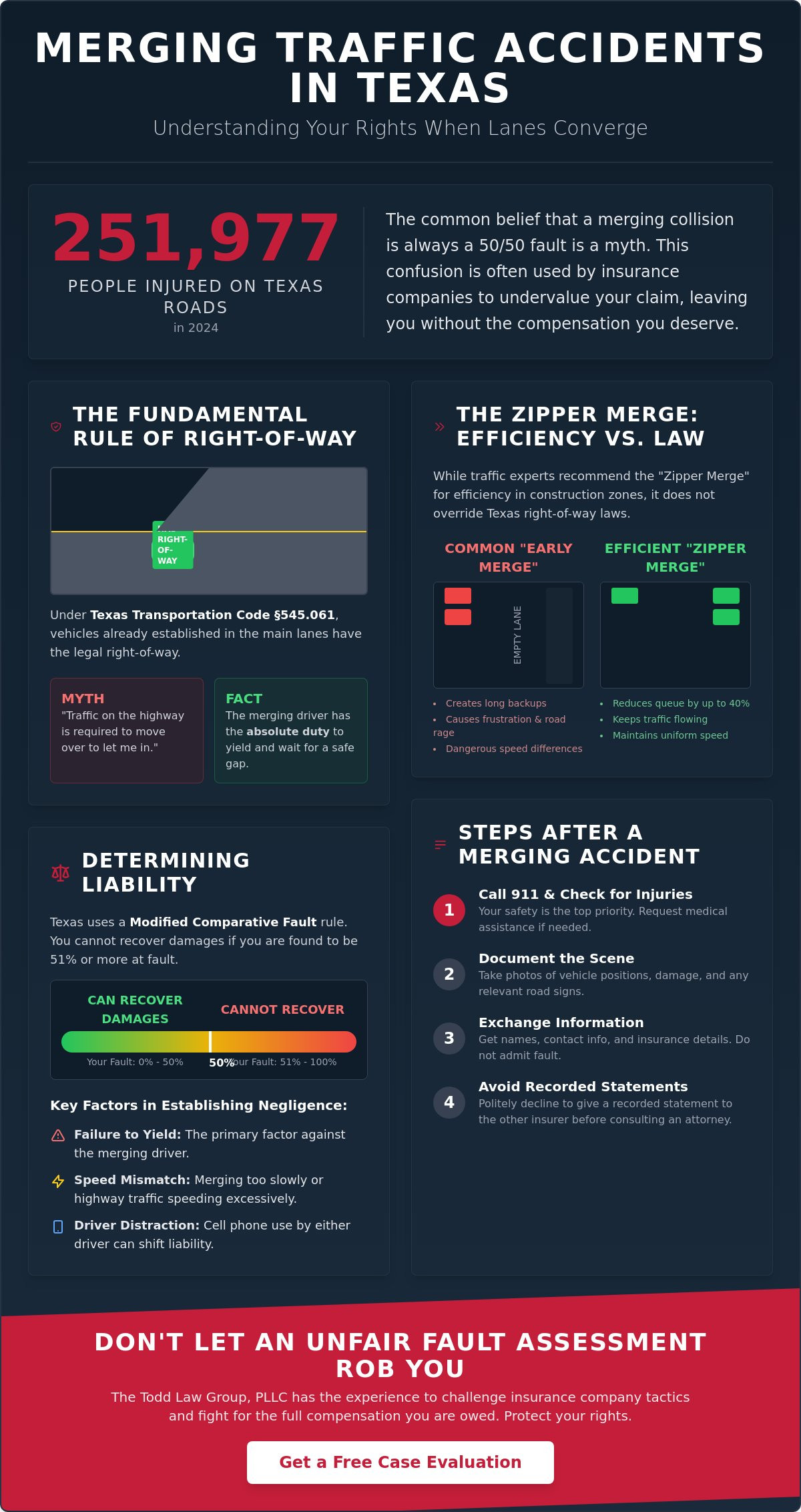
You might believe that a collision while merging traffic is automatically a 50/50 split in the eyes of the law, but that common assumption often leaves Texas drivers without the compensation they deserve. It is a frustrating reality for many of the 251,977 people injured on our state's roads in 2024. You likely feel the daily tension between the "zipper merge" recommendations you see in construction zones and the strict yield requirements of the Texas Transportation Code. This confusion creates deep anxiety, especially when insurance companies use it to undervalue your claim after a highway accident.
We provide the steady reassurance and legal weight you need to move forward. You will master the specific rules governing right-of-way and learn how liability is actually determined when a lane change leads to a crash. We'll examine why the merging driver carries the primary burden of safety and how modified comparative fault rules impact your ability to recover damages. This guide provides a clear path through the legal complexities of Texas road laws, ensuring you have the knowledge to protect your interests after a serious car accident.
Key Takeaways
- Understand the fundamental legal duty every driver owes and how the Texas Transportation Code defines right-of-way for vehicles entering the flow of traffic.
- Learn why the popular "zipper merge" is recommended by experts for efficiency but does not necessarily override statutory yield requirements.
- Discover how Texas comparative negligence laws can shift liability in a collision involving merging traffic, which is vital when insurance adjusters claim you are 100% at fault.
- Identify the critical role speed mismatches and driver distractions play in establishing negligence during complex highway transitions.
- Master the essential steps to document a wreck and understand why you should avoid providing recorded statements to insurance adjusters before speaking with a professional.
Understanding the Mechanics and Laws of Merging Traffic
In the context of Texas roadways, merging is the physical and legal transition of a vehicle from an entrance ramp or accelerating lane into the primary flow of traffic. This maneuver requires more than just technical skill; it demands a strict adherence to the "duty of care." This is a legal principle requiring every motorist to act with the level of caution that a reasonable person would use to avoid causing injury to others. While many drivers use the terms interchangeably, the Texas Transportation Code distinguishes between a standard lane change and the act of joining a highway. Understanding the Mechanics of Merging Traffic is the first step toward protecting your rights after a collision.
The Legal Definition of Right-of-Way
Right-of-way is frequently misunderstood as a privilege to proceed. In legal terms, it is actually a directive for one driver to yield to another under specific circumstances. Texas law prioritizes the stability of the existing traffic flow. If you are already established in a lane, you have the primary right to that space. Texas Transportation Code Section 545.061 states that on a roadway divided into three or more lanes, an operator shall yield the right-of-way to a vehicle entering from the right if both are attempting to enter the same lane. The law focuses on predictability. When merging traffic disrupts this predictability, the legal system looks at who failed to yield as the primary negligent party.
On-Ramps vs. Highway Lanes: Who Yields?
One of the most dangerous misconceptions on Texas highways is the belief that through-traffic must move over to allow others to enter. This is not the case. Under state law, the driver entering from a feeder road or on-ramp has the absolute duty to yield to those already on the main lanes. If a "Yield" sign is present, its legal weight is absolute in a personal injury case. Failing to slow down or wait for a safe gap is a clear act of negligence.
Highway drivers may move over as a courtesy, but they aren't legally obligated to disrupt their own path or risk a collision in another lane to accommodate merging traffic. If you were hit while entering the freeway, an insurance adjuster might claim the accident was a mutual mistake. However, we focus on the intellectual rigor of the law to prove otherwise. Proving liability requires looking at who had the legal requirement to wait for a safe gap. We act as a stable partner for those in distress, ensuring that the burden of a crash isn't unfairly placed on the victim.
The Texas Zipper Merge: Law vs. Social Norms
There is a persistent cultural tension on Texas highways between what drivers think is polite and what traffic science proves is efficient. Most Texans are raised with the "early merge" habit, believing that moving over as soon as a "Lane Closed Ahead" sign appears is the courteous choice. However, Texas A&M Transportation Institute research suggests that this instinct actually creates longer backups and more dangerous speed differentials. The "Zipper Merge," or late merge strategy, encourages drivers to use both lanes until they reach the actual point of closure. This method keeps the flow consistent and reduces the risk of rear-end collisions by keeping speeds uniform across all lanes.
When merging traffic follows a zipper pattern, it maximizes the available pavement. It prevents the frustration that leads to aggressive maneuvers. By utilizing the full length of the merging lane, drivers avoid the sudden braking and lane-switching that characterizes early-merge bottlenecks. This orderly transition is a calculated approach to road safety that prioritizes the collective movement over individual positioning.
How the Zipper Merge Works in Construction Zones
Major infrastructure projects, such as the ongoing work on the I-10 Katy Freeway or the 610 Loop, frequently require lane closures that test driver patience. A successful zipper merge in these zones follows a specific, alternating rhythm. Drivers should stay in their respective lanes until the merge point is reached. At that junction, vehicles should take turns like the teeth of a zipper: one vehicle from the through lane, then one from the closing lane. This process can reduce the total length of a traffic queue by nearly 40 percent. It ensures that no single lane becomes a stagnant bottleneck while the other sits empty and wasted.
The Legality of "Blocking" Merging Traffic
Conflict arises when drivers in the through lane view those using the merging lane as "line cutters." This often leads to "lane blocking," where a motorist intentionally straddles the line or swerves to prevent others from passing. This behavior is more than just a social disagreement; it is a dangerous form of aggressive driving. Intentionally obstructing the path of another vehicle can be used as evidence of negligence in a personal injury case. Road rage behaviors significantly increase the likelihood of a collision and can shift liability toward the "policing" driver.
If you have been the victim of a driver who used their vehicle as a barrier, the path to recovery requires a clear understanding of your rights. These high-stress incidents often necessitate the guidance of a Houston personal injury lawyer to navigate the complexities of aggressive driving claims. We believe in providing a sense of quiet confidence for those who have experienced such distress. If you find yourself dealing with the physical and emotional fallout of a wreck, seeking dedicated legal counsel is an essential part of your restoration process.
Common Causes of Merging Collisions and Negligence
Speed is the most critical variable when merging traffic joins a high-speed freeway. If a driver enters at 45 mph while the main flow is moving at 70 mph, they create a dangerous obstacle that forces others to brake abruptly. This speed mismatch is a frequent catalyst for rear-end collisions. Conversely, through-drivers who are distracted by mobile devices or navigation systems often fail to notice a vehicle properly yielding and accelerating in the merge lane. These split-second lapses in attention are not just accidents; they are failures to uphold the fundamental duty of care that every motorist owes to others on the road.
Truck Blind Spots and Merging Dangers
Merging near 18-wheelers requires a heightened level of awareness due to the immense size and limited visibility of commercial vehicles. A critical mistake for passenger cars is lingering in the "No Zone." These are large blind spots where a truck driver cannot see you, particularly on the right side and directly behind the trailer. If you merge into this space, the trucker may change lanes or move toward the shoulder without ever knowing you are there. We recommend reviewing our guide on Houston truck blind spots to better understand how to navigate these high-risk zones safely. Because of their weight, trucks cannot stop or swerve as quickly as smaller cars, making a merging error around them potentially catastrophic.
Failure to Signal and Abrupt Lane Changes
Communication between drivers is essential for safety. Texas law requires drivers to signal their intent to turn or change lanes at least 100 feet before the maneuver. In the context of merging traffic, failing to use a turn signal deprives other motorists of the time needed to adjust their speed or position. This lack of communication is a primary factor in side-swipe accidents. Abruptly "cutting off" another driver or swerving across multiple lanes to reach an exit constitutes reckless behavior that endangers everyone on the road.
These sudden movements often lead to multi-car pileups, especially on congested routes like I-45 or US-59. When a driver merges without signaling and then immediately slams on their brakes, they trigger a chain reaction. Our experience in handling truck accidents and complex car wrecks has shown that these cases often hinge on proving the exact sequence of events. We provide the intellectual rigor needed to reconstruct the scene and hold the negligent party accountable. This dedicated advocacy ensures that the victim's physical and legal progression remains the top priority during their total restoration.
Determining Liability in a Merging Traffic Accident
Determining who is responsible for a collision involves more than just identifying which vehicle was entering the freeway. While previous sections established that the law requires a merging driver to yield, Texas follows the doctrine of proportionate responsibility. This means that liability is rarely an all-or-nothing scenario. If the driver already established in the lane was traveling 15 mph over the speed limit or was looking at a smartphone, they may share a significant portion of the fault. Proving this requires a meticulous examination of physical evidence. Skid marks, dashcam footage, and the final resting positions of the vehicles serve as silent witnesses to the truth of the incident.
The police report is a foundational document in any merging traffic claim. It provides the officer's initial assessment of the scene and any citations issued for failure to yield or reckless driving. However, an officer's opinion is not the final word in a civil case. We use these reports as a starting point for a deeper investigation into the mechanical and human factors that led to the crash. This intellectual rigor is what allows us to challenge incorrect assumptions made at the scene.
The "50/50" Fault Myth
Insurance adjusters frequently attempt to settle merging cases by claiming fault is split 50/50 between both parties. This is often a strategic move to minimize payouts rather than an accurate reflection of the law. We look closely at the "point of impact" to debunk this myth. If the damage occurred to the rear of the merging vehicle, it suggests the driver had already successfully occupied the lane before being struck. This shifts the narrative from a failure to yield to a rear-end collision. When these wrecks involve heavy haulers, a houston truck accident lawyer is essential to handle the complex layers of commercial liability and federal safety regulations.
Proving Negligence Through Expert Reconstruction
Modern vehicles are equipped with Event Data Recorders, often called "black boxes," that capture telemetry data in the seconds leading up to a crash. An accident reconstruction expert can use this data to determine the exact speed, braking force, and steering input of each driver. This technical proof is vital in establishing who had the "last clear chance" to avoid the wreck. Witness testimony also plays a key role in confirming whether a driver was weaving or acting aggressively. Under Texas law, you can only recover damages if your share of the fault is 50% or less. This 51% bar rule makes the precision of your evidence the most critical factor in your financial recovery.
If you are struggling with the logistical and emotional weight of a highway collision, you don't have to face the insurance companies alone. We provide the stable partnership and dedicated advocacy you need for a total restoration. Contact us today for the legal guidance your case deserves.
Navigating the Legal Path After a Merging Wreck
The moments following a collision are often characterized by adrenaline and confusion, yet the actions you take can determine the success of your future recovery. Once you've ensured everyone's safety and contacted local law enforcement, focus on the scene's unique physical characteristics. Take detailed photographs of the lane markings, any yield signs, and the length of the acceleration lane where the incident occurred. These visual markers are essential for proving that you followed the proper protocols for merging traffic. Seek a medical evaluation even if you feel fine; the internal strain from a highway-speed impact often takes time to become symptomatic.
A personal injury claim is a structured progression intended to return you to the life you had before the crash. It covers the tangible costs of medical treatment and lost income, but it also addresses the intangible weight of pain and suffering. We view this process as a holistic restoration rather than a mere financial settlement. By handling the logistical burdens of your case, we allow you to focus on your physical and emotional healing while we build a rigorous legal argument to protect your future.
Dealing with Insurance Companies
Insurance adjusters are trained to protect the company's bottom line, often by exploiting the common misconception that the merging driver is always at fault. They may use your own recorded statements against you to suggest you didn't yield properly or were traveling at an unsafe speed. It's vital to avoid accepting any quick settlement offers before you understand the full scope of your long-term medical needs. If your wreck involved a commercial vehicle, the stakes are even higher. Our firm has extensive experience navigating complex commercial liability to ensure corporate entities are held accountable for their drivers' negligence.
Why Legal Representation Matters
Securing an advocate with a deep understanding of Texas road laws can significantly impact the outcome of your claim. Jeff Todd has been licensed to practice in Texas since 1994, bringing over three decades of professional authority to every case. This level of experience allows us to anticipate insurance tactics and counter them with technical proof and intellectual rigor. We work on a contingency fee basis, which means you don't owe us anything unless we successfully recover compensation for you. This model ensures that high-quality legal advocacy is accessible to everyone, regardless of their current financial situation.
If you're struggling to deal with the aftermath of a collision, don't navigate the complex legal system alone. We're here to act as your stable partner and dedicated advocate throughout the entire process. Contact The Todd Law Group, PLLC today for a free case evaluation and take the first step toward your total restoration. We're committed to helping you move forward with quiet confidence and the financial support you deserve.
Securing Your Restoration After a Highway Collision
Understanding the legal nuances of merging traffic is the first step toward reclaiming your peace of mind after a wreck. While Texas law places a clear burden on the merging driver to yield, the reality of highway accidents often involves shared negligence and complex speed variables. You shouldn't accept an insurance company's attempt to split fault 50/50 without a thorough investigation into the trajectory and speed of all vehicles involved. Proactive documentation and a clear understanding of your legal standing are vital for your financial and physical recovery.
Attorney Jeff Todd has been licensed in Texas since 1994 and maintains dedicated offices in Houston, Austin, and Galveston. We provide a holistic approach to legal healing, focusing on your total restoration rather than just a settlement check. If you're facing a difficult liability dispute, we offer the steady reassurance of a partner who has navigated elite legal environments and chooses to fight for individuals. You deserve a stable path forward. Get a Free Case Review from a Seasoned Houston Accident Attorney today. Your journey toward restoration starts with a single, confident step.
Frequently Asked Questions
Who is at fault if two cars collide while merging into the same lane?
Texas Transportation Code Section 545.061 dictates that if two vehicles attempt to enter the same lane from different sides on a road with three or more lanes, the driver on the left must yield to the driver on the right. In most other scenarios, the driver joining the primary flow of traffic carries the burden of yielding. Liability is often determined by analyzing the point of impact and whether either driver was speeding or distracted.
Is the zipper merge actually legal in Texas?
Texas does not currently have a specific statute that mandates the zipper merge. While the Texas Department of Transportation recommends this "late merge" method in construction zones to improve efficiency, the legal requirement to yield still rests with the driver entering the through lane. Following a safety recommendation doesn't excuse a driver from the statutory duty to wait for a safe gap without disrupting established traffic.
What should I do if a truck hits me while I am merging on I-10?
You should prioritize your safety by moving to the shoulder and calling the police immediately. Merging traffic around commercial vehicles is exceptionally dangerous due to large blind spots known as "No Zones." Because truck accidents involve complex federal regulations and corporate insurance policies, you should avoid giving recorded statements to the trucking company's adjusters until you have secured legal representation to protect your interests.
Can I still recover compensation if I was partially at fault for a merging accident?
Yes, you can recover damages as long as your share of the responsibility is 50% or less. Texas follows a modified comparative negligence rule, meaning your total recovery is reduced by your percentage of fault. For example, if a jury finds you 20% responsible for the collision, you'll receive 80% of the total damages awarded. If your fault exceeds the 50% threshold, you're barred from recovery.
How is right-of-way determined on a Texas highway on-ramp?
The driver already established on the main lanes of the highway has the right-of-way. Motorists on the on-ramp or feeder road are legally required to yield and wait for a clear opening before joining the flow of traffic. Although it's a safe practice for highway drivers to move over or slow down as a courtesy, they aren't legally required to do so under the Texas Transportation Code.
Does a dashcam help in proving fault in a merging traffic case?
Dashcam footage is one of the most persuasive forms of evidence in a merging traffic dispute. It provides an objective record of speed, turn signal usage, and the distance between vehicles at the time of the crash. This footage can help debunk an insurance adjuster's claim that a collision was a 50/50 split by proving the other driver's aggressive behavior or failure to maintain a consistent speed.
How long do I have to file a lawsuit after a merging accident in Houston?
In most Texas personal injury cases, you have two years from the date of the accident to file a lawsuit. This timeframe is strictly enforced by the statute of limitations. Failing to act within this window generally results in the permanent loss of your right to seek compensation. You should begin the legal process early to ensure that critical evidence, such as nearby highway camera footage, is preserved.
What if the other driver sped up to prevent me from merging?
Intentionally accelerating to block another driver can be considered a form of aggressive driving or road rage. While the merging driver has the primary duty to yield, all motorists are required to avoid actions that create an immediate hazard. If evidence proves the other driver acted recklessly to cause the crash, they may be held partially or fully liable for the resulting damages despite their right-of-way.


