

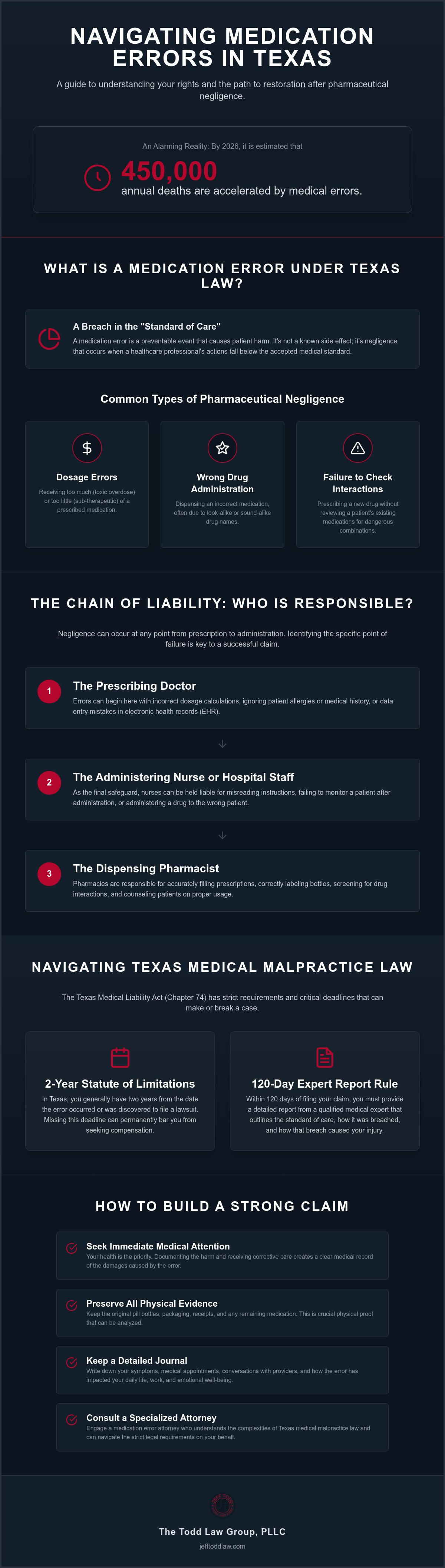
In 2026, estimates suggest that as many as 450,000 deaths annually are significantly accelerated by medical errors, often involving the very prescriptions meant to heal us. If you're struggling with declining health because of a pharmacy mistake or an incorrect dosage, the confusion over whether the doctor, nurse, or pharmacist is at fault can feel overwhelming. Finding a dedicated medication error attorney Texas is the first step toward cutting through that uncertainty and holding the negligent parties accountable.
It's exhausting to face rising medical bills for corrective treatments while your body tries to recover from a preventable mistake. We believe that legal representation should be a holistic part of your healing process, focusing on your total restoration rather than just a settlement check. This guide will show you how to navigate the complex landscape of Texas medical malpractice laws, including the two year statute of limitations and the specific damage caps that apply to your case. You'll learn how to build a path toward financial recovery for lost wages and medical expenses, ensuring your family has the stability needed for long term physical and emotional recovery.
Key Takeaways
- Understand how Texas law defines a medication error as a preventable breach of the "standard of care" that leads to patient harm.
- Learn to identify liability across the medical chain of command, distinguishing between prescribing mistakes by doctors and dispensing errors by pharmacies.
- Navigate the strict requirements of the Texas Medical Liability Act, including the critical 120-day expert report rule, with the help of a medication error attorney Texas.
- Follow a strategic checklist for preserving physical evidence, such as pill bottles and packaging, to build a robust foundation for your legal claim.
- Discover how a contingency-based legal approach focuses on your total restoration, securing compensation for medical bills and lost wages without upfront costs.
What Qualifies as a Medication Error Under Texas Law?
In the eyes of Texas law, a medication error is a preventable event that leads to inappropriate medication use or patient harm while the drug is in the control of a healthcare professional. This isn't just a clerical slip. It's a specific breach of the legal "standard of care," which is the benchmark used to determine if a provider acted as a reasonably prudent professional would have in similar circumstances. When a doctor, nurse, or pharmacist falls below this line, they've committed medical malpractice.
Distinguishing between a negligent error and a known side effect is vital for your case. Most medications carry inherent risks that are disclosed to patients during the prescribing process. However, if you suffer harm because a provider ignored your medical history or misread a prescription, that isn't a side effect; it's negligence. Consulting a medication error attorney Texas helps you identify these distinctions, as proving a medical error requires specialized knowledge of both clinical standards and the Texas Medical Liability Act.
Common Types of Pharmaceutical Negligence
Negligence in the pharmaceutical chain often involves three specific failures. Dosage errors are among the most dangerous, where a patient receives either a sub-therapeutic amount that fails to treat their condition or a toxic overdose that causes immediate harm. Wrong drug administration frequently occurs due to look-alike or sound-alike medication confusion, especially in high-pressure hospital environments. Finally, a failure to check drug interactions can lead to life-threatening complications when a provider neglects to review a patient's existing prescriptions before adding a new one.
The Impact on Patient Health and Restoration
The damage from these mistakes can range from short-term physiological distress to permanent organ failure or neurological impairment. While the physical symptoms are often the most visible, the emotional toll of medical betrayal is equally significant. Victims often find it difficult to trust the healthcare system again after being harmed by the people meant to protect them. Taking legal action is a proactive step toward your total restoration. It provides the financial resources needed for corrective treatments and creates a clear path toward both physical and emotional healing. A seasoned medication error attorney Texas can help you hold the responsible parties accountable, ensuring that your journey back to health is supported by the justice you deserve.
Liability and Fault: Who is Responsible for a Drug Error?
Determining who is at fault for a prescription mistake requires a meticulous review of the medical "chain of command." This chain begins with the prescribing physician and extends through the nurses who administer the drug to the pharmacists who fill the order. If any link in this chain breaks, the resulting injury isn't just an accident; it's often a case of negligence. Identifying the specific point of failure is a task that a seasoned medication error attorney Texas handles by examining medical records, pharmacy logs, and hospital protocols.
Doctor and Nurse Negligence in Hospitals
Hospital settings introduce unique risks for patients. While electronic health records (EHR) were designed to reduce mistakes, data entry errors or software glitches can still lead to the wrong dosage being ordered. Nurses also play a critical role; they're the final safeguard before a drug enters a patient's system. If a nurse fails to monitor a patient after administering a high-risk medication, or if they misread a doctor's instructions, the hospital may be held liable for their employee's actions. Inadequate review of a patient's history, such as ignoring a documented allergy, remains a primary cause of preventable harm in Texas facilities.
Pharmacy Malpractice and Dispensing Mistakes
Outside of the hospital, retail pharmacies are a common site for negligence. Pharmacists have a legal duty to counsel patients on proper usage and to screen for dangerous drug-to-drug interactions. When a pharmacist rushes through these steps, they bypass essential safety checks. Research on Medication Dispensing Errors and Prevention highlights that many mistakes occur during the transition from the doctor's office to the pharmacy counter. These can include mechanical errors in automated dispensing machines or simple labeling mistakes where the wrong instructions are printed on the bottle.
Institutional liability extends beyond individual staff members. If a healthcare facility suffers from chronic understaffing or lacks clear safety protocols, the institution itself may be at fault for systemic failures. In rarer cases, pharmaceutical manufacturers are responsible if a medication error occurs due to confusing packaging, poor labeling, or bottling mistakes at the factory level. These multi-party cases require the intellectual rigor of a legal team that understands how to pursue various defendants simultaneously.
Identifying the correct defendant is the first step toward your total restoration. If you're unsure where the breakdown occurred in your treatment, speaking with a dedicated legal advocate can help clarify your options. A medication error attorney Texas ensures that every negligent party is held accountable, providing you with a stable partner to navigate the complexities of your recovery.
Navigating Texas Medical Malpractice Laws and Chapter 74 Requirements
Texas law is notoriously complex when it comes to medical liability. The primary governing framework is the Texas Medical Liability Law (Chapter 74), which sets high procedural hurdles for victims. Unlike a standard personal injury case, a medication error claim requires immediate, technical precision. You generally have a strict two year window from the date of the error to file a claim. Missing this deadline usually means losing your right to seek compensation forever, regardless of how clear the negligence was. It's a rigid system that demands a proactive legal strategy from day one.
The Expert Report Hurdle
The most significant barrier in a Texas malpractice case is the 120 day expert report rule. Within 120 days of filing your lawsuit, you must serve each defendant with a report from a qualified medical expert. This expert must be currently practicing or teaching in a field relevant to the error. The report must explicitly detail three things: the standard of care, how the provider breached it, and how that specific breach caused your injury. If the report is deemed insufficient or is served late, the court must dismiss your case "with prejudice." This means you can never refile, and you may even be ordered to pay the defendant's legal fees. A medication error attorney Texas understands how to identify and retain the right experts to clear this hurdle safely.
Texas Damage Caps and Your Recovery
Texas imposes strict limits on "non-economic" damages, such as pain, suffering, and emotional distress. For claims against individual physicians or healthcare providers, this cap is $250,000. If multiple institutions like hospitals are involved, the total cap for non-economic damages can reach up to $750,000, but it never exceeds $250,000 from a single facility. These caps make it essential to have a stable partner who knows how to navigate the statutory limits while advocating for your full needs.
Fortunately, economic damages remain uncapped. This includes your actual medical bills, the cost of future corrective surgeries, and all lost wages or loss of earning capacity. Because these amounts aren't limited by law, your medication error attorney Texas will focus on documenting every dollar of financial loss to maximize your total restoration. By building a comprehensive life care plan, we ensure the legal system accounts for the full scope of your physical and financial needs, providing a clear path toward healing.
How to Build a Strong Medication Error Claim in Texas
If you suspect a medication error has occurred, the moments following that discovery are critical for both your health and your potential legal case. Your first step should always be to seek immediate medical attention from an independent provider to stabilize your condition. Once you're safe, you must protect the evidence. Do not return the medication to the pharmacy or the hospital. The physical bottle, the original packaging, and any remaining pills are the most direct proof of what went wrong. Keeping these items in a secure place prevents the negligent party from claiming the error never happened.
Documenting your experience is just as vital. Start a daily log to track the progression of your physical symptoms and your emotional state. This record serves as a timeline that connects the medication mistake to your declining health. If you're approached by hospital risk managers or insurance adjusters, remember that their goal is to protect the institution's bottom line. They may offer a quick settlement or ask for a recorded statement that could later be used to undermine your claim. It's best to decline these conversations until you have a medication error attorney Texas by your side.
Essential Evidence for Pharmaceutical Claims
Building a successful case requires a deep dive into records that aren't always easy for a patient to access. Your legal team will secure your Pharmacy Profile and the internal hospital Medication Administration Record (MAR). These documents show exactly what was ordered versus what was actually administered. In many cases, blood tests and toxicology reports provide the scientific evidence needed to prove that a specific drug or dosage reached toxic levels in your system. We also look to witness statements from family members or caregivers who observed the immediate physical changes after the medication was taken.
Working with a Medical Malpractice Attorney
A seasoned medication error attorney Texas does more than just file paperwork; they act as a stable partner through a high-stakes investigation. We coordinate with medical experts to validate the breach in the standard of care and uncover hidden negligence in medical logs that might otherwise be overlooked. This meticulous approach allows us to negotiate with malpractice insurance carriers from a position of strength. If you're ready to hold the negligent parties accountable and start your journey toward total restoration, contact our experienced legal team for a review of your case.
Seeking Justice and Restoration with The Todd Law Group, PLLC
Jeff Todd has been a fixture in the Texas legal community since 1994, bringing over three decades of experience to every case. Transitioning from high-stakes corporate environments, he applies that same intellectual rigor to advocating for individuals harmed by healthcare negligence. When you choose a medication error attorney Texas from our firm, you aren't just hiring a litigator; you're gaining a stable partner dedicated to your total restoration. We recognize that these errors represent a profound breach of trust that requires both legal authority and compassionate support.
Our practice operates on a contingency-based model, ensuring that financial barriers never prevent a victim from seeking justice. We maintain a "No Fee Unless We Win" policy, which means our interests are perfectly aligned with yours. This commitment allows you to focus on physical recovery while we manage the complex litigation process against well-funded medical institutions and insurance carriers.
A Sophisticated Approach to Complex Malpractice
We move with an efficient, goal-oriented rhythm to secure time-sensitive evidence like pharmacy logs and hospital records before they can be obscured. This proactive investigation is a hallmark of our service-first practice, ensuring every detail of the medication chain is scrutinized. To understand more about our broader work in this field, you can explore our insights on being a Medical Malpractice Attorney Texas.
Start Your Path to Recovery Today
With physical offices in Houston, Austin, and Galveston, we're personally invested in the communities we serve. We handle the logistical burdens of your claim, from filing Chapter 74 notices to coordinating with medical experts, so you can prioritize your health and family. If you're ready to hold the negligent parties accountable, Contact The Todd Law Group, PLLC for a free consultation. A medication error attorney Texas will provide a clear, professional evaluation of your case and help you begin the journey toward healing.
Take the First Step Toward Your Restoration
Navigating the aftermath of a pharmaceutical mistake requires a blend of technical legal knowledge and compassionate advocacy. We've discussed the rigorous demands of the Texas Medical Liability Act, from the critical 120 day expert report to the statutory caps on non-economic damages. Securing your future after such a breach of trust depends on the proactive strategy of a medication error attorney Texas who understands how to maximize uncapped economic damages for your long term care and lost wages.
Jeff Todd has been licensed in Texas since 1994, bringing the intellectual rigor of a corporate background to personal injury victims in Houston, Austin, and Galveston. Our "No Fee Unless We Win" policy ensures that you can pursue justice without adding to your financial stress. We don't just see a case file; we see a neighbor whose life has been disrupted. Our goal is your total restoration, providing the stable partnership you need to move from the trauma of a medical error toward a future of healing and accountability.
Schedule Your Free Case Evaluation with The Todd Law Group, PLLC Today. We're ready to stand by your side and help you reclaim your health and peace of mind.
Frequently Asked Questions
What is the statute of limitations for a medication error in Texas?
You generally have two years from the date the medication error occurred or was discovered to file a medical malpractice lawsuit in Texas. This strict deadline is established by the Texas Civil Practice and Remedies Code. If you miss this window, you'll likely lose your right to seek compensation. It's vital to consult a medication error attorney Texas early to ensure all filings are completed before this period expires.
Can I sue a pharmacy for giving me the wrong medication in Texas?
You can sue a pharmacy if their failure to meet the professional standard of care resulted in your injury or declining health. Common pharmacy errors include dispensing the wrong drug, providing an incorrect dosage, or failing to check for dangerous drug interactions. These cases fall under the same medical liability laws as doctor negligence. We focus on holding the specific pharmacist or the corporate entity accountable for these preventable mistakes.
What is a Chapter 74 expert report and why do I need one?
A Chapter 74 expert report is a mandatory document that must be served to defendants within 120 days of filing a medical liability lawsuit. This report must be written by a qualified medical professional who explains the standard of care, how it was breached, and how that breach caused your injuries. Without a sufficient report, Texas courts are required to dismiss your case with prejudice. This makes the report the most critical technical hurdle in your litigation.
How much is a medication error case worth in Texas?
The value of a medication error case depends on the severity of your injuries and the financial losses you've incurred. While Texas caps non-economic damages like pain and suffering at $250,000 for physicians, there's no cap on economic damages. This means you can recover the full amount for medical bills, lost wages, and future corrective treatments. A medication error attorney Texas will calculate your total losses to maximize your potential recovery and support your restoration.
Can I file a claim if the medication error resulted in a wrongful death?
Surviving family members can file a wrongful death claim if a medication error led to the loss of a loved one. Texas law allows spouses, children, and parents of the deceased to seek compensation for funeral expenses, lost financial support, and emotional loss. These cases are subject to the same strict procedural requirements as other medical malpractice claims. We help families navigate this painful process to ensure the negligent healthcare provider is held responsible for the tragedy.
What if the doctor says the error didn't cause my new symptoms?
It's common for doctors or their insurance carriers to argue that your symptoms were caused by a pre-existing condition rather than a medication error. We counter this by working with independent medical experts who specialize in toxicology and pharmacology. These experts review your medical records and lab results to establish a direct causal link between the incorrect medication and your physiological harm. Proving causation is a technical process that requires sophisticated legal and medical analysis.
Do I have to pay legal fees upfront for a medical malpractice case?
You don't have to pay any upfront legal fees when you work with our firm. We handle medical malpractice cases on a contingency basis, which means our fees are a percentage of the final settlement or verdict we secure for you. If we don't win your case, you don't owe us an attorney fee. This allows victims of medical negligence to pursue justice without the burden of immediate financial costs during their physical recovery.
How do I prove a nurse gave me the wrong dosage in a hospital?
Proving a dosage error usually involves securing the hospital's internal Medication Administration Record (MAR) and electronic health record logs. These documents track exactly what was ordered by the doctor and what was scanned or recorded by the nurse at the bedside. We also look for discrepancies in pharmacy dispensing logs and witness statements from staff or family. This paper trail is essential for establishing exactly where the breakdown in the standard of care occurred during your treatment.


