

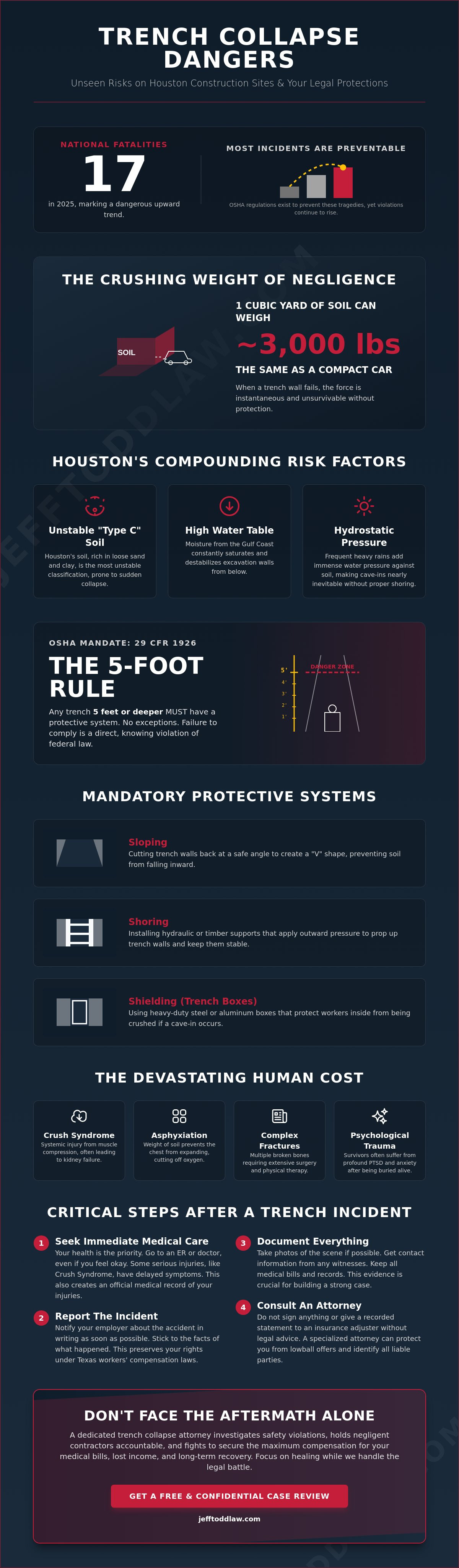
In 2025, national trench collapse fatalities rose to 17, marking a dangerous upward trend from the previous year. For families in Southeast Texas, these aren't just statistics; they're life-altering events like the fatal 10-foot cave-in that occurred in Conroe on April 12, 2026. If you've been buried under the physical and financial weight of a construction accident, you're likely facing mounting medical debt and the fear of losing your family's primary income. Partnering with a dedicated trench collapse attorney Houston is the first step toward reclaiming your stability and ensuring your voice is heard.
We understand the hesitation you might feel, especially when navigating the friction between Texas workers' compensation and third-party liability. You shouldn't have to choose between your job security and the justice you're owed. This article explores your legal protections under OSHA's 29 CFR 1926 standards and identifies who can be held accountable beyond just your direct employer. You'll learn how to secure the maximum compensation necessary for your long-term recovery and discover why professional advocacy is essential for your holistic healing after a catastrophic incident.
Key Takeaways
- Understand the OSHA "5-Foot Rule" and why most trenching incidents are classified as preventable failures rather than unavoidable accidents.
- Learn how to navigate the complex chain of command to hold general contractors and developers accountable for site safety oversights.
- Identify the critical medical and reporting steps you must take immediately following an incident to preserve your rights under Texas law.
- Discover how a trench collapse attorney Houston utilizes technical experts and decades of legal experience to secure compensation for your total restoration.
- Explore the legal strategies used to address loss of income and catastrophic medical bills while you focus on your physical healing.
Understanding Trench Collapse Risks in Houston Construction
A trench collapse is the sudden, violent displacement of soil into an open excavation. It happens in the blink of an eye, leaving workers with no time to react. OSHA classifies trenching and excavation as "high-hazard" activities because the risks are both extreme and immediate. By Understanding Trench Collapse Risks, families can better grasp why strict engineering controls are a non-negotiable right for every worker. The physics involved are staggering. One cubic yard of soil can weigh approximately 3,000 pounds, which is the weight of a compact car. When a trench wall fails, the victim is essentially crushed by the weight of a vehicle. This is why a trench collapse attorney Houston focuses so heavily on the preventable nature of these incidents.
Why Houston Soil Conditions Increase Cave-in Hazards
Houston's geography presents specific dangers that many contractors fail to address. Our region is primarily composed of "Type C" soil, which includes loose sand and submerged clay. This is the most unstable soil classification recognized by safety experts. Because the Gulf Coast has an exceptionally high water table, moisture constantly destabilizes excavation walls. Frequent heavy rain in the Houston area creates intense hydrostatic pressure. This is the force of water pushing against the soil, making a cave-in nearly inevitable if proper shoring or shielding isn't used. Contractors who ignore these local environmental factors are not just cutting corners; they're risking lives.
The Devastating Physical and Emotional Toll of a Collapse
The injuries sustained during a cave-in are often life-altering. When thousands of pounds of earth compress the body, the damage is deep and complex. Common medical outcomes include:
- Crush Syndrome: Serious systemic injury resulting from muscle compression, often leading to kidney failure.
- Asphyxiation: The weight of the soil prevents the chest from expanding, cutting off oxygen.
- Traumatic Brain Injuries (TBI): Caused by falling debris or prolonged oxygen deprivation.
- Complex Fractures: Multiple broken bones that may require several surgeries and long-term physical therapy.
Beyond the physical wounds, the psychological trauma of being buried alive is profound. Many survivors suffer from debilitating PTSD and anxiety. Seeking a houston personal injury lawyer is a critical step in the journey toward holistic healing. Legal advocacy ensures you have the financial resources to treat both the visible injuries and the emotional scars. It's about moving from a place of victimhood to a state of total restoration.
OSHA Safety Standards and Preventable Contractor Negligence
Adhering to OSHA Safety Standards isn't an optional choice for Houston construction firms; it's a federal mandate designed to prevent the exact tragedies we see too often. The cornerstone of these regulations is the "5-Foot Rule." OSHA requires that any trench five feet or deeper must be protected by a system that prevents soil movement. If a contractor allows a worker to enter an unprotected excavation of this depth, they're in direct violation of 29 CFR 1926. Experts consistently categorize these incidents as "preventable fatalities" because the engineering solutions to stop them have existed for decades. When these rules are ignored, a trench collapse attorney Houston can help you hold the negligent parties accountable for their shortcuts.
Mandatory Protective Systems: Sloping, Shoring, and Shielding
Contractors have three primary methods to ensure worker safety. They must select the right one based on the soil conditions discussed earlier. These methods include:
- Sloping: This involves cutting the trench walls back at a specific angle, essentially creating a "V" shape so the earth cannot fall inward.
- Shoring: Workers install aluminum hydraulic or timber supports that apply pressure against the trench walls to "prop" them up and keep them stable.
- Shielding (Trench Boxes): This method uses heavy steel or aluminum boxes. While they don't prevent a cave-in, they protect the worker inside the box from being crushed if the walls fail.
The Role of the "Competent Person" on the Job Site
OSHA requires every job site to have a designated "Competent Person." This individual must have the specific training to identify existing and predictable hazards. They're required to conduct mandatory daily inspections before any worker enters a trench. If weather conditions change or if they spot a crack in the soil, they must have the absolute authority to stop work immediately. A failure to appoint a truly qualified person, or that person's failure to halt dangerous work, often points to a significant premises liability issue. If you've been hurt because a supervisor prioritized the schedule over your safety, it's vital to speak with a legal professional who understands the intricacies of construction negligence. These inspections are the final line of defense, and when they fail, the consequences are almost always catastrophic.
Determining Liability: Who is Responsible for a Houston Trench Accident?
Identifying who is responsible for a catastrophic cave-in requires a deep dive into the project's contractual hierarchy. While your immediate employer might have been on-site, the General Contractor (GC) often bears the ultimate responsibility for maintaining a safe environment. GCs are tasked with coordinating safety protocols across all subcontractors. If they failed to supervise the excavation or ignored a subcontractor's lack of shoring, they're likely liable. Property owners and developers aren't exempt either; they have a duty to hire competent firms and ensure the site remains safe for all workers. A seasoned trench collapse attorney Houston will examine every variable to ensure no liable party is overlooked.
Liability can also extend to entities that weren't even on the job site. If a trench box failed due to a structural defect, the equipment manufacturer could be held accountable through a product liability claim. Additionally, external factors like heavy machinery vibration can trigger a collapse in unstable soil. If a commercial vehicle operated by a separate company caused the ground to shift, a houston truck accident lawyer might need to investigate the operator's negligence. This multi-layered approach is essential for your total restoration.
Third-Party Claims vs. Workers’ Compensation
Many workers believe that Workers' Compensation is their only option after an injury. In Texas, this system often limits your recovery to medical bills and a portion of your lost wages. It doesn't account for the mental anguish or the loss of quality of life that follows a burial incident. Third-party claims allow you to sue entities other than your direct employer, such as negligent GCs or equipment manufacturers. These lawsuits are vital because they provide a path to secure full damages. This includes compensation for physical pain, suffering, and the long-term emotional trauma associated with a preventable accident.
Texas Non-Subscriber Laws and Your Legal Rights
Texas is unique because it allows employers to opt out of the Workers' Compensation system. These companies are known as "Non-Subscribers." If your employer is a Non-Subscriber, you have the right to sue them directly for negligence. In these cases, the employer loses several key legal defenses. This makes it significantly easier to hold them accountable for unsafe trenching practices. Jeff Todd prioritizes identifying an employer's insurance status immediately. This technical proof is the foundation of a proactive legal strategy aimed at your holistic healing. We don't just look for a quick settlement; we look for the accountability you deserve.
Critical Steps to Take After a Houston Trenching Incident
Your first priority after a cave-in is immediate medical intervention. The immense pressure of soil discussed in previous sections can cause "silent" internal injuries, such as organ damage or internal bleeding, that don't show symptoms right away. Even if you walked away from the site, you need a full evaluation. Once you're stable, ensure a formal report is filed with your employer. This initiates a paper trail that is difficult for corporate defense teams to dispute later. You should also confirm that OSHA has been notified, as federal law requires reporting for any hospitalization or fatality within strict timeframes.
Documentation is your strongest ally. Adopting the same meticulous approach used by a houston car accident lawyer is essential for success. You must treat the construction site like a scene that needs to be preserved. Companies often move equipment or "clean up" the area quickly after an incident, which can result in the loss of vital evidence. If you're unable to do this yourself, have a family member or a trusted trench collapse attorney Houston begin the investigation immediately.
Preserving Evidence at the Construction Site
If possible, take clear photos of the trench from multiple angles. Pay close attention to the "spoil piles," which are the mounds of excavated dirt. OSHA requires these to be at least two feet from the trench edge; if they're closer, they likely contributed to the collapse. Capture images of any missing or damaged trench boxes and shoring equipment. It's also vital to identify coworkers who witnessed the event. Construction crews move from job to job frequently. Getting their personal contact information now ensures your legal team can reach them for statements before they disappear to a different project.
Navigating Insurance Adjusters and Corporate Investigators
Within hours of a collapse, corporate investigators and insurance adjusters will likely be on-site. It's important to remember they aren't there to facilitate your healing; they're there to protect the company's bottom line. One common tactic is the "recorded statement" trap. Adjusters may sound sympathetic while asking leading questions designed to shift the blame onto you. They might ask if you were "rushing" or if you "noticed anything unusual" before entering. These statements can be used to argue that you assumed the risk or were partially at fault. Jeff Todd acts as a shield between you and these aggressive tactics, managing all communication to ensure your rights remain protected. Before you sign any documents or provide a statement, contact our firm to discuss your situation.
How a Houston Trench Collapse Attorney Secures Your Restoration
Securing justice after a catastrophic excavation incident requires more than just basic legal knowledge; it demands a deep understanding of the engineering and regulatory failures that lead to cave-ins. Jeff Todd has been licensed in Texas since 1994, bringing over three decades of serious legal experience to every client we serve. While some firms might look for the easiest path to a settlement, a dedicated trench collapse attorney Houston builds a case meant to withstand the scrutiny of a courtroom. We coordinate with a network of forensic engineers and OSHA compliance experts to reconstruct the scene and prove exactly where safety protocols were ignored. This technical precision is what forces negligent contractors and their insurers to provide the compensation you truly deserve.
We believe that financial barriers shouldn't prevent you from accessing high-caliber legal representation. Our firm operates on a contingency model, often described as "No Fee Unless We Win." This means you don't pay any upfront costs or hourly fees while we build your case. We take on the financial risk of the litigation so you can focus entirely on your physical recovery. In the most tragic circumstances where a collapse results in a loss of life, our team provides the compassionate guidance needed to pursue a claim through an austin wrongful death attorney approach, ensuring your family's future is protected even in the wake of an unthinkable loss.
Beyond the Settlement: A Holistic Approach to Recovery
Our commitment to your case extends beyond the final check. We view legal advocacy as a vital component of your holistic healing process. A successful outcome provides the essential resources for long-term rehabilitation, specialized medical equipment, and the replacement of lost earning capacity. We act as your steady partner through every step of the legal progression, ensuring you aren't overwhelmed by the logistical demands of a lawsuit. By securing your financial stability, we empower you to move forward with the confidence that your family's needs are met for years to come.
Why The Todd Law Group, PLLC is the Right Choice for Houston Workers
The Todd Law Group, PLLC offers a unique advantage by applying an elite corporate legal background to personal injury advocacy. Jeff Todd has transitioned from high-stakes corporate environments to dedicated personal representation, meaning you receive the intellectual rigor of a large-scale firm with the personalized support of a community-invested team. We understand the local Houston landscape, from our specific soil conditions to the regional construction industry's practices. If you're ready to hold negligent parties accountable and begin your journey toward total restoration, we're here to help. Contact us to schedule a free, no-obligation consultation today.
Secure Your Path to Total Restoration
The weight of a trench collapse extends far beyond the immediate physical impact of the soil; it disrupts the very foundation of a family's financial and emotional stability. As established, these incidents are rarely true accidents but are often the result of systemic failures in site oversight and engineering. By leveraging the expertise of a trench collapse attorney Houston, you can hold every negligent party accountable and secure the resources necessary for your long-term recovery. Whether navigating complex third-party claims or investigating an employer's non-subscriber status, professional legal advocacy ensures your voice is heard in a complex corporate system.
Attorney Jeff Todd has been licensed in Texas since 1994, applying the intellectual rigor of a corporate background to help injured individuals reclaim their lives. With offices in Houston, Austin, and Galveston, we are personally invested in the recovery of our local workforce. We operate on a contingency basis, ensuring you face no financial risk while pursuing justice. If you or a loved one has been injured in a cave-in, contact The Todd Law Group, PLLC today for a free consultation. We don't just fight for a financial settlement; we partner with you for your holistic healing and future peace of mind.
Frequently Asked Questions
How long do I have to file a trench collapse lawsuit in Texas?
You generally have two years from the date of the incident to file a personal injury lawsuit in Texas. If the claim involves a fatality, the Texas wrongful death statute of limitations is strictly two years from the date of the person's death. Missing these deadlines will likely result in the court dismissing your case and losing your right to seek justice.
Can I sue my employer for a trench cave-in if they have Workers’ Comp?
In Texas, Workers' Compensation is typically the exclusive remedy against your direct employer, which often prevents you from suing them for negligence. However, exceptions exist if the employer's gross negligence caused a fatal injury or if they are a "non-subscriber" who opted out of the system. Even if you receive benefits, a trench collapse attorney Houston can often identify third-party claims against other negligent entities involved in the project.
What if the trench collapse was caused by another company on the job site?
You can file a third-party liability claim if a general contractor, subcontractor, or equipment manufacturer contributed to the collapse. These claims are separate from workers' compensation and are essential for your total restoration. They allow you to pursue full damages for pain, suffering, and mental anguish that standard insurance benefits do not cover.
What are the main causes of trench collapses in Houston?
Houston's unique Type C soil, which consists of loose sand and wet clay, is a primary cause of instability. The high water table in the Gulf Coast region and frequent heavy rains create hydrostatic pressure that can easily trigger a cave-in. Most incidents occur because contractors fail to follow OSHA's 29 CFR 1926 standards, specifically the requirement for protective systems in trenches five feet or deeper.
How much does it cost to hire a Houston construction accident lawyer?
Our firm operates on a contingency-fee model, meaning there are no upfront costs or hourly fees for our services. We only receive payment if we successfully secure a settlement or jury verdict on your behalf. This approach ensures that every worker has access to high-caliber legal representation regardless of their current financial situation.
What kind of compensation can I recover in a trench collapse case?
You can recover compensation for all medical expenses, including future surgeries and long-term rehabilitation. A successful claim also addresses lost wages, loss of earning capacity, and physical impairment. In third-party lawsuits, you may also secure damages for emotional distress and the loss of quality of life resulting from your injuries.
Do I still have a case if OSHA wasn’t called to the scene?
You still have a valid legal path even if OSHA did not conduct an immediate on-site investigation. While federal safety reports are valuable, a trench collapse attorney Houston can utilize independent forensic engineers and safety experts to prove negligence. It is vital to document the scene and identify witnesses as early as possible to preserve the evidence needed for your case.
What happens if a loved one was killed in a Houston trench accident?
If a loved one was killed, surviving family members may file a wrongful death claim to seek accountability. This legal action provides resources for funeral costs, the loss of the provider's future income, and the emotional trauma of losing a family member. Under Texas Civil Practice & Remedies Code §16.003(b), you must file this claim within two years of the date of death.


