
Did you know that the liability waiver you signed when enrolling your child is likely unenforceable if they were injured due to negligence? Many Houston parents believe they've signed away their right to justice, but Texas courts are remarkably protective of a child's right to seek compensation. It's a devastating sense of betrayal when the people you trusted to keep your child safe fail in their most basic duty. You're likely feeling the weight of mounting medical bills and the fear that this incident might have long-term consequences for your child's physical or developmental health.
This guide will show you how to hold negligent facilities accountable and secure the specialized medical funding your child needs for a total restoration. Partnering with an experienced Houston daycare injury attorney ensures you don't have to face the insurance companies or complex state regulations alone. We'll explore how Texas staff-to-child ratios impact your case, why "negligence per se" simplifies the legal process, and what steps you must take within the two-year statute of limitations to protect your family's future and find peace of mind.
Key Takeaways
- Understand the legal distinction between unavoidable accidents and daycare negligence caused by a failure to meet professional standards of care.
- Learn how Texas Health and Human Services Minimum Standards serve as a safety benchmark and how violations provide powerful evidence for your claim.
- Discover why liability waivers often fail to protect negligent facilities and how a Houston daycare injury attorney can challenge these documents to secure your child's rights.
- Identify critical immediate actions to take after an incident, including prioritizing specialized medical evaluations and preserving evidence through scene documentation.
- Explore a holistic approach to legal advocacy that prioritizes your child's total restoration and your family's long-term peace of mind.
When Trust is Broken: Defining Daycare Negligence in Houston
Entrusting a facility with your child's safety is one of the most significant decisions a parent can make. When that trust is shattered by an injury, the emotional weight is paralyzing. It's not just about the physical harm; it's about the profound sense of betrayal that follows when a caregiver fails to provide the basic oversight your child deserves. For many Houston families, the immediate aftermath is a blur of medical appointments and questions about how such a failure could happen in a professional setting.
Legally, daycare negligence is anchored in the legal definition of negligence, which describes a failure to behave with the level of care that someone of ordinary prudence would have exercised under the same circumstances. In these cases, the legal foundation is often premises liability. This means the facility is responsible for hazards they knew about or should have discovered through regular inspections. A dedicated Houston daycare injury attorney works to prove that the injury wasn't a random occurrence but a direct result of the facility's failure to maintain a safe environment or adhere to required protocols.
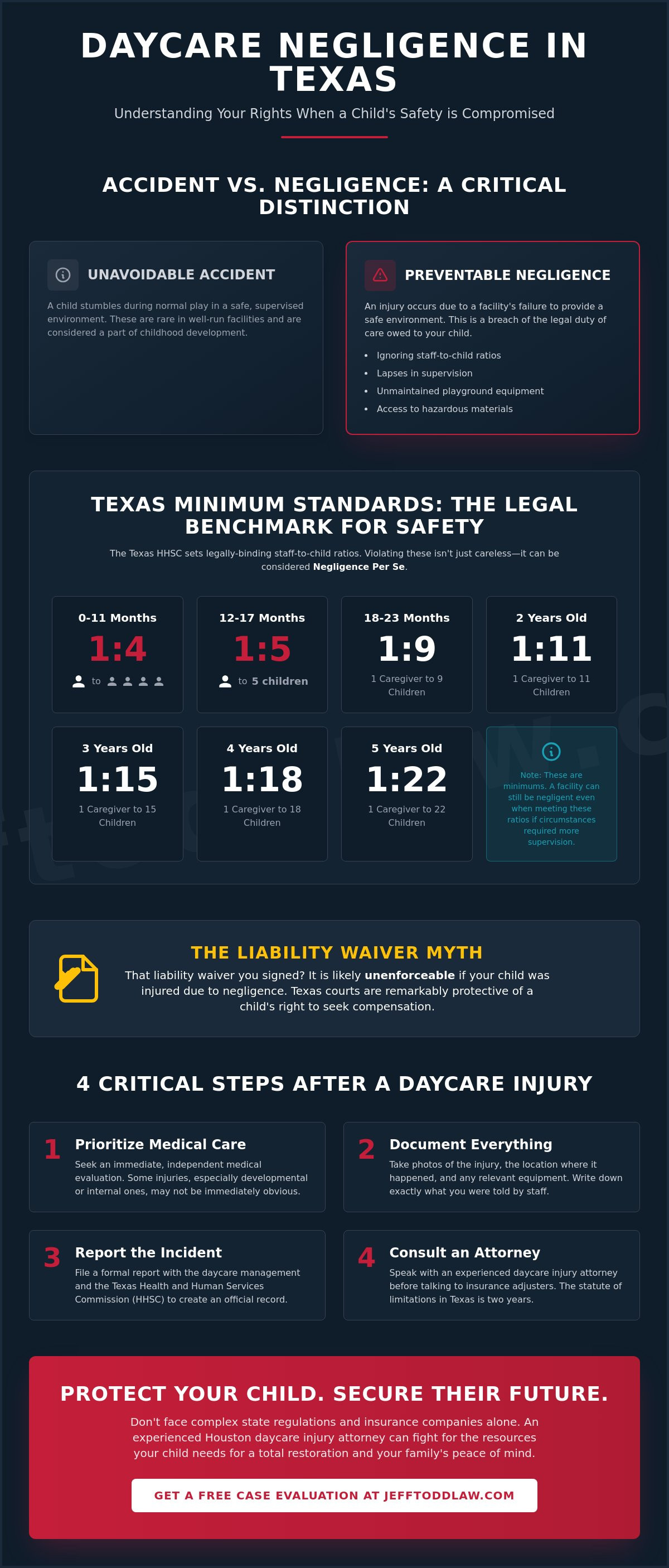
It is vital to separate unavoidable accidents from preventable oversight. A child might stumble while playing, which is a normal part of childhood development. However, if that child falls because a staff member was distracted or because the facility ignored staff-to-child ratios, that is negligence. True accidents are rare in a well-run facility. Most injuries we see are the result of a facility choosing to cut corners on safety to save time or labor costs.
Common Types of Preventable Daycare Injuries
While every situation is unique, certain types of injuries occur frequently when Houston facilities fail to maintain their premises or supervise children adequately. These include:
- Playground Equipment Failures: Falls from unmaintained slides, swings, or high surfaces lacking proper impact-absorbing ground cover.
- Supervision Lapses: Injuries that happen during transitions between rooms or during naptime when staff presence is insufficient.
- Hazardous Exposure: Access to toxic cleaning chemicals, small choking hazards, or unsecured furniture.
- Sanitation Issues: Severe infections or illnesses resulting from unsanitary food preparation or diaper-changing areas.
The Distinction Between Negligence and Intentional Abuse
There is a critical difference between a failure in a duty of care and willful harm. Negligence involves a failure to act or supervise correctly, whereas abuse involves a deliberate act to cause injury. Both scenarios are devastating and require immediate legal intervention to protect your child and others in the community. While the state may pursue criminal charges in cases of abuse, The Todd Law Group, PLLC handles the civil side of these complex matters. We focus on securing the financial resources your child needs for a total restoration and long-term healing.
Texas Minimum Standards: The Benchmark for Childcare Safety
In Texas, the Health and Human Services Commission (HHSC) establishes a rigorous framework known as the "Minimum Standards for Child-Care Centers." These aren't merely suggestions for best practices; they are the legal floor that every licensed facility in Houston must meet to ensure child safety. When a facility falls below these standards, they aren't just being careless. They are breaking the law. For a Houston daycare injury attorney, a documented violation of these standards often serves as "negligence per se," which means the violation itself provides powerful evidence that the facility failed in its legal obligations.
Under Texas law, daycare owners owe a specific duty of care to children to provide a safe, supervised environment that protects them from foreseeable risks and physical harm. This duty extends beyond just preventing active abuse. It requires proactive measures to maintain equipment, vet employees, and manage the chaotic nature of a group childcare setting. If a center ignores these mandates to save on labor costs or maintenance fees, they must be held accountable for the consequences.
Staffing Ratios and Supervision Requirements
Staffing levels are the most frequent point of failure in daycare safety. As of 2026, Texas law requires specific caregiver-to-child ratios to ensure every child receives adequate attention. For infants aged 0 to 18 months, the ratio is 1:4. For toddlers aged 18 to 36 months, it's 1:11. When these ratios are ignored, children are left "out of sight," which almost always means the facility is out of compliance. Understaffing in Houston daycares is a primary driver of catastrophic injuries, as a single distracted caregiver cannot possibly intervene during a choking incident or a dangerous fall when they are overwhelmed by too many children.
Environmental Safety and Facility Maintenance
The physical environment must be as strictly regulated as the staff. State standards require specific impact-absorbing surfaces, such as rubber mats or engineered wood fiber, under all playground equipment to prevent traumatic brain injuries. Facilities must also adhere to child safety standards regarding furniture stabilization; heavy bookshelves and storage units must be anchored to walls to prevent "tip-over" accidents. Additionally, HHSC mandates that every staff member completes 24 hours of pre-service training and undergoes a comprehensive background check. If a facility skips these steps and hires an unqualified individual, they are directly responsible for any harm that follows. If you suspect a regulatory failure led to your child's accident, it's vital to speak with a dedicated advocate who can investigate the center's history of compliance.
The Liability Waiver Myth: Can You Still Sue a Houston Daycare?
Many Houston parents remember the thick stack of paperwork they signed during enrollment. It's common to feel that by signing a "Release of Liability," you've signed away your family's right to pursue a claim. However, in Texas, these documents are rarely the final word. A Houston daycare injury attorney understands that courts often find these broad waivers unenforceable because they violate public policy. For a waiver to hold any weight, it must meet the "fair notice" and "express negligence" doctrines. This means the language must be clear, conspicuous, and unambiguous. Most standard daycare contracts fail these strict legal tests.
Texas law is particularly protective of a minor's rights. You cannot simply sign away a child's right to a safe environment. If a facility attempts to use a waiver to shield themselves from the consequences of failing to meet basic safety standards, a judge will likely strike that clause down. These documents are often drafted by the facility's insurance carriers to limit financial exposure, but they cannot override the fundamental legal protections afforded to children in our community.
Gross Negligence vs. Ordinary Negligence
Even if a waiver is technically well-drafted, it cannot protect a facility from claims of gross negligence. While ordinary negligence is a simple mistake, gross negligence is a conscious indifference to your child's safety. It's a reckless disregard for a known danger. For instance, leaving a child unattended in a hot transport van or failing to secure a swimming pool area goes far beyond a simple lapse. Texas law holds that no contract can excuse such extreme behavior, ensuring that children still have a path to justice when facilities act with total disregard for their well-being.
Why Daycares Use Waivers (And Why They Fail)
Daycares continue to include these clauses primarily as a deterrent. They want you to believe you have no legal recourse so that you won't question the circumstances of an injury. It's a tactic designed to stop investigations before they start. The Todd Law Group, PLLC takes a meticulous approach to analyzing these enrollment agreements, identifying the specific legal flaws that Houston judges frequently strike down. Don't let a piece of paper silence your family's voice. It's essential to have a Houston personal injury lawyer review the contract terms before you assume your case is barred. We've spent years defeating these myths to help families secure the healing resources they need.
Critical Steps to Take After a Daycare Injury in Houston
Your child's physical well-being is the only priority in the immediate aftermath of an incident. Even if a bump on the head seems minor, you must seek a professional medical evaluation right away. Traumatic brain injuries or internal bleeding don't always show symptoms immediately. Having a medical record that links the injury to the daycare incident is a cornerstone of any legal claim. Once your child is stable, use your phone to capture high-quality photos and video of the injury and the specific location where it happened. If a broken latch or a lack of padding caused the fall, that visual evidence is irreplaceable.
You should also report the incident to the Texas Department of Family and Protective Services (DFPS) or the Health and Human Services Commission (HHSC) as soon as possible. These agencies are responsible for investigating safety violations in Houston facilities. While you're dealing with the fallout, the daycare's insurance company may contact you for a recorded statement. Don't give one. Their goal is to minimize their financial exposure, not to help your child heal. A seasoned Houston daycare injury attorney will handle all communication with these adjusters to ensure your rights remain protected.
Gathering Evidence in the Digital Age
Digital evidence disappears quickly. Most Houston daycare centers use surveillance systems that overwrite footage every few days. You must request that the facility director preserve all video from the day of the incident immediately. Additionally, save every email, text, or app notification sent by the facility. These communications often contain admissions of fault or details that contradict the official incident report. If other parents witnessed the event or have complained about similar issues, collect their contact information. Former employees can also be invaluable sources of information regarding chronic understaffing or ignored maintenance requests.
Navigating the State Investigation Process
When you file a report, an HHSC inspector will visit the facility to conduct an independent investigation. They'll review staff-to-child ratios, training logs, and the physical safety of the premises. If the inspector issues a finding of "deficiency," it means the facility officially violated the Texas Minimum Standards. This finding is a powerful tool in a civil lawsuit, as it serves as a formal government record of the facility's failure. Your attorney should monitor this state investigation from day one to ensure all evidence is properly documented. If your family is struggling to get answers from a facility director, contact our team today to start the process of securing the truth.
Holistic Advocacy: How The Todd Law Group, PLLC Protects Your Family
Jeff Todd's career began in the rigorous world of high-stakes corporate litigation, where he honed the intellectual precision required to handle complex legal disputes. He eventually transitioned that elite experience into personal advocacy, focusing on helping individuals recover from life-altering events. When you partner with a Houston daycare injury attorney from our firm, you benefit from a sophisticated professional background applied to a deeply personal mission. The Todd Law Group, PLLC is built on the belief that every family deserves a stable, battle-tested partner who understands the local legal landscape and is personally invested in the community's well-being.
Our firm has a prestigious history of handling premises liability cases throughout Harris County. We know how to navigate the specific local court procedures that can influence the outcome of your claim. Because we understand the financial strain that follows a child's injury, we operate on a contingency-fee basis. You won't face any upfront costs or hourly bills; we only receive payment if we successfully secure a recovery for your family. This model allows you to focus entirely on your child's physical and emotional needs while we manage the logistical weight of the litigation.
Personalized Support for Injured Children
We treat the legal process as a vital component of your child's holistic healing process. Our team coordinates with medical experts and pediatric specialists to accurately forecast your child's long-term care requirements. This isn't just about a settlement check; it's about achieving "total restoration" for the child and the family. We provide steady, reassuring guidance through every phase of the case, ensuring you're never left wondering about the status of your claim or the next step in the legal progression.
Maximum Compensation for Daycare Negligence
Securing the funds necessary for a full recovery requires an aggressive yet calculated approach to negotiations. We hold daycare insurance carriers to a high standard, pursuing compensation for medical bills, future therapy, and the mental anguish your child has endured. The Todd Law Group, PLLC is comfortable in formal proceedings and efficient in our internal processes, giving us the momentum needed to reach a favorable resolution. If you're ready to hold a negligent facility accountable, schedule a free, compassionate consultation with our Houston team to discuss your path toward justice.
Secure the Justice and Healing Your Child Deserves
You've learned that a signed liability waiver doesn't give a facility permission to ignore Texas safety standards. Whether the issue was chronic understaffing or a failure to maintain playground equipment, you have the right to seek a total restoration for your child. By prioritizing immediate medical care and reporting the incident to state regulators, you've already started the necessary work of holding negligent providers accountable for their oversight.
Choosing the right Houston daycare injury attorney is about finding a partner who balances intellectual rigor with genuine compassion. Attorney Jeff Todd has been licensed in Texas since 1994, bringing decades of battle-tested experience to families through our offices in Houston, Austin, and Galveston. We operate on a contingency basis, so there's no fee unless we win your case. You don't have to carry the weight of medical bills and legal complexity alone.
Contact The Todd Law Group for a Free Daycare Injury Case Review. Your child's future is worth protecting, and we're ready to help your family move forward with steady, reassuring guidance.
Frequently Asked Questions
How long do I have to file a daycare injury lawsuit in Texas?
In Texas, you generally have two years from the date of the injury to file a claim for damages like medical bills and out of pocket expenses. While the law often allows a child's personal right to sue to be delayed until they turn 18, waiting is rarely advisable. Evidence can be lost and staff members often move on to other jobs. A Houston daycare injury attorney can help you file a claim immediately to ensure all current and future medical needs are documented while the evidence is still fresh.
Can I sue a daycare if my child was bullied by another student?
You can hold a facility accountable if the bullying resulted from a failure in supervision or a breach of state-mandated ratios. Daycare centers have a legal duty to protect children from foreseeable harm, including aggressive behavior from other children. If the staff was aware of a pattern of bullying and failed to intervene or follow a proper supervision plan, their negligence may be the legal cause of your child's injury.
What if the daycare is an unlicensed "in-home" facility in Houston?
Unlicensed facilities are still legally responsible for the safety of the children in their care. Operating without a license is a serious violation of state law and often serves as strong evidence of negligence in a premises liability claim. While these cases can present challenges regarding insurance coverage, an attorney can investigate the provider's homeowners' insurance or personal assets to secure the compensation your child needs for a full recovery.
What kind of compensation can I recover for a daycare injury?
Victims can recover compensation for both economic and non-economic damages resulting from the incident. This typically includes coverage for immediate medical evaluations, future specialized care, and psychological therapy for the child. You may also seek damages for physical pain, mental anguish, and the emotional trauma the injury caused your family. Our firm focuses on a "total restoration" approach to ensure the settlement accounts for long-term developmental needs.
Will my child have to testify in a daycare negligence case?
It is extremely rare for a young child to testify in a courtroom during a negligence case. Most cases are built using physical evidence, surveillance footage, and testimony from adult witnesses or medical experts. If a child's statement is essential to the case, there are specialized, sensitive procedures designed to protect them from further stress. We manage the legal process to ensure your child's healing remains the primary focus.
How do I report a Houston daycare to the state authorities?
You should report any injury or safety violation to the Texas Health and Human Services Commission (HHSC) through their statewide intake office. For facilities in the Houston area, you can also contact the local Childcare Regulation office to request an inspection. Filing an official report is a critical step because it creates a formal government record of the incident, which can be used as powerful evidence in your civil lawsuit.
Does a "no-fault" clause in my contract mean I cannot sue?
A "no-fault" clause or broad liability waiver is often unenforceable under Texas law, especially when a child is involved. These clauses are frequently used as a deterrent to stop parents from seeking legal advice after an accident. If the facility violated a state safety standard or acted with gross negligence, these contract terms typically fail in court. You shouldn't let a confusing contract prevent you from protecting your child's future rights.


