Retail efficiency should never come at the cost of your physical safety; however, Houston big-box stores often prioritize high-stacking inventory over human lives. If you are struggling with head, neck, or back pain after an object fell from a shelf, you likely feel overwhelmed by mounting medical bills and the sheer power of a giant corporation. Partnering with a dedicated falling merchandise lawyer Houston can level the playing field. You deserve a legal partner who views your recovery as a holistic healing process rather than just a financial transaction.
We understand that facing a retail giant feels like an uphill battle. You're right to expect a safe shopping environment, and it's unacceptable when negligent stacking practices lead to life-altering injuries. This article will show you how to hold retailers accountable under the latest Texas legal standards, including the April 2026 H-E-B, L.P. v. Marissa Peterson ruling. We'll explore the two-year statute of limitations for filing your claim and the specific evidence needed to secure a settlement that covers your total restoration and rehabilitation costs.
Key Takeaways
- Understand your status as an "invitee" under Texas law, which grants you the highest level of legal protection when shopping in Harris County retail environments.
- Learn why common "high-stacking" practices and a lack of safety barriers constitute retail negligence rather than just standard warehouse efficiency.
- Discover the critical immediate steps to take after an incident, including how to document the scene to protect your potential premises liability claim.
- See how a battle-tested falling merchandise lawyer Houston can apply corporate-level rigor to challenge billion-dollar retailers on your behalf.
- Identify the specific evidence required to ensure your settlement covers the full cost of your medical recovery and long-term rehabilitation.
What is a Falling Merchandise Claim in Houston?
A falling merchandise claim is a specific legal action where a property owner or business is held liable for injuries caused by unsecured or improperly stored overhead items. While most people expect a routine trip to the store to be safe, the industrial nature of modern retail in Harris County has introduced significant hazards. You'll find these risks most frequently in big-box retailers, warehouse clubs, and high-volume grocery stores where inventory is stacked several feet above the heads of unsuspecting shoppers. When a heavy box or pallet is not properly restrained, the store has failed in its basic duty to provide a safe environment.
The scale of this problem is often driven by a corporate culture that prioritizes restocking speed over consumer safety. In the rush to keep shelves full, employees may take dangerous shortcuts, such as "double-stacking" heavy items or failing to use shelf fencing. Gravity doesn't wait for a convenient time to strike. The physics of these incidents are often catastrophic because an object falling from a height of ten or fifteen feet gains immense velocity. Even a relatively small item can strike a shopper with enough force to cause permanent disability. If you've been struck by a falling object, a falling merchandise lawyer Houston can help you determine if these retail shortcuts led to your injury.
The Distinction Between General Negligence and Premises Liability
In Texas, falling object cases are typically handled under the framework of premises liability law. This distinction is vital because it requires specific types of evidence to prove the store was at fault. You must demonstrate that the property owner knew, or reasonably should have known, that the merchandise posed a danger. Constructive knowledge is established when a hazardous condition has existed for a sufficient length of time that a store employee, through routine safety inspections, should have discovered and corrected the unstable item before it fell.
Common Injuries Resulting from Overhead Hazards
The impact from falling merchandise often results in injuries that require long-term medical intervention and rehabilitation. Because the force is usually directed at the upper body, the damage is frequently internal and severe. Common diagnoses include:
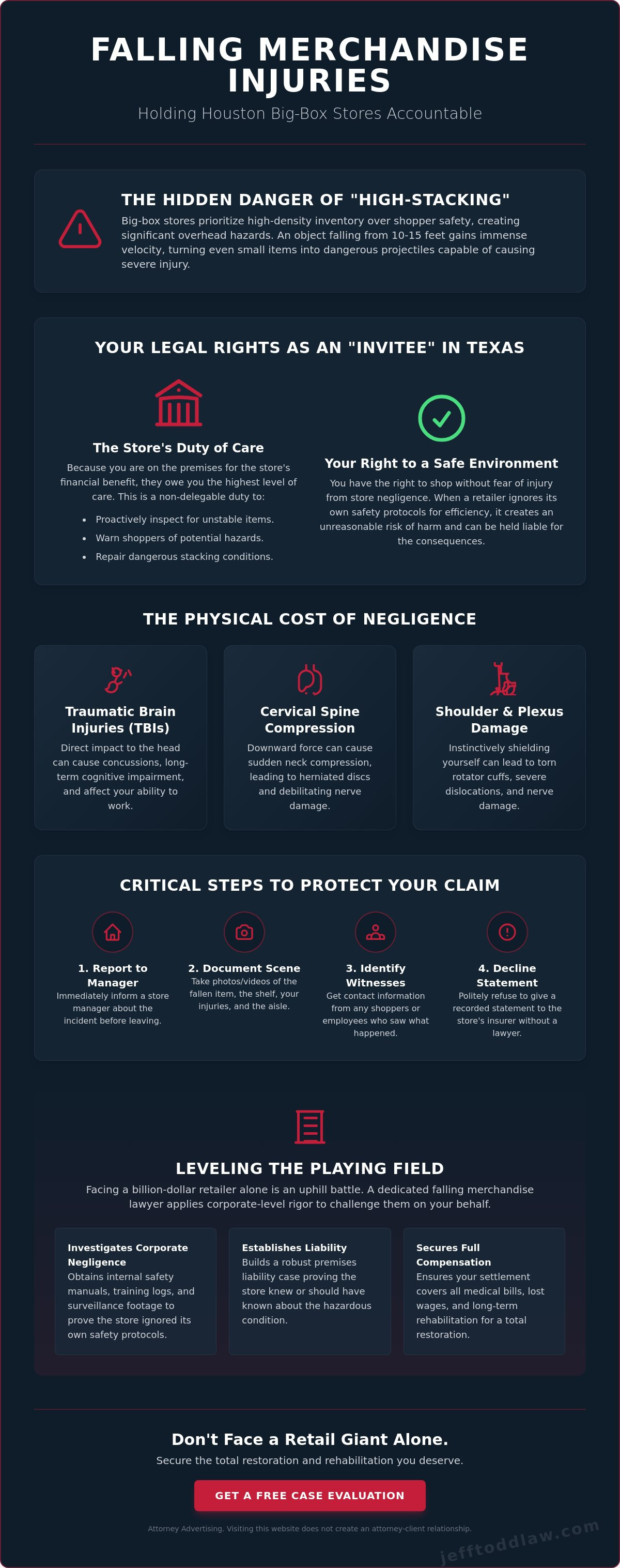
- Traumatic Brain Injuries (TBIs): Direct impact to the head can cause concussions or long-term cognitive impairment that affects your ability to work.
- Cervical Spine Compression: The downward force often leads to sudden neck compression, resulting in herniated discs or debilitating nerve damage.
- Shoulder and Brachial Plexus Damage: Many shoppers instinctively reach out to shield themselves, which often leads to torn rotator cuffs or severe dislocations.
An experienced falling merchandise lawyer Houston understands that these injuries aren't just physical; they're financial and emotional burdens that require a comprehensive legal strategy for total restoration.
Texas Premises Liability: Understanding Your Rights as an Invitee
When you enter a store in Houston, the law classifies you as an invitee. This specific legal designation means the retailer owes you the highest level of care possible under Texas premises liability law. Unlike a social guest or a trespasser, you're there for the store's financial benefit. In exchange, the store has a non-delegable duty to maintain a safe environment. This includes a proactive obligation to inspect shelves for unstable items, warn you of potential overhead hazards, and repair any dangerous stacking conditions immediately. If a store fails to perform these basic safety checks, they've breached their duty to you.
Proving a breach of this duty often requires a falling merchandise lawyer Houston to examine the store's internal safety manuals. These documents outline exactly how employees should secure inventory and how often they must perform floor sweeps. When a retailer ignores its own protocols to save time or labor costs, it creates an unreasonable risk of harm. A shelf stack is legally dangerous if it's top-heavy, lacks proper fencing, or contains items that are too large for the shelving unit's depth. These aren't just accidents; they're the result of systemic safety failures.
The Three Pillars of a Successful Houston Injury Claim
A successful claim rests on three specific legal foundations. First, a condition on the premises must have posed an unreasonable risk of harm. Second, the owner must have had actual or constructive knowledge of that risk. The April 2026 Texas Supreme Court ruling in H-E-B, L.P. v. Marissa Peterson reinforces that you must provide evidence showing how long the hazard existed before the incident occurred. Finally, you must prove the store failed to exercise reasonable care to reduce or eliminate the danger. Meeting these high evidentiary bars requires a meticulous approach to data and documentation.
Challenging the "Open and Obvious" Defence
Retailers often attempt to avoid liability by claiming a hazard was open and obvious. They argue that a shopper should have noticed a leaning pallet or a loose box and avoided the area. However, this defense rarely holds weight in falling merchandise cases. Retailers spend millions of dollars on marketing displays specifically designed to draw your eyes to eye-level products. It's unreasonable to expect a customer to scan high-altitude shelving for danger while navigating a crowded aisle. If a store tries to shift the blame onto you, you should consult with a legal professional who understands how to counter these corporate tactics and prioritize your total restoration.
Why "High-Stacking" Practices Put Houston Shoppers at Risk
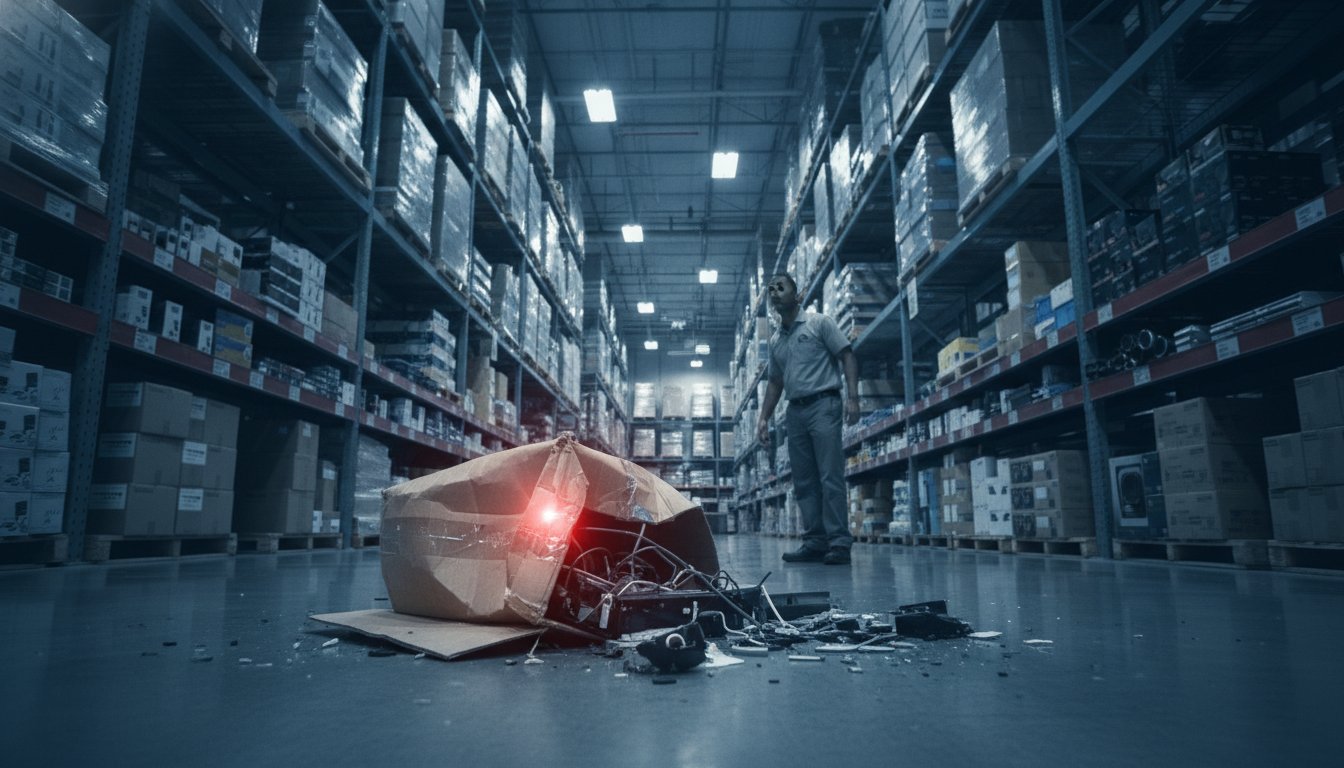
The Warehouse Club model has normalized the practice of storing heavy industrial pallets directly above active shopping aisles. This "high-stacking" creates a vertical hazard that most shoppers don't consider until it's too late. While it's efficient for the store's bottom line, it places an immense burden of risk on you. Items often become unstable over time due to subtle vibrations from nearby forklifts or heavy floor traffic. Without proper shelf fencing or industrial-strength shrink-wrapping, these items are essentially waiting to fall. If you've been injured, a falling merchandise lawyer Houston can help you uncover the specific stacking failures that led to your accident.
Retailers often use "top-down" stocking during business hours, which significantly increases the risk of an incident while you're simply trying to buy groceries. This method involves moving heavy inventory on high shelves while customers are in the immediate vicinity. When a store prioritizes restocking speed over creating a "buffer zone" for shoppers, they're choosing corporate efficiency over your physical safety. These practices aren't just minor oversights; they're calculated risks that often lead to life-altering injuries.
The Danger of Unsecured Pallets and Overloaded Racks
Forklift operators often work in adjacent aisles, and the jarring impact of a pallet being set down can travel through the racking system. This can loosen merchandise on the other side of the shelf, causing it to teeter on the edge. Many retailers fail to install pallet stops or safety netting, which are standard safety features in industrial settings but often omitted in retail spaces to save on overhead costs. In our local climate, the persistent Houston humidity can weaken cardboard packaging over time, causing a stack's structural integrity to fail and leading to a sudden, silent collapse of heavy merchandise onto shoppers below.
Failure to Follow OSHA or Internal Safety Protocols
Retailers usually have strict internal safety audits and "zone check" requirements designed to catch unstable items. However, in the rush of high-volume shopping days, these checks are often skipped or the logs are falsified to maintain a facade of compliance. As of January 2026, the maximum OSHA penalty for a serious violation, such as unsafe stacking, is $16,550. For willful or repeated violations, that penalty jumps to $165,514. A Houston personal injury lawyer can subpoena surveillance footage and safety logs to see if those zone checks actually occurred. If you've been hurt, a falling merchandise lawyer Houston will dig into these corporate records to prove that the store knew its stacking practices were dangerous but chose profit over your safety.
The sudden impact of an overhead object leaves you in a state of physical and emotional shock. In these critical moments, your priority must be your health and the preservation of your legal rights. If you've been struck, you should follow a specific protocol to ensure your total restoration is possible. A falling merchandise lawyer Houston can help you manage the logistical burden of a claim, but the initial actions you take at the scene are foundational to your success.
- Seek immediate medical evaluation. Even if you feel okay, head impacts can result in delayed-onset traumatic brain injuries. Professional documentation of your condition immediately after the event is vital for your recovery.
- Document the scene visually. Take photos of the specific item that fell, the high-stacking shelf it originated from, and the absence of safety barriers or shrink-wrap.
- Identify independent witnesses. Collect names and phone numbers from fellow shoppers who saw the incident. Don't rely on store employees to provide unbiased accounts later.
- Report the event to management. State the facts clearly but avoid discussing fault or the severity of your injuries until you've seen a doctor.
- Consult a specialist. Contact a falling merchandise lawyer Houston before providing a recorded statement to the store’s insurance adjusters.
The Pitfalls of the Store Incident Report
The incident report is not a neutral document. It's a defensive tool used by corporate legal teams to minimize liability. You should never admit fault or sign a statement claiming you're uninjured, as the adrenaline of the moment often masks pain that becomes debilitating hours later. Always request a physical or digital copy of the report before leaving the premises. These initial, shock-induced statements are frequently used to challenge the credibility of your injuries during settlement negotiations. If you're feeling the weight of mounting medical bills and corporate pressure, you can contact our team to begin the process of holding the negligent retailer accountable.
Preserving Physical and Digital Evidence
Evidence in retail environments is notoriously fragile. Security footage is often overwritten within days, making it essential to send a spoliation letter immediately. This legal notice requires the retailer to preserve all relevant video and digital records. You should also document the "point of origin" on the shelf to prove the item was precariously placed. While less common in falling object cases than in slip-and-fall claims, keeping the clothing you wore can occasionally help refute claims of comparative negligence. Proving the store had constructive knowledge of the hazard requires securing this evidence before it's "lost" by the corporation.
How a Houston Falling Merchandise Lawyer Levels the Playing Field
Fighting a billion-dollar retailer requires more than just a basic understanding of the law. These corporations employ sophisticated legal teams specifically trained to protect their profit margins by devaluing your suffering. When you're facing a giant, you need a battle-tested partner who understands their internal tactics. A specialized falling merchandise lawyer Houston provides the intellectual rigor necessary to challenge these entities. We don't just see a case number; we see a neighbor whose life has been disrupted by avoidable corporate negligence.
Calculating the full value of your claim is a complex process that goes far beyond your immediate emergency room bills. It involves a meticulous analysis of your future medical needs, lost earning capacity, and the long-term impact on your quality of life. Retailers will often offer a quick, low-ball settlement in hopes that you'll go away before the true extent of your injuries is known. Our approach ensures that every variable is accounted for so that your recovery is fully funded. We operate on a contingency basis, so you can check with our team regarding how we only receive payment if we successfully secure a recovery for you.
Holistic Healing vs. Financial Transactions
We view legal representation as a path toward total restoration. An injury from a falling object isn't just a physical event; it's a violation of the safety you should feel in a public space. This psychological impact can be just as debilitating as the physical pain in your head or back. Jeff Todd’s extensive case experience across major metropolitan hubs allows him to serve as a stable partner throughout this legal progression. The Todd Law Group, PLLC prioritizes your healing by managing every technical detail, allowing you to focus entirely on your physical and emotional recovery.
The Litigation Advantage in Harris County Courts
Our firm is deeply comfortable in formal proceedings and efficient in the internal discovery processes that reveal retail negligence. We leverage a network of expert witnesses, including retail safety specialists and mechanical engineers, to prove exactly how a shelf failed or why a stacking method was inherently dangerous. This high-impact expertise is vital in Harris County courts, where local juries expect clear, technical proof of liability. If you're ready to hold a negligent store accountable for their stacking practices, schedule your free consultation with The Todd Law Group, PLLC today.
Secure Your Total Restoration After a Retail Injury
You now understand how corporate stacking shortcuts transform shopping aisles into danger zones. By prioritizing immediate medical care and securing physical evidence, you've already taken the first steps toward holding negligent retailers accountable. Your status as an invitee grants you powerful rights under Texas law, but exercising those rights requires a sophisticated strategy that looks beyond immediate costs. Each piece of evidence, from surveillance footage to safety logs, builds the foundation for your recovery.
Navigating this path alone is daunting when facing a billion-dollar corporation's legal team. Partnering with a dedicated falling merchandise lawyer Houston ensures your claim accounts for long-term rehabilitation and lost earning capacity. Attorney Jeff Todd has been licensed in Texas since 1994, bringing corporate-level intellectual rigor to personal advocacy. The Todd Law Group, PLLC focuses on your total physical and financial restoration through a contingency-based model; you won't owe any fees unless we successfully recover compensation for you.
Get a Free Case Evaluation from The Todd Law Group, PLLC today. We're ready to serve as your stable partner throughout this legal progression and help you reclaim your peace of mind.
Frequently Asked Questions
Can I sue a store if I accidentally caused the item to fall?
You may still have a valid legal claim even if you touched the item before it fell. Texas follows a modified comparative negligence rule, which means you can recover compensation as long as you are not more than 50% responsible for the incident. Retailers have a duty to stack items so they don't collapse from minor, expected customer contact.
What is the average settlement for a falling merchandise case in Houston?
Settlement amounts are determined by the specific severity of your injuries and the total impact on your quality of life. A case involving a traumatic brain injury or permanent spinal damage will naturally result in a higher valuation than a minor soft tissue injury. A falling merchandise lawyer Houston will calculate your lost wages and future medical needs to ensure your demand covers your total restoration.
How long do I have to file a claim after being hit by a falling object in Texas?
You generally have two years from the date of the injury to file a lawsuit in a Texas civil court. This deadline is set by the Texas Civil Practice and Remedies Code § 16.003. If you fail to take legal action within this two-year window, you will likely be barred from seeking any financial recovery for your medical bills or pain and suffering.
Do I still have a case if there were no witnesses to the accident?
You can still build a successful case without independent eyewitnesses. Physical evidence at the scene, such as the position of the fallen item and the condition of the shelving, often tells a clear story of negligence. Additionally, store surveillance footage and your immediate medical records serve as powerful evidence to corroborate your account of how the injury occurred.
What if the item fell because another customer was reaching for something?
The store is often still liable if their stocking methods allowed one customer's actions to create a hazard for others. Retailers must use safety equipment like shelf fencing or pallet netting to prevent a "domino effect" when items are moved. If the store's failure to secure the shelf contributed to the item falling, they can be held responsible for the resulting harm.
Is the store liable if a "Warning" sign was posted nearby?
A simple warning sign does not automatically protect a retailer from a premises liability claim. While stores must warn of known dangers, a sign is often insufficient if the store had the opportunity to fix the dangerous stacking condition entirely. Texas courts evaluate whether the warning was prominent enough and if the store fulfilled its primary duty to maintain a safe environment.
What kind of evidence is most important in a falling merchandise lawsuit?
Internal store records, including safety inspection logs and "sweep" sheets, are vital for proving the store knew about a hazard. Security camera footage is equally critical because it provides an objective timeline of the incident. A falling merchandise lawyer Houston will also look for evidence of previous similar accidents at that specific location to demonstrate a pattern of safety failures.
How much does it cost to hire a Houston falling merchandise lawyer?
Most personal injury attorneys operate on a contingency fee basis, meaning there are no out-of-pocket costs to begin your case. The legal fees are only paid as a percentage of the final settlement or jury award we secure for you. This structure ensures that every injured person has access to high-caliber legal representation regardless of their current financial situation.


