
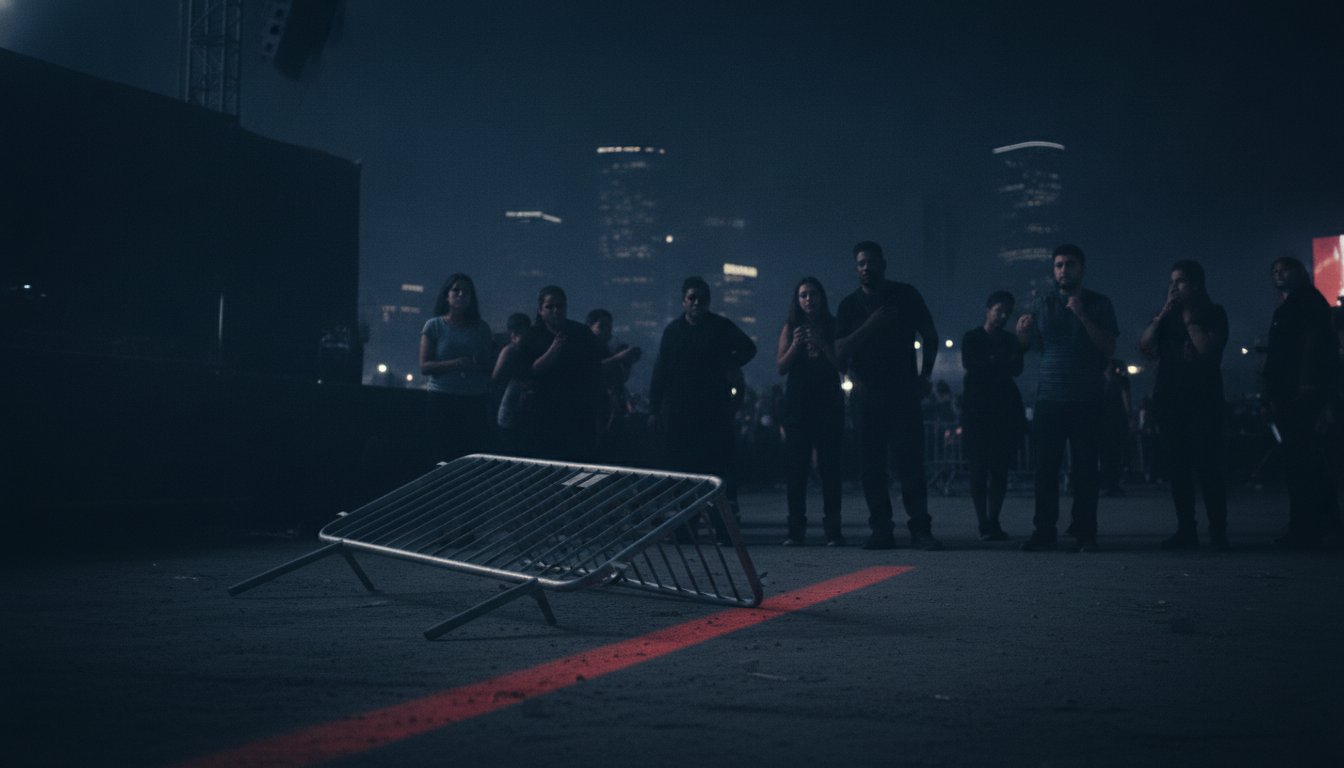
When a night at a Houston or Austin venue ends in an ambulance ride, is it really just a "freak accident," or is it the result of a billion-dollar promoter cutting corners on your safety? You went for the music, but you left with mounting medical bills and a profound sense of betrayal. It's natural to feel overwhelmed when facing off against massive corporations, especially while you're still trying to heal. If you've been hurt, filing a concert venue injury claim Texas is about more than just a financial transaction; it's a vital step toward your total restoration and holding negligent parties accountable.
We understand the weight of your situation and the confusion that follows a traumatic event. This guide will clarify how to navigate the complexities of Texas premises liability law to secure the compensation you deserve. You'll learn about the strict evidentiary standards recently reinforced by the Texas Supreme Court, the two-year statute of limitations for filing your claim, and how to prove that a venue owner had constructive notice of the hazard. We're here to help you move from being another case number to finding a steady partner in your legal journey.
Key Takeaways
- Identify your legal standing as an "invitee" and understand the high duty of care Texas entertainment venues must provide for your safety.
- Recognize how to build a concert venue injury claim Texas by documenting safety failures like overcrowding or negligent security.
- Master the "Four Pillars" of negligence required to hold billion-dollar promoters accountable for their oversight and hazards.
- Protect your right to recovery by adhering to the strict two-year statute of limitations and specific regional filing requirements.
- Learn how elite legal advocacy focuses on your total restoration, moving beyond simple financial transactions to true justice.
Understanding Concert Venue Liability and Your Rights in Texas
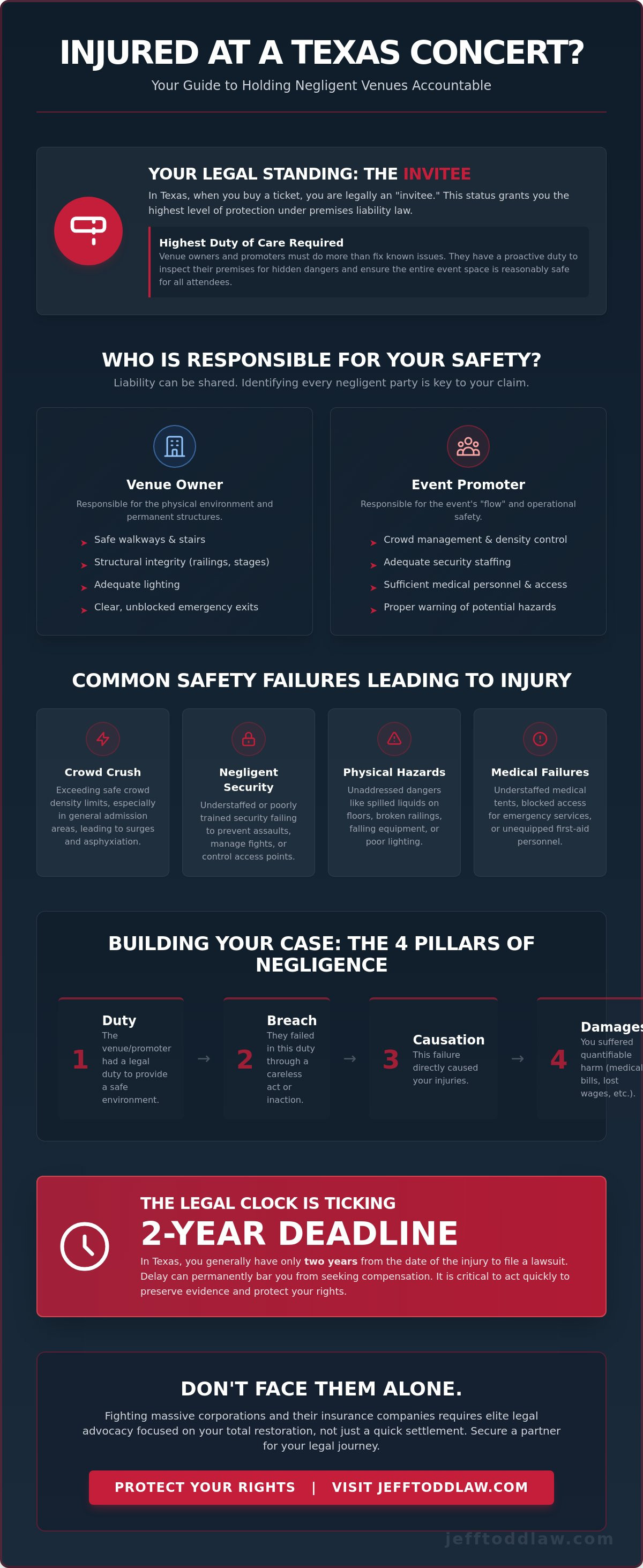
Texas law treats you with a high level of respect when you purchase a ticket to a show. You aren't just a guest; you're legally classified as an "invitee." This status is critical because it places the highest possible duty of care on the property owner. They don't just have to fix known problems. They're required to inspect the premises and ensure they're reasonably safe for everyone attending. When you pursue a Premises Liability in Texas case, your recovery depends on showing the venue failed this fundamental test of safety.
It's a common fear that the fine print on the back of a ticket bars you from seeking justice. Big promoters often use broad waivers to suggest you've assumed all risks by entering the gates. However, these waivers aren't a "get out of jail free" card. Texas courts often find these clauses unenforceable if they're hidden in tiny text or if the venue's actions constitute gross negligence. If a promoter's choices directly led to your harm, a concert venue injury claim Texas is still a viable path to restoration.
The law also distinguishes between the venue owner and the event promoter. In many cases, the entity that owns the stadium or club isn't the same group managing the crowd. Liability can be shared. A venue owner is responsible for the physical structure, like broken railings or dark stairwells. The promoter, however, is often responsible for the "flow" of the event, including security staffing and crowd density. We look at the entire ecosystem of the event to identify every party that failed you.
The Duty of Care at Texas Music Festivals
Festivals present unique challenges because they rely heavily on temporary infrastructure. Proving negligence requires showing the venue knew, or should have known, about a dangerous condition. This includes inspecting temporary stages for structural integrity or ensuring that outdoor grounds aren't prone to dangerous mud pits or tripping hazards. Safety isn't optional just because the event is temporary. Promoters must provide adequate warnings and mitigate hazards before the first fan enters the grounds.
When a "Fun Night Out" Becomes a Legal Matter
There's a line between the inherent risks of a concert, like a loud environment, and actionable negligence, like a crowd crush. The 2021 Astroworld tragedy in Houston, which resulted in 10 deaths and hundreds of injuries, fundamentally changed how Texas views crowd control. It highlighted that massive promoters can't ignore signs of distress. If you've been injured, immediate action is vital. Evidence at concert sites disappears quickly as stages are torn down and crowds disperse. Securing a concert venue injury claim Texas requires moving fast to preserve the proof of what really happened.
Common Safety Failures Leading to Texas Concert Injuries
While fans focus on the performer, the venue must focus on the floor, the ceiling, and the exits. A spilled drink left for twenty minutes on a slick concrete floor or a loose lighting rig isn't just an unfortunate mistake; it's a breach of duty. These physical hazards often form the foundation of a concert venue injury claim Texas. Beyond the immediate environment, failures in medical readiness can turn a treatable incident into a life-altering tragedy. If emergency exits are blocked by equipment or medical staff are under-staffed and under-equipped, the venue has failed its most basic obligation to your safety and total restoration.
Crowd Management and "Crush" Negligence
Crowd density isn't a matter of opinion; it's a matter of physics and careful planning. Venue operators have a legal duty to monitor how many people occupy a specific square footage to prevent dangerous surges. When density exceeds safe limits, "crowd crush" occurs, leading to traumatic asphyxiation, internal bleeding, or broken bones. Following OSHA Crowd Management Guidelines is considered a standard industry practice for professional promoters, yet some choose to ignore these safety benchmarks to maximize ticket revenue. This negligence is especially prevalent in "festival seating" or general admission pits where there are no assigned seats to act as natural buffers. If you were caught in a crowd surge, you may need a legal advocate who understands these logistics to prove that the promoter's greed outweighed their safety protocols.
Negligent Security and Attendee Safety
Security is more than just a visible presence at the gates. It's a proactive strategy to prevent foreseeable harm from third parties. In Texas, if a venue has a history of incidents or is hosting an event where tensions are known to run high, they must provide security that is proportional to the risk. This includes rigorous screening for weapons and the active management of intoxicated patrons who may become aggressive. When a private security firm fails to intervene in a physical assault or uses excessive force against a guest, they can be held liable for the resulting trauma. Proving that a criminal act was foreseeable requires a meticulous investigation into the venue's past incident reports and the specific staffing plan used for your event. This level of detail is essential for a successful concert venue injury claim Texas.
Proving Negligence: Building a Strong Texas Venue Injury Case
Winning a legal battle against a major entertainment entity requires more than just showing you were hurt. It requires a meticulous assembly of the "Four Pillars" of negligence: Duty, Breach, Causation, and Damages. In the context of a concert venue injury claim Texas, this means proving the venue had a legal obligation to protect you, they failed that obligation, that failure directly caused your injury, and you suffered real losses as a result. We don't just look at medical bills; we look at your total restoration, including the psychological impact of a traumatic event.
A central challenge in these cases is establishing "Actual or Constructive Knowledge." Under the Texas Civil Practice and Remedies Code, a plaintiff must show the property owner knew of the danger or should have discovered it through reasonable inspection. This is where "foreseeability" becomes the deciding factor. If a promoter has a history of overcrowding at specific venues or if similar incidents occurred earlier in the night, the law argues they should have foreseen the risk. We bridge this gap by employing experts in crowd dynamics who can testify about how density and flow should have been managed to prevent your injury.
Evidence Preservation in the Digital Age
The chaos of a concert makes immediate evidence gathering difficult, but the digital footprint left behind is often undeniable. Cell phone footage from other attendees acts as a "black box" for the event, capturing the exact moment a barrier failed or a crowd surge began. We work to secure social media posts, internal venue surveillance, and security incident reports before they're deleted or overwritten. Your digital ticket receipts and event app data are also vital. They establish a precise timeline of your movements and the venue's communications during the crisis.
Identifying All Liable Parties
It's a mistake to assume only the name on the ticket is responsible. Liability in Texas is often distributed among several entities. You might be suing a global promoter like Live Nation alongside a local municipal property owner and a third-party security firm. Even vendors providing food or equipment can be held liable if their setup created a tripping hazard or blocked an exit. Understanding how premises liability law distributes fault is essential. Texas uses a proportionate responsibility system, meaning we must identify every party that contributed to the danger to maximize your recovery and ensure true accountability.
The Legal Process and Texas Statute of Limitations
Time is a silent but decisive factor in the success of your case. Under the Texas Civil Practice and Remedies Code § 16.003, you generally have exactly two years from the date of the incident to file a concert venue injury claim Texas. If you miss this deadline, the court will likely bar you from seeking any compensation, regardless of how clear the venue's negligence was. While two years might seem like a generous window, the reality of premises liability is that evidence degrades quickly. Security footage is overwritten; witnesses move away; and temporary structures are dismantled. Starting the process early ensures your legal team can freeze the evidence before it vanishes.
The path to recovery involves a rigorous discovery process. This is the phase where we demand internal communications from promoters and take sworn depositions from venue staff. It's a period of intense scrutiny that requires a stable partner to manage the heavy lifting. You should be wary of insurance adjusters who reach out shortly after the event with a quick settlement offer. These early offers are almost always designed to save the insurance company money by paying out far less than your total restoration requires. Accepting an early check usually means signing away your right to sue for future medical complications that haven't surfaced yet.
Steps to Take Immediately Following a Concert Injury
Your actions in the minutes and hours following an injury create the foundation for your claim. Even if you feel your injuries are minor, seek immediate medical attention. This creates an objective, third-party paper trail that links your physical trauma directly to the event. Before leaving the site, report the incident to venue management and request a copy of their internal report. If the environment is chaotic, take your own photos of the hazard. Once you're safe, contact a legal professional to begin the work of protecting your future.
Consulting an experienced houston personal injury lawyer is a vital step in navigating the specific jurisdictional rules of Harris, Travis, or Galveston counties. Filing in the correct court is not just a formality; it dictates the procedural rules that will govern your entire case.
Understanding Comparative Fault in Texas
Texas follows a "modified comparative negligence" rule, often called the 51% bar rule. This means you can still recover damages even if you were partially responsible for the accident, provided your share of the fault is 50% or less. However, if a jury finds you were 51% or more at fault, you're barred from receiving any compensation. Defense lawyers for billion-dollar promoters often try to shift the blame onto the victim, claiming they were intoxicated or ignoring posted warnings. We anticipate these tactics and build a proactive defense to ensure the focus remains on the venue's systemic safety failures rather than your individual actions.
How The Todd Law Group Fights for Concert Injury Victims
Facing off against a global entertainment conglomerate requires more than just a basic understanding of personal injury law. It requires a legal partner who has operated within the same elite corporate environments as the defendants. At The Todd Law Group, we leverage a sophisticated background in high-stakes litigation to level the playing field for individuals. We understand that a concert venue injury claim Texas is often a battle of resources. By applying the intellectual rigor of a corporate legal career to personal advocacy, we ensure that our clients aren't intimidated by the legal teams representing billion-dollar promoters.
Our firm operates on a "No Fee Unless We Win" contingency model. This structure removes the financial barrier to high-quality legal representation, allowing you to focus entirely on your physical recovery while we handle the logistical complexities of your case. We view our role as more than just legal counsel; we are stable partners in a journey toward what we call "Total Restoration." This philosophy recognizes that your injury impacted your life holistically, affecting your finances, your physical health, and your emotional well-being. Whether you are in Houston, Austin, or Galveston, our team provides personalized support that treats you as a person, not a case number.
A Battle-Tested Approach to Premises Liability
Founding attorney Jeff Todd brings over 30 years of Texas legal experience to every case. This deep-rooted regional history is vital when navigating the specific court systems of the Gulf Coast and Central Texas. We've developed a battle-tested approach to premises liability that anticipates the defensive maneuvers used by major corporations to delay or deny justice. We provide a steady, reassuring presence through the entire legal progression, moving quickly from evidence preservation to aggressive representation in formal proceedings. Our experience allows us to handle complex litigation with both speed and meticulous attention to detail.
Securing Your Maximum Recovery
Securing a fair settlement requires a comprehensive calculation of how the injury has altered your future. We look beyond immediate medical bills to account for lost wages, reduced earning capacity, and the costs of long-term rehabilitation. Beyond these economic damages, we aggressively pursue compensation for non-economic losses such as pain and suffering, emotional distress, and the loss of enjoyment of life. We believe that true accountability only happens when the responsible parties are held liable for the full scope of the harm they caused. If you're ready to take the first step toward justice, Contact The Todd Law Group today for a free consultation.
Take the First Step Toward Your Total Restoration
Your journey from a traumatic event to total restoration begins with a single decision to seek accountability. We've explored how your status as an invitee grants you significant legal protections and why the two-year statute of limitations makes early action essential. Successfully navigating a concert venue injury claim Texas requires a partner who understands the sophisticated tactics used by major entertainment corporations. You deserve an advocate who treats your recovery as a holistic process rather than just a financial settlement.
Attorney Jeff Todd has been licensed in Texas since 1994, bringing over three decades of battle-tested experience to every case. With offices in Houston, Austin, and Galveston, we're deeply rooted in the communities we serve. Our firm operates on a contingency basis, meaning there's no fee unless we win your case. You've already endured the physical and emotional weight of an injury; let us handle the legal burden of holding negligent parties responsible. Schedule a Free Consultation with The Todd Law Group today to protect your rights. You don't have to walk this path alone, and we're ready to stand by your side until justice is served.
Frequently Asked Questions
Can I sue for a concert injury if I signed a waiver on my ticket?
Yes, you can often still sue because ticket waivers are not absolute bars to recovery in Texas. Courts frequently find these broad liability releases unenforceable if they are inconspicuous or if the venue's conduct involves gross negligence. If the promoter failed to meet basic safety standards, the fine print on your ticket likely won't prevent you from seeking justice for your injuries.
What is the statute of limitations for a concert injury claim in Texas?
The statute of limitations for a personal injury claim in Texas is generally two years from the date the injury occurred. This deadline is strictly enforced under the Texas Civil Practice and Remedies Code. If your claim involves a government-owned venue or municipality, you might have a much shorter window, sometimes as little as 90 days, to provide formal notice of the incident.
Who is responsible if I was trampled in a crowd crush at a Texas festival?
Responsibility for a crowd crush usually falls on a combination of the event promoter, the venue owner, and the private security firms hired to manage the gates. These parties have a legal duty to monitor crowd density and maintain safe flow. If they ignored signs of overcrowding or failed to provide adequate barriers, they can be held liable in a concert venue injury claim Texas.
Can I still recover damages if I was partially at fault for my injury?
You can recover damages as long as you are found to be 50% or less at fault for the incident. Texas follows a modified comparative negligence rule, which reduces your final compensation by your specific percentage of responsibility. However, if a jury determines you were 51% or more responsible for the accident, the law prevents you from receiving any financial recovery at all.
What kind of compensation can I get for a concert venue injury?
You may seek compensation for both economic and non-economic damages resulting from the venue's negligence. This includes reimbursement for hospital bills, lost wages, and the cost of future medical treatment. You can also pursue damages for pain and suffering, emotional distress, and the loss of enjoyment of life as part of your total restoration and healing process.
How much does it cost to hire a concert injury lawyer in Houston?
Most reputable personal injury firms in Texas work on a contingency fee basis, meaning there are no upfront costs for the client. You won't pay hourly fees or retainers while your case is active. The legal team only receives a percentage of the final settlement or court award, which allows you to access high-caliber advocacy regardless of your current financial situation.
What if my injury was caused by another concertgoer rather than the venue?
The venue can still be held responsible if they failed to provide adequate security to prevent foreseeable third-party violence. If the venue had a history of similar incidents or failed to manage intoxicated patrons, their negligence created the dangerous environment. Proving a concert venue injury claim Texas in these cases requires showing that the security plan was insufficient for the event's specific risk level.
How long does a concert injury lawsuit typically take in Texas?
A concert injury lawsuit can take anywhere from several months to over a year to reach a final resolution. The timeline depends on the complexity of the evidence, the number of liable parties involved, and whether the case settles during negotiations or proceeds to a full trial. Litigation against major national promoters often involves extensive discovery, which can extend the duration of the legal process.


