
Did you know that over one million people are treated in emergency departments for stair-related injuries every year? In a city as busy as Houston, a broken step or a loose railing isn't just a minor trip hazard; it is a structural failure that often violates specific safety codes. It's exhausting to manage physical pain and mounting medical bills while an aggressive insurance adjuster tries to blame you for being clumsy. You deserve a partner who understands that your recovery involves both physical healing and legal justice.
By working with a broken stair injury lawyer Houston, you can shift the stress of the legal process onto a professional who knows how to navigate premises liability claims. This guide will show you how to hold negligent landlords or business owners accountable to secure the maximum compensation you need for a full recovery. We will cover the critical evidence you need to preserve, how the Texas 51% bar rule affects your case, and the specific building codes that property owners must follow to keep you safe.
Key Takeaways
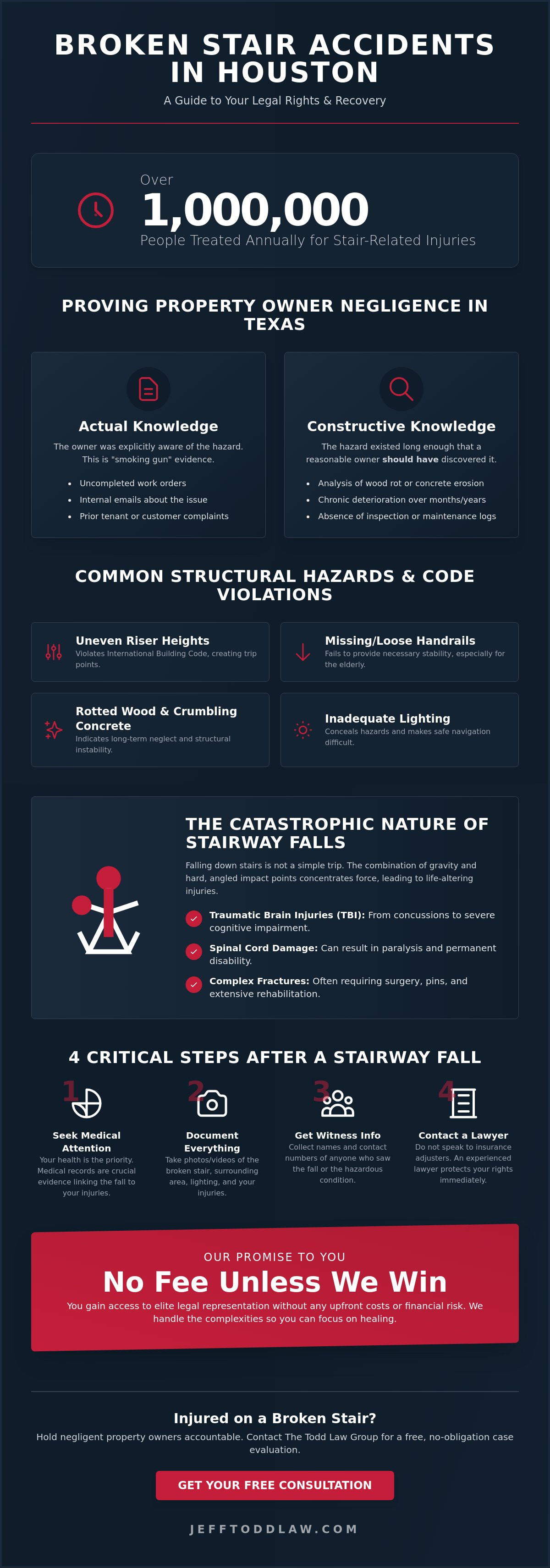
- Learn the legal distinction between actual and constructive knowledge required to hold a Houston property owner liable.
- Identify common structural failures like uneven riser heights and missing handrails that violate local safety codes.
- Understand the vital steps for preserving evidence, including documenting lighting conditions and securing witness statements.
- Discover how a broken stair injury lawyer Houston from The Todd Law Group, PLLC manages the complexities of your recovery.
- See how our "No Fee Unless We Win" guarantee ensures you can access elite legal representation without financial risk.
Understanding Broken Stairway Liability in Houston
In Texas, a stairway accident isn't just a simple slip; it represents a failure of the safety systems that protect the public. When you seek the help of a broken stair injury lawyer Houston, you're looking to hold a property owner accountable for a specific breach of duty. Under the legal theory of Premises liability, owners must maintain their stairs in a reasonably safe condition. This includes conducting regular inspections to identify structural defects like rotted wood, rusted iron railings, or crumbling concrete. Unlike a temporary hazard, such as a spilled drink in a grocery store aisle, a broken stair often points to a chronic lack of maintenance that has existed for weeks or months. Houston property owners must adhere to the International Building Code, which sets strict requirements for riser height and tread depth to prevent dangerous stumble points.
The Severity of Stairway Fall Injuries
Falling on a flat surface is dangerous, but falling on stairs is often catastrophic. Gravity accelerates your body as you tumble, and the hard edges of the steps act as impact points that concentrate force. This physical reality results in severe injuries like traumatic brain injuries (TBI), complex fractures, and spinal cord damage. Even a fall that seems minor at first can cause long-term neurological impacts or chronic pain. Because these injuries are so significant, you must seek medical attention immediately. These medical records serve as the foundation for your legal claim, proving the direct link between the broken stair and your physical condition.
Who Is Responsible for a Broken Stair?
Determining liability depends on who controlled the premises at the time of the accident. In a commercial setting, like a Houston shopping center, the business owner or a third-party property management company may be responsible for the maintenance failure. In residential cases, a landlord is typically liable if they knew about the broken step but failed to repair it. If your injury occurred on government-owned property, such as a public transit station or a municipal building, the rules change significantly. Claims against government entities often require a formal notice within 90 days. This makes it vital to contact a broken stair injury lawyer Houston as soon as possible. Whether it's a private business or a large apartment complex, identifying every negligent party is the first step toward your total restoration.
Proving Negligence: The Legal Hurdles in Texas
Securing compensation after a fall requires more than just showing a photo of a cracked step. Texas law places a high burden of proof on the injured party, making the role of a broken stair injury lawyer Houston essential for navigating these complexities. To win a premises liability case, you must demonstrate that the property owner had "actual" or "constructive" knowledge of the dangerous condition. This means they either knew the stair was broken or, through reasonable inspection, should have discovered the defect. Property owners often claim they were unaware of the hazard, but we dig deeper into maintenance logs, employee emails, and prior tenant complaints to build a factual timeline of neglect.
Actual vs. Constructive Knowledge
Actual knowledge is often proven through "smoking gun" evidence, such as a work order that was never completed or an internal email discussing a loose handrail. Constructive knowledge is more subtle; it relies on proving the defect existed for such a length of time that a careful owner would have found it. We often utilize expert testimony from structural engineers to analyze wood rot or concrete erosion. These experts can determine if a stair has been deteriorating for months, effectively dismantling the owner's "I didn't know" defense. Adherence to OSHA stairway safety standards serves as a vital benchmark during these investigations, as these regulations help define what constitutes a safe and well-maintained environment.
The Role of Victim Status: Invitee vs. Licensee
Your legal standing on the property significantly impacts the owner's duty of care. Most stairway accidents involve "Invitees," such as retail shoppers or apartment tenants, to whom the owner owes the highest level of protection. This includes a duty to inspect the premises and repair known dangers. "Licensees," or social guests, are protected against known traps but have a different path to recovery. Understanding how premises liability law categorizes your visit is the first step in determining the strength of your claim. If you aren't sure which category you fall into, consulting a dedicated legal partner can provide the clarity you need to move forward.
Texas operates under a modified comparative fault rule, which insurance companies frequently use to devalue claims. If an adjuster can convince a jury that you were 51% or more at fault for your own fall, you are barred from recovering any damages. They might point to your footwear or claim you were distracted by a phone to shift the blame. A skilled broken stair injury lawyer Houston anticipates these tactics, gathering digital evidence and witness statements to prove that the structural failure, not your behavior, was the primary cause of the accident. We focus on the facts to ensure your recovery is not unfairly reduced by aggressive defense strategies.
Common Structural Hazards and Code Violations
A stairway might look safe at a glance, but even a few millimeters of deviation can cause a catastrophic fall. According to National Safety Council statistics on falls, these incidents remain a leading cause of preventable injury and death across the country. In Houston, property owners often overlook structural maintenance, allowing stairs to become "stumble points" where the brain expects one height but the foot encounters another. When these defects lead to a hospital stay, a broken stair injury lawyer Houston looks for specific code violations that prove the property was legally unsafe. We don't just look at the broken wood; we examine the lighting levels and the security of the handrails to see if the entire safety system failed you.
Houston Building Code Standards for Stairs
Texas typically adopts the International Residential Code (IRC) and International Building Code (IBC) to ensure public safety. One of the most critical regulations is the "3/8-inch rule." This standard dictates that the difference between the tallest riser and the shortest riser in a flight of stairs cannot exceed 3/8 of an inch. If one step is 7 inches high and the next is 7.5 inches, it's an illegal hazard. Handrails are equally vital; they must be between 34 and 38 inches high and have a grip size that allows for a firm hold during a slip. We work with forensic engineers to measure these dimensions with precision, ensuring that a landlord's negligence is documented with hard data. Poorly lit stairwells also violate these codes, as they mask structural defects that would otherwise be visible to an alert pedestrian.
Environmental Factors in Houston
Our local climate plays a massive role in stairway safety. Houston's extreme humidity and heat accelerate the decay of outdoor wooden stairs, especially in older apartment complexes throughout the metro area. When wood rots, the structural integrity of the tread vanishes, causing it to collapse under a person's weight. Rain also turns metal and concrete stairs into ice-like surfaces if they lack proper non-slip materials. Property owners have a duty to anticipate these conditions. They must use grip tape, textured coatings, or abrasive finishes in high-traffic areas to prevent predictable accidents. If they ignore the signs of crumbling concrete or failing wood, they're choosing profit over tenant safety. A broken stair injury lawyer Houston can help you prove that the owner's failure to adapt to our environment was a direct cause of your injuries.
What to Do After a Stairway Fall in Houston
The moments following a fall are often a blur of pain and confusion. However, the actions you take in the first hour can determine the success of your future claim. While your health is the priority, preserving the scene is vital because property owners often rush to "fix" a broken stair once they realize a legal claim is possible. Engaging a broken stair injury lawyer Houston early ensures that evidence is professionally gathered before it disappears. You must focus on creating a factual record that links the property defect directly to your physical injuries.
- Photograph the defect: Take clear pictures from multiple angles. Close-ups show the break, while wide shots show the lack of warnings.
- Collect witness data: Neighbors or bystanders may have seen the fall or complained about the step previously. Their testimony can prove the owner knew about the hazard.
- Report the incident: Notify the manager or owner in writing. Stick to the facts of where and when the fall occurred without apologizing or admitting fault.
- Seek immediate medical care: A gap in treatment allows insurance companies to argue your injuries weren't caused by the fall. Visit an ER or urgent care to document your condition.
Before you speak with an insurance adjuster, it's wise to consult a Houston personal injury lawyer who can evaluate the strength of your case. Early legal guidance prevents you from making statements that could jeopardize your recovery.
Preserving Physical Evidence
If a piece of wood or concrete broke off during your fall, keep it in a safe place. Never hand this over to the landlord or their insurance agent. When taking photos, place a common object like a ruler or a coin next to the crack or gap. This provides a sense of scale for a jury to understand the hazard's true size. Additionally, return to the scene at the same time of day your fall happened to document the lighting. If the stairwell was dark when you tripped, a photo taken with a bright camera flash at noon won't accurately represent the dangerous conditions you faced.
Navigating Insurance Tactics
You will likely receive a call from an insurance adjuster shortly after your report. They may sound empathetic, but their goal is to minimize the payout. They often use the "open and obvious" defense, arguing that the broken stair was so visible that you should have avoided it. Never provide a recorded statement or sign any documents without legal advice. Early settlement offers are designed to close cases quickly and cheaply. If you accept one, you waive your right to seek more money if you later discover you need surgery or long-term therapy. To protect your total restoration, you should contact an experienced legal advocate who can handle these aggressive negotiations for you.
How The Todd Law Group, PLLC Fights for Your Total Recovery
Many law firms treat premises liability cases as simple financial transactions, but The Todd Law Group, PLLC views legal representation as a holistic healing process. When you select a broken stair injury lawyer Houston, you aren't just hiring a litigator; you're gaining a partner dedicated to your physical and emotional restoration. We move beyond current medical bills to ensure your future health needs are fully funded and protected. Jeff Todd’s background in elite corporate law provides the intellectual rigor necessary to challenge aggressive insurance adjusters. This transition from corporate environments to personal advocacy means The Todd Law Group, PLLC applies sophisticated, battle-tested strategies to every case. You get the benefit of high-impact expertise combined with a deep commitment to the Houston community.
A Holistic Approach to Legal Advocacy
Our firm manages the heavy lifting of your legal claim so you can focus on physical therapy and restoration. The Todd Law Group, PLLC coordinates with medical specialists to project the true cost of your recovery. If your injury requires long-term rehabilitation or home modifications, we build those needs into your demand. We treat you as a person with a story, not just another case number on a ledger. This proactive method allows us to handle the logistics and negotiations while you concentrate on your journey toward physical progression.
Start Your Path to Recovery Today
We remove the financial barrier to elite legal help through our "No Fee Unless We Win" guarantee. You won't pay attorney fees unless we successfully recover compensation for your injuries. During your initial evaluation, we'll discuss the specifics of your fall and how we can hold negligent parties accountable. If you're ready to pursue the justice you deserve, schedule your free consultation with Jeff Todd today. The Todd Law Group, PLLC is ready to lead your journey toward justice and physical healing.
Secure Your Restoration and Legal Justice
A stairway fall is a traumatic event that disrupts your life, but the legal system provides a clear path toward reclaiming your stability. By understanding the specific building codes and evidence requirements discussed in this guide, you've already moved from uncertainty to empowerment. You now know that a structural failure is not your fault. Texas law holds negligent property owners to a high standard of safety. Moving forward requires a partner who combines the intellectual rigor of a corporate background with a deep commitment to individual restoration.
Your journey toward recovery is best supported by a seasoned broken stair injury lawyer Houston who understands the local courts and the tactics insurance companies use to deny claims. Jeff Todd has been licensed in Texas since 1994, bringing decades of experience to every case. With offices in Houston, Austin, and Galveston, we are personally invested in the communities we serve. Our "No Fee Unless We Win" guarantee ensures that your pursuit of justice is never hindered by financial concerns. We don't get paid unless you win.
Contact The Todd Law Group, PLLC for a Free Case Evaluation and let us begin the work of holding negligent parties accountable. We are here to manage the legal burden so you can focus on your health and mobility. Your restoration starts with a single phone call.
Frequently Asked Questions
Can I sue my landlord for a broken stair in Houston?
You can sue your landlord if their failure to maintain the property caused your injury. In Houston, landlords have a legal duty to ensure common areas, including stairways, are safe for tenants and guests. If they knew about a cracked step or rotted wood and failed to fix it, they are likely liable for your medical bills and lost wages.
What if there was a "Watch Your Step" sign near the broken stair?
A warning sign doesn't automatically protect a property owner from a lawsuit. While a sign shows the owner knew about the hazard, it doesn't fulfill their duty to actually repair a dangerous structural defect. If the stair was still unreasonably dangerous despite the warning, you may still be able to hold the owner accountable for your fall.
How long do I have to file a stairway injury lawsuit in Texas?
The statute of limitations for personal injury in Texas is two years from the date the injury occurred. This deadline is strictly enforced under the Texas Civil Practice & Remedies Code § 16.003. If you are searching for a broken stair injury lawyer Houston, it's vital to begin your claim early so your legal team can preserve evidence before it's destroyed.
What kind of compensation can I get for a broken stair fall?
You can recover both economic and non-economic damages following a stairway accident. This includes reimbursement for all past and future medical treatments, surgery costs, and lost income from time missed at work. You can also seek compensation for physical pain, mental anguish, and any permanent physical impairment or scarring caused by the fall.
Do I have a case if I tripped on my own shoelaces but the stair was also broken?
You may still have a case under the Texas modified comparative fault rule. As long as you are found to be 50% or less at fault for the accident, you can still recover damages. Your total compensation will be reduced by your percentage of fault. If the broken stair was the primary reason you couldn't regain your balance, the property owner remains responsible.
What if I fell on a public staircase owned by the City of Houston?
Claims against government entities follow the Texas Tort Claims Act, which has much stricter requirements than private claims. You must often provide a formal notice of claim within 90 days of the accident. These cases involve sovereign immunity issues, so it's important to verify the specific notice period for the city or county department involved to avoid losing your right to sue.
Is a loose handrail enough to prove negligence in a fall case?
A loose or missing handrail is a significant safety violation that can prove negligence. Building codes require handrails to be securely fastened to support the weight of a person losing their balance. If a handrail gives way or isn't present when you reach for it, the property owner has failed to meet basic safety standards, making them liable for the resulting injuries.
How much does it cost to hire a broken stair injury lawyer in Houston?
Hiring a broken stair injury lawyer Houston typically involves no upfront costs. Most personal injury firms operate on a contingency fee basis. This means the attorney only receives a percentage of the final settlement or court award. If they don't win your case, you won't owe any attorney fees, allowing you to pursue justice without the burden of additional debt.


