

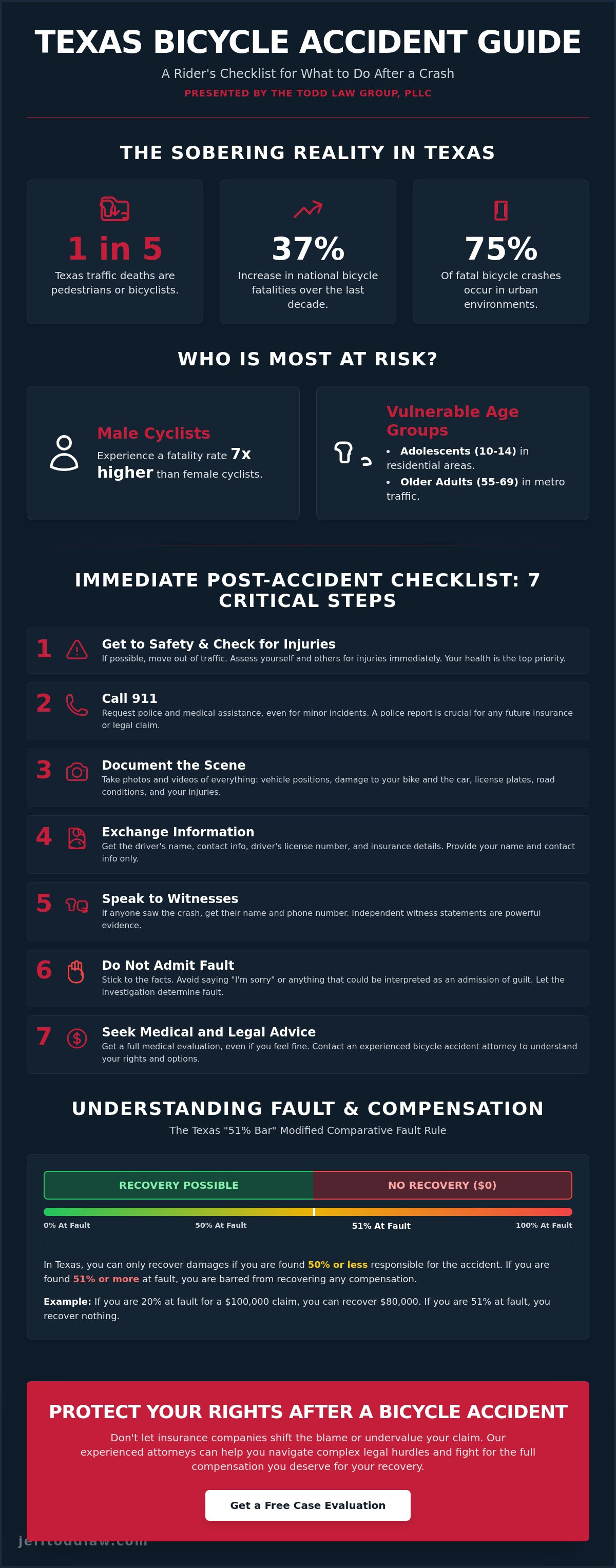
Did you know that pedestrian and bicyclist fatalities account for one in five of all traffic deaths in Texas? It's a sobering reality for those who travel our streets on two wheels. You likely chose cycling for its health benefits or as a sustainable way to commute through our metropolitan hubs, only to find that the road isn't as safe as it should be. If you've experienced one of these bicycle accidents, you're probably facing more than just physical pain. You might be struggling with rising medical costs or the fear that insurance companies and police will unfairly shift the blame onto you.
We understand that the road to recovery feels steep when you're balancing physical therapy with complex legal hurdles. This comprehensive 2026 checklist is designed to help you manage the aftermath of a crash with steady reassurance. You'll learn the essential steps to take at the scene, how Texas right-of-way laws protect you, and the critical timelines for filing a claim. We'll also examine how the state's modified comparative fault rule affects your recovery and what you need to know about local safe passing ordinances to ensure your case is positioned for success.
Key Takeaways
- Recognize your legal status as a vehicle operator under the Texas Transportation Code and ensure your equipment meets mandatory state safety standards.
- Understand how the Texas "51% Bar" rule functions, as being found primarily responsible for a crash can completely prevent you from recovering damages.
- Follow a strategic seven-step response plan immediately following bicycle accidents to preserve critical evidence and protect your physical well-being.
- Learn the specific types of scene documentation, including photo evidence and police reporting thresholds, that are essential for building a credible legal claim.
- Discover how professional advocacy shifts the focus from a mere financial transaction to a holistic restoration process that prioritizes your long-term recovery.
The Rising Risk of Bicycle Accidents in Texas Metro Areas
Texas law treats bicycle accidents with the same seriousness as any other motor vehicle collision. According to the Texas Transportation Code, a bicycle is legally considered a vehicle. This means cyclists have the same rights and responsibilities as drivers. However, the physical reality is much more dangerous for the rider. Statistics show a troubling trend. Nationally, bicycle fatalities have seen a 37% increase over the last decade. Texas reflects this surge. In 2024 alone, 80 bicyclists lost their lives on our roads. By early 2025, the state recorded 527 crashes involving cyclists, resulting in 186 deaths. High-speed intersections remain the most dangerous points of contact, accounting for 29% of all fatalities. Even environmental factors like the intense Texas summer heat can play a role, as heat-induced fatigue leads to driver inattention and slower reaction times.
Urban vs. Rural Risk Profiles
The risk isn't distributed evenly across the state. Approximately 75% of fatal crashes happen in urban environments. In cities like Houston, the sheer density of traffic on the I-10 corridor creates a high-pressure environment where drivers often overlook smaller vehicles. Austin has made strides in infrastructure, yet the transition between protected bike lanes and high-speed corridors remains a point of high risk. When riders move away from intersections, they often encounter vehicles traveling at much higher speeds, which significantly increases the likelihood of a catastrophic outcome. Following comprehensive bicycle safety guidelines is essential, but even the most prepared rider can't always account for aggressive urban driving patterns or poorly maintained city infrastructure.
Demographics of Danger: Who is Most at Risk?
Data reveals specific groups face higher levels of danger in bicycle accidents. Male cyclists experience a fatality rate seven times higher than females. This disparity often stems from a combination of higher ridership numbers and different risk profiles in traffic. Age also plays a critical role. Adolescents between 10 and 14 are particularly vulnerable in residential areas where drivers might be less alert. Conversely, older adults between the ages of 55 and 69 face increasing risks in metro traffic. As our population ages and more people turn to cycling for fitness, the interaction between senior riders and high-speed urban traffic requires greater legal and safety attention to prevent tragic outcomes.
Essential Texas Bicycle Laws: A Compliance Checklist for Riders
Understanding your legal standing on the road is the first step toward a successful recovery after a crash. Under Texas Transportation Code Section 551.101, a person operating a bicycle has the same rights and duties as a motor vehicle operator. This means you aren't just a guest on the pavement; you're a legitimate participant in traffic. However, this status comes with specific compliance requirements. To be street-legal during nighttime hours, your bicycle must be equipped with a white lamp on the front visible from at least 500 feet. You must also have a red reflector or a red lamp on the rear visible from a distance of 300 to 600 feet. Failing to meet these equipment standards can lead to a finding of comparative negligence in bicycle accidents, potentially reducing your compensation.
When you're out on the road, Texas law dictates that you ride "as near as practicable" to the right curb or edge of the roadway. There are four key exceptions to this rule: when you're overtaking another vehicle, preparing for a left turn, avoiding hazards, or if the lane is too narrow to share safely. Communication is also a legal mandate. You must use hand signals to indicate your intentions. Extend your left arm horizontally for a left turn, and for a right turn, you can either extend your left arm upward or your right arm horizontally. A stop or a sudden decrease in speed requires you to extend your left arm downward. Following these protocols ensures that you're acting predictably, which is your best defense against both physical harm and legal liability.
Right-of-Way and Intersection Rules
Texas law requires cyclists to obey all traffic control devices, including stop signs and red lights. At a four-way stop, the right-of-way belongs to the vehicle that arrived first. If you're riding with a partner, you're legally allowed to ride two-abreast as long as you don't impede the normal flow of traffic. Sidewalk riding is a common point of confusion. While no state law prohibits it, local ordinances in cities like Houston and Austin often ban sidewalk cycling in busy commercial districts. If you're navigating these urban centers, it's vital to stay informed about local rules to avoid unnecessary citations or liability issues. If you have questions about how local regulations affect your specific situation, consulting a bicycle accident lawyer can help clarify your rights.
The Texas Helmet Law Debate
Texas does not have a statewide helmet law for adult cyclists. Some municipalities have enacted their own ordinances, and riders under 15 must wear helmets on Class 3 e-bikes. Despite the lack of a state mandate, the "Helmet Defense" is a frequent tactic used by insurance companies to blame the victim for the severity of their injuries. They may point to national bicycle accident statistics regarding brain injury prevention to argue that your recovery should be limited because you didn't wear protective gear. While your choice to ride without a helmet is often legal, it creates a complex narrative that requires a seasoned advocate to manage effectively during settlement negotiations.
Proving Liability: How Fault is Determined in a Texas Bike Wreck
Proving liability in bicycle accidents requires demonstrating that a driver breached their duty of care. Negligence is the legal distance between what a driver should have done and what they actually did. For instance, while Texas law requires a "safe distance" for passing, a driver failing to yield at a marked bike lane clearly violates their duty. While a police report provides a foundational narrative, it isn't the final word. Officers often arrive after the fact and may not fully understand the mechanics of a cycling collision. A thorough investigation often uncovers details the initial report missed, such as distracted driving or mechanical failure.
Texas operates under a modified comparative fault system, often called the "51% Bar." This means you can only recover damages if your responsibility for the crash is 50% or less. If an insurance company or a jury determines you are 51% at fault, you are barred from any recovery. This is why addressing driver errors like "dooring" or unsafe passing is critical. These aren't just accidents; they are often the result of a driver's failure to observe the road. We focus on proving the driver's negligence to ensure your percentage of fault remains as low as possible, protecting your right to a full recovery.
Evidence Gathering for Cyclists
Protecting your rights starts at the scene. If you're physically able, collect witness contact information immediately. Eyewitness accounts are vital because they provide an outside perspective on the driver's behavior. Don't throw away your damaged helmet or bike. These are physical proof of the impact's force and direction. Modern cyclists often have a "silent witness" in their pocket. GPS and Strava data can prove your speed, position, and path of travel, making it harder for insurance companies to claim you were riding erratically or in an unauthorized area.
Dealing with Insurance Adjusters
Insurance adjusters are trained to minimize payouts. They may reach out shortly after the incident asking for a "recorded statement." You should be cautious. These statements are often used to find inconsistencies in your story to shift the 51% bar in their favor. Many adjusters hold a subconscious bias against cyclists, assuming they don't belong on the road. Navigating these tactics requires a specific strategy, especially when dealing with major carriers. You can learn more about these methods in our guide to Progressive claims. Seeking professional guidance before speaking to an adjuster ensures your words aren't used against you during the healing process.
The Immediate Post-Accident Checklist: 7 Critical Steps
The moments following a collision are often a blur of adrenaline and confusion. While your primary focus is understandably on your physical safety, the actions you take in the first hour significantly impact your ability to recover damages. Following a structured checklist ensures that you don't overlook critical details while in a state of shock. If you've been involved in one of these bicycle accidents, follow these steps to protect your health and your legal rights:
- Step 1: Check for injuries and call 911 immediately. Even if you believe the incident was minor, a formal emergency dispatch record is vital.
- Step 2: Document the scene. Take wide-angle and close-up photos of the car's position, your bike's damage, and the surrounding road conditions.
- Step 3: Exchange information carefully. Collect the driver's license number and insurance details. Be polite, but do not apologize or admit fault, as these statements can be used against you later.
- Step 4: Seek a medical evaluation. Visit an emergency room or urgent care facility within 24 hours. Adrenaline often masks serious internal trauma.
- Step 5: File a police report. Ensure the responding officer records your version of events. In Texas, accidents involving injury or property damage exceeding $1,000 must be reported.
- Step 6: Preserve digital evidence. Look for nearby security cameras or doorbell cams that may have captured the impact.
- Step 7: Contact an advocate. Before speaking with an insurance adjuster, consult a professional who understands the specific nuances of Texas cycling laws.
Medical Documentation and TBI Awareness
Adrenaline is a powerful natural painkiller that can hide the symptoms of head injury for several hours or even days. Traumatic Brain Injuries (TBIs) are common in cycling crashes, even when a helmet is worn. Insurance companies look for any "gap in treatment" to argue that your injuries weren't caused by the crash. Prompt diagnostic imaging, such as MRIs or CT scans, provides the objective medical proof needed to link your condition directly to the incident. Consistent follow-up care is not just about healing; it's about building a chronological record of your recovery process.
Preserving the Scene Digitally
Physical evidence on the road disappears quickly. Use your phone to record a voice memo of your immediate recollection while the details are fresh. Capture images of skid marks, weather conditions, and any road hazards like potholes or obscured signs that might have contributed to the crash. In urban areas like Houston or Austin, check with local businesses for surveillance footage. Many doorbell cameras delete footage within 48 to 72 hours, so identifying these sources immediately is essential. If you need assistance securing this evidence, speaking with a Texas bicycle accident lawyer as soon as possible can ensure that vital data is not lost forever.
Beyond the Crash: How Legal Advocacy Secures Your Recovery
True restoration after a crash involves more than just physical therapy or bike repairs. At The Todd Law Group, PLLC, we view legal representation as a holistic healing process. While you focus on your physical progression, we manage the aggressive tactics of insurance carriers who often prioritize their bottom line over your health. We handle the heavy lifting of negotiations and procedural deadlines so you can direct your energy toward your family and your physical recovery. Our commitment is anchored by a contingency fee model. You pay nothing for our services unless we successfully recover compensation for you. This allows you to pursue justice without the burden of upfront costs during an already stressful time.
Securing "Maximum Compensation" requires a deep understanding of how bicycle accidents impact a person's long-term quality of life. We don't just look at the immediate medical bills. We analyze the trajectory of your recovery and the potential for future complications. By framing your case through both a legalistic and empathetic lens, we ensure that the insurance company sees the human being behind the claim. Our goal is to provide the steady reassurance you need to navigate the aftermath of a collision with confidence.
Calculating the True Cost of an Injury
A comprehensive claim accounts for both economic and non-economic damages. Economic damages include your hospital visits, diagnostic imaging, lost wages, and any future care related to your injuries. Non-economic damages are more complex, covering pain, suffering, and the loss of enjoyment of life. If a crash results in a permanent disability or a traumatic brain injury, we work with medical and vocational experts to calculate the lifetime cost of your care. We ensure that every aspect of your loss is meticulously documented to protect your right to a full and fair recovery.
Your Partner in the Road to Recovery
Jeff Todd brings a sophisticated professional background to every case he handles. After a prestigious career trajectory in elite corporate legal environments across major metropolitan hubs, he transitioned to personal advocacy to help individuals in his local community. This intellectual rigor ensures that The Todd Law Group, PLLC provides the high-caliber representation usually reserved for large corporations. With offices in Houston, Austin, and Galveston, we offer localized support that understands the unique challenges of Texas roads. Schedule your free consultation with The Todd Law Group, PLLC today.
Securing Your Path to Restoration
You now have the tactical tools to navigate the aftermath of a collision with confidence. From understanding the 51% bar to preserving digital evidence, these steps are vital for protecting your rights. However, the legal system is complex and often biased against cyclists. Having a reliable partner allows you to focus on your physical restoration while we handle the technical rigors of your claim. We're here to ensure the driver's negligence is clearly documented and that your voice is heard throughout the proceedings.
Attorney Jeff Todd has been licensed in Texas since 1994 and understands how to counter the tactics insurance companies use in bicycle accidents. At The Todd Law Group, PLLC, we provide the intellectual rigor and regional expertise necessary to secure your recovery. With offices in Houston, Austin, and Galveston, we're personally invested in our local communities. We work on a contingency basis, so you don't pay anything unless we win your case. This commitment ensures that high-caliber legal representation is accessible to everyone seeking justice.
Get a Free Evaluation of Your Bicycle Accident Case
Your journey toward total restoration is our priority. Let's start moving forward together.
Frequently Asked Questions
Do I have to follow the same traffic laws as cars while biking in Texas?
You must follow the same traffic laws as motorists because Texas law defines bicycles as vehicles under Transportation Code Section 551.101. This means you are required to stop at red lights, obey stop signs, and yield the right of way just like any other driver. Adhering to these regulations is essential not only for your safety but also to protect your legal standing if a collision occurs.
Can I still file a claim if I was partially at fault for the bicycle accident?
You can still file a claim as long as you are found to be 50% or less at fault for the incident. Texas follows a modified comparative negligence rule, which means your total compensation will be reduced by your percentage of responsibility. However, if a jury determines you are 51% or more responsible, the law bars you from recovering any damages from the other party.
What if the driver who hit me doesn’t have insurance or it was a hit-and-run?
If the driver is uninsured or leaves the scene, you may be able to seek recovery through your own auto insurance policy. Many cyclists don't realize that their Uninsured/Underinsured Motorist (UM/UIM) coverage often applies even when they are on a bike. Personal Injury Protection (PIP) can also provide immediate funds for medical bills regardless of who caused the crash or whether the driver is identified.
How long do I have to file a bicycle accident lawsuit in Texas?
You generally have two years from the date of the crash to file a lawsuit in a Texas civil court. This deadline is governed by the Texas Civil Practice & Remedies Code section 16.003. If you miss this two-year window, you will likely lose your legal right to pursue compensation. It's vital to begin your investigation early to ensure all evidence is preserved within this timeframe.
Does my car insurance or homeowners insurance cover me while I’m on a bike?
Your auto insurance policy is often a primary source of coverage for injuries sustained in bicycle accidents through your PIP or UM/UIM benefits. Homeowners insurance typically does not cover your own medical expenses, though it might provide liability coverage if you are accused of causing an accident. You should have an advocate review your policy declarations to confirm exactly which protections follow you onto the road.
Should I get my bike repaired before talking to a lawyer?
You should avoid repairing or disposing of your bike until it has been fully documented as physical evidence. The specific damage to the frame and components can prove the angle of impact and the speed of the vehicle that hit you. While you can take the bike to a shop for a repair estimate, keep the damaged equipment in its post-crash state until your legal team advises otherwise.
What are the most common injuries in a bicycle accident and how are they compensated?
Common injuries in bicycle accidents include traumatic brain injuries, complex bone fractures, and internal organ damage. Compensation is designed to cover your "economic damages," such as hospital bills and lost wages, as well as "non-economic damages" like physical pain and mental anguish. If your injuries result in long-term disability, the claim will also account for future medical care and your diminished earning capacity over time.
Why do I need a specialized bicycle accident lawyer instead of a general attorney?
A specialized lawyer understands the unique prejudices cyclists face from insurance adjusters and the specific nuances of the Texas Transportation Code. General practitioners may not be familiar with local safe-passing ordinances or the technical aspects of bicycle-versus-car accident reconstruction. Having an advocate who focuses on these cases ensures your rights as a vehicle operator are vigorously defended against common anti-cyclist biases.


