

You walked into the Texas Medical Center expecting a routine surgery, trusting the anesthesiologist to monitor your vitals while you were most vulnerable. Instead, you woke up to a reality defined by unexplained complications, mounting medical bills, and a hospital staff that suddenly seems unreachable. When a medical error changes your life, partnering with a seasoned anesthesia malpractice lawyer Houston provides the steady reassurance you need to move forward. It's a heavy burden to carry, especially when you suspect that a professional's negligence caused your current suffering.
We understand the fear that Texas laws favor healthcare institutions over the individuals they've harmed. You deserve accountability and the financial security to cover your future medical needs. This guide explains how to navigate the 2026 legal landscape, including the critical 120 day expert report deadline and the non-economic damage caps that impact your recovery. You'll discover how a sophisticated legal strategy can secure the financial resources needed for your long term care and hold negligent providers responsible for their actions.
Key Takeaways
- Learn how to distinguish between unavoidable surgical risks and preventable medical negligence by understanding the legal "standard of care."
- Identify the warning signs of anesthesia errors, ranging from dosage toxicity to airway management failures that cause permanent injury.
- Understand how a seasoned anesthesia malpractice lawyer Houston navigates Texas damage caps and strict expert report deadlines to protect your claim.
- Discover who is truly responsible for your injury, whether it is the attending anesthesiologist or a supervised nurse anesthetist.
- See how applying elite corporate-level legal rigor to personal advocacy can help you achieve holistic healing and long-term financial security.
Anesthesia Malpractice in Houston: When a Routine Procedure Becomes a Life-Changing Event
Medical procedures often start with a sense of hope, but for some, the experience turns into a nightmare before the surgery even begins. While patients often research their surgeon's reputation, the person managing their consciousness is just as vital to their survival. Understanding what anesthesia is helps clarify the immense responsibility placed on the medical team to maintain a delicate balance between sedation and life support. When that balance is ignored or mismanaged, the results are catastrophic.
If you feel something went wrong in the operating room, don't dismiss your intuition. Hospital staff might offer vague explanations or avoid your questions, but a seasoned anesthesia malpractice lawyer Houston can look past the medical jargon to find the truth. We treat these cases with the intellectual rigor they require, investigating the "black box" of surgical logs to identify exactly where the standard of care was breached. You aren't just a case number; you're a person seeking a stable partner to help restore what was taken from you.
The Difference Between a Complication and Malpractice
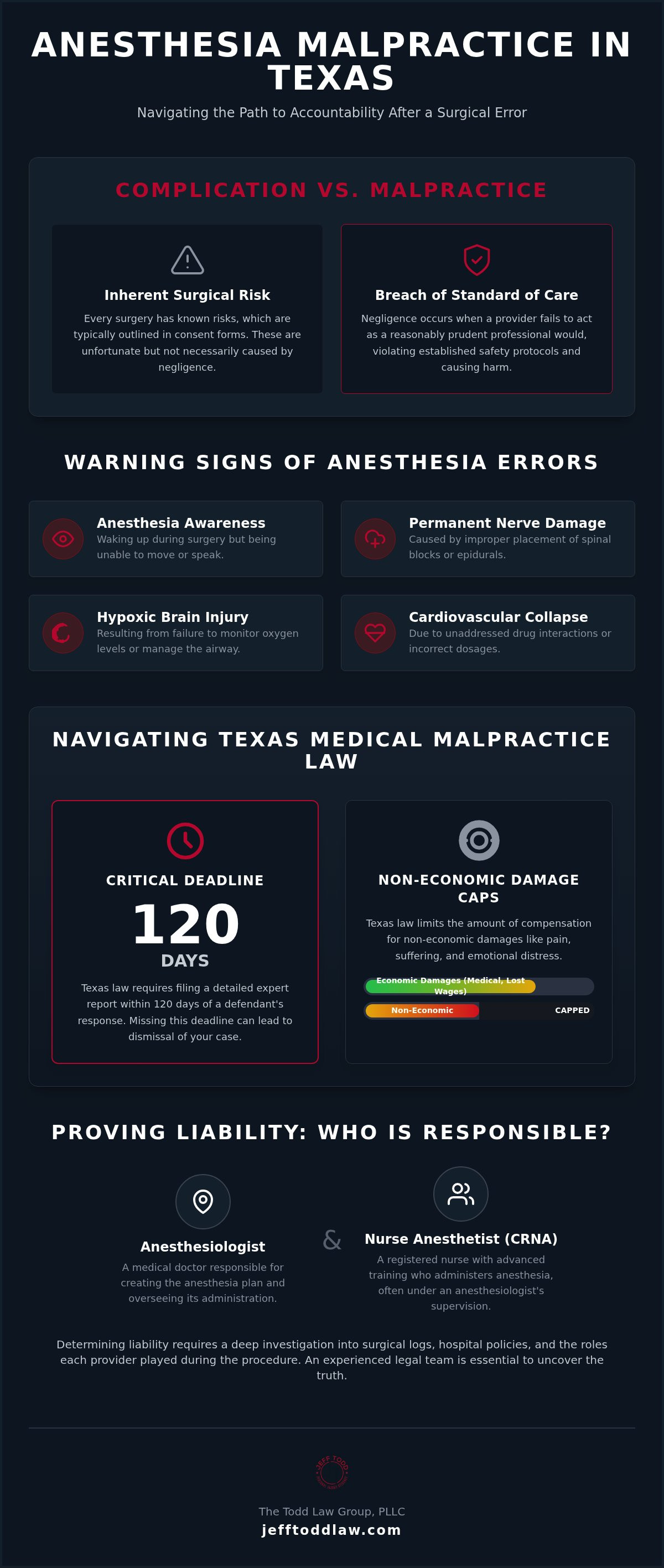
Every surgery carries inherent risks, but a complication isn't the same as negligence. You likely signed an informed consent form, yet this document doesn't grant medical providers a license to be careless or ignore safety protocols. In Texas, medical negligence occurs when a healthcare provider fails to act as a reasonably prudent provider would under similar circumstances. While some reactions are unpredictable, many injuries result from a direct failure to monitor the patient or follow basic dosing guidelines.
Certain outcomes are rarely just "bad luck" and often point toward a deviation from the standard of care:
- Anesthesia awareness: A traumatic event where a patient wakes up but remains paralyzed during surgery.
- Permanent nerve damage: Often caused by improper placement of a spinal block or epidural.
- Hypoxic brain injury: Resulting from a failure to monitor oxygen levels or manage the airway.
- Cardiovascular collapse: Caused by an unaddressed drug interaction or incorrect dosage.
Why Anesthesia Cases are Unique in Personal Injury Law
Anesthesia errors are often "invisible" compared to the obvious impact of a car accident. While a broken bone is easy to document, an error in gas titration or a failure to monitor heart rate happens in seconds and leaves no physical mark on the skin. The stakes are incredibly high. These errors frequently lead to permanent organ failure, cognitive impairment, or wrongful death. Because the patient is unconscious when the error occurs, the medical team holds all the information, making it difficult for families to get clear answers.
Proving these claims requires a sophisticated approach. Unlike other personal injury cases, anesthesia litigation relies heavily on medical experts who can translate complex surgical logs and electronic monitoring data. Your legal team must bridge the gap between medical science and legal accountability. An anesthesia malpractice lawyer Houston ensures that the intellectual rigor of a corporate background is applied to your personal advocacy, helping you achieve holistic healing and long term financial security.
Identifying Common Anesthesia Errors in Houston Hospitals
In the high-pressure environments of the Texas Medical Center (TMC), clinicians handle thousands of surgeries daily. While Houston boasts world-class facilities, the sheer volume of patients can sometimes lead to rushed pre-operative assessments or lapses in vigilance. Common anesthesia errors often stem from these systemic pressures, resulting in dosage mistakes where a patient receives too much medication leading to toxicity or a dose insufficient to maintain unconsciousness. These mistakes are frequently paired with pre-operative failures, such as neglecting to review a patient's history for allergies or contraindications that make certain drugs dangerous. If you suspect a mistake occurred during your procedure, consulting an anesthesia malpractice lawyer Houston is the first step toward uncovering the truth.
Monitoring negligence is another recurring issue in busy surgical centers. Anesthesiologists and CRNAs must track pulse oximetry, blood pressure, and carbon dioxide levels constantly. When a provider becomes distracted or fails to respond to equipment alarms, the window for intervention closes rapidly. This "failure to rescue" transforms a manageable complication into a life-altering injury. It's a heavy burden for families to witness the aftermath of such preventable lapses. If you aren't getting answers from the hospital, seeking an independent investigation can help clarify what happened behind closed doors.
Anesthesia Awareness: The Trauma of Waking Up
Few medical errors are as psychologically damaging as anesthesia awareness. This occurs when a patient is conscious of the surgical environment but remains paralyzed by neuromuscular blockers, unable to scream or signal for help. Modern hospitals should utilize Bispectral Index (BIS) monitoring to track brain activity and ensure deep sedation. When these tools are ignored or misinterpreted, the result is often long-term PTSD and severe emotional trauma. Recovery from this trauma requires more than just medical treatment; it requires a commitment to total restoration.
Hypoxic and Anoxic Brain Injuries
Oxygen is the most critical element in the operating room. A failure in intubation or airway management can lead to hypoxia or anoxia within minutes. Even a brief period of deprivation causes permanent brain damage or organ failure. These cases require a deep understanding of medical protocols, which is why working with a medical malpractice attorney texas is essential for navigating the path to recovery. If your family is facing the aftermath of a surgical error, a sophisticated legal approach provides the intellectual rigor needed to hold the facility accountable.
Texas Tort Reform: Navigating Damage Caps and Expert Report Requirements
Many Texans feel discouraged by the state's reputation for aggressive tort reform, often asking if it's even worth pursuing a claim. While the legal environment is challenging, it's designed to filter out frivolous claims, not to block victims of genuine negligence. A sophisticated anesthesia malpractice lawyer Houston applies high-level legal rigor to ensure your case meets these strict standards while fighting for the compensation you deserve. Success in these cases requires a stable partner who understands the nuances of the law and the intellectual demands of medical litigation. We focus on building a case that stands up to the scrutiny of Texas courts while prioritizing your total restoration.
Understanding the $250,000 Non-Economic Cap
Under Texas Civil Practice and Remedies Code Chapter 74, non-economic damages are capped at $250,000 per individual healthcare provider. These damages cover intangible losses like pain and suffering, mental anguish, and the loss of enjoyment of life. If a healthcare institution, such as a hospital, is also found liable, an additional $250,000 cap applies, bringing the potential non-economic total to $500,000. While these limits are strict, it's vital to distinguish them from economic damages. Economic damages cover tangible costs like past and future medical bills, specialized home care, and lost earning capacity. These costs are not capped in Texas. For victims of catastrophic anesthesia errors, the uncapped economic damages often form the majority of the recovery, providing the financial security needed for lifelong care.
The 120-Day Expert Report Hurdle
Perhaps the most dangerous obstacle in a Texas medical malpractice case is the 120-day expert report requirement. According to Section 74.351, a plaintiff must serve each defendant with a qualified expert report and the expert's curriculum vitae within 120 days of the defendant filing an answer to the lawsuit. This report must provide a fair summary of the expert's opinions regarding the standard of care, how the provider breached that standard, and the causal link to the injury. If the report is deemed insufficient or is filed late, the judge must dismiss the case with prejudice. This "death penalty" for lawsuits makes early investigation essential. A houston personal injury lawyer with experience in complex medical claims will begin securing medical records and consulting experts months before filing a suit to ensure every deadline is met with precision.
Proving Liability: Who is Responsible for Anesthesia Negligence?
Identifying the liable party in a medical malpractice case is rarely as simple as pointing to the person holding the syringe. In the operating room, a complex hierarchy of professionals must work in perfect synchronization. When a mistake occurs, it's often the result of a breakdown in this professional chain. An anesthesiologist, as a medical doctor, is the primary architect of your sedation plan, but they don't work alone. Many Houston surgeries involve Certified Registered Nurse Anesthetists (CRNAs) who execute the plan under supervision. If that supervision is lax or if the CRNA deviates from established protocols, both the nurse and the supervising physician may bear responsibility. Partnering with an anesthesia malpractice lawyer Houston allows you to untangle these professional relationships and identify exactly where the negligence began.
Liability can also extend beyond the individuals in the room to the facility itself. Hospitals and surgical centers have a legal duty to ensure their staff is properly credentialed and that their equipment is in working order. If a patient is harmed because of a defective ventilator or a monitor that failed to alarm, the manufacturer or the hospital's maintenance department could be at fault. We apply the same intellectual rigor used in elite corporate environments to investigate these systemic failures, ensuring that every negligent party is held accountable for your recovery.
Vicarious Liability and Hospital Responsibility
Houston is home to the Texas Medical Center (TMC), one of the densest collections of clinical and research institutions in the world. While these facilities are prestigious, they often rely on a mix of staff employees and independent contractors. This distinction is critical for your claim. Under the doctrine of vicarious liability, a hospital is generally responsible for the actions of its employees. However, if the anesthesiologist is an independent contractor, the hospital might try to distance itself from the error. Investigating the hospital's safety record and the specific terms of these professional contracts is a vital part of building a stable legal strategy. If you've suffered because of a facility's failure to maintain standards, consulting a Houston medical malpractice team is the best way to protect your rights.
The Role of the Surgical Team
A crisis in the operating room requires immediate, clear communication between the surgeon and the anesthesia provider. If a surgeon continues a procedure despite a drop in the patient's blood pressure, or if an anesthesiologist fails to communicate a vital sign alert, they may share joint and several liability. While the "Captain of the Ship" doctrine traditionally held surgeons responsible for every person in the room, Texas law has evolved to recognize that specialists have distinct, independent duties to the patient. Proving who had control over the specific act of negligence requires a meticulous review of surgical logs and witness testimony to ensure the burden of proof is met with precision.
Why The Todd Law Group is the Right Choice for Your Houston Claim
Selecting a legal team is a pivotal decision that impacts your total restoration. At The Todd Law Group, PLLC, we recognize that your journey began with a breach of trust in an operating room. Our firm is positioned to bridge the gap between medical tragedy and legal accountability. Jeff Todd's transition from elite corporate law to personal advocacy means he brings a sophisticated level of intellectual rigor to every claim. This background is essential when facing the massive legal departments of Houston's largest healthcare systems. As your anesthesia malpractice lawyer Houston, we don't just see a case file; we see a family that needs a path back to stability.
Our firm views the legal process as a component of holistic healing rather than a mere financial transaction. While securing maximum compensation is a primary goal, we understand that true recovery involves addressing your long term medical needs and emotional restoration. Having a physical office in Houston allows us to be personally invested in the community we serve. We collect local evidence, interview witnesses, and provide face to face support that remote firms simply can't match. This local presence ensures we move quickly from identifying the problem to implementing a proactive solution for your future.
Elite Legal Rigor Applied to Your Case
Jeff Todd has been licensed since 1994, providing a battle-tested foundation for the complex litigation required in medical negligence claims. Over three decades of experience has taught us that anesthesia cases are won or lost on the quality of the experts. The Todd Law Group, PLLC coordinates with top-tier medical specialists nationwide to translate surgical logs and prove deviations from the standard of care. This quiet confidence comes from years of handling catastrophic injury and wrongful death cases with meticulous attention to detail. We possess the intellectual rigor of a corporate background but choose to apply it to helping individuals through their most difficult moments.
No Upfront Costs: Our Contingency Fee Commitment
The financial burden of a long term injury is already overwhelming. You shouldn't have to worry about how to afford high-caliber legal representation while managing mounting medical bills. The Todd Law Group, PLLC operates on a contingency fee model, which means you pay $0 out of pocket unless we successfully recover compensation for you. This commitment levels the playing field against wealthy hospital insurance companies that have nearly unlimited resources to fight your claim. We take the financial risk so you can focus on your physical and emotional recovery. Contact The Todd Law Group, PLLC for a free consultation today.
Secure Your Path to Restoration and Justice
The aftermath of a surgical error is often a period of isolation and unanswered questions. Navigating the 120-day expert report deadline and the complexities of Texas damage caps requires a legal team with the intellectual rigor to challenge high-volume medical institutions. By focusing on uncapped economic damages for long-term care, an anesthesia malpractice lawyer Houston can help you secure the financial resources necessary for a full recovery. Accountability is the first step toward reclaiming your future after a life-changing medical event.
Jeff Todd has been licensed in Texas since 1994, applying the precision of an elite corporate background to personal injury advocacy. At The Todd Law Group, PLLC, we operate on a contingency basis, meaning there's no fee unless we win your case. This allows you to pursue justice without the stress of upfront legal costs. Schedule your free, confidential case review with The Todd Law Group, PLLC today to begin your journey toward restoration. You deserve a partner who is personally invested in your local Houston community and committed to your holistic healing.
Frequently Asked Questions
How long do I have to file an anesthesia malpractice lawsuit in Houston?
In Houston, you generally have two years from the date of the negligent act to file a medical malpractice lawsuit. Providing a formal pre-suit notice at least 60 days in advance can extend this deadline by 75 days. Texas also enforces a 10-year statute of repose, which serves as an absolute deadline regardless of when the injury was discovered. Missing these dates bars your recovery, so early legal intervention is vital.
What is the average settlement for anesthesia errors in Texas?
Average settlement figures are misleading because every patient's economic losses are unique. In Texas, non-economic damages like pain and suffering are capped at $250,000 per healthcare provider. However, there is no cap on economic damages, which include medical bills, rehabilitation costs, and lost earning capacity. A seasoned anesthesia malpractice lawyer Houston focuses on documenting these uncapped costs to ensure your family secures the maximum possible financial recovery.
Can I sue for anesthesia awareness if I didn't suffer physical pain?
Yes, you can pursue a claim for anesthesia awareness even without physical pain. The psychological trauma and long-term PTSD resulting from being conscious but paralyzed during surgery are significant non-economic damages. These cases require proving that the medical team failed to monitor brain activity or ignored equipment alarms. Expert testimony is essential to demonstrate that this traumatic experience was a preventable deviation from the accepted standard of care.
What happens if the anesthesiologist was a contractor, not a hospital employee?
If the anesthesiologist was an independent contractor, you can still hold them personally liable for their negligence. While the hospital may not be vicariously liable for the doctor's specific actions, the facility could still face liability for negligent credentialing or systemic monitoring failures. We investigate the professional contracts and hospital bylaws at facilities across the Texas Medical Center to ensure every responsible party is identified and held accountable.
Do I need to prove the doctor intended to hurt me?
You don't need to prove that a doctor intended to cause harm to win a civil lawsuit. Medical malpractice is based on negligence, which means the provider failed to meet the standard of care that a reasonably prudent doctor would have provided. Our job is to demonstrate that a breach occurred, such as a dosing error or monitoring lapse, and that this specific failure directly caused your injuries or complications.
How much does it cost to hire an anesthesia malpractice lawyer in Houston?
Hiring our firm involves no upfront legal fees or out-of-pocket expenses. We operate on a contingency fee basis, meaning our revenue is a percentage of the final settlement or court award. If we don't win your case, you owe us nothing for our services. This model allows individuals in Houston to challenge well-funded hospital insurance companies without taking on personal financial risk during their physical and emotional recovery.
What specific evidence do you need to win a medical negligence case?
Winning a case requires a combination of objective data and expert analysis. We secure anesthesia records, surgical logs, and electronic data from monitoring equipment used during your procedure. Additionally, Texas law requires serving a qualified expert report within 120 days of the defendant's answer. This report must clearly define the standard of care, the breach, and the causal link to your injury. Our team coordinates with national medical experts to build this foundation.
Can I file a claim if my loved one died from an anesthesia error?
Yes, surviving family members can file a wrongful death claim if an anesthesia error resulted in a fatality. These claims allow you to seek compensation for funeral expenses, lost financial support, and the loss of companionship. In 2026, the inflation-adjusted cap for wrongful death damages in Texas medical malpractice cases is approximately $2 million. We provide the compassionate advocacy needed to help families navigate these tragic losses while seeking justice.


