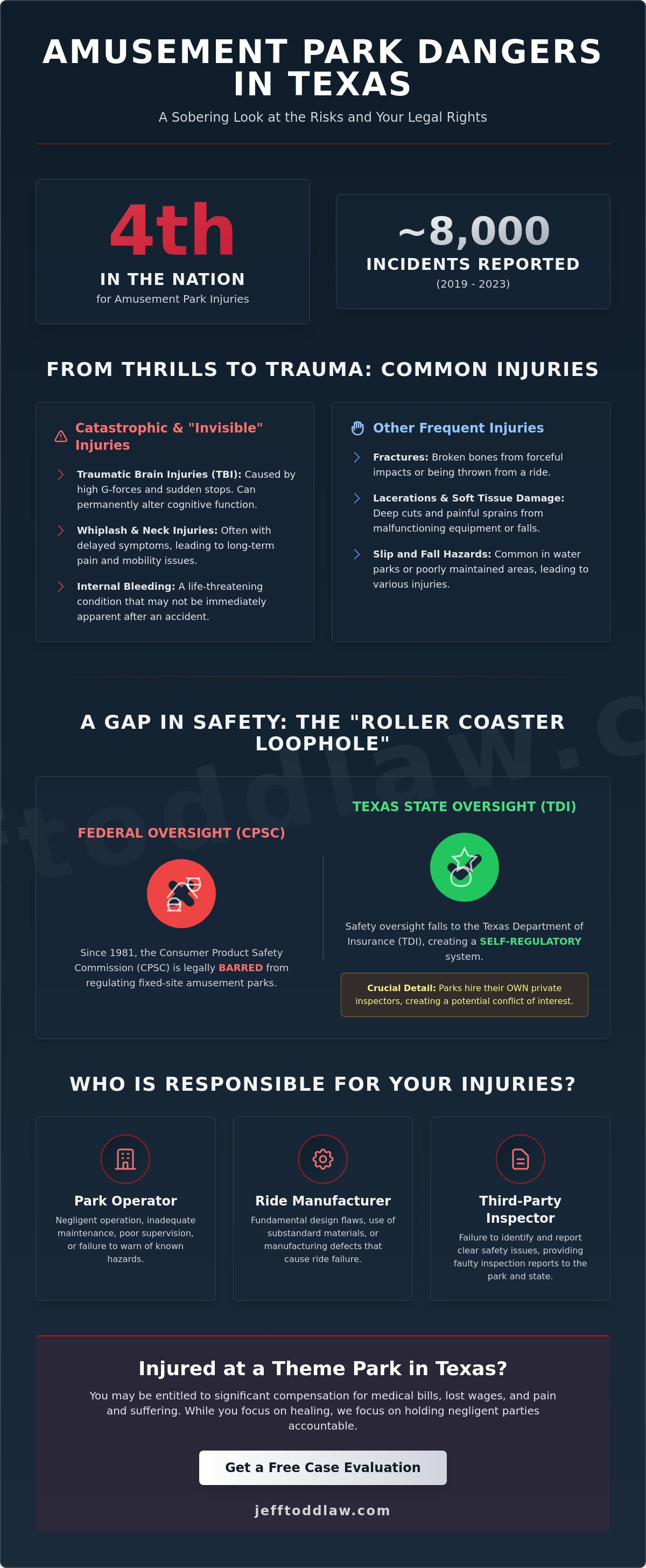
Texas ranks fourth in the nation for amusement park injuries, with nearly 8,000 incidents reported between 2019 and 2023. It's a sobering reality for families who expect a day of fun but end up facing a traumatic incident instead. You might be struggling with mounting medical debt and the fear that the fine print on the back of your ticket bars you from recovery. It's common to feel confused about whether the park, a ride manufacturer, or a private inspector is truly at fault. Working with an experienced amusement park injury lawyer Houston families rely on can provide the clarity and steady reassurance you need during this difficult time.
We understand that your priority is total physical and financial restoration. This guide will help you understand your legal rights under the Texas 51 percent bar rule and explain how the roller coaster loophole affects safety standards in our state. You'll learn how to identify liable parties and discover how a dedicated advocate can handle every legal logistics of your case. While you focus on healing, we focus on holding negligent parties accountable for the gaps in their safety protocols and ensuring your voice is heard in the legal system.
Key Takeaways
- Identify the most common theme park injuries in the Houston area and the specific medical risks associated with high-impact ride malfunctions.
- Uncover the impact of the "Roller Coaster Loophole" and how the Texas Department of Insurance oversees ride safety standards.
- Learn how to determine liability by exploring the three primary pillars of negligence and the role of premises liability in your claim.
- Gain clarity on whether ticket liability waivers are legally enforceable and what immediate steps you must take at the scene to preserve your rights.
- Explore how a seasoned amusement park injury lawyer Houston advocate provides a holistic approach to your legal and physical recovery.
Understanding Amusement Park Injury Risks in Houston (2026)
Houston's entertainment scene offers everything from coastal boardwalks to high-tech thrill rides. While these venues promise joy, the reality of theme park safety in the Houston metropolitan area is often more precarious than guests realize. Texas ranks fourth in the United States for amusement park injuries, with nearly 8,000 incidents reported between 2019 and 2023, many occurring right here in the Houston area. Mechanical failures, operator errors, and inadequate maintenance can turn a celebratory outing into a medical emergency. If you've been hurt, an amusement park injury lawyer Houston families rely on can help bridge the gap between your current distress and future restoration.
The physical toll of these accidents varies widely. We see everything from painful soft tissue damage and lacerations to devastating fractures. Understanding the broader context of U.S. amusement park accident statistics helps highlight that these are not just isolated incidents; they are often the result of systemic safety failures. Victims often face an overwhelming emotional and financial burden. The cost of emergency room visits, surgeries, and ongoing physical therapy can quickly deplete a family's savings while the emotional trauma of the event lingers long after physical wounds heal.
Catastrophic Injuries and Long-Term Consequences
Proving the link between ride mechanics and severe injuries requires a deep understanding of physics and engineering. High G-forces or sudden stops can cause the brain to strike the inside of the skull, leading to TBIs. These "invisible" injuries, including whiplash and internal bleeding, are particularly dangerous because symptoms might not appear for hours or days. A traumatic brain injury sustained on a ride can permanently alter a victim's cognitive functions, often resulting in a complete inability to return to their previous professional role or maintain a steady career path. If you're dealing with the aftermath of a ride failure, an amusement park injury lawyer Houston specialist can navigate the complex evidence required to prove negligence.
Recreational Venues Beyond the Major Theme Parks
Houston's unique hazards extend beyond permanent installations. Venues like the Kemah Boardwalk or the various traveling carnivals that visit our suburbs present specific challenges. These seasonal or mobile operations often have lower safety oversight than major permanent parks. Liability also extends to inflatable bounce centers where poor supervision leads to collisions and Houston-area water parks where slip-and-fall hazards are rampant. Smaller venues may lack the rigorous daily inspection protocols required by larger corporations. This makes it even more vital to have a seasoned advocate who understands how to investigate these diverse environments and secure your recovery.
The Legal Landscape: Texas Safety Regulations and the Roller Coaster Loophole
The legal landscape in Texas presents a unique hurdle for those seeking justice after a theme park accident. While many assume a federal agency oversees these massive attractions, the "Roller Coaster Loophole" tells a different story. Since 1981, the Consumer Product Safety Commission (CPSC) has been legally barred from regulating fixed-site amusement parks. This means for Houston residents visiting permanent local venues, safety oversight falls entirely on the state. This fragmented approach can leave victims vulnerable when a ride fails, as there's no single national safety standard governing every loop and drop.
In our state, the Texas Department of Insurance (TDI) manages ride safety through the Texas Amusement Ride Safety Inspection and Insurance Act. This law requires parks to carry liability insurance and submit an annual inspection report. However, these inspections are performed by private inspectors chosen by the park or their insurance company, not by state employees. This self-regulatory environment often leads to gaps where maintenance issues can be overlooked. If you find yourself navigating this complex system, a seasoned amusement park injury lawyer Houston families trust can help you uncover the truth behind a park's safety records.
State vs. Federal Oversight in Texas
The limitation of the CPSC is a critical factor in Texas personal injury law. While the federal government can regulate and recall mobile rides, like those found at traveling carnivals, it has no authority over permanent installations. Texas law attempts to fill this gap by requiring parks to display TDI inspection stickers. These stickers signify that a park has met the minimum insurance and paperwork requirements, but they aren't a guarantee of daily operational safety. According to the industry's own amusement ride safety report, consistent data collection is vital for preventing injuries, yet the lack of federal oversight makes uniform reporting difficult to achieve.
The Burden of Proof in Regulatory Failure
Proving a park failed to meet safety standards is a rigorous process. Under Texas law, the mere possession of a TDI compliance sticker and the filing of an annual insurance certificate do not constitute a legal shield against liability or provide definitive proof that a ride was maintained in a reasonably safe condition at the time of a guest's injury. We use detailed inspection records, maintenance logs, and operator training manuals as evidence in a premises liability claim. By exposing discrepancies between "certified safe" documents and the actual state of the equipment, we hold negligent owners accountable for the harm they've caused.
Determining Liability: Who Is Responsible for Your Injuries?
Identifying the responsible party after a theme park accident is rarely a straightforward task. Liability in Texas typically rests on three primary pillars: premises liability, product liability, and general negligence. Because multiple entities often share control over a single attraction, determining who is at fault requires a meticulous investigation into contracts, maintenance logs, and operational history. If you've been injured, the counsel of an amusement park injury lawyer Houston families trust becomes indispensable for untangling these complex legal threads and ensuring every negligent party is held accountable.
Premises liability is often the first avenue we explore. This legal theory holds property owners responsible for injuries caused by unsafe conditions on their land. If a park owner knew about a loose railing or a slippery walkway but failed to fix it or warn guests, they've breached their duty of care. However, the park owner isn't always the only entity to blame. In many cases, the failure lies within the machinery itself or the way it was operated, requiring a shift in focus toward manufacturers or staff training protocols.
The Role of Ride Manufacturers and Designers
Third-party liability often extends beyond the park gates to the companies that designed or built the ride. If a roller coaster derails due to a structural flaw or a restraint fails because of a manufacturing defect, the victim may have a claim under product liability laws. We carefully compare maintenance logs against the original design specifications to see if the park's upkeep or the manufacturer's engineering is at fault. These cases are governed by the standards found in the Texas Amusement Ride Safety Inspection and Insurance Act, which sets the framework for how these complex machines must be documented and insured.
Operator Negligence and Inadequate Training
Even the safest ride can become deadly in the hands of an undertrained operator. Seasonal carnivals and local Houston festivals frequently rely on temporary staff who may not receive the rigorous training necessary to manage emergency stops or verify safety restraints. Proving that an operator failed to perform a height check or was distracted by their phone at a critical moment is essential for a negligence claim. We look for patterns of operator fatigue or systemic failures in training programs that suggest a park prioritized profit over guest safety. When an employee's error leads to a catastrophic event, the park owner is typically held liable for their staff's actions through the principle of vicarious liability.
Protecting Your Rights After a Theme Park Accident in Texas
The moments following a theme park accident are often chaotic, but they are critical for your physical and legal recovery. Many victims feel discouraged when they notice the fine print on their admission ticket, which often includes a broad liability waiver. It is a common misconception that these waivers provide the park with total immunity. In Texas, while a waiver might cover ordinary negligence, it rarely protects a company from "Gross Negligence." This occurs when a park owner is aware of an extreme degree of risk but remains consciously indifferent to the safety of others. An amusement park injury lawyer Houston specialist can help you determine if the park’s conduct crossed this specific legal threshold, allowing you to pursue justice despite the fine print.
Seeking an independent medical evaluation is just as vital as legal counsel. While park medics provide immediate first aid, their primary role is to stabilize you on-site. They may not have the diagnostic tools to identify internal bleeding or a slow-developing traumatic brain injury. Visiting your own physician or an emergency room ensures your injuries are documented by an unbiased professional. This medical record serves as the foundation for your claim, linking your physical condition directly to the incident at the park. If you're unsure how to proceed, reaching out to an amusement park injury lawyer Houston families trust can provide you with a clear roadmap for your next steps.
Evidence Preservation at the Scene
Proactive evidence collection can make or break your case. If you are physically able, use your phone to photograph the ride, the specific area where the injury occurred, and any visible defects like rusted bolts or frayed belts. Don't rely on the park's internal incident report, as these are often written to minimize the venue's liability. Collect the names and phone numbers of any witnesses who saw the accident occur. Be wary of park insurance adjusters who may ask for a recorded statement shortly after the event. These adjusters are trained to elicit responses that could inadvertently damage your claim before it even begins.
Navigating Texas Statutes of Limitations
Time is a factor that works against the injured. Texas law generally provides a two-year window from the date of the accident to file a personal injury lawsuit. While two years might seem like a long time, maintenance logs can be lost and memories of witnesses can fade much sooner. Engaging a houston personal injury lawyer immediately after an accident ensures that your legal interests are protected while evidence is still fresh and accessible. Prompt action allows your advocate to secure ride data and surveillance footage before it is overwritten or destroyed by the park’s routine data management cycles.
How The Todd Law Group Pursues Maximum Compensation for Your Claim
Seeking compensation from a multi-billion dollar theme park corporation requires more than just a basic understanding of personal injury law. It demands a level of intellectual rigor and strategic planning usually reserved for high-stakes corporate courtrooms. At The Todd Law Group, we apply this elite level of legal sophistication to individual advocacy. If you're searching for an amusement park injury lawyer Houston families can trust, it's important to find a partner who sees your case as a journey toward total restoration rather than a mere financial transaction. We focus on a holistic healing process, ensuring that your physical, emotional, and financial needs are all addressed with equal urgency.
Our "No Fee Unless We Win" contingency model removes the financial barrier to high-quality representation. You shouldn't have to worry about legal bills while you're already managing mounting medical debt. We take on the risk because we believe in the merit of your claim and our ability to hold negligent corporations accountable for their safety failures. As a dedicated amusement park injury lawyer Houston advocate, we ensure that the burden of proof never falls solely on your shoulders. We are committed to a proactive approach that prioritizes your family's long-term stability.
A Seasoned Approach to Complex Litigation
Jeff Todd brings a prestigious professional history to every case, having transitioned from elite corporate environments to dedicated personal advocacy. This background is vital when facing the massive legal teams employed by major amusement parks. We don't just file paperwork; we build a comprehensive narrative of negligence. This involves coordinating with world-class expert witnesses in ride engineering and forensic medicine to prove how a specific mechanical failure or operator error caused your injury. Whether we are acting as a wrongful death attorney austin for a grieving family or representing a victim of a catastrophic spinal injury, our approach remains meticulous and battle-tested.
Your Partner in Restoration
The logistical burden of a lawsuit can be overwhelming for a family already in distress. We handle the complex communications with insurance adjusters, the collection of evidence, and the filing of legal motions so you don't have to. Our goal is to reduce your stress, allowing you to focus entirely on your physical recovery. We view ourselves as a stable partner through your legal progression, offering quiet confidence and steady reassurance at every turn. Your total recovery is our priority, and we are personally invested in the Houston community we serve. Schedule a free consultation with Jeff Todd today.
Restoring Your Future After a Theme Park Accident
The path to restoration after a traumatic theme park accident involves more than just filing a claim; it requires a strategic understanding of the Texas legal framework. We've explored how the "Roller Coaster Loophole" places the burden of safety oversight on the state and why identifying the correct liable party is vital for your recovery. Whether your injury was caused by a mechanical defect or operator error, you don't have to face these corporate giants alone. Partnering with an amusement park injury lawyer Houston families trust ensures that your rights are protected throughout this complex process.
Attorney Jeff Todd has been licensed since 1994 and brings extensive experience in complex premises liability and medical malpractice to every case. Our firm operates on a no-win, no-fee contingency basis; this means you can pursue justice without the stress of upfront legal costs. We prioritize your holistic healing and handle the logistics while you focus on getting better. Contact The Todd Law Group for a free, confidential case evaluation today. You deserve a stable partner who is personally invested in your total recovery and the well-being of our local community.
Frequently Asked Questions
Is an amusement park liable if I signed a waiver?
Yes, you can often hold an amusement park liable even if you signed a waiver or have one printed on your ticket. Texas courts generally find that these waivers only cover ordinary negligence. If the park’s actions constitute gross negligence, which involves a conscious indifference to safety, the waiver is typically unenforceable. An amusement park injury lawyer Houston specialist can analyze the specific language of your waiver to determine your legal standing and right to recovery.
How long do I have to file an amusement park injury claim in Houston?
You generally have two years from the date of the injury to file a lawsuit in Texas. This timeline is strictly enforced by the Texas Civil Practice and Remedies Code. If you miss this deadline, you will likely lose your right to seek compensation forever. It's vital to begin the investigation early to ensure maintenance records and security footage are preserved before they are destroyed by the park’s routine data retention policies.
What if my child was injured due to an operator’s mistake?
If an operator’s error caused your child’s injury, the park is typically responsible for their employee’s actions. This legal concept is known as vicarious liability. Furthermore, children in Texas have a unique statute of limitations; their two-year clock doesn't usually start until they turn 18. However, parents should act quickly to recover medical expenses they've already paid on the child’s behalf to avoid those specific financial claims expiring before the child reaches adulthood.
Can I still recover damages if I was partially at fault for the accident?
You can still recover damages as long as you are found to be 50 percent or less at fault for the incident. Texas follows a modified comparative fault rule. If you are 30 percent responsible for a fall, your total compensation will be reduced by that same 30 percent. If your fault exceeds 50 percent, you are barred from any recovery. This rule makes professional evidence gathering essential to prove the park’s primary responsibility.
What kind of compensation can I expect from a theme park lawsuit?
Compensation typically includes both economic and non-economic damages. You can seek recovery for medical bills, lost wages from missed work, and future rehabilitation costs. Non-economic damages cover your physical pain, emotional distress, and loss of enjoyment of life. In rare cases involving gross negligence, a court might also award exemplary damages to punish the park for its extreme indifference to guest safety and prevent future incidents.
How do I prove the amusement park was negligent?
Proving negligence requires showing that the park breached its duty to provide a reasonably safe environment. We establish this by examining maintenance logs, operator training certifications, and internal safety reports. If a ride was operated outside of its design specifications or a known mechanical issue was ignored, we can link that specific breach directly to your injuries. Expert testimony from engineers often plays a decisive role in establishing these technical failures.
Will I have to go to court for my theme park injury case?
Most personal injury cases settle out of court before a trial ever begins. However, an amusement park injury lawyer Houston advocate prepares every case as if it is going to trial to ensure you have the strongest possible leverage during negotiations. If the park’s insurance company refuses to offer a fair settlement that covers your total restoration, we are fully prepared to present your case before a jury to secure the justice you deserve.
Are traveling carnivals held to the same safety standards as permanent parks?
Traveling carnivals must follow the same Texas state safety laws as permanent parks, but they are also subject to federal oversight. Because carnival rides are mobile, they fall under the jurisdiction of the Consumer Product Safety Commission (CPSC). This adds an extra layer of regulatory requirements that permanent parks avoid. Despite these rules, the frequent assembly and disassembly of mobile rides can create unique mechanical risks that require a thorough investigation after an accident.


