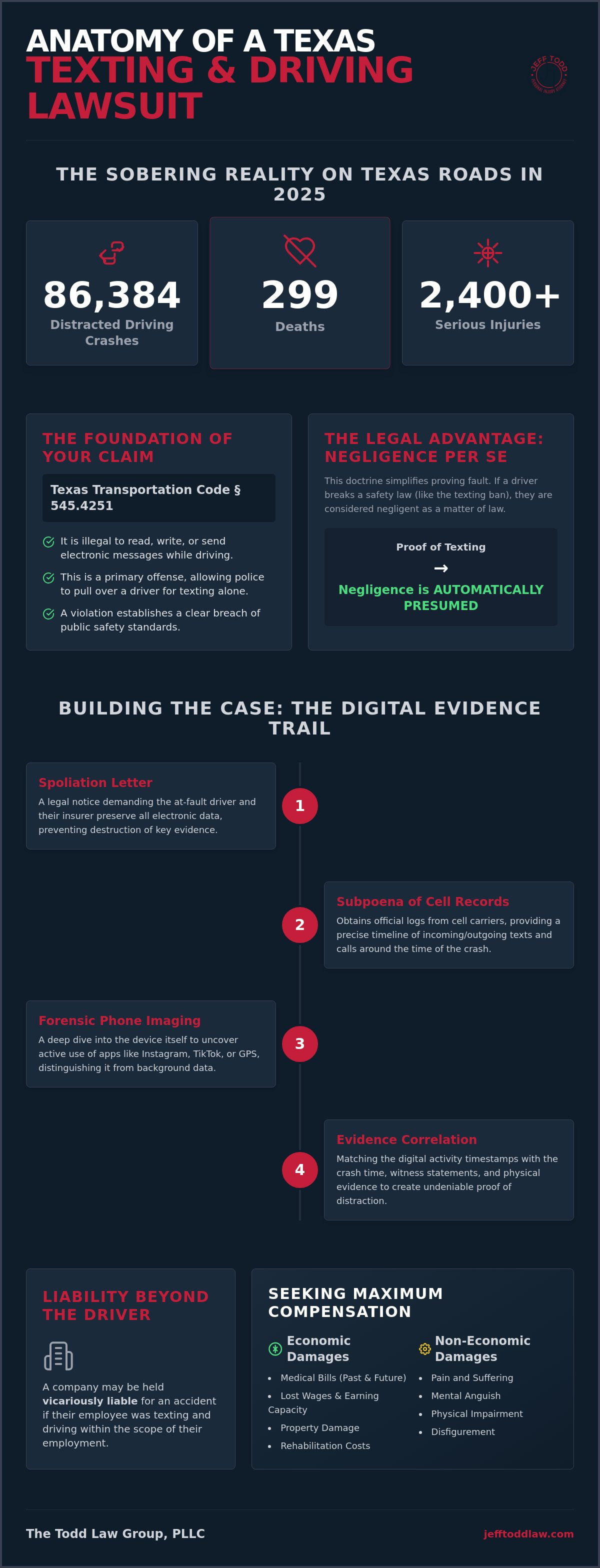
In 2025, distracted driving was responsible for 86,384 crashes on Texas roads, resulting in 299 deaths and over 2,400 serious injuries. If you've been hit by someone who was staring at a screen instead of the street, you know the physical and financial toll is immense. Filing a texting while driving lawsuit Texas requires more than just your word against theirs. It is a high-tech search for the truth that often requires forensic evidence to prove what happened in the seconds before impact.
We understand the frustration of dealing with aggressive insurance adjusters who downplay your injuries while your medical bills and lost wages continue to climb. It feels like an uphill battle when you're trying to prove cell phone use without a direct confession from the other driver. You shouldn't have to carry this burden alone. This article explains how to hold distracted drivers accountable by navigating the complexities of a Texas cell phone accident claim. We'll look at how legal experts use digital forensics, subpoenas for mobile records, and the negligence per se doctrine to prove liability and help you achieve a full restoration.
Key Takeaways
- Understand how Texas Transportation Code § 545.4251 and the doctrine of negligence per se can simplify the process of proving a distracted driver's fault.
- Learn why issuing a prompt spoliation letter is critical to securing digital evidence and cell phone records for your texting while driving lawsuit Texas.
- Discover when a company may be held vicariously liable for an accident caused by an employee who was texting within the scope of their employment.
- Identify the full range of recovery available to you, including economic damages for medical bills and non-economic damages for physical impairment and mental anguish.
- See how a dedicated legal partner can facilitate a holistic healing process by managing aggressive insurance adjusters and prioritizing your total restoration.
Texas Distracted Driving Laws and Negligence Per Se
Since 2017, Texas has maintained a clear stance on digital distractions. Under Texas Transportation Code Section 545.4251, it's illegal to read, write, or send electronic messages while operating a motor vehicle. This isn't just a suggestion; it's a primary offense. If an officer sees a driver typing, they can pull them over without needing another reason. This law forms the bedrock of many a texting while driving lawsuit Texas because it establishes a clear violation of public safety standards.
The law defines "electronic message" broadly. It includes texts, emails, and instant messages. While the statewide ban focuses on messaging, many cities like Austin, San Antonio, and El Paso have enacted stricter "hands-free" ordinances. These local laws often ban any handheld use of a mobile device entirely. When a driver receives a citation at the scene of an accident, that ticket becomes a powerful piece of evidence. It serves as a contemporaneous record that the driver was likely distracted at the moment of impact. Texting while driving is a documented danger that the state of Texas takes seriously to protect its citizens.
Understanding Negligence Per Se in Texas
In a standard car accident case, you generally have to prove the other driver acted carelessly. However, the doctrine of negligence per se changes the game. This legal principle states that if a person violates a statute designed to protect the public, they're considered negligent as a matter of law. In your texting while driving lawsuit Texas, this means you don't have to argue about what a "reasonable person" would do. If they were texting, they broke the law, and therefore, they were negligent. This shift simplifies your path to recovery. A police report noting cell phone use or a citation for violating Section 545.4251 is the most critical starting point for your claim.
The 'Hands-Free' Misconception
Many drivers believe that using a Bluetooth headset or a dashboard system makes them safe. This is a dangerous myth. While hands-free use might be legal in some parts of Texas, it doesn't eliminate cognitive distraction. Your brain still has to process the conversation, which slows your reaction time and narrows your field of vision. If a driver is on a hands-free call and causes a wreck, they can still be held liable for their lack of attention. In specific commercial contexts, such as truck accidents, relying on hands-free technology while ignoring hazardous road conditions can still constitute gross negligence.
Proving Fault: The Digital Discovery Process
Evidence in a car accident case can vanish in an instant. This is especially true for digital data that resides on a smartphone. To protect your claim, the first step is often sending a "spoliation letter." This legal notice demands that the other driver and their insurance company preserve all electronic data, including mobile devices and internal logs. Without this, a driver might delete incriminating messages or even replace a damaged phone, effectively destroying the very proof needed for a texting while driving lawsuit Texas.
Once a case is filed, we move into the formal discovery phase. This involves subpoenaing cell phone carrier records. These logs provide a precise timeline of incoming and outgoing texts and calls. By matching these timestamps with the exact moment of the crash, we can establish a clear pattern of distraction. However, records only show part of the story. We also look at cell tower "pings" to verify the driver's location and use forensic imaging of the device itself. This technical deep dive reveals when the screen was active and which specific apps were being manipulated in the seconds leading up to the collision.
Beyond Cell Records: Social Media and App Data
Carriers don't track what happens inside third-party apps like Instagram, TikTok, or Snapchat. Forensic experts must step in to bridge this gap. They distinguish between "background data," like an automatic email sync, and "active use," such as scrolling a feed or typing a caption. Correlating a social media post or a GPS adjustment to the second of impact provides undeniable proof of negligence. If you suspect distraction played a role in your crash, it's vital to consult with a legal professional who understands these technical nuances and can secure this data before it's lost.
Witness Testimony and Physical Evidence
Digital footprints aren't the only way to prove fault. Eyewitnesses often provide compelling accounts of "the glow," which is the distinct blue light of a smartphone illuminating a driver's face just before an impact. We also analyze dashcam footage from your vehicle or nearby commercial trucks to see the driver's behavior. Physical evidence at the scene tells a story, too. A lack of skid marks, known as "no-skid" evidence, often suggests the driver never looked up to brake because they were too focused on their screen. These combined elements create a powerful narrative for your texting while driving lawsuit Texas.
Liability Beyond the Driver: Can You Sue an Employer?
In many cases, the person behind the wheel isn't the only party responsible for your injuries. If a driver was working at the time of the crash, the legal doctrine of Respondeat Superior, or vicarious liability, may apply. This principle holds Texas employers accountable for the actions of their employees. To succeed in a texting while driving lawsuit Texas, you must prove the employee was acting within the "course and scope" of their employment. This means they were performing duties for their employer or furthering the company's interests when the distraction occurred. Whether they were a delivery driver or a sales executive, their employer shares the burden of the damage they caused.
The distinction between a personal phone and a company-issued device often matters less than the nature of the activity. If an employee was responding to a work-related text or checking a corporate email on a personal device, the employer can still be held liable. Companies have a legal obligation to implement and strictly enforce cell phone safety policies. When a business fails to monitor its drivers or creates a culture where immediate digital responses are expected even while driving, the organization itself becomes a target for litigation. Proving this often requires subpoenaing internal company communications to see if the driver was under pressure to stay connected.
Negligent Entrustment and Supervision
You can also sue a company for negligent entrustment if they allowed a known "distracted driver" to operate a vehicle. Negligent entrustment occurs when a company provides a vehicle to a driver they know, or should know, is incompetent or reckless. If a commercial trucking fleet ignores a driver's history of cell phone violations or fails to check their safety record, they may face punitive damages. These damages are designed to punish the company for its gross negligence and deter similar behavior in the future. We look for patterns of behavior that show the employer prioritized speed over safety.
Rideshare Liability (Uber and Lyft)
Rideshare accidents introduce additional layers of complexity. When an Uber or Lyft driver is distracted by their phone, their "app-on" status determines which insurance policy applies. If the driver was actively transporting a passenger or searching for a fare, higher coverage limits usually kick in. However, these companies often fight to distance themselves from liability by labeling drivers as independent contractors. Navigating Lyft and Uber accident liability in Houston Texas requires a deep understanding of how these corporate structures attempt to shield themselves from responsibility. We work to pierce those defenses and ensure every negligent party is held accountable for your total restoration.
Seeking Maximum Compensation for Distracted Driving Injuries
Recovery in a car accident isn't just about paying off current bills. It's about securing your future and ensuring your total restoration. In high-traffic areas like Houston's I-10 or I-45 corridors, distracted driving accidents often happen at high speeds, leading to devastating results. When you initiate a texting while driving lawsuit Texas, you're seeking compensation for two primary types of losses: economic and non-economic damages. Economic damages cover the tangible costs like medical bills, lost wages, and vehicle repairs. Non-economic damages address the invisible impact, such as physical impairment, mental anguish, and the loss of enjoyment of life.
Texas follows a "modified comparative fault" rule, also known as the 51% bar rule. This means you can recover damages as long as your share of responsibility for the crash isn't more than 50%. If a jury finds you were 20% at fault, your total award is reduced by that percentage. However, if you're found 51% responsible, you recover nothing. This is why proving the other driver's distraction is so vital. It ensures the fault remains where it belongs and protects your right to a fair recovery.
Calculating Long-Term Medical Costs
Because texting drivers often never look up, they rarely apply the brakes before impact. This unbraked force leads to catastrophic injuries like spinal damage or traumatic brain injuries. A Houston personal injury lawyer must evaluate the total claim value by accounting for future surgeries, physical therapy, and chronic pain management. We look at the holistic healing process to ensure you aren't left paying for someone else's mistake years down the road. If you're struggling with the aftermath of a crash on a busy Texas highway, you can contact our firm for guidance on your path to recovery.
Punitive Damages: Holding Reckless Drivers Accountable
In specific cases, you may be entitled to punitive damages, also called exemplary damages. These aren't meant to compensate you for a loss but to punish the defendant for gross negligence. Texting while driving often crosses the line from a simple mistake to a conscious disregard for the safety of others. While Texas places caps on these awards, they serve as a critical tool for the community to deter others from picking up a phone behind the wheel. A jury has the power to use these damages to send a clear message that distracted driving won't be tolerated in our local communities. This commitment to safety is mirrored by educational initiatives and speakers like Jeff Yalden, who work directly with young drivers to address the mental health and behavioral choices that lead to such preventable tragedies.
Why The Todd Law Group for Your Texas Texting Case
Choosing the right legal partner is the most important decision you'll make after a life-altering crash. With over 30 years of experience in Texas personal injury litigation, Jeff Todd provides the steady reassurance and intellectual rigor your case deserves. Our firm isn't just about securing a settlement; we're committed to your total restoration through a dedicated and compassionate approach. We serve clients across Houston, Austin, and Galveston, bringing deep regional knowledge to every texting while driving lawsuit Texas. You don't have to worry about upfront costs because we operate on a "No Fee Unless We Win" basis. This contingency-based representation ensures that high-caliber legal guidance is accessible to everyone, regardless of their current financial situation.
Jeff Todd's career trajectory across major metropolitan legal hubs has prepared him to handle the most complex matters with speed and meticulous attention to detail. This intellectual rigor, once applied in elite corporate environments, is now dedicated solely to helping individuals recover from the negligence of others. We understand the physical and legal progression required to move from the scene of an accident to a successful recovery. By positioning ourselves as your stable partner, we ensure you have the resources necessary to stand up against the parties responsible for your injuries.
A Sophisticated Approach to Digital Evidence
Building a successful claim requires more than just filing paperwork. It requires a high-impact strategy that leverages technical proof and expert analysis. We coordinate with digital forensic specialists to uncover the truth hidden in mobile records and app data. Our background in complex litigation means we aren't intimidated by aggressive insurance adjusters or large corporate employers who may try to hide their liability. We understand that immediate legal intervention is critical. Cell phone data can be overwritten or lost if you wait too long. We move quickly to preserve this evidence, ensuring the facts of your texting while driving lawsuit Texas are clear and indisputable.
Your Path to Personal Restoration
We view legal representation as a holistic healing process rather than a simple financial transaction. While we handle the heavy lifting of subpoenas, depositions, and negotiations, you can focus on your physical and emotional recovery. You're never just a file number at our firm. We provide personalized support and treat you like a neighbor in our local community. Our goal is to shoulder the logistical burdens so you can find peace and stability again. If you're ready to hold a distracted driver accountable and begin your journey toward recovery, Contact The Todd Law Group for a free case evaluation.
Secure Your Recovery and Hold Distracted Drivers Accountable
Proving a case requires a sophisticated approach to digital evidence, from subpoenaing mobile records to establishing negligence per se under state law. You now understand how employer liability and forensic discovery play a vital role in securing the maximum compensation you deserve. Navigating a texting while driving lawsuit Texas is a complex journey, but you don't have to face aggressive insurance companies or corporate legal teams alone. Our firm provides the intellectual rigor and steady reassurance necessary to guide you through the legal process toward a full restoration.
Attorney Jeff Todd has been dedicated to personal advocacy and licensed in Texas since 1994. With offices in Houston, Austin, and Galveston, our firm provides the local expertise needed for high-impact results. We operate on a contingency basis, so there are no upfront legal fees. We only get paid if you win. We are committed to your holistic healing and will manage every logistical detail of your claim so you can focus on getting better. Start your recovery today with a free consultation from The Todd Law Group. You deserve a partner who is personally invested in your future and your community. We look forward to helping you move forward with confidence.
Frequently Asked Questions
Can I sue someone for texting while driving in Texas even if they weren't ticketed?
Yes, you can pursue a claim even without a police citation. A traffic ticket is just one form of evidence. In a texting while driving lawsuit Texas, we conduct our own investigation to uncover the truth. We use the discovery process to find digital proof that the officer may have overlooked at the scene. Your right to recovery is based on the driver's actual behavior, not just whether they were ticketed.
How do lawyers prove someone was texting at the exact time of the accident?
We rely on technical evidence to build a timeline. By subpoenaing carrier records, we can see exactly when messages were sent or received. We also work with forensic experts to examine the device's internal logs. This allows us to see if the screen was active or if social media apps were in use. Physical evidence like a lack of skid marks also helps prove the driver was distracted and never looked up.
What happens if the other driver was using a hands-free device?
Hands-free technology does not eliminate liability. While it may be legal in some areas, it still causes significant cognitive distraction. If the driver was mentally focused on a call rather than the road, they failed to maintain a proper lookout. We analyze the circumstances to prove that their divided attention was the direct cause of the accident. Safety is about more than just where a driver keeps their hands.
Is it worth suing for a texting while driving accident if I wasn't seriously hurt?
You should always consult with a professional to evaluate your losses. Even if your injuries seem minor now, they can lead to chronic pain or future medical needs. A lawsuit isn't just about the immediate aftermath; it's about your total restoration. We help you recover costs for vehicle damage, lost wages, and any medical treatment required to ensure you are physically and financially whole again.
How long do I have to file a distracted driving lawsuit in Texas?
You typically have two years from the date of the accident to file your claim. This deadline is established by the Texas Civil Practice and Remedies Code Section 16.003. It's vital to act quickly because digital evidence can be lost or deleted over time. Starting the process early allows your legal team to issue spoliation letters and secure the records needed to prove the other driver's distraction.
Can an employer be held responsible if their employee was texting and hit me?
Employers can be held vicariously liable for their employees' actions. If the driver was performing work duties or using a company-issued device, the business may share the responsibility. This is especially true if the company failed to enforce safety policies or encouraged drivers to stay connected while on the road. We look at the relationship between the driver and the company to ensure all negligent parties are held accountable.
What is the average settlement for a texting while driving accident in Texas?
Settlement amounts vary significantly based on the specific details of your situation. No two cases are identical because medical expenses, lost earning capacity, and the impact on your life are unique to you. Instead of looking for an average, we focus on the specific evidence in your texting while driving lawsuit Texas. We work to ensure your recovery reflects the full extent of your economic and non-economic damages.
Will my case have to go to court, or will it settle out of court?
The majority of personal injury claims are resolved through out-of-court settlements. Insurance companies often prefer to avoid the uncertainty and cost of a trial. However, we prepare every file with the expectation of going to court. This meticulous attention to detail shows the opposing side that we are ready to fight for your restoration. This proactive stance often leads to more favorable settlement offers during the negotiation phase.


