

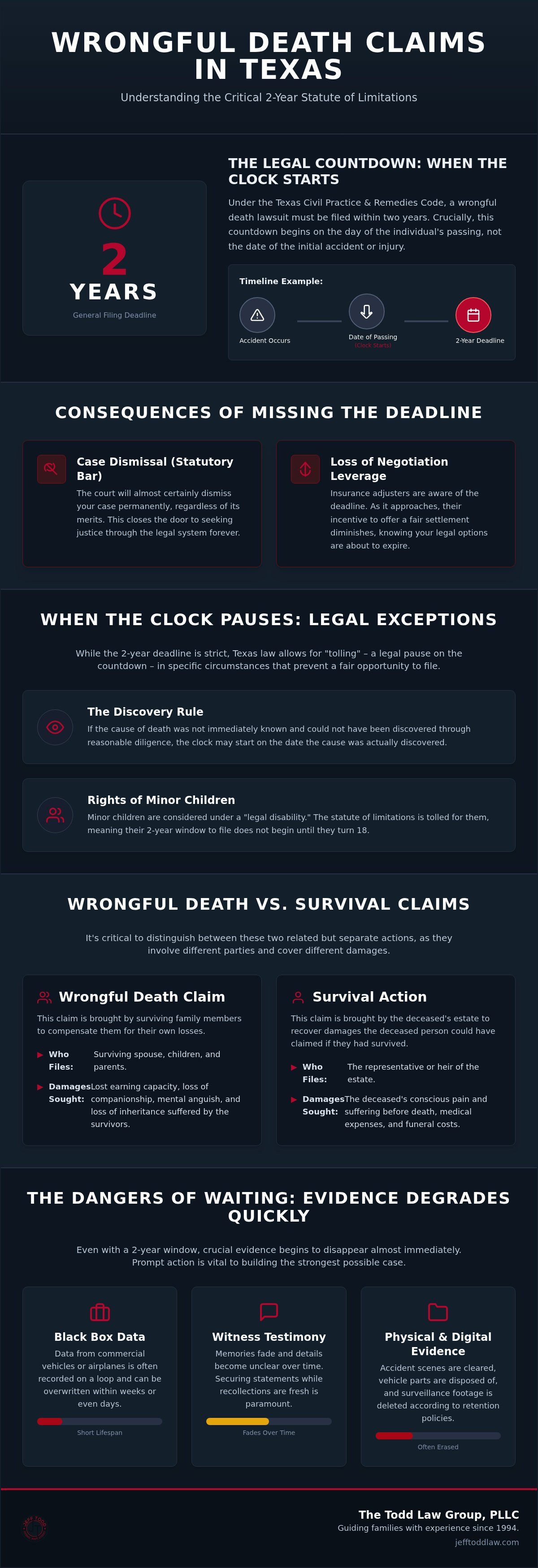
If the unthinkable happens, how much time do you really have to hold the responsible parties accountable before the law shuts the door forever? In the wake of a tragic loss, the weight of grief can make every legal requirement feel like an impossible burden. We understand that your priority is your family's emotional restoration, yet the legal clock in Texas doesn't pause for mourning. Under the Texas Civil Practice and Remedies Code, the general statute of limitations for wrongful death in texas is two years from the date of your loved one’s passing.
Missing this window can mean losing the right to seek justice entirely, but the path forward isn't always a straight line. Whether you are in Houston, Austin, or Galveston, understanding the nuances of this deadline is the first step toward regaining your footing. This 2026 guide provides the clarity you need during this difficult transition. We'll explain the standard filing deadlines, explore specific legal exceptions like the discovery rule or tolling for minors, and outline the essential steps to preserve your claim. With a professional history dating back to 1994, The Todd Law Group, PLLC aims to serve as a steady partner, helping you manage these complex statutes so you can focus on healing.
Key Takeaways
- The standard statute of limitations for wrongful death in texas is two years from the date of the individual’s passing, as established by the Texas Civil Practice and Remedies Code.
- Specific legal exceptions, such as the discovery rule or the rights of minor children, may pause or "toll" the legal clock, potentially extending your window to file.
- Differentiating between wrongful death claims and survival actions is critical for identifying which family members or estate representatives are eligible to seek damages.
- Securing legal counsel early is vital for preserving fragile evidence, such as black box data and witness testimony, which often degrades well before the two-year deadline expires.
- Utilizing a contingency-based legal partner allows your family to pursue justice and holistic healing without the added stress of upfront costs or hourly fees.
Understanding the 2-Year Statute of Limitations for Wrongful Death in Texas
A statute of limitations isn't just a legal suggestion; it's a rigid expiration date that the state enforces to maintain the integrity of the judicial system. In the context of a wrongful death claim, this clock serves as a boundary between a family's right to seek justice and a permanent loss of legal standing. Texas law prioritizes the reliability of evidence, acknowledging that as time passes, physical debris is cleared, digital logs are overwritten, and witness memories begin to fade. By setting a definitive window, the state ensures that cases are built on fresh, verifiable facts rather than fragmented recollections.
The Todd Law Group, PLLC has guided families through these complexities since 1994, providing a stable partnership when the legal landscape feels overwhelming. We understand that while you are focused on the holistic healing process, the law is focused on the calendar. Understanding the exact statute of limitations for wrongful death in texas is vital because once that window closes, even the most compelling case can be dismissed without a hearing on the merits.
The Legal Countdown: When the Clock Officially Starts
It's a common misconception that the legal clock starts on the day of the initial accident or injury. In a Texas wrongful death case, the cause of action typically "accrues" on the day the individual passes away. This distinction is critical if a loved one survived for weeks or months following a catastrophic event before succumbing to their injuries. Under Texas Civil Practice & Remedies Code § 16.003(b), a person must bring suit not later than two years after the day the cause of action accrues.
Calculating this 24-month window requires precision. If a death occurred on October 15, 2024, the filing deadline would generally be October 15, 2026. However, falling on a weekend or a legal holiday can slightly shift the final filing date. Because these calculations leave no room for error, our offices in Houston, Austin, and Galveston emphasize early intervention to avoid a last-minute rush that could jeopardize your family's future.
Consequences of Missing the Filing Deadline
Missing the deadline creates a "statutory bar." This means the defendant's legal team will likely file a motion to dismiss your case immediately, and the judge will almost certainly grant it. Beyond the courtroom, waiting too long destroys your leverage in insurance negotiations. Adjusters are acutely aware of the statute of limitations for wrongful death in texas; if they know your time is running out, they have little incentive to offer a fair settlement. Acting early and consulting a Houston personal injury lawyer ensures your rights remain protected while you focus on your family's restoration.
Exceptions to the Rule: When the Two-Year Deadline May Be Extended
While the two-year window discussed in the previous section is strict, Texas law acknowledges specific scenarios where the legal clock must pause. This concept, known as "tolling," provides a necessary safeguard for those who face insurmountable barriers to filing a claim. These exceptions aren't granted lightly; they require sophisticated legal arguments to overcome a defendant's inevitable motion to dismiss. The Todd Law Group, PLLC has navigated these complex tolling arguments since 1994, acting as a stable partner for families in Houston, Austin, and Galveston during the legal progression.
Identifying these exceptions early is a crucial part of the holistic healing process. It ensures that technicalities don't stand in the way of your family's restoration, particularly when negligence was hidden or the beneficiaries were legally unable to act. Proving that an exception applies requires a meticulous review of the case facts and a deep understanding of how Texas courts interpret "reasonable diligence" in discovering a cause of action.
Protecting the Rights of Minor Children
Minor children are considered under a "legal disability" because they cannot legally file a lawsuit on their own behalf. Consequently, the statute of limitations for wrongful death in texas is tolled until the child reaches the age of 18. Once they reach adulthood, the two-year countdown begins, theoretically allowing them until their 20th birthday to seek justice. However, waiting until a child turns 18 is rarely the best strategic choice. Physical evidence and witness memories are the lifeblood of a case, and they don't wait for a child to reach maturity. Pursuing a claim earlier through a surviving parent or guardian often ensures a stronger foundation for the child's long-term financial security.
The Discovery Rule and Fraudulent Concealment
The "discovery rule" applies when the cause of death was not immediately apparent, such as in cases involving latent toxic exposure or certain medical malpractice errors. If a family could not have known about the negligence despite exercising reasonable diligence, the court may extend the filing window. Similarly, if an at-fault party intentionally hides their wrongdoing, they shouldn't benefit from their own deception. Under the Texas Civil Practice & Remedies Code, this fraudulent concealment prevents the clock from running until the fraud is discovered or reasonably should have been discovered.
Proving that a death was "inherently undiscoverable" is a high legal bar that requires the intellectual rigor of an experienced legal team. Defense attorneys fight these extensions aggressively, often arguing that the family should have uncovered the truth sooner. If you're concerned that your time has run out, a thorough investigation by The Todd Law Group, PLLC can determine if one of these legal lifelines applies to your specific situation.
Wrongful Death vs. Survival Claims: Different Clocks, Different Damages
Texas law provides two distinct pathways for seeking accountability following a fatal incident. While they are often mentioned in the same breath, they serve different legal purposes and compensate different parties. It’s a common point of confusion for families, but understanding these nuances is essential for a total restoration of your rights. Both actions generally fall under the same two-year statute of limitations for wrongful death in Texas, yet they target different categories of loss.
The Todd Law Group has navigated these dual tracks since 1994, acting as a stable partner for families across Houston, Austin, and Galveston. We view these legal tools not just as financial transactions, but as part of a holistic healing process. By pursuing both avenues when appropriate, we ensure that every aspect of the tragedy is addressed, from the family's grief to the deceased's final medical expenses.
The Wrongful Death Act: Justice for the Living
A wrongful death claim is brought by the surviving spouse, children, or parents. Its primary goal is to compensate these individuals for the personal losses they suffer because their loved one is gone. This includes emotional damages like mental anguish and loss of companionship, as well as tangible financial losses like the loss of future inheritance and financial support. If the immediate family members don't file within three calendar months of the death, the executor of the estate may do so instead. A wrongful death attorney Austin families rely on can help determine which family members are eligible and how to best document these deeply personal losses.
The Survival Act: Justice for the Deceased
Unlike a wrongful death claim, a survival action "steps into the shoes" of the deceased. It allows the estate to recover damages the individual could have sought if they had survived the incident. This typically covers the conscious pain and suffering the person endured before passing, along with medical bills incurred and funeral costs. In many cases, these two claims are filed simultaneously to ensure the responsible party is held fully accountable for both the impact on the family and the suffering of the victim. Because the statute of limitations for wrongful death in texas applies strictly to both, coordination between the estate representative and the surviving family is vital to prevent any part of the claim from being barred by the court.
The Hidden Dangers of Waiting: Why Prompt Legal Action Protects Your Family
While the statute of limitations for wrongful death in texas gives you two years, the evidence rarely lasts that long. According to the Texas Department of Transportation, there were 4,150 fatalities on state roadways in 2024, and in each case, the window to capture pristine evidence was small. In the immediate aftermath of a tragedy, physical proof begins to disappear. Skid marks wash away with the first rain. Debris is cleared from the roadway. Even more concerning is the digital evidence that exists only for a short window. If you wait eighteen months to start the process, the very facts needed to prove liability may no longer exist.
The Todd Law Group has witnessed how quickly a case can be undermined by delay. We focus on the total restoration of your family's rights, which requires moving with both speed and meticulous attention to detail. By acting as a stable partner from the earliest stages of your grief, we ensure that the legal progression isn't stalled by the loss of critical information. Our presence in Houston, Austin, and Galveston allows us to respond quickly to incidents across the region.
Preserving Evidence in Truck and Auto Accidents
Commercial vehicles are essentially mobile data centers. They carry Event Data Recorders, often called black boxes, that track speed, braking, and steering inputs. However, trucking companies often have internal policies to overwrite this data after a set period. A houston truck accident lawyer can intervene immediately by sending spoliation letters. These are formal legal notices that require the company to preserve all commercial logs, maintenance records, and sensor data. Without this proactive step, critical proof of negligence can vanish legally before you ever file a claim.
Building a Strong Narrative Early
Witness memories are notoriously fragile. Over a two-year period, the specific details of an incident, such as the color of a traffic light or the speed of a vehicle, can become blurred. Securing recorded statements while the event is fresh ensures the narrative remains accurate. Additionally, early investigation allows accident reconstruction experts to visit the scene before it changes. This proactive approach does more than just gather facts; it signals to the defense that your family is serious about seeking justice. Even if you are well within the statute of limitations for wrongful death in texas, starting early prevents insurance adjusters from claiming your delay suggests a lack of urgency.
To ensure your family’s right to justice is fully protected, reach out to The Todd Law Group for a thorough evaluation of your case.
How The Todd Law Group Protects Your Rights in Houston and Austin
Jeff Todd has spent over three decades navigating the intricate corridors of the Texas legal system. Since being licensed in 1994, he has transitioned from elite corporate environments to dedicated personal advocacy, bringing a high-impact, battle-tested perspective to every case. This intellectual rigor is essential when facing the strict statute of limitations for wrongful death in texas. Our firm doesn't just process claims; we serve as a stable partner for families in Houston, Austin, and Galveston during their most vulnerable moments. We understand that the legal progression is often a journey toward total restoration, and we are personally invested in the local communities we serve.
A Compassionate Partner in Your Recovery
We view legal representation as a holistic healing process rather than a mere financial transaction. When you are overwhelmed by grief, the logistical burden of a lawsuit should be the last thing on your mind. Our contingency-based model ensures that there are no upfront costs or hourly fees to worry about. We don't get paid unless we win your case, allowing you to focus entirely on your family's emotional recovery. This commitment provides the steady reassurance needed to move forward with quiet confidence. Our local presence in Houston, Austin, and Galveston means we understand the specific procedural nuances of the courts in these areas, a level of detail that generic, national firms often overlook.
Taking the First Step Toward Justice
The path to accountability begins with a simple, confidential conversation. During your first meeting with Jeff Todd, you can expect a direct and supportive evaluation of your situation. We will review the timeline of your case to ensure you are well within the statute of limitations for wrongful death in texas and identify all potentially liable parties. This initial evaluation is free and carries no obligation. It is a chance for you to find a trustworthy partner who possesses the sophisticated professional background required to handle complex litigation against major corporations. By taking this step, you are signaling that your loved one's life had value and that negligence will not go unchallenged.
Schedule your free consultation with The Todd Law Group today to begin the process of protecting your family’s future.
Securing Your Family's Future and Legal Standing
The journey toward justice after a fatal loss is often paved with complex legal hurdles and emotional weight. While the two-year statute of limitations for wrongful death in texas provides a clear boundary, the strength of your case depends on the actions you take today. By understanding the critical distinction between wrongful death and survival claims, and identifying potential exceptions like the discovery rule, you can ensure your family’s voice isn't silenced by a technicality. Early intervention is the most effective way to preserve fragile evidence and build a narrative that holds negligent parties fully accountable.
The Todd Law Group has served as a steady partner for families since 1994, offering the intellectual rigor of a corporate background with the heart of a personal advocate. With offices in Houston, Austin, and Galveston, we provide localized expertise on a contingency basis; you'll never face upfront costs while focusing on your recovery. It's time to transition from the burden of logistics to the process of holistic healing. Get a Free Case Review with a Texas Wrongful Death Attorney and take the first step toward the restoration you deserve. You don't have to walk this path alone.
Frequently Asked Questions
Can the statute of limitations be extended if the death was caused by a crime?
No, the existence of a criminal case doesn't automatically extend the civil filing window. While the state pursues criminal charges, the family must still adhere to the two-year deadline for their civil lawsuit. These two legal paths are independent; the outcome of a criminal trial isn't required before you file. Waiting for a conviction can lead to missing the filing window, which permanently bars your right to seek financial restoration.
What happens if I discover the cause of death more than two years later?
The discovery rule may allow you to file after two years if the cause of death was inherently undiscoverable. This often applies to medical malpractice or toxic exposure where the negligence wasn't immediately apparent. However, you must prove you exercised reasonable diligence in seeking the truth. If the court finds you should've known sooner, the standard statute of limitations for wrongful death in texas will likely remain in effect, barring your claim.
Does the statute of limitations apply to minor children in Texas?
Yes, the statute is tolled or paused for minor children until they turn 18. Once they reach adulthood, the two-year clock begins, effectively giving them until their 20th birthday to file. While this provides a legal safety net, waiting many years is often detrimental. Evidence vanishes and witnesses move away, so it's usually better for a guardian to pursue the claim much earlier to ensure a holistic healing process and financial stability.
Can I still file a claim if the deceased lived for several months after the accident?
Yes, the filing clock typically begins on the date of death rather than the date of the injury. If your loved one survived for six months in a hospital before passing, your two-year window starts on the day they died. This distinction is vital for families who spent months focused on medical care and recovery. Our team helps track these specific dates to ensure your right to justice remains fully protected under Texas law.
What if the at-fault party is a government entity in Houston or Austin?
Claims against government entities in Houston or Austin involve much shorter notice deadlines. Under the Texas Tort Claims Act, you may have as little as six months to provide formal notice to a state agency. Some city charters, like Houston or Austin, require notice in even shorter windows, sometimes only 45 to 90 days. These notice requirements are separate from the final filing deadline and are strictly enforced by the courts.
Is it possible to pause the statute of limitations if the defendant leaves Texas?
Texas law allows for the statute of limitations to be paused if the defendant leaves the state. Under the Civil Practice and Remedies Code, the time a person is absent from Texas isn't counted as part of the two-year limit. This prevents at-fault parties from running out the clock by simply moving away. Proving the exact duration of their absence requires meticulous documentation and a battle-tested legal approach to convince the court.
How long does it typically take to resolve a wrongful death case once filed?
Most wrongful death cases take between 12 and 24 months to reach a resolution. The timeline depends on the complexity of the accident reconstruction and the willingness of the insurance company to negotiate fairly. If a case proceeds to a full trial in Houston or Austin, it may take longer due to court schedules. We focus on maintaining momentum throughout the legal progression, ensuring your family receives a resolution with speed and meticulous detail.
Do I need a lawyer to file a wrongful death claim before the deadline?
You aren't legally required to have a lawyer, but navigating the statute of limitations for wrongful death in texas alone is extremely risky. A seasoned professional manages the logistical burden of filing, preserves evidence like black box data, and handles aggressive insurance adjusters. Since we work on a contingency basis, you don't face any financial risk. Having a stable partner ensures every technical requirement is met while you prioritize your family's emotional restoration.


