

What if the insurance adjuster's "final offer" is based on a formula designed to protect their profit margin rather than your total restoration? It's a common fear for many families in Houston, Austin, and Galveston who are buried under medical debt and wondering exactly how are personal injury settlements calculated in texas. You likely feel the weight of every mounting bill and the uncertainty of when you can return to work. We understand that this process is about more than just a financial transaction; it is about the stability you need to focus on healing.
This guide provides the clarity you deserve by breaking down the specific legal formulas, such as the Multiplier Method, and the unique Texas rules that dictate your final check. You'll discover how the state's 51% modified comparative fault rule can shift your recovery and why the "Paid vs. Incurred" statute remains a critical factor in 2026. We will also examine how your specific injury severity affects the math. By the end of this article, you will have the knowledge to identify a lowball offer and ensure your settlement reflects the true value of your future medical needs.
Key Takeaways
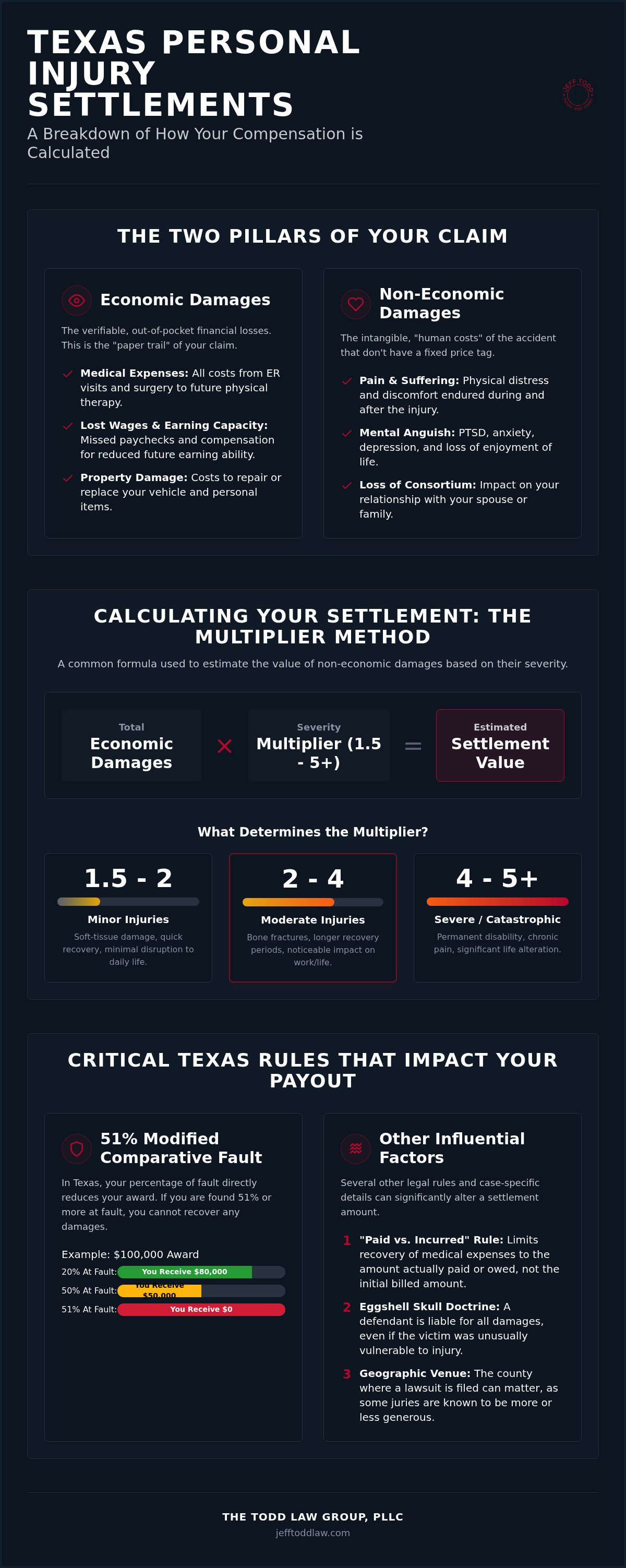
- Distinguish between economic "paper trails" and non-economic "human costs" to ensure every aspect of your life's disruption is documented and valued.
- Learn how are personal injury settlements calculated in texas using industry-standard formulas like the Multiplier Method to assign a fair value to your pain and suffering.
- Navigate critical Texas-specific statutes, including the "Paid vs. Incurred" rule and the 51% modified comparative negligence bar, which directly impact your final recovery.
- Identify "hidden" variables like the Eggshell Skull doctrine and geographic venue that often cause two similar injuries to result in vastly different settlement amounts.
- Gain the confidence to reject lowball insurance offers by understanding how a holistic legal approach prioritizes your total physical and financial restoration.
Understanding the Building Blocks: Economic vs. Non-Economic Damages
To understand how are personal injury settlements calculated in texas, you must first look at the two distinct pillars of a claim. In the legal concept of damages, compensation is designed to put the injured party back in the position they would have been in had the accident never occurred. At The Todd Law Group, we view this as a process of total restoration. It's not just about paying bills; it's about acknowledging the full scope of your loss. In Texas courts, your recovery is built upon documented evidence that falls into two categories: economic and non-economic.
Economic Damages: The Hard Numbers
Economic damages represent the "paper trail" of your financial losses. These are objective, out-of-pocket costs that we can calculate using invoices, pay stubs, and expert projections. They form the baseline of your claim because they are easily verifiable through records. Without a meticulous record of these costs, insurance companies will often try to minimize the impact of your injury.
- Medical Expenses: This includes every cost from the initial ER visit and surgery to ongoing physical therapy and future medical needs. We look at what you've already paid and what you'll likely need for years to come.
- Lost Wages and Earning Capacity: If your injury kept you away from your job, you're entitled to those missed paychecks. If your disability prevents you from returning to your previous career, we calculate the loss of future earning capacity to ensure your family's long-term security.
- Property Damage: This covers the tangible cost to repair or replace your vehicle and any personal items destroyed in the incident.
Non-Economic Damages: The Human Cost
While economic losses are reflected on a spreadsheet, non-economic damages address the "human cost" of an accident. These are the intangible impacts that don't come with a receipt but are often the most devastating parts of an injury. They represent the emotional and physical toll that disrupts your daily life and sense of well-being. Because these losses are subjective, they require a sophisticated legal strategy to value correctly.
Documenting these requires a different approach. We look at physical pain and suffering, which accounts for the actual bodily distress you've endured. Mental anguish is another critical factor, covering PTSD, chronic anxiety, or the loss of enjoyment of life that follows a traumatic event. In cases involving catastrophic injury or wrongful death, we also pursue damages for the loss of consortium or companionship—a focus shared by Leon Legal Group in their advocacy for bereaved families. Even though these don't have a fixed price tag, they are essential for your total restoration. Since there's no bill for a lost night's sleep or the inability to participate in family activities, we rely on witness testimony and personal journals to prove these losses to a Texas jury.
Common Formulas: The Multiplier and Per Diem Methods
When you're asking how are personal injury settlements calculated in texas, it's vital to recognize that the law doesn't mandate a specific arithmetic formula. While the Texas Civil Practice and Remedies Code provides the legal definitions for damages, it leaves the actual dollar amount for pain and suffering up to negotiation or jury discretion. Insurance adjusters don't just guess; they use standardized models and software like Colossus to generate a baseline. These programs often strip away the human element of your restoration, which is why you must understand the math they're using against you.
How the Multiplier Method Works
The Multiplier Method is the most frequent starting point for valuing non-economic losses. It's a three-step process that builds on the "hard numbers" of your economic losses. First, your attorney totals all economic damages, such as medical bills and lost wages. Second, a multiplier is assigned, typically ranging from 1.5 to 5. Finally, these two figures are multiplied to reach a total demand amount.
The number chosen for the multiplier depends on the severity of your injury and the impact on your life. A minor soft-tissue injury might receive a 1.5 multiplier. A catastrophic injury involving permanent disability or a long recovery often justifies a 4 or 5. Adjusters will fight for a lower multiplier by downplaying your pain. If you're struggling to determine which multiplier fits your case, The Todd Law Group can provide a professional evaluation of your claim's potential value.
The Per Diem (Daily Rate) Approach
The Per Diem method offers an alternative by focusing on the daily reality of your suffering. Instead of a lump-sum multiplier, this approach assigns a specific dollar value to every day you live with the consequences of the accident. This daily rate is often tied to your actual daily earnings or a figure deemed "reasonable" for enduring significant discomfort. For example, if your recovery takes 300 days and the rate is set at $200, the non-economic portion of your claim would be $60,000.
This method is often more effective in a Texas courtroom because it humanizes your experience. It allows a jury to see the timeline of your healing journey rather than just a final number. It's particularly useful when an injury has a clear end date but involved intense, daily struggle. Whether using a multiplier or a daily rate, the goal is to ensure the final check reflects the total restoration of your life.
Texas-Specific Legal Rules That Change Your Settlement
While the common settlement calculation methods discussed earlier provide a theoretical baseline, the actual check you receive is heavily dictated by unique Texas statutes. These rules act as a filter, often reducing the total amount before the ink is dry on a settlement agreement. Understanding how are personal injury settlements calculated in texas requires a deep dive into the Civil Practice and Remedies Code, as these laws can either protect your recovery or leave you with nothing.
The 'Paid vs. Incurred' Rule (Chapter 41)
Under Texas CPRC Chapter 41.0105, a claimant can only recover medical expenses that were actually "paid or incurred" by or on behalf of the claimant. This means that if a hospital bills you $50,000 for a surgery but your private health insurance has a contract to settle that debt for $15,000, your legal recovery is limited to that lower amount. You cannot claim the original $50,000 sticker price as an economic loss. This rule significantly lowers the "hard number" baseline used in multiplier formulas. Insurance adjusters use these adjustments to slash settlement offers, which is why having an attorney to audit bills is essential. We ensure that every dollar you are legally entitled to is included in the final demand.
Modified Comparative Negligence: The 51% Bar
Texas follows a "modified comparative negligence" system, which directly impacts your final payout based on your level of responsibility for the incident. Your settlement is reduced by your own percentage of fault; for instance, if a jury finds you 20% responsible for a collision, a $100,000 award is automatically reduced to $80,000. There's a dangerous "all or nothing" cliff in this rule. If you're found to be 51% or more at fault, you recover zero dollars. Insurance companies frequently use aggressive tactics to shift blame onto the victim to cross this 51% threshold. They'll look for any reason to claim you were distracted or speeding to avoid paying the claim entirely.
Time and policy constraints also play a role in your total restoration. In Texas, you generally have a two-year statute of limitations to file a lawsuit. If you miss this window, your claim loses all leverage and financial value. Additionally, the final settlement is often capped by the defendant's insurance policy limits. Texas requires a minimum liability of $30,000 per person for bodily injury. If your damages exceed these limits, we must look for other avenues, such as underinsured motorist coverage or corporate assets, to bridge the gap and ensure a full recovery.
Factors That Influence the 'Real World' Value of Your Claim
While the formulas and statutes discussed earlier provide a legal skeleton, the "real world" value of your claim is often shaped by external variables that a calculator cannot capture. When determining how are personal injury settlements calculated in texas, we must account for the specific environment where the case is filed and the identity of the person or corporation responsible for your injury. These factors can shift a settlement amount significantly, even when the physical injuries appear identical to another case.
A significant factor we often navigate is the "Eggshell Skull" doctrine. This legal principle states that a defendant is liable for the full extent of your injuries, even if a pre-existing condition made you more susceptible to harm. If you had a prior back injury that was aggravated by a car accident, the insurance company isn't allowed to use your history to avoid paying for your total restoration. We utilize medical and vocational expert witnesses to justify higher multipliers by proving how the incident uniquely impacted your specific physical health and future ability to work.
The identity of the defendant also changes the negotiation dynamic. A claim against a commercial trucking company often carries a higher value than one against an individual driver. Corporations have deeper pockets and a greater fear of large jury awards, which often incentivizes them to settle for a fair amount rather than risk a public trial. If you are facing a complex case against a corporate entity, you need a partner who understands these high-stakes environments. You can contact The Todd Law Group to discuss the specific factors affecting your potential recovery.
The 'Venue' Factor: Houston vs. Rural Texas
In Texas, where you file matters as much as what happened. Harris County juries are historically viewed as more receptive to plaintiff claims compared to juries in more conservative, rural counties. This reputation directly affects an insurance company's willingness to settle. If they know a venue is likely to award a higher amount at trial, they are more inclined to offer a reasonable settlement early. The Todd Law Group maintains physical offices in Houston, Austin, and Galveston, giving us the local insight needed to navigate these distinct legal landscapes and maximize your leverage.
Insurance Policy Limits and 'Collectability'
Collectability is a hard reality in every case. Texas law only requires drivers to carry a minimum of $30,000 for bodily injury per person. If your medical bills reach $100,000, that $30,000 policy acts as a functional cap unless there are other avenues for recovery. This makes it essential to understand how are personal injury settlements calculated in texas when the costs outpace the coverage. We investigate umbrella policies and corporate liability to find the resources necessary for your healing. This is especially critical in motorcycle or truck accidents where damages frequently exceed state minimums.
How The Todd Law Group Maximizes Your Texas Settlement
Jeff Todd has been licensed since 1994, bringing over 30 years of elite legal experience to every case we handle. While insurance adjusters rely on rigid, profit-driven software to decide how are personal injury settlements calculated in texas, our firm uses a human-centered approach. We don't just see a claim number; we see a path toward your total restoration. Our team applies the same intellectual rigor found in high-level corporate environments to help individuals recover after life-altering accidents in Houston, Austin, and Galveston.
We operate on a contingency-fee basis, which means there is no fee unless we win your case. This "No Win, No Fee" commitment is designed to reduce your anxiety during an already overwhelming time. By removing the financial barrier to high-caliber legal representation, we allow you to focus entirely on your physical and emotional recovery. We act as a stable partner throughout the legal progression, ensuring you are never forced to accept an offer that fails to cover your true needs.
Our Strategic Approach to Negotiation
To "beat" the standardized numbers generated by insurance software, we focus on the specific human details that data points often miss. We counter the "Paid vs. Incurred" reductions mentioned earlier by using medical experts who can testify to the necessity and future cost of your care. Our team also builds a "day-in-the-life" narrative to humanize your suffering. This evidence helps justify a higher multiplier by showing exactly how the injury has stripped away your ability to enjoy daily activities or provide for your family. This level of preparation ensures that the insurance company sees the person behind the file, not just a line item on a spreadsheet.
Getting Started: Your Pathway to Restoration
Your journey toward total healing begins with an initial consultation where we identify every possible category of damage. We handle the logistical burden of auditing medical bills, communicating with adjusters, and gathering evidence so you don't have to. Our presence in major Texas hubs means we are personally invested in the communities where our clients live and work. We stand by you from the initial filing to the final check, providing the sophisticated advocacy required to navigate complex claims. If you're ready to secure the compensation you deserve, Schedule your free case evaluation with The Todd Law Group to take the first step toward your total restoration.
Securing Your Total Restoration in Texas
You now have a clearer understanding of how are personal injury settlements calculated in texas, from the "Paid vs. Incurred" medical bill adjustments to the strategic use of multipliers for non-economic loss. These legal mechanics are complex, but they serve one ultimate purpose: your total restoration. Whether you're navigating a car accident in Houston or a motorcycle injury in Austin, the venue and the specific insurance policy limits will dictate the real-world value of your claim.
Don't let insurance companies use standardized software to devalue your recovery. Attorney Jeff Todd has been licensed in Texas since 1994 and brings corporate-level legal rigor to every individual case. With physical offices in Houston, Austin, and Galveston, we're ready to serve as your stable partner throughout this journey. We operate with no upfront fees, meaning we only get paid if you win. You deserve a legal team that prioritizes your healing over a quick transaction. Request a Free Consultation with The Todd Law Group today. You don't have to face this alone; we're here to help you move forward with confidence.
Frequently Asked Questions
What is the average personal injury settlement in Texas?
Average settlements in Texas typically range between $30,000 and $75,000 for most cases, though the median settlement is approximately $12,281 according to 2026 data. For car accidents specifically, the average increases to around $95,000. These figures vary based on the severity of your injuries and available insurance coverage. Minor injuries like whiplash might settle for $10,000, while severe spinal cord damage can exceed $2,000,000.
How does the 51% bar rule affect my Texas accident claim?
The 51% bar rule, known as modified comparative fault, prevents you from recovering any damages if you are found to be 51% or more responsible for the incident. If you are 50% or less at fault, you can still recover compensation, but the final amount is reduced by your specific percentage of negligence. For example, if you are found 20% at fault for a collision, your total settlement will be reduced by exactly 20%.
Can I still get a settlement if I had a pre-existing injury?
Yes, you can still receive a settlement even with a pre-existing condition, thanks to the legal principle known as the Eggshell Skull doctrine. This rule requires the defendant to take the victim as they find them. If an accident aggravates a previous injury or makes a dormant condition worse, the responsible party is still liable for the resulting damages. We focus on proving how the incident uniquely impacted your health to ensure your total restoration.
What is the 'Paid vs. Incurred' rule in Texas personal injury law?
The Paid vs. Incurred rule, found in Texas Civil Practice and Remedies Code § 41.0105, limits your recovery to medical expenses actually paid or legally owed. This is a critical part of how are personal injury settlements calculated in texas because it prevents you from claiming the full sticker price of a hospital bill if your insurance company negotiated a lower rate. We audit these bills to ensure every incurred cost is accurately represented.
How long does it take to receive a settlement check in Texas?
Most clients receive their settlement check within four to six weeks after the final release is signed, though the path to reaching that agreement varies. The timeline depends on the complexity of your medical treatment and the insurance company's willingness to negotiate fairly. We prioritize a proactive approach to move your case through the legal progression as efficiently as possible without sacrificing the meticulous attention your healing process requires.
Do I have to pay taxes on my personal injury settlement in Texas?
In most cases, you don't have to pay state or federal taxes on personal injury settlements in Texas. The IRS generally considers compensatory damages for physical injuries or sickness to be non-taxable because they are intended to make you whole again. Exceptions exist if a portion of your settlement is specifically allocated for punitive damages or interest earned. It's best to consult with a professional to understand your specific tax obligations.
Will my settlement be higher if I go to trial instead of settling?
While jury awards at trial can sometimes be significantly higher than settlement offers, they also carry much higher risks and longer delays. A trial can take years to resolve and there is no guarantee of a favorable verdict. Most individuals choose to settle because it provides a guaranteed recovery and immediate financial stability. We evaluate the strength of your evidence and the venue to decide if a trial is necessary for your total restoration.
How much does a personal injury lawyer cost in Texas?
Personal injury lawyers in Texas typically work on a contingency-fee basis, meaning there are no upfront costs or hourly rates for the client. At The Todd Law Group, we only receive a fee if we successfully win your case. This structure ensures that everyone has access to high-caliber legal representation regardless of their current financial situation. It aligns our goals with yours, as our success is directly tied to the final value of your recovery.


