

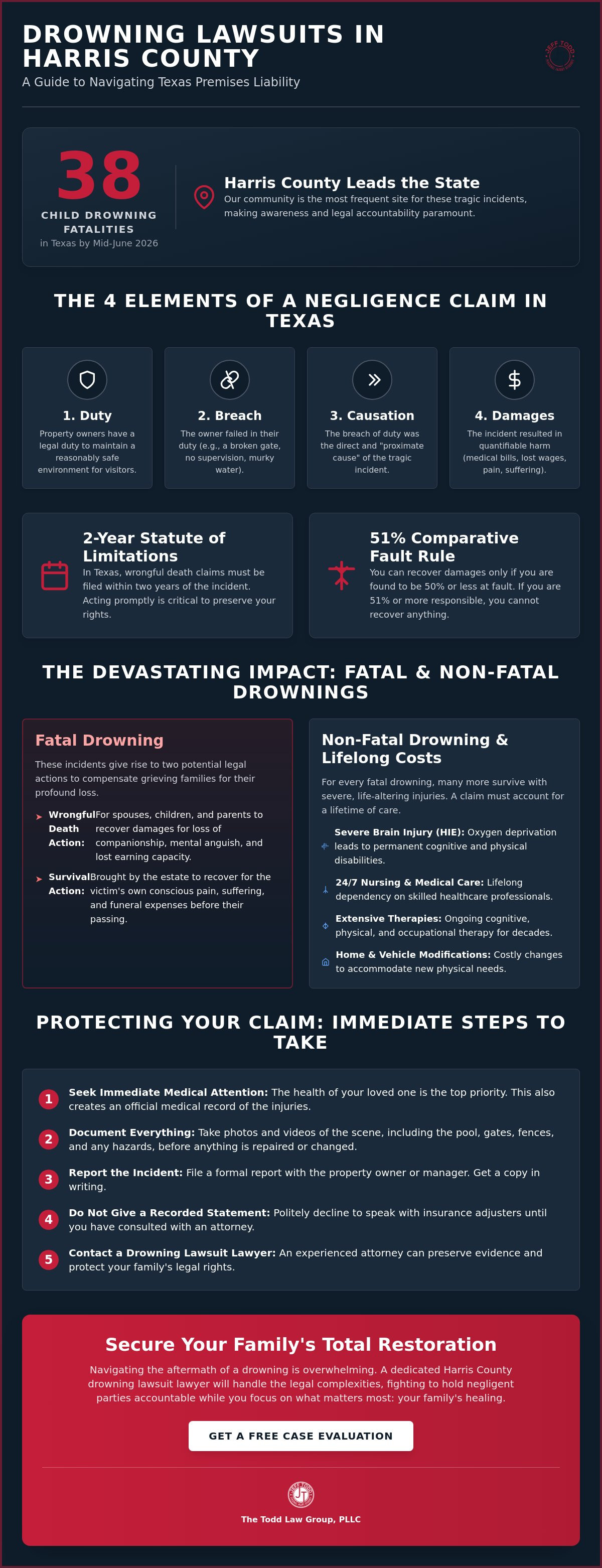
By mid-June 2026, Texas has already recorded 38 child drowning fatalities, with Harris County continuing its trend as the state's most frequent site for these heartbreaking incidents. When a day at the pool ends in tragedy, the emotional trauma is often compounded by a confusing maze of legal questions and sudden financial strain. Partnering with a Harris County drowning lawsuit lawyer allows you to focus on your family's healing while a professional handles the burden of holding negligent property owners accountable for their failures.
It's natural to feel overwhelmed by the complexity of Texas premises liability laws, especially following the 2026 Supreme Court rulings regarding constructive notice. You shouldn't have to manage the aftermath of a property owner's negligence while also facing funeral costs or the lifelong medical needs of a non-fatal submersion injury. This article will help you understand how to move through this difficult legal terrain to secure the compensation needed for your family's total restoration.
We'll cover the critical two-year statute of limitations for wrongful death claims, the 51% comparative fault rule, and the specific evidence required to prove a property owner failed in their duty of care. By the end of this guide, you'll have a clear roadmap for seeking justice and preventing similar tragedies from affecting other Houston families.
Key Takeaways
- Learn the legal distinctions between wrongful death and survival actions for both fatal and non-fatal drowning incidents.
- Understand how to establish a property owner’s "duty of care" under the latest Texas premises liability standards.
- Discover how a Harris County drowning lawsuit lawyer navigates multi-party liability involving owners, managers, and safety equipment manufacturers.
- Identify the essential documentation steps to take immediately following an accident to ensure vital evidence isn't lost or repaired.
- See how a background in high-stakes corporate law provides the intellectual rigor needed to secure compensation for your family's total restoration.
Harris County Drowning Accidents: Understanding the Risks and Realities
Harris County consistently leads the state in water-related incidents, creating a landscape where summer recreation can quickly turn into a legal and emotional crisis. As of mid-June 2026, four of the 38 child drownings in Texas occurred right here in our community. These aren't just numbers. They represent local families facing an unimaginable void and a sudden, overwhelming logistical burden. Houston's unique residential layout contributes significantly to these risks. From expansive apartment complexes in the Westchase area to private backyard oases in Cypress, water is an ever-present feature of our local life. When safety protocols fail, the transition from a peaceful afternoon to a life-altering tragedy happens in seconds. A Harris County drowning lawsuit lawyer understands that seeking justice involves more than just a financial settlement. It's about securing the resources for a family's total restoration and ensuring no other parent has to endure the same grief.
Public vs. Private Pool Hazards in Houston
The risks vary significantly depending on the setting, but the core issue of negligence remains constant. In municipal facilities or large water parks, overcrowding often leads to "silent drowning" where even trained lifeguards fail to spot a person in distress. Apartment complex pools frequently suffer from neglected maintenance, such as broken self-latching gates or murky water that obscures the pool floor. Private residential pools present a different legal challenge. Under the attractive nuisance doctrine, property owners may be held liable if they fail to secure a pool that naturally draws children onto the premises. Whether it's a defective drain cover, a missing perimeter fence, or a failure to supervise, these hazards are often the direct result of a property owner's choice to ignore safety standards. Documenting these specific failures is a critical step in building a successful premises liability claim.
Non-Fatal Drowning and Long-Term Medical Impact
Many people don't realize that for every fatal drowning, many more individuals survive with life-altering injuries that require extensive intervention. Non-fatal drowning often leads to hypoxic-ischemic encephalopathy (HIE), a severe brain injury caused by prolonged oxygen deprivation. The medical reality for these survivors is staggering. Families often face the sudden need for 24/7 nursing care, intensive cognitive therapy, and expensive home modifications. These costs don't end after a few months; they often span decades. A dedicated Harris County drowning lawsuit lawyer ensures that any legal claim accounts for this lifelong trajectory. We look beyond the immediate medical bills to secure funds for the specialized rehabilitation and future support your loved one requires to live with dignity. This holistic approach to recovery ensures that the settlement reflects the true, long-term impact of the incident on the victim's quality of life.
Proving Negligence in a Texas Drowning Lawsuit
Proving negligence is the cornerstone of any civil claim following a water-related tragedy. In Texas, negligence isn't just a general sense of wrongdoing. It's a specific legal failure to exercise the degree of care that a person of ordinary prudence would have used under the same circumstances. For families in Houston, this often means demonstrating that a property owner ignored established drowning prevention standards. Working with a Harris County drowning lawsuit lawyer provides you with the intellectual rigor needed to dissect these complex liability issues and build a case based on technical proof rather than just emotion.
The Four Elements of a Personal Injury Claim
To prevail in court, your legal team must establish four distinct components. First, we establish Duty. In 2026, Texas pool owners have a non-delegable duty to maintain their premises in a reasonably safe condition and to warn or protect invitees from known hazards. Second, we prove a Breach of that duty. This occurs when the owner fails to meet the standard of care, such as ignoring broken safety equipment. Third, we establish Causation. We must prove the breach was the "proximate cause" of the injury, meaning the tragedy was a foreseeable result of the owner's inaction. Finally, we document Damages, which includes the physical, emotional, and financial losses your family has suffered. If you're unsure how these elements apply to your case, a consultation with a dedicated advocate can help clarify your path forward.
Local Regulations: Houston Code of Ordinances Chapter 43
Houston's local laws provide a strict framework for safety that goes beyond general state requirements. Chapter 43 of the Houston Code of Ordinances outlines specific mandates for pool barriers, self-latching gates, and drain covers. When a property owner violates these local codes, it can lead to a legal finding of "negligence per se." This means the violation itself serves as proof of negligence because the law was designed to prevent the exact type of harm that occurred. Federal laws like the Virginia Graeme Baker Pool & Spa Safety Act (VGBA) also play a vital role. These regulations mandate specific anti-entrapment drain covers to prevent catastrophic suction injuries. A Harris County drowning lawsuit lawyer will meticulously investigate whether these specific codes were ignored, providing the technical evidence necessary to hold negligent parties accountable for their oversight.
Determining Liability: Who is Responsible for a Drowning in Houston?
Identifying the responsible parties in a water-related incident requires a meticulous investigation of the specific circumstances. In many Harris County cases, liability extends far beyond the individual who owns the land. A Harris County drowning lawsuit lawyer evaluates the roles of property managers, maintenance contractors, and even equipment manufacturers to build a comprehensive claim. This detailed approach is necessary because insurance coverage limits often dictate the practical path toward a family's financial recovery. Understanding the legal status of the victim is the first step in this process. Texas law applies different standards of care depending on whether the individual was an invitee, a licensee, or a trespasser.
Premises Liability and the "Attractive Nuisance" Doctrine
Texas law generally offers less protection to those who enter a property without permission, but a vital exception exists for children. The "attractive nuisance" doctrine holds property owners accountable if they maintain a dangerous condition that is likely to attract children who cannot grasp the inherent risks. A swimming pool is the primary example of such a hazard. If a homeowner fails to secure their pool with a proper fence or a self-latching gate, they may be held liable for injuries to a child. This applies even if that child entered the property without an invitation. To succeed with this specific claim, we must demonstrate that the owner knew children were likely to trespass and that the cost of eliminating the danger was minimal compared to the potential risk to a child's life.
Negligence of Lifeguards and Property Management Companies
In public or semi-private settings like apartment complexes and HOAs, liability often shifts to professional entities. We examine whether lifeguards were properly certified or if "distraction" incidents occurred during their shift. If a management company was notified of a broken gate months prior and failed to act, their corporate negligence becomes the focal point of the litigation. Product liability also enters the conversation if a defective pump or drain caused an entrapment incident. By identifying every contributing factor, we ensure that the legal process serves as a stable foundation for your family’s holistic healing. Holding these organizations accountable often prevents similar tragedies from occurring in other Houston neighborhoods.
Steps to Take After a Drowning Incident in Harris County
The moments following a water-related accident are often a blur of medical intervention and profound shock. While your focus is rightly on your family’s immediate safety, the actions taken in the first 48 hours are critical for your legal future. Property owners and insurance companies often move quickly to protect their interests, sometimes attempting to repair faulty equipment before it can be documented. Partnering with a Harris County drowning lawsuit lawyer early in the process provides you with a stable partner who can handle the logistical burden while you focus on your family's emotional needs.
Immediate Actions and Evidence Preservation
Evidence in premises liability cases is often transient. Murky water can be treated, and broken gate latches can be replaced within hours of an incident. If you're able, capture high-resolution photos of the entire pool area, focusing on perimeter fencing, warning signage, and any visible safety equipment. It's also vital to identify witnesses and secure their contact information before they leave the scene. In many Houston neighborhoods, surveillance footage from doorbell cameras or commercial security systems provides an unbiased account of the events. If there's a risk that the property owner will alter the scene, we may seek a Temporary Restraining Order (TRO) from a Harris County court. This legal mechanism prevents any repairs or changes to the pool area until an independent investigator can conduct a thorough inspection.
Calculating the Full Scope of Damages for Total Restoration
When we discuss recovery, we aren't just referring to the reimbursement of medical bills. We view the legal process as a pathway toward your family’s total restoration. This involves a meticulous calculation of both economic and non-economic damages. For survivors of non-fatal drowning, this includes the lifelong costs of cognitive therapy and specialized nursing care. In wrongful death cases, we pursue compensation for the loss of companionship, mental anguish, and the future financial support the deceased would have provided. Jeff Todd evaluates holistic recovery needs by integrating medical expertise and life-care planning into every claim to ensure no future hardship is overlooked. To begin this process, you can request a comprehensive case evaluation to understand the full scope of your legal options.
Dealing with insurance adjusters can be one of the most stressful aspects of the aftermath. It's important to remember that their primary goal is to minimize the company's financial exposure. You shouldn't sign any waivers or provide recorded statements until you've consulted with legal counsel. These early documents often contain language that can limit your ability to seek full compensation later. By allowing a professional to manage these inquiries, you protect your rights and ensure that every communication serves the ultimate goal of securing justice for your loved ones.
Why Partner with a Harris County Drowning Lawsuit Lawyer?
Choosing the right legal partner is a decision that impacts your family's ability to heal and move forward. A Harris County drowning lawsuit lawyer with over 30 years of Texas legal experience brings a level of intellectual rigor often reserved for elite corporate boardrooms. Jeff Todd transitioned from high-stakes corporate environments to personal advocacy because he believes individuals deserve the same caliber of representation as major institutions. This professional background allows the firm to dismantle complex defense strategies used by insurance companies while maintaining a dedicated focus on your family's total restoration. Our history across major metropolitan legal hubs provides us with a battle-tested perspective that's essential when facing multi-party liability claims involving negligent property owners or equipment manufacturers.
Jeff Todd’s Holistic Approach to Personal Advocacy
Jeff Todd’s approach moves beyond the typical financial transaction. We recognize that a drowning incident affects every facet of your life, from immediate medical debt to long-term emotional trauma. Our service-first practice prioritizes personalized attention, ensuring you aren't just another case number in a high-volume system. We handle the intense logistical burdens, from managing medical liens to coordinating with accident reconstruction experts, so you can dedicate your energy to your family’s emotional recovery. This intellectual rigor is particularly valuable in drowning cases where technical evidence regarding pool pump mechanics or gate latch specifications is paramount. Our firm doesn't just look at the surface of a case. We dig into the internal processes of property management companies to find where the safety breakdown occurred. It's about providing a stable path through the legal progression of your claim while staying personally invested in the Houston community.
Navigating the Contingency-Based Legal Process
We believe that high-impact legal expertise should be accessible to everyone, regardless of their current financial situation. Our firm operates on a contingency-based structure, which means you don't pay any attorney fees unless we successfully recover compensation for you. We fund the entire investigation and cover the upfront costs of expert witnesses and court filings. This reduces the barrier to entry and ensures that negligent parties are held accountable, regardless of the complexity of the case. By removing the immediate financial strain of litigation, we allow you to seek justice without further compromising your family's stability. Our proactive approach suggests a capability of handling matters with both speed and meticulous attention to detail, ensuring no evidence is lost to time. If you're ready to take the next step toward justice and holistic recovery, Schedule your confidential consultation with Jeff Todd today.
Securing Your Family's Future and Restoration
Navigating the aftermath of a water-related tragedy requires a balance of legal precision and genuine compassion. We've explored how proving negligence in Houston involves a deep understanding of local ordinances and the attractive nuisance doctrine. It's also clear that a successful claim must account for the lifelong medical and emotional needs of your family to ensure a truly holistic recovery. Partnering with an experienced Harris County drowning lawsuit lawyer ensures that the technical details of your case are handled with the intellectual rigor they deserve while you focus on healing.
Founding attorney Jeff Todd has been licensed in Texas since 1994 and brings decades of high-level experience to every case. With dedicated offices in Houston, Austin, and Galveston, our firm is personally invested in the safety of our local communities. We operate on a contingency basis, meaning there are no upfront legal fees. We only get paid if we recover compensation for you. You don't have to carry this burden alone. Contact The Todd Law Group, PLLC for a Free, Compassionate Case Review. We're here to provide the stable partnership and dedicated advocacy you need during this difficult transition.
Frequently Asked Questions
How long do I have to file a drowning lawsuit in Texas?
In Texas, the statute of limitations for a wrongful death claim is generally two years from the date of the individual's death. This deadline is strictly mandated by the Texas Civil Practice & Remedies Code. If the case involves a survival action for damages suffered before death, the clock starts at the time of the incident. However, if the victim was a minor, the two-year period typically does not begin until they reach the age of 18.
Can I sue an HOA if my child drowned in a community pool with a broken gate?
Yes, you can hold a Homeowners Association (HOA) liable if their failure to maintain common area safety led to an accident. HOAs have a legal duty to keep community facilities in a reasonably safe condition for residents and their guests. A broken self-latching gate or a hole in a perimeter fence is often considered a breach of this duty. A Harris County drowning lawsuit lawyer will investigate maintenance records to determine if the HOA had notice of the defect before the tragedy occurred.
What is the "Attractive Nuisance" doctrine in Harris County?
The "Attractive Nuisance" doctrine is a legal principle that holds property owners responsible for injuries to trespassing children who are drawn to dangerous features like swimming pools. Because children often lack the maturity to understand the risks of water, owners must take reasonable steps to secure these areas. This usually involves installing proper fencing and self-latching gates. If an owner fails to secure a pool that they know is likely to attract children, they can be held liable for resulting injuries.
What kind of compensation can I recover in a near-drowning case?
Victims of non-fatal drowning can recover compensation for immediate medical expenses and the lifelong costs of specialized care. Many survivors face hypoxic-ischemic encephalopathy (HIE), which requires decades of cognitive therapy, 24/7 nursing support, and expensive home modifications. You may also seek damages for pain and suffering, mental anguish, and lost future earning capacity. Securing a stable financial future through a legal claim is a vital step toward your family's total restoration.
Do I need a lawyer if the insurance company already offered a settlement?
You should consult a Harris County drowning lawsuit lawyer before signing any documents from an insurance company. Initial settlement offers are frequently designed to settle the claim quickly for the lowest possible amount. These offers rarely account for the long-term medical needs of a brain injury survivor or the full emotional impact of a wrongful death. Once a settlement is accepted, you generally cannot seek additional funds if your future costs increase.
What if the drowning happened at a private residence during a party?
How much does it cost to hire a drowning lawsuit lawyer in Houston?
Most drowning lawsuit lawyers in Houston work on a contingency fee basis, which means there are no upfront costs to your family. The firm covers all investigation expenses, expert witness fees, and court costs throughout the duration of the case. Attorney fees are only paid as a percentage of the final settlement or court award if the case is successful. This structure ensures that every family has access to elite legal advocacy regardless of their current financial situation.
How do I prove the pool owner was negligent?
Proving negligence involves demonstrating that the pool owner failed to meet the legal standard of care required by Texas law. We look for specific evidence such as violations of the Houston Code of Ordinances, broken latches, or inadequate depth markers. Under the 2026 Texas Supreme Court standards, we must provide proof of how long a hazardous condition existed. Documentation like maintenance logs, witness statements, and photos of the scene are essential to establishing this breach of duty.


